Samsung on Wednesday, , unveiled its 2026 television lineup at a dedicated launch event, centered on three screen technologies and a consolidated AI experience layer that Samsung is branding as AI Vision Companion. The lineup extends from the newest Micro RGB backlight flagship at the top of the range through a refreshed OLED program, a broader Neo QLED and Mini LED catalog, and a lifestyle-focused Frame and Frame Pro tier for rooms where the TV doubles as wall art. Pricing runs from roughly $1,999 for entry OLED models to $42,000 for the 115-inch Micro RGB flagship in Australian-dollar figures from the regional launch.
The pitch is not subtle. Samsung is positioning the 2026 lineup as the transition year in which television buying moves beyond pure picture-quality comparisons and into an AI-augmented viewing experience. Whether buyers pay for that transition in the volumes Samsung is projecting is the commercial question the release was designed to answer in the affirmative.
Micro RGB: The New Top of the Range
Micro RGB is the most technically significant addition to the 2026 lineup. The technology uses tiny clusters of red, green, and blue pixels as each backlight element, which delivers more precise color and contrast control than traditional mini-LED backlight systems. The approach sits between Mini LED and OLED in architectural terms: it avoids the burn-in risk of organic displays while achieving finer contrast control than Mini LED can match.
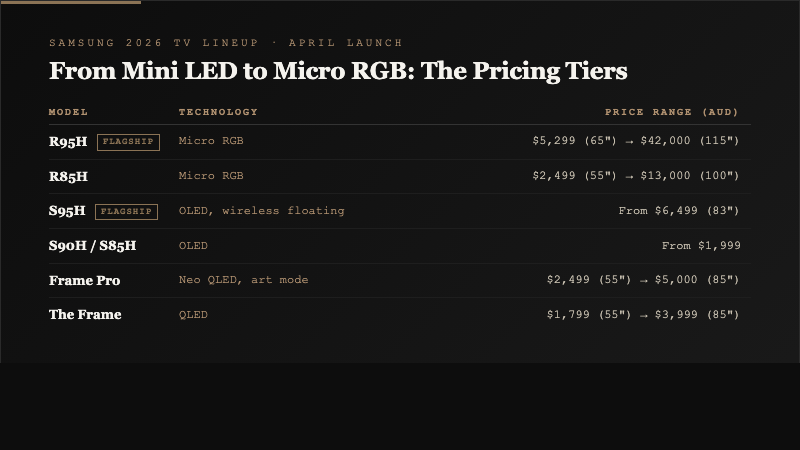
| Model | Technology | Price range |
|---|---|---|
| R95H (flagship Micro RGB) | Micro RGB | $5,299 (65") - $42,000 (115") |
| R85H (Micro RGB) | Micro RGB | $2,499 (55") - $13,000 (100") |
| S95H (flagship OLED) | OLED, wireless floating design | From $6,499 (83") |
| S90H, S85H (OLED) | OLED | $1,999 starting (43"-48") |
| The Frame Pro | Neo QLED, wireless box | $2,499 (55") - $5,000 (85") |
| The Frame | QLED, art-style bezel | $1,799 (55") - $3,999 (85") |
| QN80H (Neo QLED) | Neo QLED Mini LED | $1,599 (50") - $7,000 (100") |
The R95H is Samsung's flagship Micro RGB model, priced from $5,299 for a 65-inch unit up to $42,000 for the 115-inch size, all in Australian dollars from the regional announcement. The R85H is a more accessible Micro RGB option, starting at $2,499 for a 55-inch display and running to $13,000 for a 100-inch version. Both lines include glare-free screen options, a useful spec for rooms with heavy natural light.
OLED: Floating Flagship
The OLED range comprises three models: the S85H, S90H, and S95H. The S95H is the flagship and uses a wireless connect box plus a mounting system that makes the display appear to float rather than hanging from a traditional frame. Samsung has been experimenting with floating TV designs for several years, and the 2026 implementation is the most refined iteration. The TV presses against a mounting plate that replaces the bezel entirely, giving the screen an edge-to-edge appearance when mounted.
LG launched a similar floating OLED design with its W-series earlier in 2026. The two flagship displays now compete directly on aesthetic design as well as picture quality, reflecting how premium OLED competition has moved beyond raw image specs into industrial design. Samsung's S95H uses an AI processor with neural networks to improve visuals in real time and an OLED panel tuned for faster response time that gaming customers will notice.
"This year's TV range from Samsung may well be solid proof of that, with the assortment of screens covering new technologies aplenty."
Pickr Australia coverage of the Samsung 2026 launch, April 23, 2026
Entry OLED pricing is $1,999 for the 48-inch S85H and $1,999 for the 43-inch S90H, with both series scaling to 83-inch options priced from $6,499. The S90H and S85H do not include the floating mount or wireless connect box, which is how Samsung preserves product tier differentiation without asking flagship-level prices across the entire OLED catalog.
AI Vision Companion
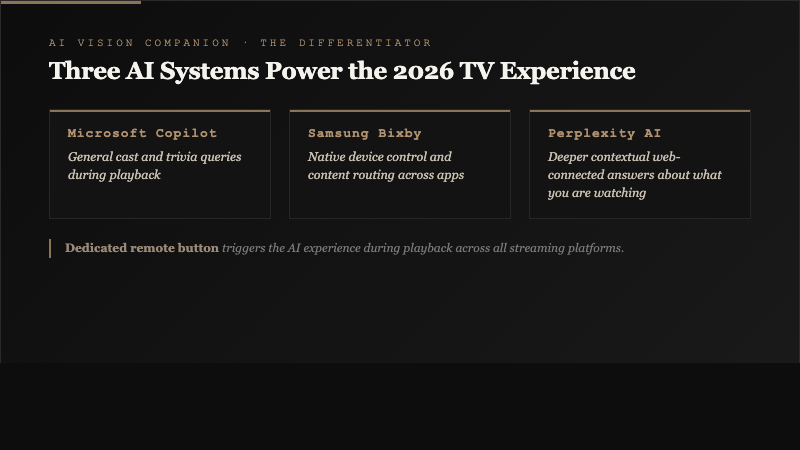
The software layer is where Samsung is trying to differentiate most aggressively. AI Vision Companion is the consumer name for a set of features that use Microsoft Copilot, Samsung's Bixby assistant, and Perplexity AI to surface contextual information about whatever is on screen. The feature is triggered by a dedicated button on the 2026 remote. Users press it to get cast information, production trivia, related recommendations, and even suggestions for music or food paired to the content.
The comparison point is Amazon's X-Ray, which Prime Video users have been able to access for years to see cast information and trivia alongside content on Amazon-owned streams. Samsung's approach extends that capability across all services and uses external AI models for the contextual responses rather than proprietary metadata. The system can also suggest related content on other platforms, which is a strategic choice that favors Samsung's hardware ecosystem over any specific streaming service.
"Samsung's AI Vision Companion looks to be one of those features you'll use, possibly without thinking."
Pickr Australia review preview, April 23, 2026
The Frame and Frame Pro
The Frame range sits in Samsung's lifestyle tier, designed to make the TV look more like wall art than technology. The 2026 iteration includes The Frame and the new Frame Pro, distinguished by QLED versus Neo QLED screen technology respectively. The Frame Pro supports Samsung's wireless connect box, which moves the tuner and input hardware away from the display and reduces the cable clutter that complicates art-style installations.
When turned off, both Frame models display visual art sourced from a subscription art store Samsung has been expanding. The anti-glare screen treatment makes the art look convincingly paper-like rather than like a switched-off display. Pricing runs from $1,799 for a 55-inch Frame to $3,999 for an 85-inch version. The Frame Pro pricing begins at $2,499 for 55 inches and reaches $5,000 for 85 inches.
The Rest of the Lineup
Below the flagships, Samsung is filling out the 2026 catalog with more affordable Neo QLED and Mini LED options. The QN80H Neo QLED starts at $1,599 for a 50-inch model and reaches $7,000 for a 100-inch configuration. The more affordable Mini LED M70H option runs from under $1,000 for 55-inch sizes up to $2,500 for an 85-inch unit. And the standard 4K LCD U9000H Crystal UHD line extends up to a 98-inch model for $3,799, which is the most aggressive per-inch pricing in the entire lineup.
For buyers focused on raw display size per dollar rather than picture quality per inch, the U9000H at 98 inches for under $4,000 is the standout value proposition. The pricing compression reflects a broader industry dynamic: consumer TV sets have gotten substantially larger on average over the past five years, and Samsung is pricing its entry-level large-screen options aggressively to capture market share at sizes that used to belong exclusively to premium models.
The AI Upscaling and Soccer Mode Stories
The AI Upscaling Pro system across the 2026 lineup boosts lower-resolution source content for the sharper, larger screens that now dominate the catalog. That is useful in practice because broadcast, cable, and older streaming content is still often rendered at resolutions well below 4K. An AI upscaling system that reliably converts 1080p content to something visually approaching 4K on a 75-inch screen is a genuine value-add.
Samsung also disclosed an AI Soccer Mode that optimizes picture settings for high-speed action. The specific tuning involves motion interpolation adjustments, color balance shifts, and audio processing calibrated for crowd noise. With the 2026 FIFA World Cup beginning June 11 and running through mid-July, the timing is not coincidental. Samsung is positioning the AI Soccer Mode as a lead consumer use case for the 2026 TV upgrade cycle, particularly for households upgrading specifically to watch the tournament.
What to Watch
The commercial test will come during the pre-World Cup retail window. Samsung is timing its 2026 launch specifically to capture upgrade demand ahead of a tournament that is expected to drive one of the largest television replacement cycles of the past decade. If Micro RGB pricing holds firm through early summer, Samsung will have validated its premium pricing strategy. If discounting begins early, the premium tier pricing may turn out to be aspirational rather than sustainable.
On the AI Vision Companion side, consumer adoption will depend on whether the three-AI integration actually works reliably enough to become part of the viewing experience rather than a button users press once and forget. Samsung's partnerships with Microsoft and Perplexity are strategically reasonable, but the execution details, particularly around latency and response quality, will determine whether the feature differentiates the 2026 lineup.
For related coverage, see our reporting on Samsung's earlier European preview of the 2026 TV lineup, on the silicon manufacturing road map supporting AI hardware acceleration, and on Google's parallel consumer AI infrastructure push.