
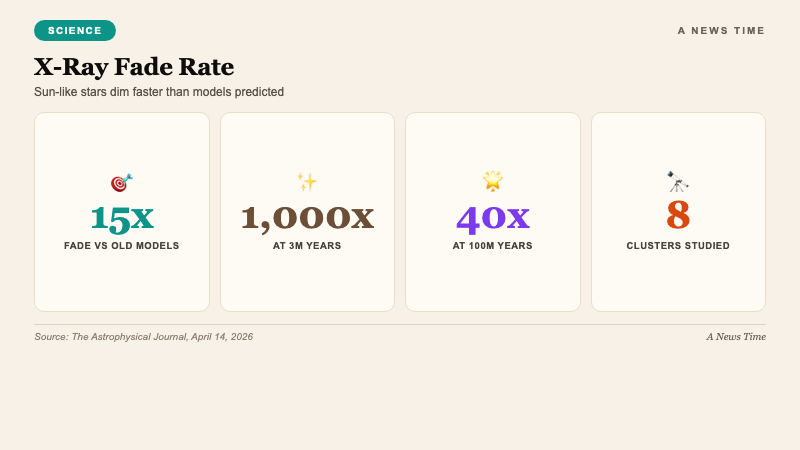
Young stars with roughly the mass of our Sun fade in X-ray emissions about 15 times faster than astronomers previously calculated, according to a NASA-summarized study led by Penn State University's Konstantin Getman and published in The Astrophysical Journal on . The research used data from NASA's Chandra X-ray Observatory, the ROSAT satellite, and the European Space Agency's Gaia telescope to analyze eight stellar clusters ranging in age from 45 million to 750 million years old. The team's headline result: stars with masses close to the Sun emit only about a quarter to a third of the X-ray radiation that prior stellar-evolution models predicted at their ages.
For astrobiology, the implication is substantial. Intense X-ray emission from a young star can strip away a newly formed planet's atmosphere, destroy organic molecules, and sterilize what might otherwise be a habitable surface. A faster fade-rate for sun-like stars means the window in which a rocky planet can develop and retain the atmospheric conditions necessary for biology opens sooner than previously calculated. Earth's existence as a habitable world may be partially owed to exactly the fading process the Chandra data now documents in younger star systems.
What Chandra Actually Measured
The research team analyzed X-ray emissions from stars in eight clusters spanning two orders of magnitude in age. Each cluster provided a snapshot of stellar X-ray activity at a specific evolutionary stage. By combining observations across clusters of different ages, the team built a time-series picture of how X-ray luminosity evolves as a solar-mass star ages from the pre-main-sequence phase into early main-sequence maturity.
| Stellar age | X-ray emission (vs current Sun) |
|---|---|
| 3 million years | ~1,000x current Sun |
| 100 million years | ~40x current Sun |
| Current Sun (4.6 billion years) | Baseline reference |
| Study sample range | 45-750 million years |
| Observed fade rate | ~15x faster than prior models predicted |
The fade is driven by the star's internal magnetic dynamo, which is the mechanism that converts rotational energy into coronal heating and X-ray emission. Stellar rotation slows over time due to magnetic braking, and as the rotation slows the dynamo becomes less efficient. The Chandra data suggests that for solar-mass stars specifically, the dynamo weakens faster than the standard models have calculated. The reason for the accelerated decline is still being investigated. Lower-mass stars, by contrast, remain magnetically active for longer, which is consistent with their slower rotational evolution.
Why This Matters for the Search for Life
X-ray radiation from a young star damages planetary biology in three specific ways. First, it strips atmospheric molecules directly through photoionization, accelerating atmospheric escape. Second, it drives photochemistry that destroys biological precursor molecules like amino acids and nucleotides before they can organize into functional biochemistry. Third, it sterilizes surface environments by depositing lethal radiation doses into anything not shielded by depth of rock, water, or atmosphere.
"It's possible that we owe our existence to our Sun doing the same thing, several billion years ago, that we see these young stars doing now."
Vladimir Airapetian, NASA Goddard Space Flight Center, co-author
The fade-rate finding means the damage window closes sooner than previous models suggested. A rocky exoplanet orbiting a sun-like star at roughly Earth-like distances could retain its atmosphere and develop prebiotic chemistry hundreds of millions of years earlier than prior calculations predicted. For the search for habitable worlds, that narrows the range of stellar ages at which planets around sun-like stars look risky and broadens the range at which they look potentially viable.
"By studying the X-ray emissions from stars that are hundreds of millions of years old, we have filled a major gap in our understanding of their evolution," said co-author Eric Feigelson, also from Penn State. The 45-to-750-million-year window the study covers has historically been thinly sampled because nearby stellar clusters tend to skew either very young or very old. The new result anchors stellar X-ray evolution across the intermediate range where habitability windows are most sensitive.
How the Data Was Put Together
Chandra provided the primary X-ray observations. ROSAT, the 1990s-era European X-ray satellite, contributed archival data from clusters Chandra had not recently targeted. Gaia, the ESA astrometry telescope that has been mapping stellar positions and motions since 2013, provided precise cluster membership and age determinations. The three-instrument combination allowed the team to match X-ray emission measurements to accurate stellar ages across the full age range of the sample.
The sample-size constraint is worth noting. Eight clusters is robust for a fade-rate determination but not exhaustive. Follow-up studies with expanded cluster samples and finer age resolution will refine the fade-rate curve. The headline result is unlikely to reverse, but the magnitude of the fade rate (15 times versus prior models) could shift modestly as more data accumulates.
The Magnetic Dynamo Puzzle
The mechanism producing the observed X-ray fade is the star's magnetic dynamo, an internal generator that converts stellar rotation and convection into magnetic field strength. The field energy heats the star's corona, the outer atmospheric layer, to millions of degrees, which is where the X-ray emission originates. Slower rotation means a weaker dynamo. Weaker dynamo means cooler corona. Cooler corona means less X-ray output.
The puzzle the Chandra data opens is why the dynamo weakens faster than standard models predicted for sun-like stars specifically. Possible explanations include stellar structural changes during early main-sequence evolution that reduce convective efficiency sooner than models calculated, or magnetic field-topology transitions that lower the star's X-ray output even when average field strength remains substantial. Neither explanation is settled. The research team explicitly flagged the mechanism as an open question.
Implications for Exoplanet Habitability Assessment
Current exoplanet habitability models weight stellar X-ray environment as one of several variables alongside planetary mass, atmospheric composition, distance from the star, and the star's mass and evolutionary state. The accelerated fade-rate finding specifically improves the habitability outlook for planets orbiting sun-like stars in the intermediate age range. For a G-type star like our Sun, a rocky planet at Earth-like distances looks more viable at stellar ages around 300 to 500 million years than prior X-ray models suggested.
For older sun-like stars with already-faded X-ray environments, the finding is less consequential. For very young stars where X-ray output remains intense, the finding has no effect. The habitability-assessment improvement is concentrated in the middle of the age range where the fade rate is most different from prior calculations.

What This Tells Us About Earth's Own History
Airapetian's framing about the Sun having done "the same thing several billion years ago" is not just a quotable observation. If the fade-rate pattern documented in the study applies to our Sun's own history, Earth's atmosphere and early biochemistry experienced a progressively less hostile stellar environment than previous models implied. The period in which life's precursor chemistry could have organized without constant X-ray disruption was longer than prior calculations suggested.
Solar-mass stars at 3 million years old produce roughly 1,000 times more X-ray radiation than our current Sun. At 100 million years old, the level is roughly 40 times current. The fade from one to the other is the specific temporal window during which Earth's first atmosphere would have been forming and the earliest biochemical reactions could have begun. If our Sun followed the faster-fade curve the Chandra data documents, that window was friendlier to early Earth biology than the standard model assumed.
Frequently Asked Questions
What did the Chandra study find about young stars?
Young sun-like stars fade in X-ray emissions roughly 15 times faster than prior stellar-evolution models predicted. The study, published in The Astrophysical Journal on April 14, 2026, analyzed eight stellar clusters between 45 and 750 million years old.
Why does X-ray fade rate matter for life?
Intense X-ray radiation from young stars strips planetary atmospheres and destroys biological precursor molecules. A faster fade rate narrows the damage window, expanding the time during which rocky planets can develop atmospheres and prebiotic chemistry.
How was the data collected?
The research combined observations from NASA's Chandra X-ray Observatory, archival ROSAT satellite data, and Gaia telescope measurements for cluster membership and precise stellar ages.
What are the practical implications?
Exoplanet habitability models will update for planets orbiting sun-like stars in the 45-to-750-million-year age range, where the fade-rate difference is most pronounced. Planets in that stellar-age window look more viable than prior models suggested.
Does this tell us anything about Earth?
Yes. If our Sun followed the same accelerated fade pattern, Earth's early atmosphere and biochemistry experienced a less hostile stellar environment during the critical 3-to-100-million-year window when precursor chemistry would have been organizing.
What Comes Next
Follow-up studies with expanded stellar cluster samples will refine the fade-rate curve. The specific mechanism driving the accelerated magnetic-dynamo decline in solar-mass stars is an open research question. The James Webb Space Telescope's exoplanet atmospheric observations will provide empirical checks on how real planets around real young stars are evolving, which can test whether the Chandra-derived habitability predictions match observation. The search for life continues, and the Chandra data has just expanded the search space.