Earth Day is being observed around the world on Wednesday, April 22, 2026, with climate scientists, educators, and policymakers using the anniversary to examine what has actually changed in the 56 years since the first coordinated US environmental teach-ins drew an estimated 20 million Americans into the streets in 1970. This year the day arrives with an unusual split screen: a global movement that has grown to an estimated one billion participants in 193 countries, set against a United States federal posture that has rolled back EV tax credits, reversed the EPA endangerment finding on greenhouse gases, and begun removing federal climate datasets from public portals.
The scale contrast is the story. When Wisconsin Senator Gaylord Nelson and a small team of organizers, including a young activist named Denis Hayes, planned the first Earth Day, they aimed at a campus-by-campus educational event modeled on the teach-ins of the Vietnam War era. Within the year, the public pressure that followed helped produce the US Environmental Protection Agency, the Clean Air Act amendments of 1970, the Clean Water Act of 1972, and the Endangered Species Act of 1973. It is one of the cleanest examples in modern American policy of a participatory civic event producing measurable statutory change inside 36 months.
How the Movement Globalized After 1990
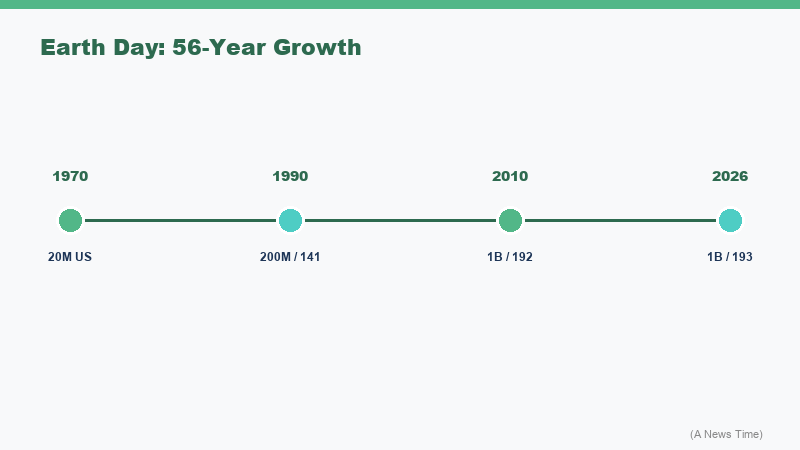
Earth Day stayed a predominantly American observance for its first two decades. The expansion to a fully international event is generally dated to 1990, when Denis Hayes, by then running the Earth Day Network, organized a 20th anniversary observance that reached an estimated 200 million people in 141 countries. That 1990 push was also when the celebration explicitly pivoted from the 1970 air-and-water agenda to a climate-centered agenda, reflecting the maturation of atmospheric science through the 1980s and the 1988 establishment of the Intergovernmental Panel on Climate Change.
The scientific framing matters. The IPCC's first assessment report, published the same year as Earth Day's global coming-out, introduced the concept of anthropogenic global warming to broad public awareness for the first time. Every subsequent Earth Day has essentially been in dialogue with the successor IPCC reports, including the most recent AR6 cycle that concluded in 2023. What changed between 1970 and 1990 was the available evidence; what changed between 1990 and 2026 was the visibility of the consequences.
"Earth Day was born because of science that revealed pollution's toll on people and the planet. Fifty-six years later, the science is clearer, the stakes are higher, and the coalition is broader than the original organizers could have imagined."
Denis Hayes, founder, Earth Day Network
Participation growth tracks with that visibility. The Earth Day Network now reports more than one billion participants annually across events in 193 countries, including school programs, municipal tree plantings, policy summits, corporate sustainability pledges, and scientific teach-ins. The 193-country figure is notable because it exceeds UN membership by one, a quirk explained by the inclusion of Taiwan in Earth Day's participating jurisdictions. For an event without a treaty, without a secretariat, and without a budget commensurate with a UN body, that reach is structurally unusual.
The 2026 US Policy Split Screen
In California, Governor Gavin Newsom's office marked Earth Week by publishing a 56-point list of state climate actions taken over the past year, including clean-energy generation records, a state-operated methane monitoring satellite program, and an ongoing transition of school-bus fleets to zero-emission vehicles. The framing was explicit: California positioning itself as a counterweight to federal rollbacks. That framing is a reasonable reading of the current political map, but it is also a reminder that climate policy in the United States now operates at wildly different levels of ambition depending on state jurisdiction.
The federal contrast is stark. As we reported in our coverage of the EPA's reversal of the 2009 endangerment finding, the regulatory basis for treating carbon dioxide as a pollutant under the Clean Air Act has been formally rescinded. Our separate reporting on the disappearance of federal climate datasets documented how researchers are racing to mirror and archive publicly funded climate data before it is removed from government servers. Taken together, those two actions represent the most significant federal retreat on climate science since Earth Day's 1970 founding.
| Year | Participants | Countries | Defining Theme |
|---|---|---|---|
| 1970 | ~20 million (US) | 1 | Air and water pollution |
| 1990 | ~200 million | 141 | Climate awareness, global framing |
| 2010 | ~1 billion | 192 | A Billion Acts of Green |
| 2020 | ~1 billion (digital) | 193 | Climate Action, pandemic pivot |
| 2026 | ~1 billion | 193 | Planet vs. Plastics, policy division |
The Earth Day Network's official 2026 theme is "Planet vs. Plastics," a multi-year campaign targeting a 60 percent reduction in plastic production by 2040. The choice of focus is a deliberate tactical response to the diffuse, large-number character of climate policy. Plastic pollution is visible, measurable, locally actionable, and scientifically well-characterized: roughly 460 million metric tons of plastic are produced annually, with less than 10 percent recycled globally, according to OECD data.
What the Science Still Does Not Settle
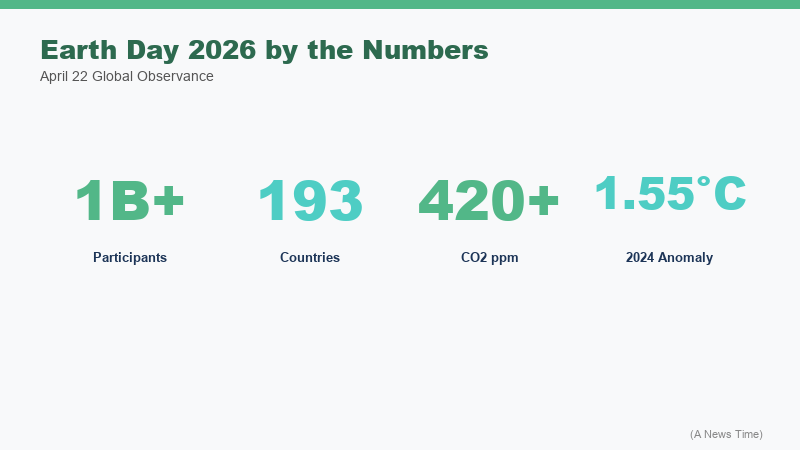
Anniversary coverage often flattens the scientific picture. The honest version is more nuanced. Atmospheric CO2 passed 420 parts per million in 2024, a level unseen in at least 800,000 years of ice-core records. Global mean surface temperature in 2024 was approximately 1.55 degrees Celsius above the pre-industrial baseline, according to the World Meteorological Organization, making it the first calendar year to exceed the 1.5 C threshold referenced in the Paris Agreement. Those numbers are as close to settled as climate science gets.
What remains more contested, and more scientifically active, is the trajectory from here. Climate sensitivity estimates, tipping-point thresholds for the West Antarctic Ice Sheet and the Amazon rainforest, and regional precipitation pattern projections all carry meaningful error bars that research teams are actively working to narrow. Earth Day coverage sometimes conflates these open questions with the settled basics, which is a disservice to both categories.
A useful comparison point: the IPCC's AR6 report characterized the statement "human influence has warmed the climate at a rate that is unprecedented in at least the last 2,000 years" as having a "high confidence" assessment, the agency's formal designation for findings supported by multiple independent lines of evidence. Statements about the exact contribution of specific Atlantic circulation changes to observed regional cooling in the North Atlantic, by contrast, carry a "medium confidence" designation, indicating the science is real but still maturing. Responsible public communication treats these two categories differently, and the best Earth Day programming does.
Cultural Programming Catches Up
This year's observance includes a notable cultural anchor at the Brooklyn Academy of Music, where Jane Fonda is narrating "Dear Everything," an Earth Day musical production with a score drawing on climate-science imagery. The BAM programming, combined with school-based events across the US and a surge in corporate sustainability reporting tied to the date, reflects the broader cultural absorption of climate themes that the 1970 teach-in could not have predicted.
Orange County Transportation Authority, for example, is offering free OCTA bus rides on April 22 to promote public-transit use as an individual action. Municipal programs like the Wisconsin DNR's Earth Week campaign are leaning into neighbor-level environmental actions, such as invasive-species removal and native-planting workshops. For readers interested in how state-level climate policy is actually evolving while federal policy contracts, our earlier reporting on the EU's Natura 2000 expansion and the UN's record climate imbalance warnings provides adjacent context.
What to Watch Beyond April 22
The operational significance of Earth Day 2026 is less about the day itself than about what follows it. The UN Framework Convention on Climate Change's next Conference of the Parties, COP31, is scheduled for late 2026. National climate plan submissions, known as Nationally Determined Contributions, are due ahead of that meeting under the Paris Agreement's five-year revision cycle. Those submissions are where the gap between Earth Day rhetoric and actual emissions-reduction commitments shows up in quantifiable form.
For the movement's founders, still active at 80, the 56-year arc carries a specific lesson. Public pressure in 1970 produced statutory change by 1973. The analogous test in 2026 is whether an even larger movement can accomplish similar results against a more complex scientific challenge and a more divided political environment. That is the question Earth Day will pose every year, until the answer resolves one direction or the other.
Frequently Asked Questions
When is Earth Day 2026?
Earth Day 2026 falls on Wednesday, April 22, 2026. It has been observed on April 22 every year since the first Earth Day in 1970, chosen because it fell between spring break and final exams for most US college students, maximizing campus participation.
Who founded Earth Day?
US Senator Gaylord Nelson of Wisconsin proposed the idea in late 1969, and Stanford student Denis Hayes was hired as national coordinator. The first Earth Day on April 22, 1970 drew approximately 20 million American participants and helped build political support for the creation of the EPA later that year.
What is the 2026 Earth Day theme?
The Earth Day Network's official theme for 2026 is "Planet vs. Plastics," part of a multi-year campaign targeting a 60 percent reduction in global plastic production by 2040. The theme was chosen for its measurability and actionability at community scale.
How many people participate in Earth Day worldwide?
The Earth Day Network estimates more than one billion people participate annually across events in 193 countries, making it among the largest recurring civic observances in the world. Participation includes schools, municipalities, scientific institutions, and community organizations.
Has Earth Day produced measurable policy change?
Yes. The first Earth Day in 1970 helped produce the US Environmental Protection Agency, the 1970 Clean Air Act amendments, the 1972 Clean Water Act, and the 1973 Endangered Species Act inside 36 months of the founding event. Subsequent Earth Days have been associated with the 1990 Clean Air Act amendments and international climate frameworks including the Paris Agreement.