The Sea of Cortez, squeezed between Baja California and mainland Mexico, contains more marine species per square kilometer than virtually any comparable body of water on earth. Baja Expeditions launched a new liveaboard itinerary in April 2026 that sails north from La Paz into waters that most visitors never reach, past Isla San Pedro Mártir (the most remote island in the sea and home to the world's largest colony of blue-footed boobies), to Bahía de Los Ángeles for the expedition's headline encounter: swimming with whale sharks in one of the few places on earth where those encounters are reliably predictable. That one itinerary encapsulates where serious adventure travel is going in 2026. It is not about discovering new continents. It is about accessing genuinely remote, biologically significant experiences through expedition infrastructure that handles the logistics of getting there.
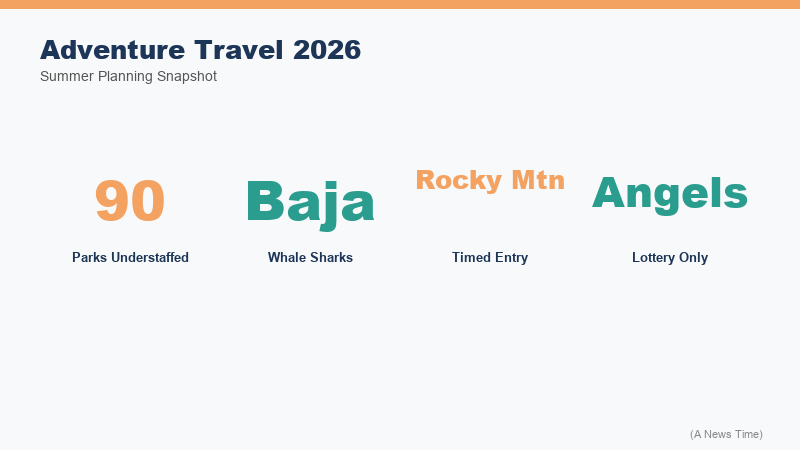
Simultaneously, on land, US national parks are entering their most complex pre-summer planning period in years. In 2025, 323 million people visited the national parks, down from 2024's record-setting 332 million, but peak-season congestion remains as intense as it has ever been. At the same time, the National Park Conservation Association reports that 90 park units out of 433 experienced staffing impacts from funding cuts, with nearly 70 parks reducing visitor center hours or services. The combination of high demand, reduced support infrastructure, and a largely dismantled timed-entry reservation system at most parks creates a landscape where adventure travelers who prepare thoroughly will have dramatically better experiences than those who do not.
Sea of Cortez: The New Standard for Marine Expedition Travel
The April 2026 Sea of Cortez expedition from Baja Expeditions represents a category of adventure travel product that is growing rapidly: small-group, expedition-grade marine itineraries that go past the accessible tourist zones and into genuinely wild territory. The logistics are handled by experienced operators with liveaboard vessels, guides with scientific backgrounds, and permit access to restricted or rarely visited areas. The guest's role is primarily to show up physically fit, have basic snorkeling or dive competency, and be willing to move with the expedition's pace rather than a fixed itinerary.
The Sea of Cortez, designated a UNESCO World Heritage Site in 2005 for its extraordinary marine biodiversity, holds particular appeal for divers and snorkelers who have exhausted more accessible destinations. The northern section of the sea, where this new itinerary focuses, hosts finback whales, sperm whales, orca pods, pilot whales, hammerhead sharks, sea lions at Las Ánimas island, and the whale sharks at Bahía de Los Ángeles. The latter is the undisputed anchor. Whale sharks (the world's largest fish, reaching up to 12 meters) aggregate in the bay in numbers that make in-water encounters far more reliable than in most other locations globally. Swimming alongside them, close enough to see the grid of white spots across their blue-grey skin, is the kind of encounter that rewires a traveler's relationship with marine environments.
"The real magic happens further north, where the water is quieter, the islands are untouched, and the wildlife encounters feel like they belong to you alone."
Baja Expeditions, Sea of Cortez expedition launch materials, April 2026
Isla San Pedro Mártir, included as a landing stop on the itinerary, adds a terrestrial dimension that most marine expeditions lack. The island is so rarely accessed that a landing there qualifies as genuinely unusual even by expedition travel standards. The blue-footed booby colony, the largest in the world, is a spectacle that wildlife photographers specifically target. For non-photographers, the sheer density of seabirds on a remote volcanic rock with no tourist infrastructure is its own argument for the detour.
For travelers evaluating this type of expedition, the practical considerations center on physical readiness and booking timing. Liveaboard expeditions in remote marine zones run small groups, typically 6 to 16 people, and sell out months in advance. The Sea of Cortez whale shark season at Bahía de Los Ángeles runs roughly from June through November, with July and August offering peak aggregations. Booking for a summer 2026 departure means acting now.
National Parks Summer 2026: What Has Changed and What Remains
The United States national park system is entering summer 2026 in a state that requires travelers to recalibrate expectations. The timed-entry reservation systems that had been standard at Arches, Glacier, Mount Rainier, Yosemite, and Rocky Mountain National Parks are largely gone, reduced to just Rocky Mountain, which will continue requiring reservations from through . That sounds like a simplification that benefits travelers, and in a narrow administrative sense it is. In practice, it means that crowds that were previously metered by reservation systems are now unmanaged, arriving at iconic sites in volumes that can overwhelm trails, parking infrastructure, and the seasonal rangers who remain on staff.
The staffing picture is material. According to the National Park Conservation Association, 90 national park units reported staffing impacts from funding cuts in 2025, with nearly 70 parks reducing visitor center hours or visitor services. Emily Thompson, head of the Coalition to Protect America's National Parks, provided specific guidance on what that means for summer visitors.
"Park impacts won't be consistent. Larger parks will be able to take the reduced staffing hit better than smaller ones. With the reservation system mostly gone, many seasonal employees will be used to direct traffic and manage parking, instead of being on the trails or doing other needed work."
Emily Thompson, head of the Coalition to Protect America's National Parks, National Geographic/AOL, April 2026
The practical implication: visitors should arrive before sunrise for popular sites, download maps in advance rather than relying on visitor centers, pack their own first aid supplies and bear canisters where required, and prepare for longer response times if something goes wrong on a trail. This is not alarmism. It is the same preparation that experienced backcountry travelers use routinely, now being recommended for day-use visits to major parks in peak season.
Permits, Timings, and the Parks That Still Require Planning
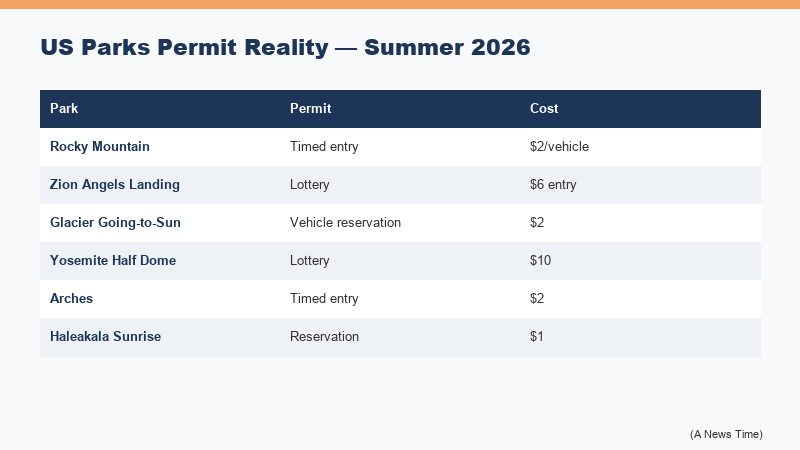
While most timed-entry systems have been discontinued, several site-specific permits remain and are as competitive as ever. At Zion National Park in Utah, the Angels Landing permit lottery is active for summer dates. Lottery entry for June through August hiking opened on . A limited number of next-day permits are also released at 12:01 a.m. the day before the hike, providing a secondary access route for travelers already in the area. Permit winners are charged $3 per person. Groups of up to six can apply.
Rocky Mountain National Park's timed-entry reservation system remains in effect for the full summer season. According to Public Affairs Officer Kyle Patterson, reservations open at 8 a.m. Mountain time for dates from May 22 through June 30, with additional reservations releasing on a rolling basis until September 1. Two reservation types are available: one that includes access to Bear Lake Road (the park's most photographically famous zone) and one without. Most of the park remains accessible without a reservation before 9 a.m. and after 2 p.m. on summer days, providing a workaround for early-rising hikers.
In Maine, Acadia National Park's Cadillac Mountain Summit Road vehicle reservation is required from May 20 to October 25. About one-third of reservations open 90 days in advance; the remainder become available two days prior. The vehicle fee is $6, booked through Recreation.gov.
Hawaii's Haleakala National Park continues to require a parking pass from 3 to 7 a.m. year-round for summit sunrise viewing, one of the more sought-after sunrise experiences in the US. Virginia's Shenandoah National Park requires a $2 day-use ticket for Old Rag Mountain hiking from March 1 through November 30, with 400 of 800 daily tickets released 30 days in advance and 400 released five days prior.
| Park | What Requires a Permit | Cost | How to Book |
|---|---|---|---|
| Rocky Mountain (CO) | Timed entry, May 22 to Oct 18 | Included in entry fee | Recreation.gov, opens May 1 |
| Zion (UT) | Angels Landing hiking permit | $3/person | Recreation.gov lottery (June-Aug: opened April 1) |
| Acadia (ME) | Cadillac Mountain vehicle pass, May 20 to Oct 25 | $6/vehicle | Recreation.gov, 90 days in advance |
| Haleakala (HI) | Summit sunrise parking, 3 to 7 a.m. | Included in entry | Recreation.gov |
| Shenandoah (VA) | Old Rag Mountain hiking, Mar 1 to Nov 30 | $2/person | Recreation.gov, rolling 30-day and 5-day windows |
| Great Smoky Mountains (TN/NC) | Parking pass (no timed entry required) | $5 daily / $15 weekly | In person or online, nps.gov |
Kim Lawson, spokeswoman for Yosemite Mariposa County Tourism, offered guidance that applies broadly to national park summer visits in 2026: "The best way to experience Yosemite is to slow down. Step away from your vehicle, take your time, and immerse yourself in nature while standing in the presence of some of the largest granite monoliths in the world." That approach, prioritizing depth over coverage, is increasingly the strategy that experienced adventure travelers are adopting as parks become more congested.
Lake Tahoe Recreation: The April 21 Forest Service Update
For hikers and outdoor recreationists targeting the western US, the Lake Tahoe Basin Management Unit of the US Forest Service released its 2026 summer recreation site opening schedule on . The release, from Public Affairs officer Lisa Herron, lays out a rolling opening calendar that adventure planners can use to target specific trailheads and campgrounds.
Mt. Tallac Trailhead opens . Bayview and Big Meadow trailheads, which access some of the basin's more demanding routes, open . Eagle Falls Picnic Area and Trailhead follows on . The first campgrounds come online May 9 at Meeks Bay Resort, with the main cluster at Blackwood Canyon, Fallen Leaf, Nevada Beach, and William Kent campgrounds opening May 22. Echo Chalet opens for Memorial Day weekend on May 25.
The Forest Service's guidance is explicit about the period before these sites open: parking, trash service, and restrooms are not available. Travelers who arrive at a trailhead before its designated opening date will need to pack out all trash and plan for no support infrastructure. That is the practical definition of adventure travel as it applies to spring access in the Sierra Nevada.
The convergence of the Lake Tahoe opening schedule with the broader national park permit dynamics creates a strategic opportunity. Tahoe Basin trails accessed from Forest Service land operate on a first-come, first-served basis with no advance reservations required. For hikers who cannot secure Rocky Mountain or Yosemite timed-entry passes, the Tahoe Basin offers comparable Sierra scenery, genuinely world-class trails, and a fraction of the permit bureaucracy.
Practical Details: How to Book, What to Budget, Where to Go
Adventure travel in spring and summer 2026 operates across a wide cost range depending on the category. Expedition marine travel (the Sea of Cortez liveaboard model) is at the premium end: multi-day liveaboard itineraries from established operators like Baja Expeditions typically run $2,500 to $5,000 per person depending on duration and vessel class, before flights to La Paz. That cost includes accommodation, meals, guides, and equipment use on the vessel.
National park hiking sits at the opposite end of the cost spectrum. With an America the Beautiful pass ($80 annually, available through Recreation.gov), a hiker can access all 63 national parks with no per-visit entrance fee. Site-specific permits (Angels Landing, Cadillac Mountain, Old Rag) add $2 to $6. The primary costs are transportation to the park, accommodation (which can range from free dispersed camping in adjacent national forests to $300-plus lodge rooms inside popular parks), and gear. For domestic adventure travelers, the total cost of a national park-anchored trip is as budget-accessible as any outdoor experience in the country.
The growing middle ground is guided adventure travel from domestic operators: rock climbing packages in Yosemite or Red Rocks, kayaking and paddleboard rentals in the Sea of Cortez's Loreto Bay, guided whale-watching in the Gulf of Maine, or whitewater day trips on Colorado or Tennessee rivers. These typically run $150 to $500 per day per person, include instruction and safety support, and dramatically reduce the planning and gear overhead that deters first-time adventure travelers.
For context on how active holidays have been trending, our earlier feature on the surge in hiking, cycling, and wellness bookings in 2026 showed a 40 percent year-over-year increase in active holiday bookings. That figure is consistent with what the national park data reflects: people are choosing to move on their vacations rather than simply arrive at a destination.
Adventure travel is also intersecting with international routes in ways that create new itinerary possibilities. The new Philippine Airlines Chicago-Manila nonstop, which our coverage of the A350-900 launch detailed, opens Southeast Asia diving and island trekking to US travelers at a significantly reduced transit burden. Palawan, Coron, and Tubbataha Reef are all within practical reach of a traveler connecting beyond Manila, at a price point that competes directly with European summer itineraries on overall trip cost.
Insider Tip: National Forests as the Undiscovered Alternative
The single most effective strategy for adventure travelers targeting US outdoor experiences in peak season is to use national forests as overflow from national parks. The strategic logic is simple: national forests typically share similar ecosystems, terrain, and scenery with adjacent national parks, operate on minimal permit systems with mostly first-come first-served camping, and receive a fraction of the visitor volume.
Dixie National Forest is 15 minutes from Bryce Canyon National Park and offers equivalent hoodoo formations with no reservation requirements. Pisgah and Nantahala National Forests in North Carolina provide backcountry solitude within 30 minutes of Great Smoky Mountains. Bridger-Teton National Forest surrounds Grand Teton National Park on three sides and contains dispersed camping sites with Teton views that rival anything accessible from the park's oversubscribed campgrounds.
The tradeoff is trail maintenance and safety infrastructure. National forests operate with leaner staffing than national parks. Trails are often less clearly marked, footbridges more likely to be washed out or unrepaired, and ranger presence minimal. The standard gear list for a backcountry day hike, including topographic map, compass or GPS device, first aid kit, water filtration, and 10 essentials, is not a recommendation for national forest hiking. It is a minimum requirement.
For travelers who make that preparation, however, the national forest system represents 193 million acres of adventure access without the queuing and permit anxiety that have come to define peak-season national park visits. The Forest Service's own trail maps and Recreation.gov both catalog what is available in each forest adjacent to the parks travelers already have on their lists. That research, done now, translates directly into better experiences when summer arrives.
Frequently Asked Questions
When can I book a Sea of Cortez whale shark expedition for summer 2026?
Whale shark aggregations at Bahía de Los Ángeles in the Sea of Cortez peak from July through September. Liveaboard operators including Baja Expeditions are running summer 2026 departures. Given small group sizes (typically 6 to 16 people), summer dates fill months in advance. Booking in April or May is advisable for a July or August departure.
Do I need a permit to hike in US national parks this summer?
Most national parks no longer require timed-entry permits for general access. Rocky Mountain National Park continues to require them from May 22 to October 18, with reservations opening May 1. Site-specific permits at Angels Landing (Zion), Old Rag Mountain (Shenandoah), Cadillac Mountain (Acadia), and Haleakala summit parking remain required and are booked through Recreation.gov.
How has staffing at national parks changed for summer 2026?
The National Park Conservation Association reports 90 park units experienced staffing impacts from funding cuts in 2025, with nearly 70 parks reducing visitor center hours or trail services. Travelers should plan self-sufficiently: download maps in advance, carry first aid supplies, and be prepared for longer ranger response times on busy days.
What are the best US national park alternatives for avoiding crowds?
Adjacent national forests offer comparable terrain and scenery with first-come first-served camping and no timed-entry permits. Dixie National Forest (near Bryce Canyon), Bridger-Teton (near Grand Teton), Pisgah and Nantahala (near Great Smoky Mountains), and the Lake Tahoe Basin Management Unit (Sierra Nevada) are all strong alternatives to their adjacent parks for peak-season adventure travelers.
What should adventure travelers budget for a US national park trip in summer 2026?
An America the Beautiful annual pass ($80, valid at all 63 national parks) eliminates entrance fees. Site-specific permits add $2 to $6. Dispersed camping in national forests is free. Guided day activities (climbing, kayaking, whitewater) run $150 to $500 per person per day depending on the operator and activity type. The biggest variable is accommodation; popular parks and adjacent gateway towns see lodging prices spike significantly in July and August.
Sources
- Sea of Cortez Expedition: Whale Sharks and Remote Islands — Baja Expeditions, April 2026
- How to Plan an Epic Summer Trip to a National Park — National Geographic via AOL, April 2026
- Opening Dates for Lake Tahoe Recreation Sites — US Forest Service, April 21, 2026
- National Park Conservation Association — Park Staffing Impact Reports, 2025-2026