
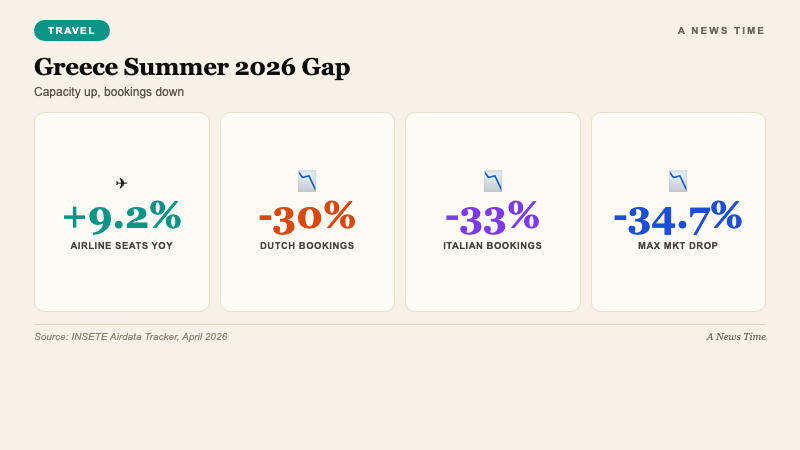
Greek tourism arrives at the 2026 summer season with a gap that the industry has not seen in nearly a decade. According to INSETE Airdata Tracker data summarized by Travel and Tour World on , scheduled international airline seats to Greece for summer 2026 are up 9.2% year over year to more than 30.8 million. End-March bookings from the country's major source markets have dropped by double digits across the board, with some markets reporting declines of up to 34.7%. Airlines are flying additional capacity into a demand environment that has not matched it.
For anyone tracking the European travel season, the Greek numbers are the clearest quantitative signal of how the Iran war's energy channel is reshaping leisure travel. Elevated jet fuel prices, driven by the extended Strait of Hormuz disruption, have pushed ticket prices higher. Geopolitical uncertainty has pushed travelers toward either cheaper or safer-feeling alternatives. And the booking pattern has shifted toward shorter lead times as consumers wait to see whether prices fall or the security picture clarifies.
The Capacity-Demand Mismatch
The headline number is the 9.2% year-over-year increase in scheduled seats. That expansion is not speculative. Airlines file their summer schedules months ahead and commit to operating them. Brussels Airlines increased Athens frequency from eight to nine weekly services between July and August. Austrian Airlines expanded Vienna capacity to Chania, Heraklion, Kalamata, Kefalonia, and Samos. SWISS added services to Athens and Thessaloniki for May. Wizz Air launched a seasonal Varna-Athens route running three times weekly from mid-June to mid-September. Volotea opened Venice-Corfu, Venice-Rhodes, Verona-Athens, and Verona-Karpathos.
The bookings number is where the problem lives. INSETE's end-of-March tracker shows bookings from six major European markets down significantly:
| Market | YoY booking change | Stated driver |
|---|---|---|
| Netherlands | -30%+ | Cost + geopolitical caution |
| France | -28% approx. | Costs + travel conditions |
| United States | -28% | Airfares + Middle East uncertainty |
| Italy | -33% | Demand softness + cost |
| United Kingdom | -26%+ | Fuel prices + affordability |
| Germany | -30.6% | Economic + travel uncertainty |
Greece remains one of Europe's most visible summer destinations. The mismatch between capacity and current bookings suggests two possibilities. Either demand arrives in a compressed late-booking window over May and June and the season fills in, or the aggregate gap holds and airlines reduce frequencies mid-season. Both outcomes have precedent. The 2008 financial crisis produced a similar compressed-booking recovery that filled a majority of the capacity gap by July. The 2020 pandemic-era patterns showed the opposite: an early gap that widened into an actual operational reduction.
Why Fuel and Geopolitics Are the Load-Bearing Variables
Jet fuel prices have followed crude oil higher since the US-Israeli conflict with Iran began on . Brent crude spiked above $110 per barrel during the first Strait of Hormuz closure, moderated toward $94 during the short-lived ceasefire and reopening, and is now trading above $100 again following the US seizure of the Iranian ship Touska on April 19 and Tehran's second Hormuz closure declaration. Every incremental dollar of Brent translates roughly one-to-one into jet fuel spot prices with a brief lag.
"Concerns over jet fuel availability in Europe have also emerged as a potential issue, especially given the geopolitical risks associated with the Strait of Hormuz. While European officials have reassured that fuel supplies remain adequate for the time being, the volatility of the global fuel market continues to cast a shadow over the travel industry."
Travel and Tour World, April 20, 2026
Airline ticket pricing responds to jet fuel with a compressed lag because carriers run dynamic pricing models that update on weekly if not daily cadence. The leisure traveler response is a slower-moving variable. When fares climb noticeably, price-sensitive consumers defer, shorten trips, switch destinations, or postpone. All four behaviors are visible in the current Greek booking pattern.
Geopolitical risk is the second load-bearing variable. Long-haul flights from the US, UK, and Western Europe to Greek destinations do not themselves pass through the Strait of Hormuz, but the regional air traffic infrastructure has been affected. Several Gulf hubs including Dubai, Doha, and Abu Dhabi have reported elevated diversions, delays, and fuel surcharges. The second-order effect is a broader perception that Mediterranean travel is regionally close to a conflict zone, even when the actual flight paths are unaffected.
The Last-Minute Booking Pattern
One of the most important behavioral shifts in the current data is the move toward last-minute bookings. Historically, summer reservations for Mediterranean destinations have tracked a predictable January-to-March front-loading pattern with a secondary peak in May. End-March 2026 bookings are running behind both windows. Travelers are waiting longer to commit, which shifts revenue recognition further into the season and complicates capacity planning for both airlines and accommodation operators.
The behavioral explanation is straightforward. A consumer looking at uncertain fuel prices and unresolved Middle East security has an incentive to delay booking in case either variable clarifies. That rational individual behavior aggregates into a demand-curve shift that airlines cannot easily accommodate. Empty seats in June become hard to fill even if August demand recovers, because load-factor constraints at the route level are weekly, not seasonal.
Where Greek Tourists Are Going Instead
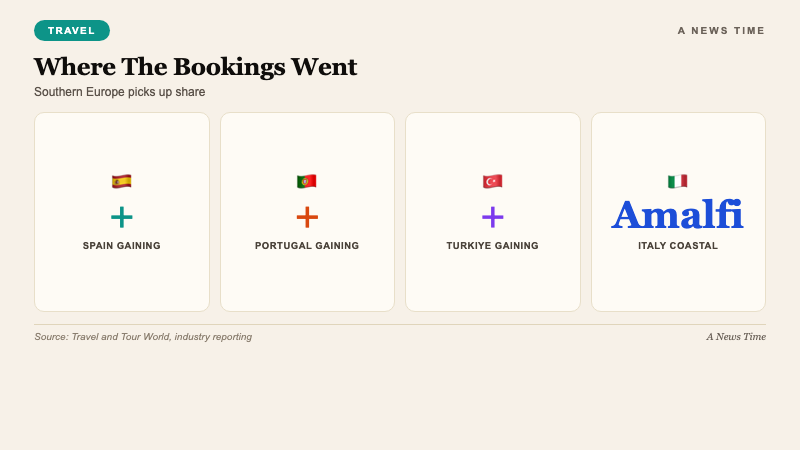
Displacement demand is visible in other destinations. Spain, Portugal, and Türkiye are the three European markets showing the strongest offset bookings as travelers who would have chosen Greece pick alternatives that feel equally safe and, in the case of Türkiye, meaningfully cheaper. All three benefit from geographic distance from the Middle East conflict zone and, for non-EU Türkiye, a favorable exchange rate for euro, pound, and dollar earners.
Southern European markets more broadly are picking up share. Italy's Amalfi Coast, Croatia's Dalmatian islands, and Sardinia are all tracking ahead of year-over-year bookings through end-March. For travelers, the calculus is partly price, partly perceived security, and partly the kind of lateral destination substitution that travel agents see every major geopolitical cycle. In the 2001 post-9/11 season, Caribbean demand surged at the expense of Mediterranean bookings. In 2020, domestic US destinations picked up share from international leisure. The 2026 pattern fits a similar mold.
What Greek Tourism Needs to Hit Summer Targets
The fundamentals of Greek tourism remain strong. The country generates more than 25% of its GDP from tourism when counting indirect effects. Islands like Santorini, Mykonos, Rhodes, and Kos retain intense brand pull. The 2026 season's problem is not attractiveness, it is price and timing.
For the season to recover to the full capacity airlines have scheduled, three things need to happen. First, jet fuel prices need to stabilize at or below current levels, which requires the Iran war to reach a durable diplomatic resolution or at least a sustained ceasefire. Second, the booking pattern needs to compress the lag between intent and commitment, which typically happens when consumers see early-summer bookings close at what look like sustainable prices. Third, airlines and accommodation operators need to resist mid-season capacity cuts that would lock in the shortfall.
None of those conditions are guaranteed. The most realistic planning assumption for the Greek tourism industry through May is that the season recovers 60% to 80% of its initial capacity projection, with the gap concentrated in the Dutch, German, and British markets where year-over-year declines are largest.
Frequently Asked Questions
Why is Greece tourism down for summer 2026?
Bookings from major European source markets are down 26% to 34% year over year as of end-March, driven by elevated jet fuel prices tied to the Iran war, geopolitical uncertainty near the Strait of Hormuz, and a general shift toward last-minute booking patterns.
How many airline seats are scheduled to Greece for summer 2026?
More than 30.8 million scheduled international airline seats, up 9.2% year over year, according to INSETE Airdata Tracker data. The capacity increase has not been matched by booking demand.
Which countries are cutting Greece bookings the most?
Italy (-33%), Netherlands (-30%+), Germany (-30.6%), France (-28% approx.), US (-28%), and UK (-26%+). All six are major Greek source markets.
Where are travelers going instead?
Spain, Portugal, and Türkiye are the three main beneficiaries of displacement demand. Italian coastal destinations, Croatia, and Sardinia are also picking up bookings that would have gone to Greek islands.
Will the Greece 2026 summer season recover?
Partial recovery is likely if jet fuel prices stabilize and last-minute bookings fill the mid-summer gap. The most realistic industry planning assumption is that the season closes at 60% to 80% of the capacity originally projected, with the gap concentrated in the weakest-performing source markets.
What to Watch
Three indicators will shape how the Greek summer 2026 season actually unfolds. The jet fuel price trajectory over May and early June, which depends directly on whether the Iran conflict stabilizes or escalates. The week-over-week booking velocity, which will indicate whether the compressed last-minute pattern is filling in or not. And whether any airlines announce capacity reductions, which would signal that the carriers themselves have accepted the gap as structural for this season. The first data window closes in mid-May. What Greek tourism looks like then will determine the 2026 financial results.