
Firefighters continued battling two simultaneous wildfires in Otsuchi, Iwate Prefecture on the morning of , after evacuation orders placed nearly 1,900 residents under shelter as flames driven by strong winds spread through forest and scrubland along the Sanriku coast. The fires, burning in the Kirikiri and Kozuchi districts of the same municipality, forced 219 people into three emergency evacuation centers by 6 a.m. and prompted Iwate Prefecture to activate its special disaster alert headquarters.
The fires broke out in rapid succession on . The Kozuchi district blaze ignited first, followed approximately two hours later by the Kirikiri fire roughly 15 minutes' drive away. By the following morning, Kirikiri had burned 140 hectares. Kozuchi had consumed 15 hectares. Firefighters from Otsuchi and neighboring municipalities were working to keep flames from reaching private residences, a nursing home, and a nursery school in the path of the fire.
What Is Burning and Where
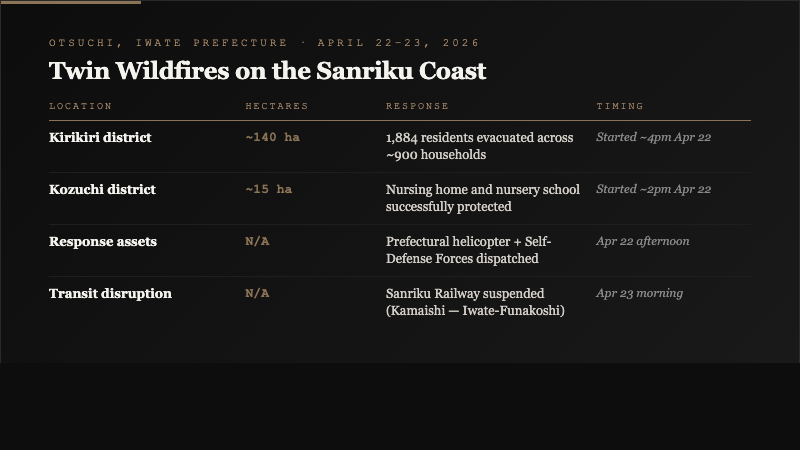
Both fires are in Otsuchi, a small coastal town of fewer than 12,000 residents in Iwate Prefecture on Japan's Sanriku coast, roughly 120 kilometers northeast of the prefectural capital, Morioka. The Kirikiri district fire is the larger of the two. It started around 4 p.m. on , approximately two hours after the Kozuchi fire began. By 8 a.m. the following morning, Kirikiri had burned 140 hectares of land, and the Kozuchi fire had burned 15 hectares.
Strong winds were identified as the primary driver of rapid spread in both locations, according to reporting by the Asahi Shimbun. The Morioka Local Meteorological Office issued warnings about dry conditions expected to persist, urging residents and officials to exercise extreme caution with open flames. The combination of persistent dryness and gusting winds is a well-recognized accelerant of wildfire spread, and forecasters indicated neither condition was likely to ease quickly.
| Location | Hectares Burned (by 8 a.m. April 23) | Key Response Action | Timing |
|---|---|---|---|
| Kozuchi district | 15 hectares | Municipal and regional firefighters deployed | Fire ignited ~2 p.m., |
| Kirikiri district | 140 hectares | Aerial firefighting, evacuation order issued for 900 households | Fire ignited ~4 p.m., |
| Prefecture-wide | 155 hectares combined | Special disaster alert headquarters activated; SDF assistance requested | 4 p.m., |
| Aerial support | N/A | Prefectural disaster-management helicopter dispatched for aerial firefighting | Shortly after 3 p.m., |
The prefecture's disaster-management helicopter was dispatched shortly after 3 p.m. on April 22 for aerial firefighting operations. At 4 p.m., the prefectural government formally requested disaster relief assistance from Japan's SDF. Sanriku Railway Co. suspended train service between Kamaishi and Iwate-Funakoshi stations as a precautionary measure, disrupting an important coastal rail link in a region that relies heavily on rail for regional connectivity.
The Evacuation and Emergency Response
Iwate Prefecture issued an evacuation order covering 1,884 residents from 900 households in the Kirikiri district. By 6 a.m. on , 219 people had taken shelter across three emergency evacuation centers. The gap between the total evacuation order number and those actually sheltered reflects a pattern seen across Japan: many residents choose to stay with relatives, leave the area on their own, or shelter in vehicles rather than designated centers.
"We are urging the public to exercise extreme caution with open flames. Dry conditions are expected to persist, and the combination of low humidity and strong winds creates elevated wildfire risk across Iwate Prefecture."
Morioka Local Meteorological Office, April 23, 2026
Firefighters were working in active coordination across municipal lines, with crews from neighboring municipalities joining Otsuchi's own department. The priority was protecting residential structures and the two vulnerable institutional targets: a nursing home and a nursery school in the fire's projected path. As of the morning of April 23, those structures had not been reached by the flames, though the fire remained active and conditions continued to shift with wind direction.
The prefectural government's activation of a special disaster alert headquarters allowed for centralized coordination between local government, fire services, police, and the SDF. The SDF request at 4 p.m. on April 22 brought the national government's disaster infrastructure into play alongside prefectural and municipal resources.
Why Iwate's Coast Carries a Particular Weight
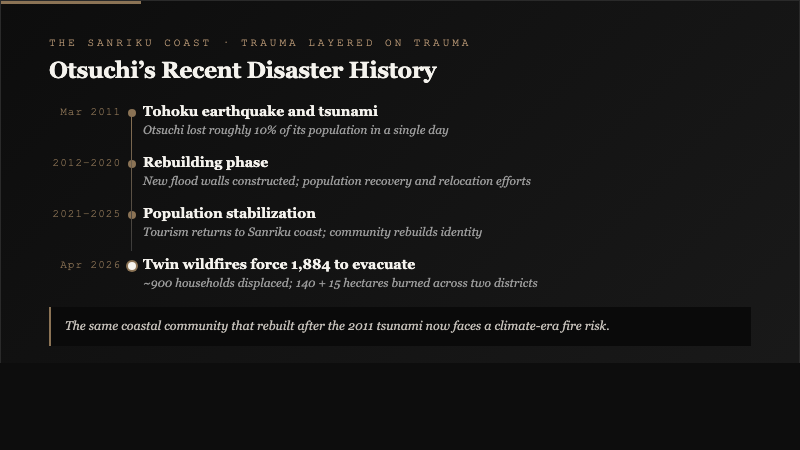
Otsuchi is not an unfamiliar name in the geography of Japanese disaster. On , the Tohoku earthquake and the tsunami it generated struck this stretch of the Sanriku coast with catastrophic force. Otsuchi was among the hardest-hit communities. The town lost approximately 10 percent of its pre-2011 population to the waves, a loss so concentrated in a small municipality that the grief and reconstruction have shaped the town's identity ever since.
The coast has spent the intervening 15 years rebuilding, relocating residents to higher ground, constructing tsunami barriers, and working through the slower, harder process of economic and social recovery. For a community that has already experienced one generational disaster, an emergency of this scale carries an emotional and institutional weight that simple hectare counts do not capture.
"Iwate Prefecture's coastal communities are among the most disaster-resilient in Japan because they have had to become so. But that resilience is built on resources and community cohesion that repeated emergencies put under pressure."
Asahi Shimbun, reporting on the Otsuchi wildfires by Yoshikazu Sato and Masakazu Higashino, April 23, 2026
The Sanriku Railway line, whose service between Kamaishi and Iwate-Funakoshi was suspended in response to the fires, is itself a symbol of that recovery. The railway was severely damaged in 2011 and restored through years of community effort and public investment. Temporary suspension for public safety is a manageable disruption, but it is a reminder of how tightly infrastructure, memory, and daily life are woven together along this coast. For context on Japan's broader regional resilience challenges and the environmental pressures on coastal communities, the framing connects to the global climate conversation that has taken on new urgency in 2026.
The Climate Pattern Behind the Timing
Wildfires in Japan in late April are not unprecedented, but the timing and intensity of the Otsuchi fires fit a pattern that climate scientists have been tracking for several years. Japan's winters have been warming, and spring drying has been arriving earlier. The window of dangerous fire conditions, which historically opened later in spring as snowmelt kept forests and scrubland moist, has been shifting earlier and extending longer.
Attributing any individual fire directly to climate change is not scientifically appropriate. What research indicates is that the aggregate conditions favorable to wildfire spread, including lower winter precipitation, earlier snowmelt, lower spring soil moisture, and stronger seasonal winds, have become more frequent and more persistent across Japan's mountainous and coastal-forested regions. The Otsuchi fires fit that pattern. The Morioka Local Meteorological Office's warnings about persistent dry conditions and wind are a real-time illustration of those aggregate factors.
Japan's Japan Meteorological Agency has documented a consistent upward trend in spring temperatures across Honshu over the past three decades. Warmer springs reduce snowpack at mid-elevation, dry out forest litter faster, and extend the period during which a spark, whether from agricultural burning, machinery, or lightning, can produce a large fire rather than a small one. The Otsuchi fires occurred in conditions the meteorological office had already flagged as requiring heightened caution.
These dynamics connect to a pattern visible globally. On , the same day the Otsuchi fires ignited, the Horseshoe Fire was reported in Kern County, California, part of a spring fire season that California and the American West have seen intensify as warming dries out landscapes earlier each year. The parallel is not a coincidence of timing so much as a shared symptom of warming-driven shifts in when and how fire behaves across temperate and Mediterranean-climate zones. That interconnection between energy markets, carbon emissions, and fire risk is part of a larger picture being tracked across multiple sectors in April 2026.
Japan's Broader Spring Fire Season
Japan recorded a notable increase in large wildfire events in the 2020s, a trend that forest management agencies and climate researchers have been examining with growing attention. The country's extensive forested hillsides, many of which are managed as timber plantations of densely planted cedar and cypress, create fuel-load conditions that can, under dry and windy conditions, carry fire rapidly from canopy to canopy.
Iwate Prefecture sits in a region where mixed forest types dominate: broadleaf deciduous species at lower elevations, transitioning to conifer plantations on steeper slopes. In spring, before deciduous trees leaf out, the fuel load from dead leaves and dried winter vegetation is at its annual peak. This is the period when forest fire danger ratings are typically highest across Japan's northeastern Tohoku region.
Research published in Japanese forestry and fire science journals has found that the number of days per year with fire weather index ratings in the highest categories has increased across Honshu over the past two decades. Evidence suggests the trend is consistent with warming projections, though attribution to specific causal drivers requires careful modeling that differentiates natural variability from forced change. What is already visible is the operational reality: Japanese fire agencies are managing longer periods of dangerous conditions and coordinating at scales that historical fire seasons did not require. For related context on land and fire ecology in different climate contexts, the science of ground conditions and fire behavior has global parallels.
What to Watch in the Days Ahead
The immediate question is containment. As of the morning of , neither the Kirikiri nor the Kozuchi fire had been reported as contained. The wind conditions flagged by the Morioka Local Meteorological Office as likely to persist were the same conditions driving the fires' expansion overnight. Until wind speeds drop and humidity rises, firefighters face an environment where gains achieved during calmer overnight hours can be reversed quickly when conditions change during the day.
The nursing home and nursery school near the Kirikiri fire line are the two most urgent protection priorities. Evacuation of mobility-limited nursing home residents is resource-intensive and time-sensitive in ways that differ from general residential evacuation. The fact that both structures were still standing as of the morning report is a measure of how far firefighters had been able to hold the line, but it is not a resolution.
A longer-term question is what the Otsuchi fires add to the picture of wildfire risk in Iwate and Tohoku more broadly. Japan's Japan Meteorological Agency and regional forest management agencies will likely conduct post-incident analysis of the fire's ignition, spread patterns, and the meteorological conditions that shaped both. That analysis will add a data point to the growing body of evidence on how spring fire risk is changing in northeastern Japan.
For Otsuchi specifically, the fires are an emergency layered on top of a recovery that never fully ends. The community rebuilt its infrastructure, its memorial sites, and its sense of itself after 2011. It is doing so again under conditions it did not create and cannot fully control. Whether the fires are contained in the next 48 to 72 hours, whether evacuation orders can be lifted quickly, and whether the structures in the fire's path survive, those are the measures that matter most to the 1,884 residents waiting for news. The parallel fires in California on the same day, detailed by the Sacramento Bee, are a reminder that Otsuchi's situation is not an anomaly. It is one point in a spring fire season that has become a global pattern.
Sources
- Asahi Shimbun: Wildfires in Iwate Prefecture force evacuation of nearly 2,000 residents (Yoshikazu Sato and Masakazu Higashino, April 23, 2026)
- Japan Meteorological Agency: International Activities and Climate Monitoring
- Otsuchi Town Government: Official Disaster and Emergency Information
- Sacramento Bee: Horseshoe Fire reported in Kern County, California, April 22, 2026