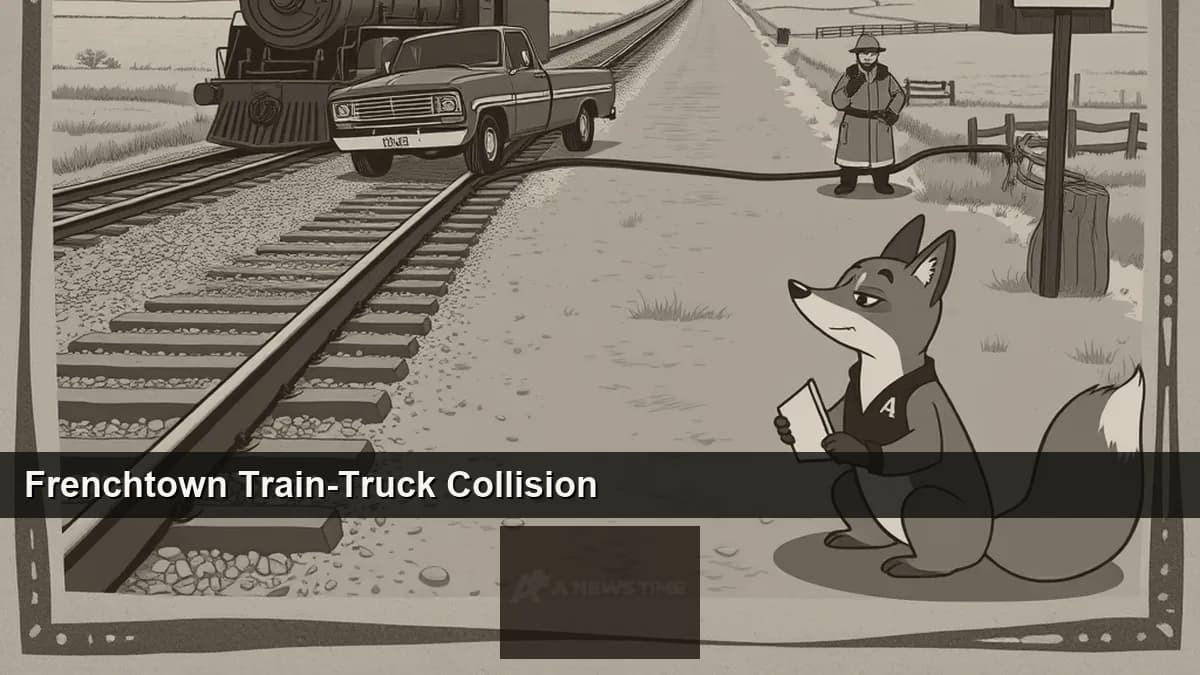
A train struck a vehicle at the Beckwith Street crossing in Frenchtown, Montana, early Sunday morning , according to the Frenchtown Rural Fire District. Two occupants of the vehicle were trapped and had to be extricated from the heavily damaged truck, one of them with serious injuries. Both were transported to area hospitals. The train crew was uninjured. Beyond the immediate human toll, the Frenchtown collision sits inside a larger industry conversation about rural rail-crossing safety funding, passive-warning device upgrades, and what protected grade crossings actually cost when a US rail network built across a century has to be maintained in the 2020s.
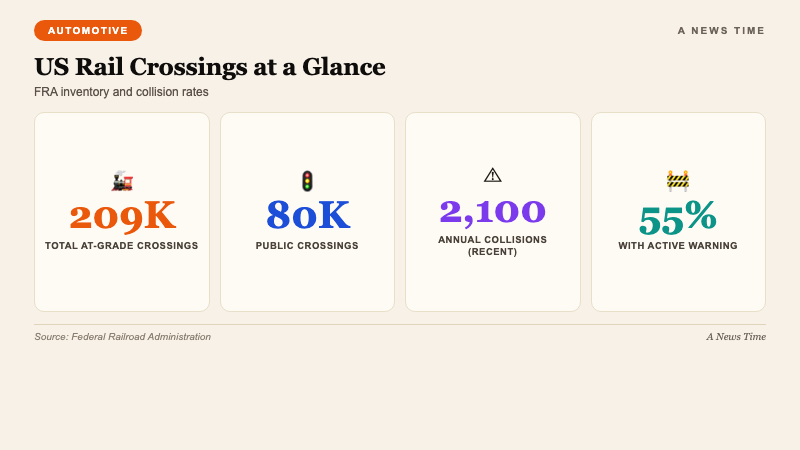
The US has approximately 209,000 public and private at-grade rail crossings, according to the Federal Railroad Administration. Roughly 80,000 of those are public crossings. Of the public crossings, slightly more than half have active warning devices such as flashing lights, gates, or bells. The remaining crossings rely on passive warning signs, crossbuck markers, and driver attention. Collision statistics concentrate heavily on the passive-warning subset, particularly in rural corridors where sightlines are long, traffic density is low, and driver expectation of encountering a train is proportionately lower.
The Frenchtown Crossing
Beckwith Street is a small road off the north end of Frenchtown, an unincorporated community in Missoula County with a population of just over 1,800 in the 2020 census. The rail line through Frenchtown is part of the Montana Rail Link network, long operated as a short-line partner to BNSF Railway and now integrated fully into BNSF operations following the 2024 consolidation. The Beckwith Street crossing's current warning-device profile, whether active signals, gates, or passive crossbuck only, has not been specified in public reporting of the collision. The Frenchtown Rural Fire District has said only that both occupants were trapped in the vehicle and extricated, with one taken to the hospital with serious injuries.
| Category | Approximate count | Context |
|---|---|---|
| Total US public and private at-grade crossings | ~209,000 | Federal Railroad Administration |
| Public at-grade crossings | ~80,000 | FRA inventory |
| With active warning devices | ~55% | FRA |
| Passive-warning only | ~45% | FRA |
| Annual US grade-crossing collisions (recent avg) | ~2,100 | FRA |
Two-occupant crossing incidents, particularly ones producing serious injury with no fatality, track closely with a specific failure pattern. The vehicle enters the crossing, either because of obstructed sightlines, distracted driving, or insufficient active-warning indication, and the train engineer has inadequate stopping distance to avoid contact. Trains at rural line speeds of 40 to 60 mph require 1 to 1.5 miles to stop. A vehicle that enters a crossing with even a few seconds of engineer warning is not reliably recoverable through emergency braking.
The Funding Backdrop
Congress passed the Infrastructure Investment and Jobs Act in 2021, which included a Railroad Crossing Elimination Grant Program funded at $600 million annually for five years. The program targets grade-crossing elimination and safety-device upgrades, with priority weighting for collision-history, sightline-compromised, and high-speed corridors. Montana has received multiple grant awards under the program, primarily focused on Front Range crossings along the BNSF and Montana Rail Link corridors.
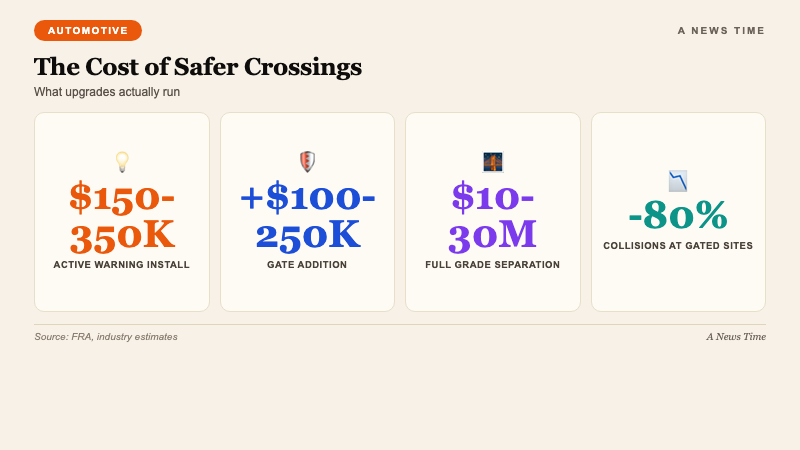
The award pattern matters because grade-crossing upgrades are expensive. A typical active-warning installation, including flashing lights, bells, and a power supply, runs between $150,000 and $350,000 per crossing depending on track configuration and local utility availability. A full-gate installation adds between $100,000 and $250,000. A grade-separation project, eliminating the at-grade crossing entirely through an overpass or underpass, typically costs $10 million to $30 million per crossing. At US annual funding levels, the country cannot eliminate every at-grade crossing within any reasonable planning horizon.
What Has Actually Worked
The single most effective intervention at the crossing level is active warning combined with gate installation. Studies summarized by the Federal Railroad Administration have consistently found that gated crossings reduce collision frequency by roughly 80% relative to passive-warning crossings with comparable traffic profiles. The combination of light, sound, and physical barrier produces a multi-modal signal that pierces distraction, obstructed sightlines, and driver misjudgment more reliably than any single-mode warning.
"Gate installation at a high-risk crossing is one of the most cost-effective safety interventions available in the surface-transportation system. The marginal cost per avoided collision compares favorably to most highway-safety projects."
Federal Railroad Administration analysis of grade-crossing safety outcomes
Driver education is a secondary factor. Operation Lifesaver, the nonprofit funded by the US rail industry and federal grants, has conducted rail-safety education programs since 1972 and credits itself with a significant share of the multi-decade decline in collision frequency. Crossing collisions peaked at around 12,000 per year in the 1970s and have declined to approximately 2,100 per year in recent federal reporting. Not all of that decline is education. A significant share comes from active-warning upgrades, grade-separation projects, and general declines in rural vehicle miles traveled.
The Montana Context
Montana's rural geography compounds the grade-crossing safety challenge. The state has roughly 3,300 rail miles across BNSF, Montana Rail Link integrated operations, and several short lines. Many of those miles run through agricultural and forest land with county roads crossing at intervals measured in miles rather than blocks. Active-warning installations are expensive to power and maintain in corridors where the nearest commercial power line may be several miles away.
Recent Montana Department of Transportation reporting has emphasized a shift toward targeted upgrades at high-collision-history crossings combined with rumble-strip installations on approach roads. Rumble strips are a low-cost intervention, typically installed for $2,000 to $10,000 per crossing approach, that forces driver attention through the vibration channel. They do not replace active warning devices. They supplement them at crossings where the full upgrade budget is not yet available.
For the Freight Industry
BNSF Railway, which now operates the Montana Rail Link corridors after the 2024 integration, publishes safety data under the Federal Railroad Administration's reporting requirements. The industry's collective message has been consistent. Grade-crossing collisions are almost always the result of a vehicle entering the crossing, rather than the result of train operation, and the incentive structure for the rail industry is to invest heavily in corridor safety because every collision produces operational delay, potential litigation, and reputational cost.
The harder, more honest version of the industry's position is that at-grade crossings are a legacy infrastructure choice that was cheap to build and is expensive to eliminate. The US rail network was assembled in the late 19th and early 20th centuries with at-grade crossings as the default. Replacing that choice at scale would cost hundreds of billions of dollars and would take decades even with unconstrained funding. The actual path forward is incremental: targeted upgrades, active-warning expansion, grade separation at the highest-priority locations, and continued driver education.
What to Watch in Frenchtown
Three questions will determine whether the Beckwith Street collision becomes a case study or a contained incident. First, what the existing warning-device configuration at the crossing actually is. Second, whether Missoula County or the Montana Department of Transportation reviews the crossing under the state's safety priority criteria and flags it for upgrade. Third, whether the injured occupants recover fully, which is the question that matters most to the families involved. The broader industry conversation about grade-crossing safety funding will continue regardless of what happens in Frenchtown. For the community, the specific conversation will center on whether the crossing itself changes between now and the next time a train and a truck meet at Beckwith Street.
Frequently Asked Questions
What happened at the Beckwith Street crossing?
A train collided with a vehicle at the Beckwith Street rail crossing in Frenchtown, Montana, early on the morning of April 19, 2026. Both vehicle occupants were trapped and had to be extricated by Frenchtown Rural Fire District and Missoula Emergency Services. One was taken to the hospital with serious injuries. The train crew was uninjured.
How many rail crossings exist in the US?
Approximately 209,000 at-grade public and private crossings, of which roughly 80,000 are public crossings, according to the Federal Railroad Administration. Slightly more than half of public crossings are equipped with active warning devices such as flashing lights, gates, or bells.
How much does it cost to upgrade a rail crossing?
A typical active-warning device installation costs between $150,000 and $350,000. Adding full gates adds $100,000 to $250,000. A grade-separation project, which eliminates the at-grade crossing through an overpass or underpass, typically costs $10 million to $30 million depending on location and complexity.
How many grade-crossing collisions happen in the US each year?
Recent Federal Railroad Administration reporting averages approximately 2,100 grade-crossing collisions per year. That figure is down from a peak of roughly 12,000 collisions per year in the 1970s, a decline attributed to active-warning installations, grade separation, driver education programs like Operation Lifesaver, and long-term changes in vehicle miles traveled.
What federal funding is available for rail-crossing safety?
The Infrastructure Investment and Jobs Act of 2021 created the Railroad Crossing Elimination Grant Program, funded at $600 million annually for five years. The program targets grade-crossing elimination and safety-device upgrades with priority for collision-history, sightline-compromised, and high-speed corridor crossings.