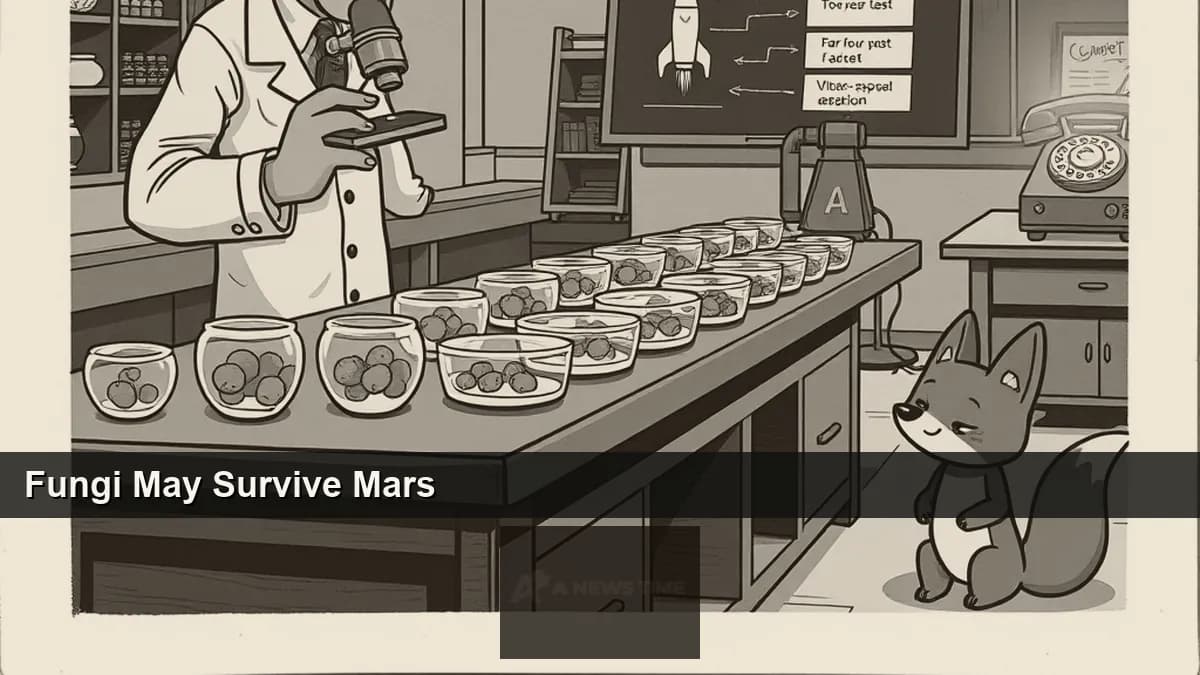
A new study published in Applied and Environmental Microbiology and covered by Discover Wildlife on , found that spores of the filamentous fungus Aspergillus calidoustus can survive every step of a mission to Mars, from cleanroom assembly through interplanetary transit to exposure on the Martian surface. It is the first study to show that microbial eukaryotes, complex cells with membrane-bound nuclei, can persist through the full stress profile of a Mars mission. For NASA's Jet Propulsion Laboratory Biotechnology and Planetary Protection Group, the finding is the kind of empirical result that directly shapes how future missions design their sterilization protocols.
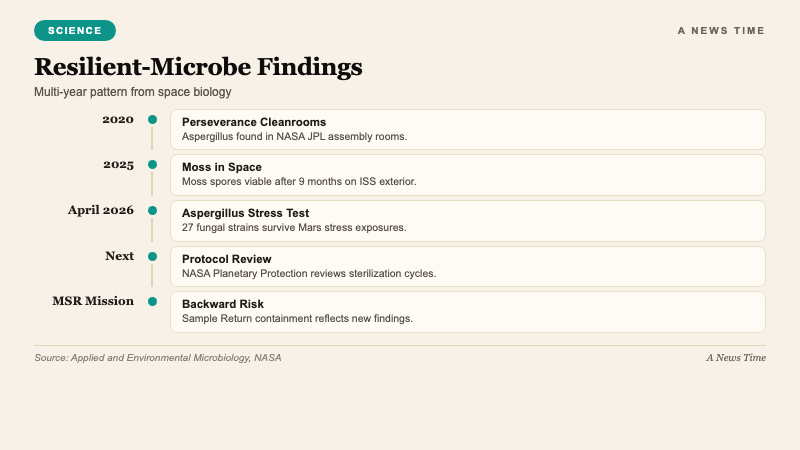
For anyone tracking space biology and planetary-protection policy, the Aspergillus result is the latest in a clustering of recent studies, including a 2025 experiment showing moss spores remain viable after nine months on the exterior of the International Space Station, that collectively complicate the long-held assumption that Earth microbes cannot ride a spacecraft to another world. What we still do not know is whether any of these hardy organisms could establish a population on Mars if they arrived. What we now know is that arriving alive is possible.
What the Study Actually Tested
The research team began with strains isolated from NASA cleanrooms where the Perseverance rover was assembled in 2020. Aspergillus calidoustus is a small filamentous fungus that does not produce mushrooms but does reproduce via asexual spores called conidia. It is commonly found in indoor environments, including plumbing and ventilation systems. The cleanrooms, despite ISO-certified particulate controls and standard decontamination cycles, harbored the fungus.
Researchers generated conidia from 27 of the isolated strains and exposed them to a sequence of environmental stressors. The stress set included low temperature simulating deep-space transit, ultraviolet radiation at intensities matching the Martian surface, ionizing radiation replicating solar and galactic cosmic-ray exposure, low atmospheric pressure, and physical exposure to Martian regolith (the loose, dusty rock material that covers the planet's surface). Each stressor was applied individually to isolate which conditions the conidia could tolerate.
| Stress condition | Conidia survival |
|---|---|
| Low temperature (deep space) | Survived |
| Ultraviolet radiation (Mars surface) | Survived |
| Ionizing radiation (cosmic rays) | Survived |
| Low atmospheric pressure | Survived |
| Martian regolith exposure | Survived |
| Combined extreme cold + high radiation | Did not survive |
The finding that single stressors did not kill the conidia is not itself surprising. Researchers have known for years that spore-forming organisms are unusually hardy against individual extreme conditions. What the study adds is a quantified picture of which combinations of stressors are actually lethal. Only the simultaneous combination of extreme cold and high radiation consistently killed the conidia. Every other single-stress exposure produced surviving populations that could germinate when returned to growth conditions.
Why This Matters for Planetary Protection
Planetary-protection protocols exist to prevent forward contamination of other worlds by terrestrial microbes and backward contamination of Earth by any microbes that might return on a sample-return mission. The current US standard, set by NASA's Office of Planetary Protection and aligned with COSPAR recommendations, allows for a small tolerated bioburden on spacecraft components, determined by category of mission and probability of contact with a potentially habitable environment.
"Microorganisms can possess extraordinary resilience to environmental stresses. This does not mean that contamination of Mars is likely, but it helps us better quantify potential microbial survival risks."
Kasthuri Venkateswaran, NASA Jet Propulsion Laboratory Biotechnology and Planetary Protection Group
Venkateswaran's framing is carefully measured. Survival of conidia through exposure does not equal establishment of an ecological population on Mars. The Martian surface is, by Earth standards, extraordinarily hostile to biology. Water activity is close to zero. Atmospheric pressure is less than 1% of Earth's. Surface temperatures average roughly -60°C. The study's finding is not that Earth fungi will colonize Mars. It is that a sterile spacecraft may be harder to achieve than current protocols have assumed, which means the bioburden budget for sensitive mission categories may need to be revisited.

The Broader Pattern of Resilient Space Biology
The Aspergillus study is the latest addition to a growing literature on the surprising resilience of terrestrial microorganisms in space conditions. In 2025, researchers reported that moss spores remained viable after nine months attached to the exterior of the International Space Station. Earlier work has documented bacterial endospores surviving years of low-Earth-orbit exposure. Deinococcus radiodurans, a bacterium famous for its radiation tolerance, has been shown to withstand radiation doses thousands of times higher than lethal human levels.
The accumulating evidence points to a specific conclusion. Life on Earth has evolved, across many separate lineages, mechanisms for surviving environmental extremes that far exceed anything a spacecraft decontamination cycle typically simulates. Heat sterilization does not kill all spore formers. UV exposure does not reach interior crevices. Chemical decontamination leaves residual populations in ventilation systems. The combined effect is that every spacecraft we launch carries a small but non-zero population of organisms with at least some probability of surviving a long-duration mission.
What We Still Do Not Know
Three specific questions remain open. First, whether conidia that survive the stress profile can actually germinate and form viable fungal populations on the Martian surface. The study tested survival but not post-arrival viability in realistic Martian-surface simulation. Second, whether the 27 isolated strains are representative of the broader microbial community present in spacecraft cleanrooms, or whether they are a hardy subset. Third, whether current NASA decontamination protocols, which rely on combinations of heat, UV, and chemical treatments, effectively address the Aspergillus-type organisms that the study showed can pass through individual-stress exposures.
The third question is the one most likely to drive near-term protocol changes. A sterilization cycle that combines heat and UV simultaneously may be more effective than sequential cycles of each, based on the study's combined-stress lethality finding. That kind of protocol refinement is the operational output of this kind of research.
The Policy Horizon
NASA's upcoming Mars Sample Return mission, which aims to retrieve Perseverance's cached rock samples and bring them to Earth for analysis, has a specific backward-contamination concern tied to this research. If Earth-derived organisms can survive Martian-surface exposure, sample handling and containment protocols need to assume that any returned sample could contain viable terrestrial organisms that inadvertently rode outbound. The implications ripple through sample-curation facility design, handling procedures, and scientific analysis methodology.
For the broader astrobiology community, the result also matters for the reverse question. If Earth organisms can survive on Mars, the window in which we could potentially detect signs of Mars-native life, assuming any exists or ever existed, narrows. Any biosignature detected in a Martian sample has to be checked against the possibility that the signature came from terrestrial contamination rather than native biology. That is a harder analytical problem than it would have been if the planetary-protection assumption of effective decontamination had held up.
Frequently Asked Questions
Can fungi really survive on Mars?
A new study in Applied and Environmental Microbiology reported that Aspergillus calidoustus spores survived individual exposures to low temperature, UV and ionizing radiation, low atmospheric pressure, and Martian regolith. Only the combined exposure to extreme cold and high radiation killed the spores consistently.
Where did the fungus come from?
The strains were isolated from NASA cleanrooms where the 2020 Perseverance rover was assembled. The fungus is commonly found in indoor environments including plumbing and ventilation systems.
Does this mean Mars will be contaminated?
Not necessarily. Survival through exposure does not equal establishment of a viable population on Mars, which remains extraordinarily hostile to biology. The finding primarily means current sterilization protocols may need refinement and that backward-contamination protocols for sample-return missions need to assume Earth organisms could be present on returned samples.
Why does planetary protection matter?
It prevents cross-contamination in both directions. Forward contamination of other worlds by terrestrial microbes would complicate any future detection of native life. Backward contamination of Earth by returned samples could introduce unknown biological risks, though the probability of Mars-native life existing is low.
What about bacterial or moss contamination?
Previous research has documented bacterial endospore survival in low-Earth-orbit exposures for years and moss spore viability after nine months on the exterior of the International Space Station. The Aspergillus study extends this pattern to complex eukaryotic microbes.
What Comes Next
NASA's Planetary Protection office is likely to reference the study in upcoming protocol reviews. The Mars Sample Return mission's handling and containment plans will probably cite the finding in updated risk assessments. Academic researchers will conduct follow-up studies testing whether surviving conidia can actually germinate and grow under Martian surface conditions, which is the load-bearing question for long-term contamination risk. The broader research trajectory continues to challenge assumptions about microbial fragility that date to early-era space biology.