By , the year's running list of notable deaths had crossed a threshold that even veteran entertainment journalists were calling striking. Not just in numbers, though the count was notable, but in the concentration of figures who had shaped specific cultural eras and left behind fanbases that remained deeply attached decades after their peak work. From the teen-drama generation of the late 1990s to the SCTV comedy era of the 1970s and 1980s, from the psychedelic rock world of the Grateful Dead to the civil rights movement's final living architects, the first four months of 2026 have asked a great deal of those who grew up with these figures. This is a record of who we have lost, why each person mattered, and what their collective absence means for the culture they helped build.
The Television Generation: Van Der Beek, O'Hara, Dane, and Brendon
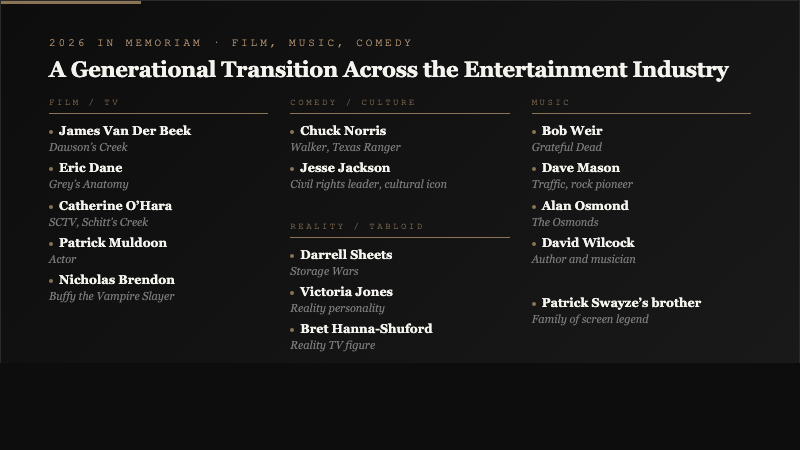
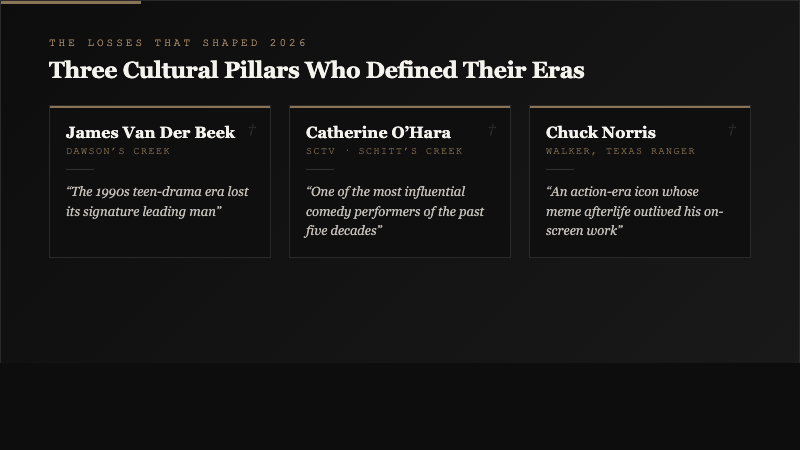
No single category of loss in early 2026 has hit harder for audiences of a certain age than the deaths of actors whose faces were weekly fixtures in American living rooms. James Van Der Beek, who built his career as the title character of Dawson's Creek beginning in , passed away in 2026 and prompted one of the year's most sustained waves of public grief. He was 49. The show, which premiered on the WB network and ran for six seasons, was not merely popular: it served as a cultural touchstone for an entire generation navigating adolescence, and Van Der Beek's Dawson Leery, with his oversize vocabulary and earnest emotional intensity, became the template for a certain kind of sensitive, self-aware teenage masculinity that the late 1990s prized. The "Dawson crying" reaction image he later embraced with humor revealed a man comfortable enough in his own legacy to find joy in it. That quality made his loss feel personal to people who had never met him.
Catherine O'Hara, who died in 2026, represented a different but equally irreplaceable lineage. Her career began with SCTV in the 1970s and ran through decades of film comedy, including her roles in Tim Burton's Beetlejuice and Home Alone, before reaching its most celebrated late chapter in Schitt's Creek, where her performance as Moira Rose earned her an Emmy Award in 2020. O'Hara's ability to play broad comedy with absolute internal logic, to make a character as absurd as Moira Rose feel emotionally true, placed her in a tradition of technically gifted comedic performers whose craft is often underestimated precisely because it looks effortless. The comedy community's response to her death was immediate and unambiguous: she was, by consensus, one of the most gifted performers her generation produced.
"Catherine O'Hara's performance as Moira Rose stands as one of the defining comedic achievements in television history. She made the impossible look inevitable, which is the hardest thing an actor can do."
Entertainment Weekly, tribute coverage, 2026
Eric Dane, who was 54 at the time of his death, built his most recognized work as Dr. Mark Sloan on Grey's Anatomy, where the "McSteamy" nickname became a genuine cultural shorthand. Dane's career after the show, particularly his leading role in TNT's The Last Ship, demonstrated a range that his network-drama fame did not always make room to display. His death, reported early in 2026, drew tributes from the large ensemble of actors who had passed through the Shondaland universe over two decades. Nicholas Brendon, who played Xander Harris across seven seasons of Buffy the Vampire Slayer, also died in 2026. Brendon's loss was complicated by the public struggles he had navigated in the years since the show ended, including legal and health issues he had discussed openly. His death prompted his former castmates to speak about him with consistent warmth, centering the character and the work he had done on the series that defined his career.
Music's Losses: Bob Weir, Dave Mason, and Alan Osmond
The music world's 2026 losses began earlier in the year with Bob Weir, the Grateful Dead co-founder and rhythm guitarist whose career stretched across six decades of American rock history. Weir, who had continued performing into his late seventies with Dead and Company, was one of the last surviving members of the original Dead lineup. His death closed a specific chapter of the psychedelic San Francisco scene that had begun in the mid-1960s, a chapter whose influence on improvisational rock, live music culture, and the touring industry remains foundational. The Grateful Dead did not merely have fans; they had a community, and Weir's presence within that community was as much about connection as it was about music. His loss was mourned across the full spectrum of the jam-band world and well beyond it.
Dave Mason, the British-born singer-songwriter and guitarist who co-founded Traffic with Steve Winwood in 1967 before pursuing a highly regarded solo career, also died in 2026. Mason's "We Just Disagree," released in 1977, remains one of the most-played soft-rock tracks in American radio history, a song so clean in its construction and honest in its sentiment that it has lost none of its resonance across nearly five decades. His guitar work, both with Traffic and as a solo artist, influenced a generation of players who absorbed his instinct for melodic simplicity and restraint. Alan Osmond, the eldest of the Osmond Brothers and a key figure in both the family's musical success and its broader entertainment enterprise, died in 2026 after a long battle with multiple sclerosis. Osmond had been open about his diagnosis for decades, and his advocacy work within the MS community gave his later years a purpose that extended beyond the industry that had made him famous.
| Name | Role / Achievement | Category |
|---|---|---|
| James Van Der Beek | Lead, Dawson's Creek; cultural figure of the late-1990s teen drama era | Television |
| Catherine O'Hara | Emmy winner, Schitt's Creek; SCTV alumna; Beetlejuice, Home Alone | Television / Film / Comedy |
| Eric Dane | "McSteamy" on Grey's Anatomy; lead, The Last Ship | Television |
| Nicholas Brendon | Xander Harris, Buffy the Vampire Slayer (1997-2003) | Television |
| Bob Weir | Co-founder, Grateful Dead; rhythm guitarist, six-decade career | Music |
| Dave Mason | Co-founder, Traffic; solo artist, "We Just Disagree" | Music |
| Alan Osmond | Eldest Osmond Brother; MS advocate | Music / Entertainment |
| Jesse Jackson | Civil rights leader; two-time presidential candidate; RPC founder | Civil Rights / Politics |
| Chuck Norris | Martial arts champion; star of Walker, Texas Ranger; action film icon | Film / Television |
| Patrick Muldoon | Actor, Starship Troopers, Days of Our Lives | Television / Film |
| Darrell Sheets | "The Gambler" on Storage Wars | Reality Television |
| Victoria Jones | Journalist and broadcaster | Media |
Chuck Norris and the Action Hero Generation
Chuck Norris died in 2026, and the response was predictably vast but also notably layered. Norris was, in one sense, a straightforward cultural figure: a champion kickboxer who became an action star and then, with Walker, Texas Ranger, a television institution. In another sense, he was a more complex figure, one whose internet mythology (the "Chuck Norris facts" meme phenomenon that dominated the mid-2000s web) transformed him into a kind of living cultural joke that he navigated with surprising good humor. The tension between the earnest patriotism that defined his public persona and the ironic distance with which the internet had adopted him made Norris one of the more interesting cultural case studies of the digital age. His death prompted reflections on what action heroes meant to the generations that consumed them in the 1980s and 1990s, and on the specific brand of American confidence that Walker, Texas Ranger, which ran for eight seasons on CBS, both reflected and reinforced.
His career intersected directly with Bruce Lee's, and his acknowledgment of that intersection, including their famous fight sequence in Way of the Dragon (1972), gave his biography a connection to martial arts history that extended beyond the entertainment industry. He was 85.
Jesse Jackson and the Civil Rights Legacy
Jesse Jackson, who died in 2026, was not primarily an entertainment figure, but his presence in American cultural life was so pervasive and so long-running that his loss registered across every sector of public life, including entertainment and media, where he had been a consistent and vocal advocate for inclusion and representation. Jackson's two presidential campaigns, in 1984 and 1988, introduced a level of rhetorical ambition to American political discourse that remains influential. His founding of the Rainbow/PUSH Coalition created infrastructure for advocacy that outlasted the specific political moment that produced it. He was 84.
"Jesse Jackson's presence in American life for more than half a century was a reminder that the work of equality is never finished. He spent his career making that case, in terms that were sometimes uncomfortable and always necessary."
People Magazine, tribute, 2026
His death, coming at a moment when discussions of civil rights history have taken on renewed urgency in American political discourse, prompted a wave of reflection on what it means to carry a movement across decades, and on the specific sacrifices required of those who do. He had been a witness to the assassination of Dr. Martin Luther King Jr. in Memphis in 1968 and spent the subsequent five decades building on the legacy of that movement. His passing marks the end of a generation of direct-action civil rights leadership.
Reality Television, Supporting Players, and Other Losses
Darrell Sheets, known to Storage Wars viewers as "The Gambler" for his high-stakes bidding style and theatrical personality, died in 2026. Sheets was a fixture on the A&E reality series that turned storage unit auctions into appointment television, and his showmanship represented a particular kind of reality TV charisma: rooted in genuine expertise but amplified by an understanding of what cameras required. Patrick Muldoon, the actor who appeared in Starship Troopers and had a long run on Days of Our Lives, also died in 2026. David Wilcock, the author and researcher known for his work on consciousness, metaphysics, and alternative history, died as well, prompting significant response from the communities that had followed his decades of writing and media appearances.
Victoria Jones, a longtime journalist and broadcaster, died in 2026. Jones had spent decades covering Washington and had a presence in political media that extended well beyond any single outlet or affiliation. Bret Hanna-Shuford, whose work in local news and community media had made him a familiar figure in his market, also passed this year. Don Swayze, the younger brother of Patrick Swayze and a character actor who appeared in dozens of films and television series, died in 2026. His brother Patrick's 1987 death in the iconic film Dirty Dancing and his broader Hollywood legacy had always cast a long shadow over Don's own career, but those who worked with him consistently described a genuine talent who operated with independence and craft.
The reality television world also mourned figures connected to shows like Storage Wars and the broader unscripted landscape that emerged in the 2000s and 2010s. These were not household names at the level of Van Der Beek or O'Hara, but their loss underlines a reality about the entertainment industry's second and third tiers: the people who populate reality programming often have the same depth of fan attachment as scripted stars, even if the industry's awards infrastructure has never fully acknowledged it. For audiences who spent years watching Storage Wars or similar shows, Sheets' death was a genuine loss of a familiar presence.
For context on the entertainment industry's broader April calendar and the shows and films that continue to arrive even as these losses register, see our coverage of streaming releases for April 21-22 and our look at the week's major music news.
What These Losses Say About 2026
There is a temptation, when confronting a list like this, to reach for the comforting narrative of natural order: these were people of advancing age, careers fully lived, legacies secure. That framing is not wrong, but it is incomplete. What the 2026 losses actually reveal, taken together, is a specific generational turnover that was always coming but has now visibly arrived. The performers who defined the 1990s teen drama boom are now in their late forties and fifties. The musicians who built the psychedelic rock era of the late 1960s are in their seventies and eighties. The civil rights leaders who were young men and women at the March on Washington are gone or very nearly so.
This is what a generation passing looks like from the inside. It does not happen all at once. It happens in clusters, in waves, with each death prompting a fresh reckoning with a body of work that had been taken for granted because the artist was still alive. Bob Weir's death forced a re-examination of the Grateful Dead's full catalog. Catherine O'Hara's death sent Schitt's Creek to the top of streaming charts for the first time in years. James Van Der Beek's death brought Dawson's Creek back into conversation for a generation that had largely moved on. In each case, the loss became an occasion for rediscovery, for introducing younger audiences to work they had missed and for giving older audiences permission to feel, openly and without irony, the grief that comes with losing the cultural touchstones of formative years.
The entertainment industry has systems for this, tributes and memorial segments at awards shows, retrospective profiles in trade publications, streaming services that surface catalog work in response to trending searches. Those systems exist because the industry understands what research has confirmed repeatedly: that parasocial relationships with performers are real, that the grief people feel when a beloved figure dies is legitimate, and that cultural figures occupy a space in collective memory that is distinct from, but not lesser than, personal relationships. The losses of 2026 are a test of that understanding, and of the culture's capacity to honor the specific contributions of a very wide range of public figures without flattening them into a single story.
As the year continues, including a summer and fall entertainment calendar that promises significant new work in television, film, and music (as tracked in our coverage of upcoming streaming originals), the industry will move forward. It always does. But the names above will remain part of the record of what 2026 was, what it cost, and what it owed to the people who helped build the culture that so many now inherit.