
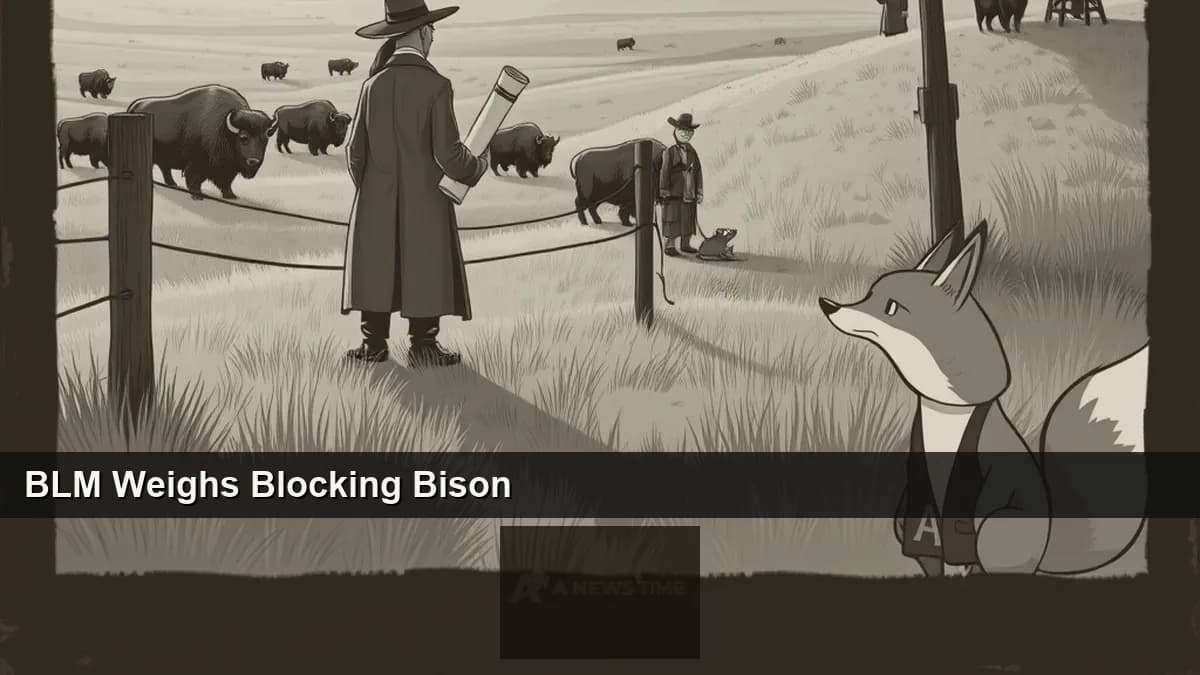
A long-running Montana dispute over whether bison legally count as "livestock" under federal grazing law reached a new decision point this month, as the US Bureau of Land Management continues to advance a proposal to revoke the permits that allow the nonprofit American Prairie to graze its bison herd on 63,000 acres of public land in north-central Montana. The status of the decision, framed as a win for local ranchers by Montana state officials and as a threat to tribal buffalo restoration by a coalition of more than 50 tribes, anchored local news coverage in Billings, Bozeman, and Missoula through the weekend of .
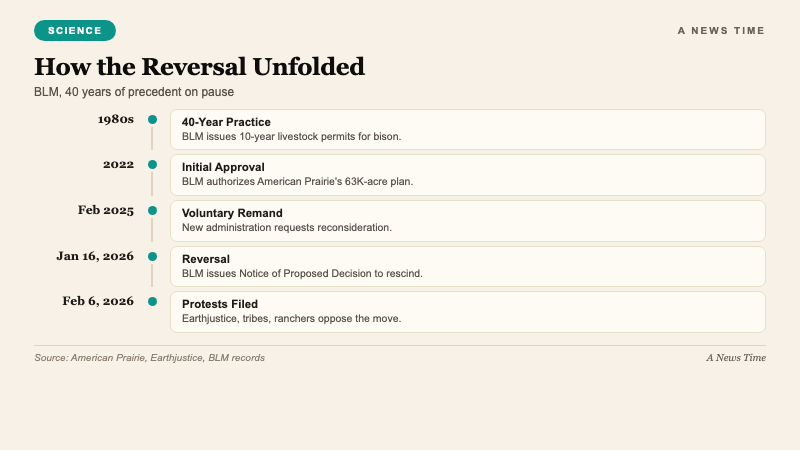
The policy question is narrower than the cultural dispute suggests. BLM approved the 63,000-acre bison grazing authorization in 2022. The state of Montana, two regional grazing districts, and the Montana Stockgrowers Association appealed. BLM defended its approval for nearly three years, through multiple administrative proceedings, until February 2025, when the agency requested a voluntary remand to reconsider. On , BLM issued a Notice of Proposed Decision reversing its prior position. American Prairie's formal protest, filed on February 6, argued that BLM cannot lawfully change position after four decades of treating bison as livestock-eligible under federal grazing statutes.
What the 63,000-Acre Landscape Actually Looks Like
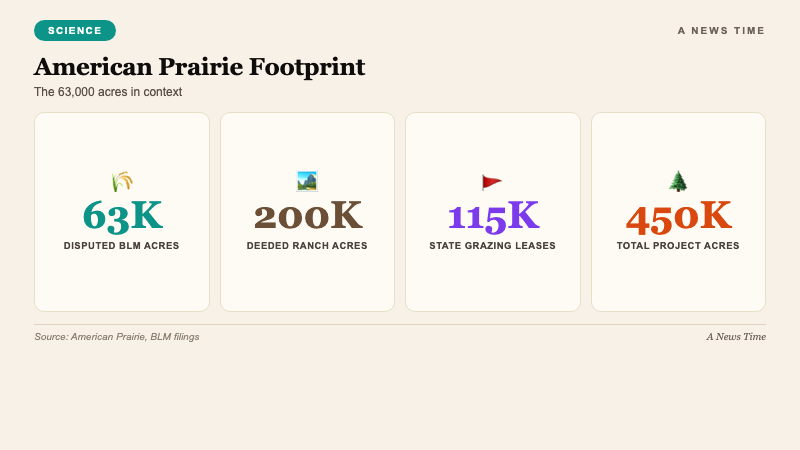
The acreage in dispute sits in the northern Great Plains, roughly 4% of the footprint American Prairie has been assembling since 2004. The full conservation project spans approximately 450,000 acres across the Phillips County region, combining deeded ranch land purchased by the nonprofit with state and federal grazing leases. Bison are the ecological linchpin. Reintroduction of a free-ranging bison herd on open grassland at this scale is the continent's most ambitious post-reservation buffalo restoration project.
| Category | Approximate acreage | Role |
|---|---|---|
| Deeded ranch land (owned) | ~200,000 acres | Core herd range |
| State grazing leases | ~115,000 acres | Grazing rotation |
| BLM grazing permits (disputed) | 63,000 acres | Public land integration |
| Private conservation agreements | ~70,000 acres | Corridor connectivity |
For scale, 63,000 acres is roughly the land area of Washington, DC, plus the city of Alexandria, Virginia, combined. The acreage is not a trivial fraction of the conservation project. It is enough land that its removal would force American Prairie to rebalance its grazing rotation, potentially reduce herd size, or lease substitute pasture at market rates the nonprofit has never had to pay before.
The Legal Question: Are Bison "Livestock"?
The dispute hinges on a statutory reading that has been settled practice for more than forty years. Under the Taylor Grazing Act of 1934 and subsequent BLM regulations, "livestock" has been interpreted to include bison managed commercially or for conservation. BLM has issued general 10-year livestock grazing permits for bison in six western states continuously since the 1980s. The 2022 American Prairie authorization was unusual in scale but not in category.
The January 2026 Notice of Proposed Decision advances a different statutory interpretation. Under that reading, bison managed for conservation rather than commercial livestock production do not qualify for livestock grazing permits. Earthjustice's protest filing on American Prairie's behalf argues that nothing in the underlying statute distinguishes between commercial and conservation livestock management, and that a change in administration is not by itself a legally adequate basis for reversing a final agency decision.
"This BLM decision puts at risk not just American Prairie's bison grazing, but the management of bison herds across the country, including tribal herds. This shortsighted political decision would reverse decades of precedent and harm public land management moving forward. The agency must withdraw its proposal and restore the grazing permits."
Jenny Harbine, managing attorney, Earthjustice Northern Rockies Office
Alison Fox, American Prairie's chief executive, framed the policy question in institutional terms. "This proposal is an unprecedented reversal of BLM's own decision-making after more than 40 years of treating bison as eligible livestock under federal grazing law," Fox said in the organization's February protest announcement. "BLM lawfully approved these permits after a thorough environmental review and defended them for years. Abruptly rescinding them now, under political pressure, creates immense uncertainty and sends a chilling signal to Tribes, ranchers, and conservation partners who depend on fair and predictable public land management."
What We Know About the Ecology
The ecological case for bison on native shortgrass prairie is well documented in Rangeland Ecology & Management and associated grassland research literature. Compared to cattle, bison graze more selectively, disturb soil and vegetation in patterns that promote plant diversity, and return nutrients through wallowing behavior that creates microhabitats for ground-nesting birds and small mammals. Peer-reviewed grassland studies have documented measurable differences in plant species richness, pollinator abundance, and soil carbon retention in bison-grazed pastures relative to cattle-grazed controls.
The caveats matter. Most of the scientific work on bison-cattle ecological differences comes from smaller-scale enclosures, including studies at the Konza Prairie Biological Station in Kansas and similar research sites. Extrapolating to a 63,000-acre open-range rotation introduces uncertainties about herd density, winter range shifts, and drought-year carrying capacity that no single study has quantified at that scale. What we still do not know is whether the biodiversity benefits documented in research-station settings scale linearly or follow diminishing-returns curves as acreage and herd numbers grow.
The Rancher Perspective Is Not Monolithic
The narrative frame often reported in local broadcasts casts the dispute as "ranchers versus conservation." That framing oversimplifies the coalition on both sides. Several commercial bison ranchers across Montana, South Dakota, and Wyoming filed protests alongside American Prairie, worried that a narrower BLM reading of "livestock" would undercut their own federal grazing permits. Wild Idea Buffalo Company, a commercial bison meat producer in South Dakota, joined the protest.
On the other side, the Montana Stockgrowers Association, two regional grazing districts, and Montana state government under Governor Gianforte have argued that the American Prairie footprint effectively converts working ranchland into conservation land, reducing county tax bases and shrinking the cattle sector's access to public grazing. Gianforte's letter to Interior Secretary Doug Burgum, written after his administration failed to overturn the 2022 BLM decision through administrative appeals, is widely credited with prompting the January 16 reversal.
The Tribal Stakes
More than 50 tribes represented by the Coalition of Large Tribes filed a separate protest against the BLM proposal. The core concern is that the narrower BLM interpretation would make tribal governments and tribal citizen buffalo herds ineligible for BLM grazing leases going forward. That outcome would reverse a decade of progress on tribal buffalo restoration, much of which has relied on founding animals donated from or inspired by American Prairie's herd.
The Cheyenne River Sioux Tribe, the Cheyenne and Arapaho Tribes, and the Tanka Fund filed additional protests. The tribal argument links grazing permit eligibility to treaty rights, food sovereignty, and cultural restoration, framing BLM's proposed decision as a threat that extends beyond a single Montana footprint. The coalition's protest filing warned that, as written, the proposed decision would make it "unlikely that any tribal government or tribal citizen buffalo herd would ever be eligible for BLM grazing leases."
What Comes Next Procedurally
The Notice of Proposed Decision triggered a formal 15-day protest window that closed in February. BLM must now respond to the protests filed and either finalize the proposed cancellation, modify it, or withdraw it. If BLM finalizes cancellation, American Prairie's legal team has indicated the matter will move to federal court, likely in the US District Court for the District of Montana with probable appeals to the 9th Circuit.
The legal standard under the Administrative Procedure Act is whether the agency's policy reversal was supported by "reasoned explanation" rather than simply a change in political preference. Under Supreme Court precedent in Motor Vehicle Manufacturers v. State Farm, agencies can change position, but must address the facts and analysis that supported the prior decision. BLM's three-year defense of the 2022 authorization creates a substantial administrative record that the agency will need to distinguish in its final decision.
A secondary procedural question involves the practical timeline. American Prairie's existing grazing authorization remains in effect until BLM issues a final decision and until any stay pending litigation expires. The summer 2026 grazing season will likely proceed under the current authorization, meaning bison will remain on the 63,000 acres at least through the calendar year regardless of the legal trajectory.
The Broader Question
The American Prairie permit dispute has become a stand-in for a larger conversation about how the federal government interprets multiple-use mandates on public land. BLM's organic statute, the Federal Land Policy and Management Act of 1976, directs the agency to manage public lands for a mix of uses including grazing, conservation, recreation, and cultural preservation. Which of those uses carries the most weight in any given decision is a policy judgment that shifts between administrations.
What remains consistent across administrations is the scientific record on grassland ecology, the federal trust relationship with tribes, and the administrative practice of treating bison as livestock for permit purposes. Those three elements form the core of the case American Prairie and its allies are making. Whether they are sufficient to reverse BLM's proposed decision, or whether the agency finalizes cancellation and the dispute moves to federal court, is the question that will define the summer news cycle in the northern Great Plains.
Frequently Asked Questions
Why did the BLM propose canceling American Prairie's bison grazing permits?
BLM's January 16, 2026 Notice of Proposed Decision reversed its 2022 authorization after Montana Governor Greg Gianforte wrote to Interior Secretary Doug Burgum and after the agency requested a voluntary remand in February 2025. The proposed decision advances a new statutory interpretation holding that conservation bison do not qualify as livestock under federal grazing law.
How large is the disputed area?
The disputed permits cover 63,000 acres of public land in north-central Montana, primarily in Phillips County. That footprint is roughly the combined size of Washington, DC and Alexandria, Virginia.
How many bison grazing permits could be affected beyond American Prairie?
According to American Prairie's protest filing, 41 current BLM bison grazing permits across six western states could be affected by the reinterpretation. That includes commercial bison ranchers and tribal bison herds.
Why are tribes opposing the decision?
The Coalition of Large Tribes, which represents more than 50 tribes, argues the new BLM interpretation would effectively bar tribal governments and tribal citizens from ever holding federal grazing leases for buffalo herds. Tribal protesters cite impacts on treaty rights, food sovereignty, and the decade of progress on tribal buffalo restoration.
What are the next procedural steps?
BLM must now respond to the protests filed in February. If the agency finalizes cancellation, American Prairie and its partners are expected to file federal court litigation, likely in the US District Court for the District of Montana with probable appeals to the 9th Circuit. The current grazing authorization remains in effect through the pending final decision.
What to Watch
Three decision points will determine how this unfolds through the spring and summer. The first is BLM's response to the filed protests, which could come at any point before the summer grazing season begins. The second is whether the Department of the Interior signals any willingness to accommodate tribal concerns in its final decision. The third is how quickly any resulting litigation progresses through the federal courts, and whether a preliminary injunction keeps the existing authorization in place during appeals. Ecological restoration projects operate on decade timelines. Administrative decisions operate on political ones. How those two clocks align is the question that will shape American Prairie, tribal buffalo restoration, and the grazing-permit precedent across the western United States.
Sources
- American Prairie Challenges BLM's Proposed Revocation of Bison Grazing Permits - American Prairie
- Montana Ag Network: A fight over bison grazing in the plains - Q2 News KTVQ
- Gianforte Praises BLM Decision to Cancel American Prairie Reserve Bison Permits - Montana Department of Agriculture
- Coalition of Large Tribes protest filing - February 2026