
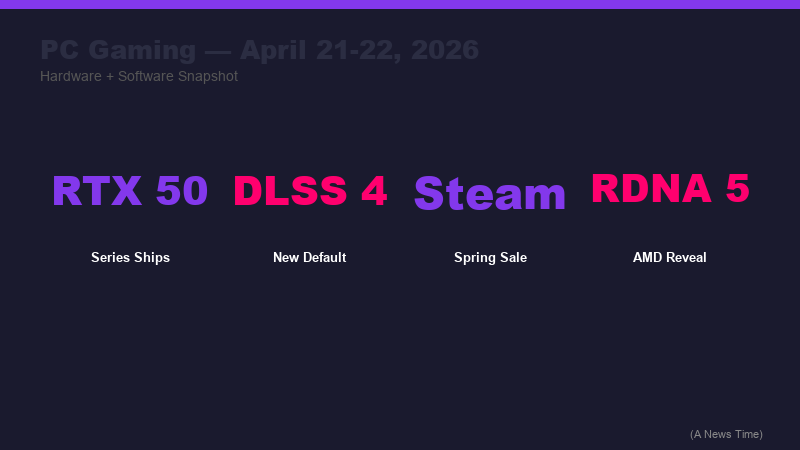
PC gaming hardware and software news moved fast on . NVIDIA pushed out its DLSS 4.5 SDK to all game developers, Capcom launched Pragmata to some of the year's highest review scores while pairing it with a GeForce RTX 50 Series bundle, Valve's long-rumored Steam Controller crept closer to a real release date, and a coolant-leak incident involving a $4,299.99 ROG Astral RTX 5090 turned into a public dispute that highlighted just how expensive this GPU generation has become. Here is what happened, what it means, and what to watch next.
NVIDIA Ships DLSS 4.5 SDK With Dynamic Multi Frame Generation
The practical implication of the DLSS 4.5 SDK release is that any developer integrating the kit from this week forward gains access to two new capabilities. The first is Dynamic MFG, which functions less like a setting and more like an automatic transmission for the GPU. Rather than asking players to choose a fixed 2x, 4x, or 6x frame multiplier, Dynamic MFG monitors the gap between the GPU's native output and the display's maximum refresh rate in real time, then shifts the multiplier to stay as close to that ceiling as possible without overproducing frames. The second capability is Multi Frame Generation 6X mode, which extends the ceiling for titles that opt in explicitly.
The distinction matters for how games feel at the keyboard and mouse. A fixed 4x multiplier can produce latency inconsistencies in moments where the native frame rate dips sharply, because the system is still generating four frames for every one native frame regardless of how much headroom exists. Dynamic MFG collapses the multiplier when native performance is strong and expands it when the GPU is under load, which in theory produces a smoother experience than a fixed setting. Andrew Burnes, writing in NVIDIA's official GeForce news post published on , confirmed that the SDK is now live at the NVIDIA RTX developer portal with updated APIs, documentation, and sample code.
For players, the near-term impact is limited to titles that actively integrate the new SDK. The longer-term effect is that the baseline for what "well-optimized DLSS support" means shifts upward again. Developers who shipped their games with DLSS 4.0 integration earlier this year will not automatically benefit. Those who build against 4.5 from this point will deliver measurably better performance scaling on RTX 50 Series hardware, which is relevant because that product line has been on sale since January.
"Updated APIs, documentation, and sample code help reduce integration time and make it easier to bring DLSS into both new and existing projects."
Andrew Burnes, GeForce.com, NVIDIA, April 21, 2026
The DLSS 4.5 SDK also matters for developers already shipping DLSS 4 support, because NVIDIA's app-level override system means end users can already apply Dynamic MFG globally across any DLSS 4-compatible title. The SDK brings that override capability into the developer's own implementation rather than leaving it to player-side configuration, which improves the consistency of how the feature behaves across different hardware and driver combinations. It is a detail, but it is the kind of detail that separates a feature that works most of the time from one that works reliably.
Pragmata Launches With Path Tracing Driving PC Performance Headlines
Capcom's Pragmata launched on and landed among the year's highest-rated releases across console and PC platforms, pulling an OpenCritic score of 87 (Mighty) by the time reviews settled. On PC, the conversation shifted quickly to one specific dimension: what path tracing does to the game's visual output, and what the RTX 50 Series does to path-traced performance.
The benchmark numbers NVIDIA published alongside the launch tell a precise story. At 4K with all settings at maximum, path tracing active, DLSS Ray Reconstruction enabled, and DLSS Multi Frame Generation running at 4X mode, the RTX 5090 delivers 290 frames per second. The RTX 5080 lands at 190 fps in the same conditions. Drop to 1440p and those numbers climb to 350 fps on the 5090 and over 200 fps on both the 5080 and 5070 Ti. At 1080p, the 5090 reaches 480 fps, the 5080 clears 330 fps, the 5070 Ti exceeds 290 fps, the 5070 runs above 220 fps, and both the 5060 Ti and 5060 clear 180 fps. These are all with path tracing active, which is a computationally intensive workload that in prior generations would have required significant compromises at similar settings.
The frame rate numbers above 200 fps are mostly academic for players using standard 144Hz or 165Hz monitors. Where they become relevant is for the growing install base of 240Hz and 360Hz displays, where reducing latency while maintaining high frame rates has tangible impact on input responsiveness. NVIDIA's Reflex technology, which is also active in Pragmata on PC, reduces latency by up to 46 percent on top of the frame rate gains, which matters particularly in the game's real-time combat sequences.
Critical reception reinforced the PC-specific case. Digital Foundry described Pragmata as "one of the standout PC releases of the year," and Destructoid called it "genuinely the best story Capcom ever told." The game had sold over one million copies in less than a week of availability across all platforms. To coincide with the launch, NVIDIA is running an RTX 50 Series bundle that includes a Steam copy of Pragmata with the purchase of qualifying RTX 5090, 5080, 5070 Ti, or 5070 desktop or laptop graphics cards at participating retailers.
Pragmata's technical success on PC is not isolated. It is part of a pattern that has been building since the RTX 50 Series launched in January, where the gap between what path-traced games look like on current-generation hardware versus what was achievable two years ago has grown wide enough to be immediately visible to non-technical players. For a broader picture of where path tracing is heading, our earlier coverage of NVIDIA's GTC 2026 vision for film-quality gaming provides useful context on the roadmap behind these numbers.
Steam Controller Returns: SteamDB Lists an Unboxing Video
The evidence that Valve is close to shipping a new Steam Controller has been building for weeks, and a new data point surfaced on . Hardware analyst Brad Lynch flagged a SteamDB listing that shows a video uploaded to the Steam platform with the filename steam_controller_unboxing_2026. The upload timestamp on SteamDB shows , at 21:22 UTC. SteamDB is an independent database that pulls data from Steam's public-facing infrastructure automatically, meaning the listing reflects something Valve actually added to its systems.
The listing itself is locked behind Steam account permissions, so the video content is not publicly viewable. What is visible is the filename, the upload date, and a controller_support status set to "full." That last detail is the kind of metadata that would make sense for an unboxing video designed to accompany a product page rather than a marketing teaser, since "full controller support" is the classification Steam uses for games and products with complete gamepad integration.
This follows a separate leak from the previous week: public shipping documents showed 14 tons of "WIRELESS PC CONTROLLER" units delivered to Valve's facilities. The combination of a bulk hardware shipment and an unboxing video in the Steam system within days of each other is difficult to explain as coincidence. Lynch went on the record stating his belief that the launch is imminent, though he stopped short of giving a specific date. PCGamesN hardware editor Edward Chester, who first reported the SteamDB discovery, noted that the controller release appears to be proceeding at a pace, unlike the Steam Machine initiative which stalled before reaching meaningful commercial scale.
The original Steam Controller launched in 2015 and was discontinued in 2019 after selling approximately 1.6 million units. Its trackpad-plus-gyroscope control scheme was ahead of what most third-party controller manufacturers were attempting at the time, and the device still has a vocal community of users. A successor in 2026 would arrive into a market where PlayStation's DualSense and Xbox's Elite Controller Series 2 have raised expectations considerably, but Valve's integration with Steam hardware ecosystems, including the Steam Deck, gives a new Steam Controller a distribution channel those competitors cannot replicate. Whether the new hardware iterates on the original's unconventional layout or moves toward something more conventional is the question every potential buyer will have the moment Valve makes the official announcement.
RTX 5090 AIO Incident Puts Premium GPU Pricing Under Scrutiny
A Reddit post that surfaced on and was subsequently reported by TweakTown details what happens when high-end liquid cooling hardware fails next to a $4,299.99 graphics card. The user reports that an NZXT Kraken AIO cooler leaked coolant onto their ASUS ROG Astral GeForce RTX 5090, damaging the card, in August 2025. According to the post, NZXT acknowledged a manufacturing defect, replaced the cooler, and then offered a cash settlement of $2,855.99 to cover the GPU damage. The user rejected the settlement on the grounds that it does not cover the full replacement cost of the card. The dispute has since escalated to the point where the user is pursuing legal action.
The specifics of who is legally liable in a hardware damage chain like this are complicated, and the user's choice to air the dispute publicly while also pursuing litigation has drawn criticism from commenters who note that public statements can complicate legal proceedings. Those legal details are for the parties involved to resolve. What the incident illustrates for the broader PC hardware market is simpler: when a single graphics card costs more than many desktop PC builds in their entirety, the risk calculus around liquid cooling changes.
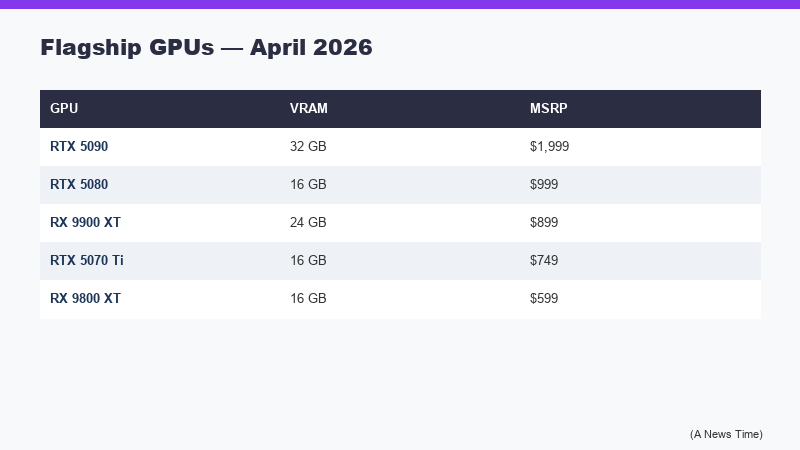
| GPU | MSRP at Launch | Pragmata 4K FPS (max settings + path tracing) | DLSS 4.5 MFG Support |
|---|---|---|---|
| RTX 5090 | $1,999 | 290 fps | Yes (up to 6X) |
| RTX 5080 | $999 | 190 fps | Yes (up to 4X) |
| RTX 5070 Ti | $749 | ~165 fps | Yes |
| RTX 5070 | $549 | ~140 fps | Yes |
| RTX 5060 Ti | $379 | ~110 fps (est.) | Yes |
Note that the ROG Astral SKU of the RTX 5090 retails at $4,299.99, more than double the Founders Edition launch price, because ASUS's flagship SKU includes a premium triple-fan cooler, factory overclock, premium capacitors, and a design tier the company positions for extreme overclockers and system builders who want the most cooling headroom. The gap between that premium card and a settlement offer that does not make the buyer whole is what generated the community reaction. NZXT's position, as reported, is that its cooler replacement and the $2,855.99 figure represent a reasonable resolution given that cleaning the GPU "fixed" it temporarily. The user disputes that characterization.
The incident connects to a broader pattern in the 2026 GPU market. For context on how the high-end GPU market arrived at $4,000-plus graphics cards, our earlier reporting on MSI's 15 to 30 percent price increases on gaming hardware traces the supply and demand dynamics behind premium GPU pricing this cycle.
Also This Week: '83 Early Access, Atomic Heart DLC, and Sudden Strike 5
Beyond the headline stories, several smaller PC releases arrived or were confirmed for . Blue Dot Games' '83 enters Steam Early Access on that date, a large-scale 40-versus-40 tactical first-person shooter set during a fictionalized NATO-versus-Warsaw-Pact conventional war in 1983. The game natively supports DLSS 4 Multi Frame Generation and can be upgraded to DLSS 4.5 Dynamic Multi Frame Generation through the NVIDIA app.
Mundfish's Atomic Heart: Blood On Crystal, the fourth and final DLC for the 2023 first-person action title, is now available. The expansion adds a new location called the Crystal Complex, new enemy types called Polymorphs with elemental combat mechanics, and new weapons and abilities. The complete Atomic Heart Ultimate Edition, bundling the base game and all DLC, launched alongside it for new buyers. Kite Games and Kalypso Media are also launching Sudden Strike 5 on , an RTS with 300-plus unit types and a 25-mission World War II campaign, featuring DLSS Super Resolution and DLAA for image quality.
Marvel Rivals Season 7.5 is live as of this week, bringing a new story arc involving the Gilded Saint and adding a free Thor Midgard Umber costume claimable through NVIDIA's GeForce Rewards via the NVIDIA app for RTX users, available while supplies last. Neverness to Everness (NTE) is also receiving a DLSS and path tracing update in China on , ahead of a global rollout. For more on the upcoming game releases filling the rest of April, see our full April 2026 game releases calendar.
What the Week's News Tells You About Where PC Gaming Is Heading
The four stories above share a common thread: PC hardware and software in 2026 are operating at a premium that makes every component decision higher stakes. A $2,000 FE GPU becomes a $4,300 ROG Astral. A $140 cooler failure can trigger a legal dispute over thousands of dollars in damages. DLSS 4.5 is free for developers and free for players, but it only matters to the RTX 50 Series buyers who paid their way into that install base. Pragmata's PC version is genuinely special, but experiencing it at its best requires hardware that cost more in early 2026 than any consumer GPU has ever cost at launch.
The Steam Controller is the outlier here. If it arrives at a sub-$100 price point, which Valve's historical pricing suggests is plausible, it would be one of the only pieces of PC gaming hardware this year that most players can access without a financial commitment that takes months to consider. That contrast, between a $4,300 GPU with coolant damage and a gamepad that might cost $70, says something real about where the PC gaming market is bifurcated in 2026. High-end hardware has never been more capable. Accessible hardware that just lets people play has never been more valuable.
The questions worth watching over the next few weeks: Will Valve announce the Steam Controller before the end of April, and if so, what does the price look like? Will the NZXT dispute generate industry conversation about warranty coverage expectations for ultra-premium GPUs? And will the DLSS 4.5 SDK adoption rate be fast enough to matter for the RTX 50 Series install base before the next GPU generation arrives?
Frequently Asked Questions
What is DLSS 4.5 Dynamic Multi Frame Generation?
DLSS 4.5 Dynamic Multi Frame Generation is NVIDIA's newest frame generation technology, available via the DLSS 4.5 SDK released on April 21, 2026. Unlike fixed-multiplier frame generation, it automatically adjusts the frame multiplier in real time based on the gap between your GPU's native output and your display's maximum refresh rate. It supports up to 6X frame multiplication in select titles and can be activated globally through the NVIDIA app on GeForce RTX 50 Series hardware.
How does Pragmata perform on PC with path tracing?
Pragmata with path tracing enabled and DLSS Multi Frame Generation 4X Mode active delivers up to 290 fps at 4K on the RTX 5090, 190 fps on the RTX 5080, and 480 fps at 1080p on the RTX 5090. All RTX 50 Series cards from the 5060 upward can play the game at path-traced settings above 180 fps at 1080p. The PC version also reduces latency by up to 46 percent via NVIDIA Reflex integration.
Is the Steam Controller confirmed for release?
It is not officially announced, but two significant leaks have emerged in rapid succession: a public shipping manifest showing 14 tons of wireless PC controllers delivered to Valve, and a SteamDB listing for a file named steam_controller_unboxing_2026 uploaded on April 20, 2026. Hardware analyst Brad Lynch has stated his belief the launch is imminent, though no official release date or price has been confirmed by Valve.
What happened with the NZXT RTX 5090 AIO leak incident?
A Reddit user reported that their NZXT Kraken AIO cooler leaked coolant onto an ASUS ROG Astral GeForce RTX 5090, which retails at $4,299.99, in August 2025. NZXT acknowledged a manufacturing defect, replaced the cooler, and offered a settlement of $2,855.99. The user rejected this because it does not cover the card's full replacement cost. The dispute has escalated to potential legal action. NZXT had not issued a formal public statement as of April 22, 2026.
What other PC games launched around April 21-22, 2026?
Alongside Pragmata (April 17), the week brought Atomic Heart: Blood On Crystal (the fourth and final DLC), Marvel Rivals Season 7.5 with a free NVIDIA GeForce Reward costume, and upcoming releases including '83 in Steam Early Access (April 23) and Sudden Strike 5 (April 23). Neverness to Everness also received its DLSS and path tracing update in China on April 23, ahead of a global launch on April 29.
Sources
- Marvel Rivals GeForce Reward and Season 7.5 Available Now, Featuring DLSS Multi Frame Generation - NVIDIA GeForce
- Steam Controller unboxing video mysteriously appears on SteamDB - PCGamesN
- NZXT AIO allegedly leaks and damages flagship ROG Astral GeForce RTX 5090 - TweakTown
- NVIDIA DLSS 4.5 SDK - NVIDIA Developer Portal