
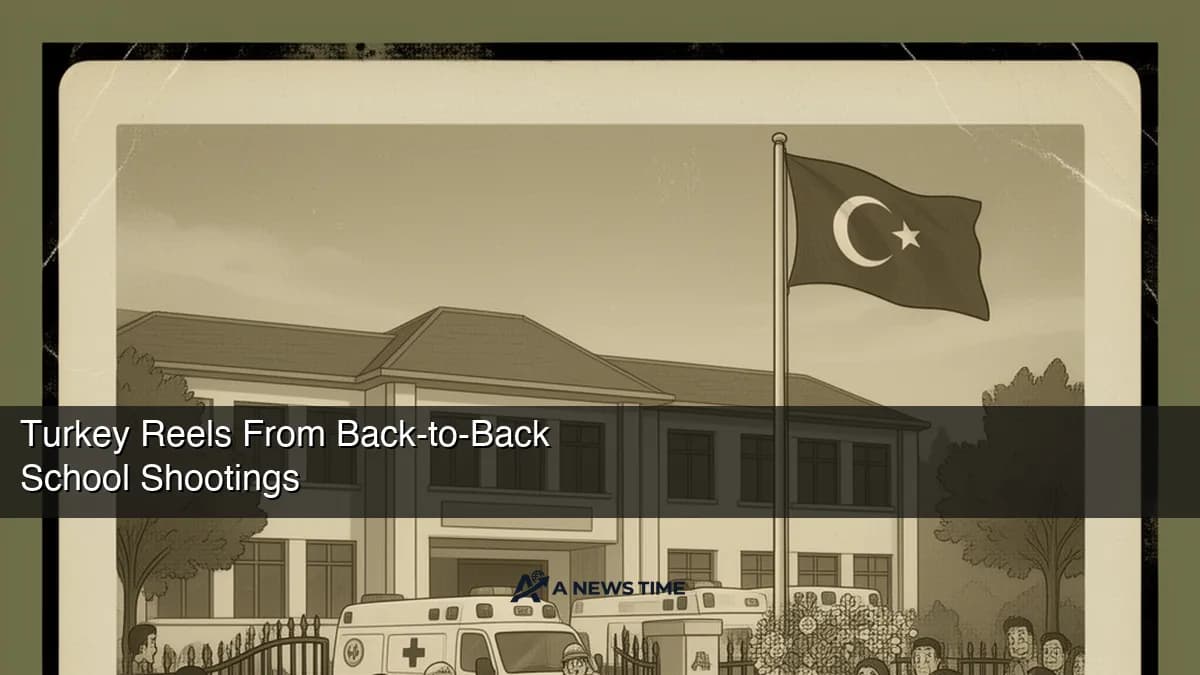
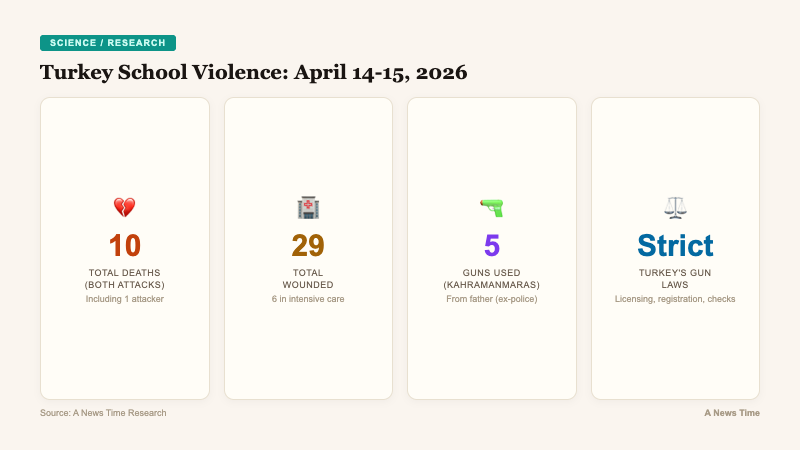
A 14-year-old student shot and killed nine people, including eight fellow pupils and one teacher, at a middle school in the south-central Turkish province of Kahramanmaras on , the country's interior minister confirmed. Thirteen additional people were wounded, six of whom were in intensive care with three in critical condition. The attack came just one day after a separate shooting at a high school in nearby Sanliurfa province wounded 16 people, making this the deadliest week of school violence in modern Turkish history.
Nine Dead in Kahramanmaras Middle School Attack
"We regret to report nine deaths and 13 wounded. Six of them are currently in intensive care, three of whom are in critical condition," Interior Minister Mustafa Ciftci said in a statement. The attacker, an eighth-grade student whose identity has not been publicly released due to his age, was also dead.
Governor Mukerrem Unluer provided additional details at a press conference, stating that the student used guns belonging to his father, a former police officer. The attacker concealed the weapons in a backpack, entered two classrooms, and opened fire "randomly," according to Unluer's account.
Footage released by the IHA private news agency showed a person being evacuated in an ambulance with body and face covered, as well as tearful parents who had rushed to the school. Witnesses quoted by Turkish media described hearing intense gunfire from inside the building. Police increased security around the school, and Justice Minister Akin Gurlek confirmed that prosecutors had launched an investigation.
"How did this young boy access his father's guns? Are authorities going to improve gun control even though it's already strict? Details remain to be assessed."Sinem Koseoglu, Al Jazeera Correspondent, reporting from Istanbul
Second Shooting in Two Days Shocks Turkey
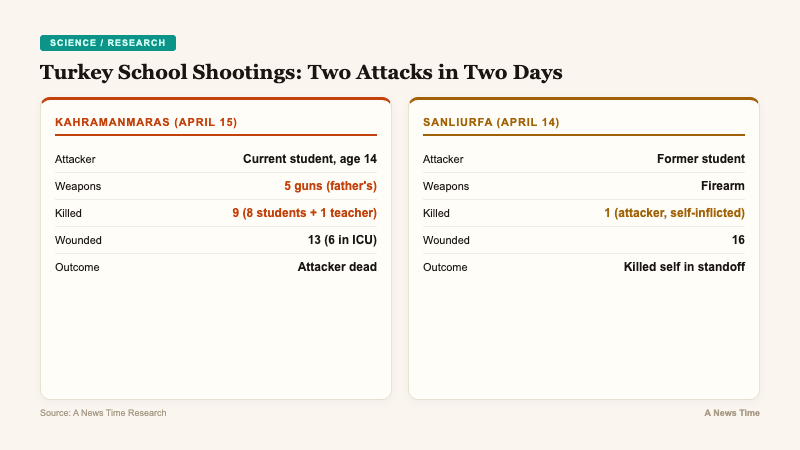
The Kahramanmaras attack followed a shooting on , at a high school in Sanliurfa province in southeastern Turkey. In that incident, a former student opened fire, wounding 16 people before killing himself during a confrontation with police.
The back-to-back attacks are unprecedented in Turkey, where school shootings have historically been extremely rare. The most recent comparable incident occurred in , when a former student killed a private high school principal in Istanbul with a firearm five months after being expelled.
| Detail | Kahramanmaras (April 15) | Sanliurfa (April 14) |
|---|---|---|
| Attacker | Current 8th-grade student, age 14 | Former student |
| Weapons | 5 guns (father's, former police officer) | Firearm (details limited) |
| Killed | 9 (8 students, 1 teacher) | 1 (attacker, self-inflicted) |
| Wounded | 13 (6 in ICU, 3 critical) | 16 |
| School Type | Middle school | High school |
| Outcome | Attacker dead | Attacker killed self during police standoff |
Turkey's Gun Laws Are Strict on Paper
Turkey's gun control framework is among the most stringent in the region. The country's firearms legislation requires licensing, registration, and both mental and criminal background checks for gun ownership. Severe penalties exist for illegal possession, and the regulatory environment is designed to make civilian access to weapons difficult.
The Kahramanmaras attack exposes a critical gap in that framework: the storage and security of weapons in homes of current and former law enforcement personnel. The attacker's father, as a former police officer, was legally permitted to own firearms. The question of how a 14-year-old accessed five weapons from within the household points to enforcement failures around safe storage requirements rather than gaps in the licensing system itself.
This distinction matters for the policy response. Tightening licensing requirements would not have prevented this attack, since the father's ownership was legal. What might have made a difference is stricter enforcement of safe storage laws, mandatory gun safes for households with minors, or periodic compliance inspections for firearm-owning households.
The debate is familiar to countries that have experienced school shootings, particularly the United States, where the question of parental responsibility for weapons that children use in attacks has become a central legal and political issue. Turkey's strict regulatory framework gives it tools that other countries lack, but those tools are only effective if enforcement matches the ambition of the legislation.
A Country Grappling With Unprecedented School Violence
The public reaction in Turkey has been one of shock and grief, compounded by the realization that the country's relative safety from school shootings can no longer be taken for granted. Turkish social media was flooded with expressions of horror and demands for answers in the hours following the Kahramanmaras attack.
The back-to-back nature of the incidents raises particular concern. Research on mass violence events has consistently shown a "contagion effect," where extensive media coverage of one attack can influence vulnerable individuals to carry out similar acts. Whether the Sanliurfa shooting on Tuesday influenced the Kahramanmaras attack on Wednesday is a question investigators will need to examine, though establishing such a connection definitively is methodologically difficult.
Turkish authorities face a communication challenge: informing the public about the attacks and the investigation while avoiding the kind of detailed, perpetrator-focused coverage that research associates with contagion risk. The decision not to publicly name the 14-year-old attacker suggests awareness of this dynamic, though the availability of information through social media and informal channels makes controlled messaging difficult.
Regional Security Context Adds Complexity
The shootings occurred against the backdrop of the ongoing war in Iran, which has heightened security concerns across the broader region. Turkey has been directly affected by the conflict, with NATO air defenses intercepting Iranian missiles that strayed into Turkish airspace in . The country also experienced a gun attack near the Israeli consulate in Istanbul in early , which authorities declared a terrorist incident.
While the school shootings do not appear to have any connection to the regional conflict, the cumulative effect of multiple violent incidents in a short period creates a heightened sense of insecurity that affects public trust in the government's ability to maintain safety. The Kahramanmaras and Sanliurfa attacks are domestic in nature, but they arrive in a security environment already stretched thin by external threats.
The investigation into both shootings is ongoing. Prosecutors in Kahramanmaras are examining the attacker's background, digital communications, and any potential warning signs that were missed. The speed with which a 14-year-old obtained and transported five firearms into a school building suggests failures that extend beyond the individual act, and the institutional response will be judged on whether it addresses the systemic vulnerabilities the attacks exposed.
What Comes Next for Turkey's Gun Safety Debate
The twin attacks will almost certainly trigger a national conversation about gun storage, school security, and the responsibilities of firearm-owning households. The specific policy areas likely to receive attention include:
- Safe storage enforcement: Whether Turkey's existing laws adequately address weapon security in homes with minors, and whether compliance inspections should be expanded
- School security protocols: Whether Turkish schools need enhanced screening measures, security personnel, or architectural changes to limit access
- Mental health systems: Whether schools and communities have adequate mechanisms for identifying and intervening with at-risk youth
- Media guidelines: Whether coverage protocols should be updated to minimize contagion risk while maintaining press freedom
- Law enforcement household audits: Whether current and former law enforcement officers should face additional requirements for securing weapons in homes with children
Turkey's experience over these two days will be studied internationally. The country had the legal framework, the cultural norm against gun violence, and the strict regulatory environment that gun control advocates in other nations point to as models. That framework was not enough to prevent a 14-year-old from walking into a school with five guns in a backpack. Understanding why, and what additional measures might have made a difference, is now the most urgent question facing Turkish policymakers and the communities that will carry the weight of this week's violence for years to come.