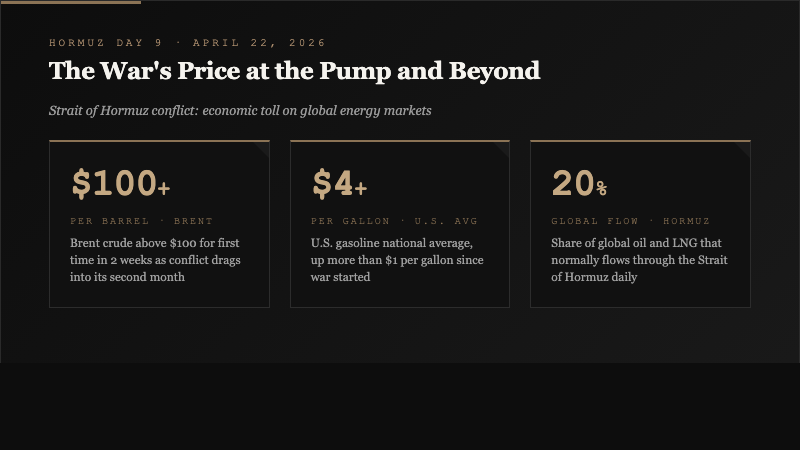
Brent crude futures settled above $100 a barrel on , the first close above that level in more than two weeks, after Iran's Islamic Revolutionary Guard Corps fired on three ships in the Strait of Hormuz and seized two of them. WTI crude jumped in parallel. U.S. gasoline prices are now averaging above $4 a gallon, more than a dollar higher than when the war started in late February. And Treasury Secretary Scott Bessent, Energy Secretary Chris Wright, and Interior Secretary Doug Burgum all softened their previous timelines during Capitol Hill testimony the same day, declining to put a date on when prices will come down.
The three data points braid into a single picture. Nine days into the U.S. sea blockade of Iranian ports and eight weeks into the broader war, the administration's early assurances that the conflict would last "four to five weeks" have given way to a messier reality. Iran still controls transit through a waterway that carried roughly 20 percent of global oil and liquefied natural gas supplies before the war. The White House still has not lifted the blockade. And the cost of that standoff is flowing directly into American household budgets.
What Iran Did on Wednesday
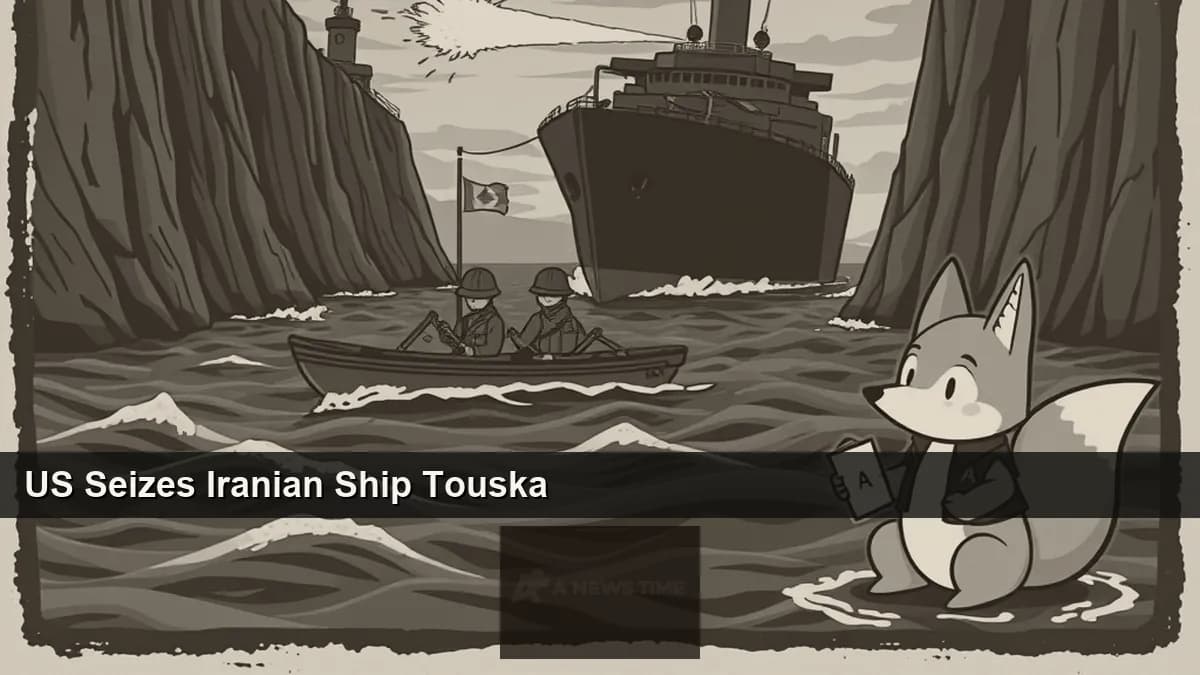
Iran's Revolutionary Guard fired on three international vessels in the Strait of Hormuz on Wednesday and successfully seized two of them, bringing them to Iranian ports according to state media. The strikes were the most aggressive naval action Iran has taken since the U.S. imposed its sea blockade of Iranian shipping roughly a week earlier, and they effectively ended any lingering market expectation that Strait traffic would normalize before a political settlement.
Maritime traffic through the Strait is still largely halted. The likelihood of reopening dimmed after the Revolutionary Guard action. Iranian parliament speaker Mohammad Baqer Qalibaf, Iran's top negotiator in the stalled peace talks, said a full ceasefire only makes sense if the U.S. lifts the blockade on Iranian ports and trade. The U.S. Navy has separately intercepted at least three Iranian-flagged tankers in Asian waters and is redirecting them away from their destinations near India, Malaysia, and Sri Lanka.
"As hopes for a resolution between the U.S. and Iran faded and peace talks stalled, the oil market is having to reprice expectations. As hopes fade, the reality of the supply disruption will set in, leaving further upside for prices."
Warren Patterson and Ewa Manthey, ING Bank strategists, research note
The Treasury and Energy Walk-Back
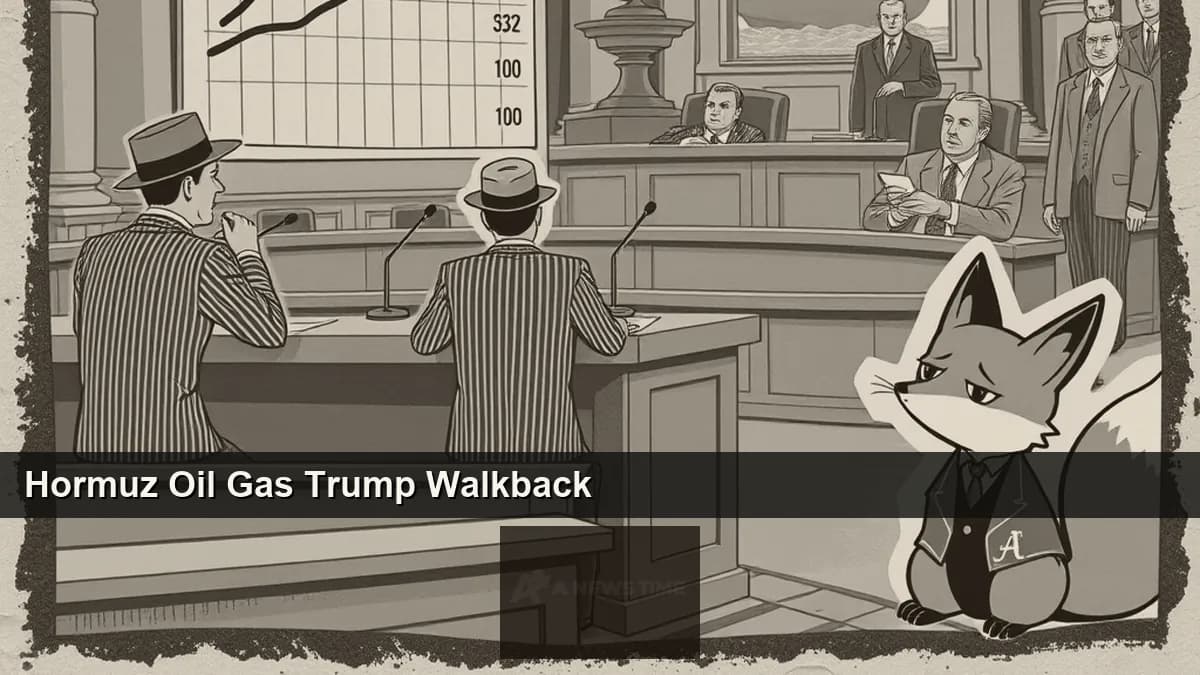
On the same day Iran was seizing ships, three administration officials appeared on Capitol Hill and delivered a different message than the one they had been offering for the past eight weeks.
Bessent declined to put a date on when gasoline prices would come back to pre-war levels. "That is path dependent on when the war and the conflict end," he told Senate appropriators. Energy Secretary Chris Wright walked back a comment he made over the prior weekend suggesting U.S. gasoline prices could stay above $3 per gallon until next year, a comment Trump publicly refuted within hours. "I never said gas prices wouldn't go down until next year," Wright told the hearing. "Never, never said such a thing." He added, more truthfully, that "no one can offer guarantees about the future."
Interior Secretary Doug Burgum barely addressed the war or energy prices at a separate Senate hearing. A month earlier, Burgum had predicted elevated energy prices would be a matter of weeks, not months. On Monday he instead blamed Democratic policies in California for high prices and contrasted current levels with the peaks of the Biden administration.
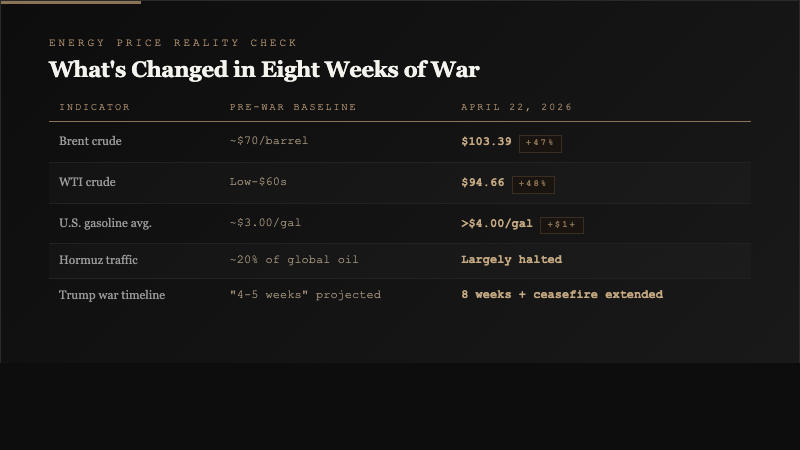
| Indicator | Pre-war baseline (late Feb) | April 22, 2026 |
|---|---|---|
| Brent crude | ~$70/barrel | $103.39 (Thursday AM) |
| WTI crude | Low-to-mid $60s | $94.66 (Thursday AM) |
| U.S. gasoline average | ~$3.00/gallon | >$4/gallon |
| Strait of Hormuz traffic | ~20% of global oil flow | Largely halted |
| War timeline (Trump March estimate) | "Four to five weeks" | Eight weeks in, ceasefire extended indefinitely |
The Sanctions Reversal That Tells the Story
Bessent's testimony included a detail that undercuts the administration's public position on the war's duration. A week earlier, Bessent had pledged that the Treasury Department would not extend a sanctions waiver allowing the sale of Russian crude oil already in transit. Days later, Treasury reversed and extended the waiver. Bessent told senators on Wednesday he had planned to let the waiver expire but was approached by "more than 10 of the most vulnerable and poorest countries in terms of energy" asking for the extension.
The waiver extension unlocked more than 250 million barrels of oil in transit. ClearView Energy Partners, a research firm, called the reversal "a tacit Administration recognition of dire global oil supply conditions that seem likely to persist." The reversal does more policy work than any Wednesday testimony: it tells you the Treasury is acting as though the supply crisis will outlast the optimistic timelines the administration has been offering Congress.
Bessent also disclosed that Gulf and Asian allies have discussed setting up currency swap lines with Treasury, a mechanism typically deployed during periods of acute dollar funding stress. The UAE has reportedly requested one directly. "Swap lines, whether from the Federal Reserve or the Treasury, are to maintain order in the dollar funding market and to prevent the sale of U.S. assets in a disorderly way," Bessent told Sen. Chris Van Hollen.
What Industry Analysts Are Actually Modeling
The oil industry's own pricing analysts have moved past the administration's talking points. Pavel Molchanov, energy industry analyst at Raymond James, told clients that "the best-case scenario for shipping getting back to pre-war levels would be June, and this scenario is predicated on a firm, long-term settlement between the U.S. and Iran being finalized over the next few weeks." He added: "The longer it takes to reach such a settlement, the longer it will take for shipping to normalize."
Even after Strait transit resumes, the underlying supply picture will not snap back to pre-war conditions. Persian Gulf countries will need to repair oil fields and export facilities that Iran has destroyed during the war. Shippers will remain wary of traversing the Strait for weeks or months after any ceasefire. Maritime insurance premiums have risen. Tanker charter rates have climbed. All of those costs flow through to the price at the pump.
"Everyone is facing high prices at the pump. Very few feel it as acutely as an Alaska off-road village that is 100 percent reliant on diesel power generation."
Sen. Lisa Murkowski (R-Alaska), Senate hearing, April 22
Murkowski's testimony at the hearing reframed the political stakes. The senator supports the Trump administration's push to open up more Alaskan lands to oil and gas development, but she was explicit that domestic production expansion would not move pump prices in the short run. The gap between national political rhetoric on energy independence and the immediate economics of fuel for remote communities was, as Murkowski put it, acute.
The Political Math Around the Corner
Republicans on Capitol Hill have begun pushing back on the administration's messaging discipline. Sen. John Kennedy (R-La.), chair of the Senate Appropriations subcommittee that questioned Wright, offered what was effectively an instruction to the energy secretary. "My advice to you is to stay away from this business of how fast the price of gas is going to come down," Kennedy said. "I don't want to get off on that tangent. The safest thing to say is 'soon.'"
Kennedy's comment lands inside a broader political environment. Trump's approval rating fell to 37 percent in an NBC poll reported earlier this month, the lowest of his second term, driven partly by voter frustration with energy prices and the war's duration. Democratic senators have been aggressive in the hearings. "Consumers know from the gasoline pumps they pass every day what the reality is," Sen. Richard Blumenthal (D-Conn.) told reporters after Wright's testimony. "He spoke the truth until his chain was yanked by Donald Trump, who is his audience of one."
What to Watch
The near-term catalyst is whether Iran and the U.S. agree to another round of peace talks, and whether those talks can produce a framework for Strait reopening. Iran has not confirmed it will attend the next round. The White House has not set an end date for the ceasefire. Neither side has publicly outlined a path to lifting the naval blockade. Until those pieces move, the supply-side math for oil is unchanged and the price trajectory follows.
The medium-term catalyst is summer driving season. Americans will hit the road in meaningful volumes beginning Memorial Day weekend. If gasoline is still averaging above $4 a gallon at that point, the political pressure on the White House will intensify further. The administration's walk-back from its earlier promises this week is, in part, a preparation for that pressure.
For related coverage, see our reporting on how the Nikkei 225 crossed 60,000 for the first time on AI flows and a ceasefire extension, on the economic risks of the Hormuz blockade, and on the Q1 earnings season backdrop against which this oil shock is unfolding.
Sources
- Trump team backs away from gasoline price promises - Politico
- Oil prices edge lower with no progress on US-Iran talks - Reuters
- Iran fires on 3 ships in the Strait of Hormuz as US maintains blockade - Associated Press
- Oil Prices Jump Above $100 a Barrel as Iran Seizes 2 Ships in Strait of Hormuz - Barron's