
Columbus, Ohio restaurants treated as a legitimate marketing day rather than a checkbox. Earth Day food deals from chains and independent kitchens overlapped with Vegan Dining Week across the city, producing the sort of coordinated promotional pressure that, a decade ago, would have been limited to coastal cities with established plant-based dining ecosystems. The moment says something about where the broader American restaurant industry is on sustainability-forward menus in 2026: further along than the culture-war framing of the last few years suggested, and pointed in directions that go beyond the meat-alternatives debate.
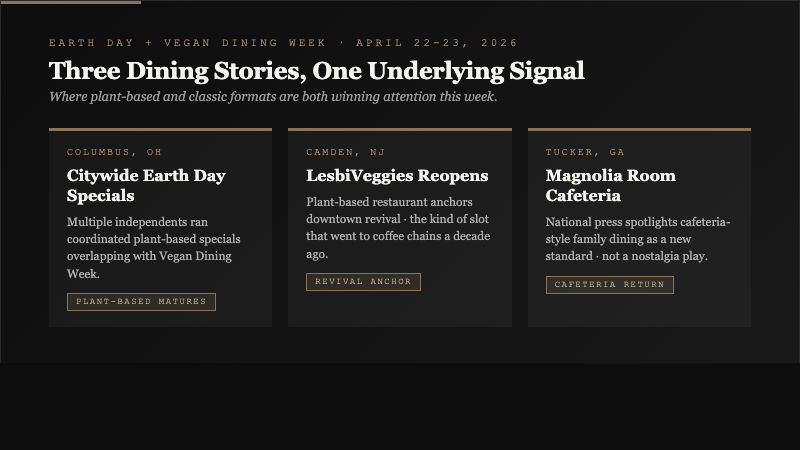
The same 48-hour window delivered two other dining-industry stories worth holding next to the Columbus coverage. LesbiVeggies, a plant-based restaurant known for its gluten-free menu and devoted following, reopened in Camden, New Jersey as part of the city's downtown revival. And Magnolia Room Cafeteria in Tucker, Georgia drew national attention for what business reporters described as a cafeteria-style family dining model gaining new life in the Atlanta suburbs. Three different stories, one underlying theme: the definition of where Americans go for food is continuing to fracture in ways that reward specific ideas well executed.
What Columbus Actually Did
The Columbus Dispatch rundown of Earth Day restaurant participation leaned practical rather than ideological. Restaurants offered free meals, promotional specials, and one-day vegan menu expansions that gave customers reasons to try plant-based options without committing to them long-term. The Earth Day timing overlapped with Vegan Dining Week, a broader national promotion that has grown from a handful of participating cities into a meaningful marketing event for plant-based restaurant groups.
"Columbus restaurants are offering free food and vegan specials for Earth Day, overlapping with Vegan Dining Week."
The Columbus Dispatch, April 22, 2026
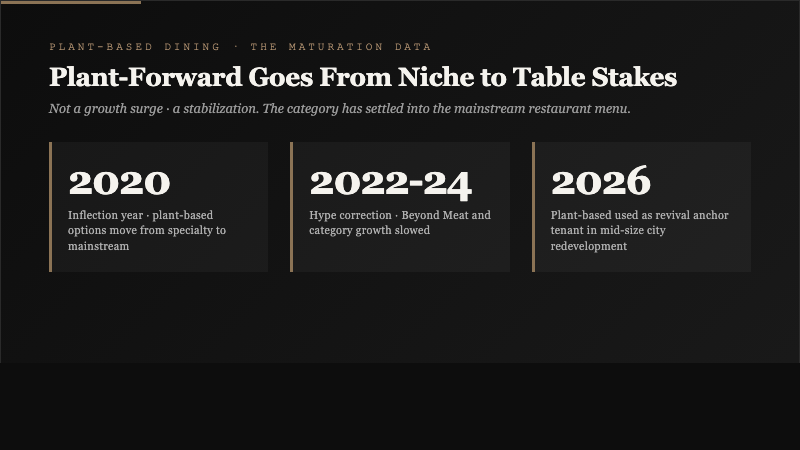
The marketing math has shifted in ways restaurant operators have noticed. Plant-based menus were, in the 2015 through 2020 window, a specialty niche that required either a dedicated vegan restaurant or a carefully labeled section on an omnivore menu. By 2026, the category has matured into something closer to table stakes for urban full-service restaurants, which are expected to offer at least one or two plant-forward options alongside their conventional menu rather than relegating vegan guests to side dishes.
| Market | Activity | Scale |
|---|---|---|
| Columbus, OH | Earth Day deals and vegan specials across multiple independent restaurants | Citywide coordinated promotion |
| Camden, NJ | LesbiVeggies plant-based restaurant reopens as part of downtown revival | Single location, revival anchor |
| Tucker, GA | Magnolia Room Cafeteria gaining national press for family-friendly dining model | Single location, category signal |
| National (chains) | Various Earth Day promotions across QSR and fast-casual | Corporate-driven, limited time |
Camden and the LesbiVeggies Story
LesbiVeggies opening a new Camden location as part of the city's downtown revival is a specific story that reflects a broader pattern in how plant-based restaurants are being used in mid-size city redevelopment plans. The restaurant, known for its gluten-free menu and a devoted customer base built up at its prior location, reopened Thursday as an anchor for the Camden downtown revival effort.
Camden is not a market that would have supported a plant-based restaurant a decade ago. The city's population and income profile would have made the operator math difficult, and the broader New Jersey plant-based dining scene was concentrated in Jersey City and the Hoboken-to-Montclair corridor. The fact that a plant-based restaurant is now an anchor tenant in Camden's downtown revival signals the category's maturation into something mid-size American cities actively compete for, not unlike how coffee shop chains were used as anchors for urban redevelopment in the late 2000s.
The pattern matters because it affects how restaurant real estate gets allocated in the coming five years. Developers and municipal planners evaluating downtown revitalization projects increasingly include plant-based restaurants in their target tenant mix alongside the traditional anchors. That pressure, in turn, creates more locations where operators can open plant-based concepts with favorable lease terms and municipal support, which then enables more operators to enter the category.
Tucker, Georgia, and the Cafeteria Comeback
The Magnolia Room Cafeteria story is the sleeper pick of the 48-hour window. Business Insider's markets desk highlighted the Tucker, Georgia cafeteria for establishing "new standards for family-friendly dining" in a market where casual table-service chains have dominated family dining for decades. The framing is correct, and the underlying trend is worth surfacing.
Cafeteria-style dining, in the American sense, means food displayed behind a glass counter, served by staff onto plates chosen by the customer, and eaten at communal or family-style seating. The format peaked in mid-20th-century America, lost ground to fast food and family restaurants in the 1970s and 1980s, and survived into the 2000s mostly in institutional settings, Southern chains like Piccadilly, and a handful of Midwestern holdouts. The revival of the format as a destination dining option in 2026, particularly in suburban markets like Tucker, reflects the same underlying preference shift that has driven the growth of fast-casual over fast food: customers want visible food preparation, perceived quality, and control over what ends up on their plate.
"Traditional cafeterias are becoming more popular as people seek authentic meals made from scratch. Magnolia Room Cafeteria is leading the change."
Markets Insider coverage of Tucker, Georgia dining scene, April 2026
For Tucker specifically, the Magnolia Room coverage positions the restaurant as a signature feature of the local dining scene rather than a nostalgic throwback. The distinction matters. A nostalgic restaurant competes on memory. A restaurant defining new standards competes on execution. The latter has a longer commercial runway.
Why Earth Day Works for Restaurants Now
A decade ago, Earth Day as a restaurant marketing moment ranged from ignored to lightly observed. Independent restaurants with a sustainability-focused brand identity did something. Most others did not. The 2026 calendar tells a different story. Corporate chains have built Earth Day into their promotional calendars, independent restaurants have coalesced around coordinated city-level promotions in markets like Columbus, and the broader customer base has come to expect at least a token acknowledgment from restaurants that claim any environmental or sustainability posture.
The reason is partly generational. Millennial and Gen Z diners, who now make up a majority of the restaurant industry's core customer base, index more strongly on sustainability signaling than older cohorts did at the same stage of their lives. The reason is partly structural. Restaurant operators have found that Earth Day promotions are relatively cheap to execute, generate disproportionate social media reach, and align with broader menu shifts toward lower-carbon ingredients that the operators are making for operational reasons anyway.
The plant-based overlap is not coincidental. Vegan Dining Week organizers have deliberately calendared the promotion to overlap with Earth Day, and the dual branding gives participating restaurants a stronger pitch than either framing on its own. A restaurant running a special is not just offering a discount. It is participating in an ecosystem of aligned promotions that customers are already tracking.
What This Does Not Mean
The Columbus and Camden stories describe a genuine shift, but it is a shift at the margins rather than a transformation of what Americans eat. USDA data on animal protein consumption has shown remarkable stability across the past decade, with per-capita meat consumption edging slightly higher on most measures. The plant-based food category, after an aggressive growth phase in 2018 through 2021, went through a correction in 2022 through 2024 as growth rates slowed and several high-profile companies including Beyond Meat struggled to maintain their valuations.
The 2026 picture is one of a plant-based category that has stabilized at a meaningful but non-dominant share of the overall food market. Restaurants have absorbed plant-based options as a standard offering rather than a specialty, which is a more durable outcome than the earlier hype cycle suggested. The Earth Day promotions in Columbus and the LesbiVeggies reopening in Camden are consistent with that stabilized picture rather than evidence of a renewed growth surge.
What to Watch
Two specific trends are worth tracking through the remainder of 2026. The first is how restaurant operators handle the transition from plant-based as a specialty offering to plant-based as standard menu content. The best-performing restaurants will likely be the ones that integrate plant-forward dishes into the main menu rather than segregating them, and the marketing will shift away from "vegan option" language toward flavor-and-ingredient-focused framing that does not require the customer to self-identify with a dietary category.
The second is the cafeteria-style revival that Tucker's Magnolia Room is part of. If the format continues to gain traction in suburban markets, the category could become a meaningful competitor to fast-casual chains in the family-dining space. The economics of cafeteria-style service, with higher throughput per square foot and lower labor costs per dollar of revenue than full-service table dining, make the format viable in markets that would not support a traditional family restaurant.
For related coverage, see our reporting on chefs featuring sustainable spring menus for Earth Day, on the expanding Michelin Great Lakes guide, and on summer travel trends that are shaping where Americans eat in 2026.