QuantumScape Corporation reported first-quarter 2026 business and financial results on , hosting a live webcast at 2 p.m. Pacific Time with CEO Siva Sivaram and CFO Kevin Hettrich. The San Jose-based company remains the most watched pure-play name in solid-state lithium-metal battery development, a category that has been perennially one generation away from commercial deployment for roughly a decade.
The Q1 release and webcast deliver, in broad strokes, the quarterly update that investors have been tracking since the company's 2020 SPAC merger: process improvements, pilot-line progress, customer engagement updates, and a cash-runway assessment. The specific commercial questions the market has been asking, particularly around when the QSE-5 cell reaches a volume production agreement and which automotive customer takes first commercial delivery, continue to drive the share reaction on release days.
Why Solid-State Batteries Matter
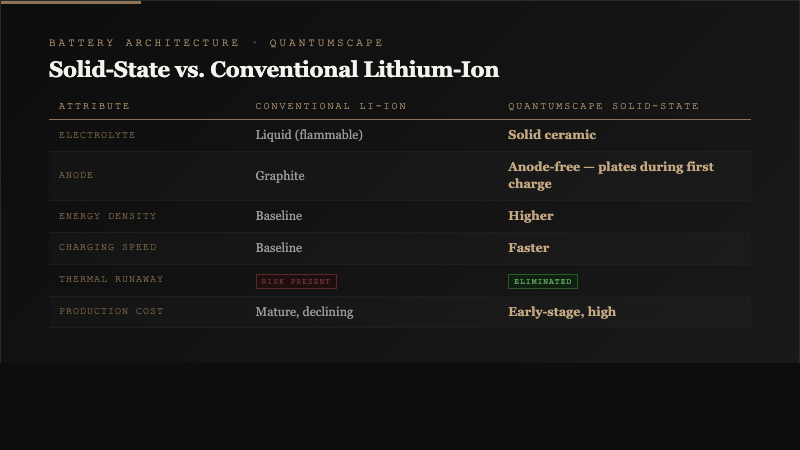
Solid-state lithium-metal batteries replace the flammable liquid electrolyte inside a conventional lithium-ion cell with a solid ceramic or polymer separator. The architecture promises higher energy density at the cell level, substantially faster charging, better cycle life, and fundamentally safer operation because the cell cannot experience the kind of thermal runaway that makes conventional lithium-ion fires difficult to extinguish.
None of those benefits are commercially meaningful unless the technology can be manufactured at automotive scale. That is the problem QuantumScape has been working on since its founding. The company's approach uses a proprietary ceramic separator and an anode-free architecture in which the lithium metal plates directly from the cathode during the first charge, eliminating the graphite anode entirely. At laboratory scale the approach has produced cells that meet or exceed the company's technical targets on energy density and cycle life. At commercial production scale the approach has been substantially slower to mature.
"QuantumScape is on a mission to revolutionize energy storage to enable a sustainable future. The company's next-generation batteries are designed to enable greater energy density, faster charging and enhanced safety to support the transition away from legacy energy sources toward a lower carbon future."
QuantumScape corporate statement, April 22, 2026 release
The State of the Commercialization Path
QuantumScape's commercial partnership with Volkswagen's PowerCo unit has been the company's flagship customer relationship since 2018. The relationship was restructured in 2024 to license QuantumScape's technology rather than producing cells directly in a joint venture, a structural shift that reduced QuantumScape's capital requirements but also delayed the timeline for revenue from automotive applications.
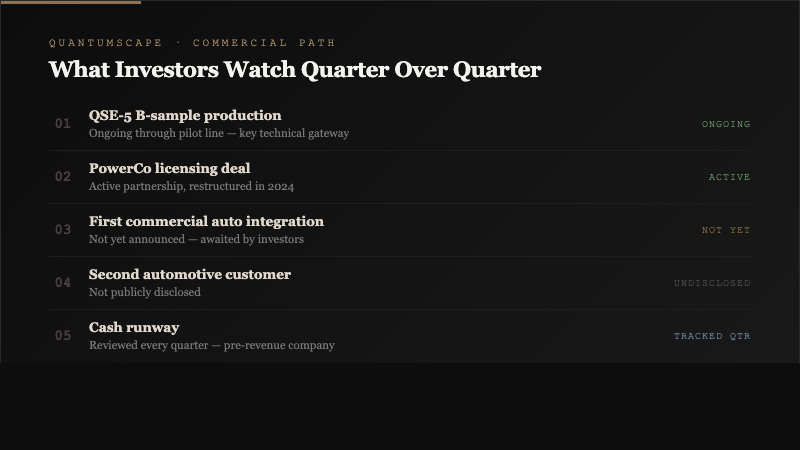
| Milestone | Status |
|---|---|
| QSE-5 B-sample cell production | Ongoing through pilot line |
| PowerCo licensing agreement | Active, restructured in 2024 |
| First commercial automotive integration | Not yet announced for a production vehicle |
| Second automotive customer | Not publicly disclosed |
| Cash runway | Tracked quarterly; critical to valuation |
The QSE-5 is the cell format QuantumScape has been scaling through its pilot manufacturing line. It is a 5-amp-hour cell designed for automotive applications, and the primary engineering challenge has been consistent production of the ceramic separator at the dimensional tolerances required for high-volume automotive integration. Investors watch each quarterly update for progress on separator yield, cell uniformity, and the cycle life the cells demonstrate under automotive drive cycles.
The Broader Solid-State Landscape
QuantumScape is not alone in the category. Toyota has been signaling imminent solid-state deployment in its own vehicles for multiple years with timelines that have repeatedly shifted. Samsung SDI has publicly disclosed solid-state cell development on an independent timeline. Solid Power, another U.S.-listed pure play, pursues a different chemistry path. Chinese manufacturers including CATL and BYD have announced semi-solid-state cells in production, though the industry distinction between semi-solid-state and true solid-state is technically meaningful.
The category-level question is whether solid-state batteries reach commercial automotive production volumes in the late 2020s or whether the timeline keeps slipping into the 2030s. The cost curve for conventional lithium-ion batteries has continued to decline in parallel, which raises the bar for solid-state economics at launch. A solid-state cell that is 30 percent more energy dense than a conventional cell does not capture market share if it costs two or three times more on a per-kilowatt-hour basis.
The Investor Psychology
QuantumScape shares have traded at a meaningful discount to the valuation the company carried during the 2020-2021 SPAC boom, when every battery technology company was capturing a narrative premium based on the EV transition timeline. As EV adoption has stalled in 2025 and 2026, and as solid-state timelines have repeatedly slipped, the narrative premium has compressed.
The shift has been disciplined in a useful way. Investors are now asking concrete commercialization questions rather than treating every process improvement as a revolutionary breakthrough. QuantumScape management has adjusted its public communications in response, emphasizing milestones that can be independently verified and avoiding the aspirational language that characterized earlier years. The Q1 webcast, consistent with recent quarters, is structured around specific technical and commercial disclosures rather than vision.
"For investors, the solid-state battery category has moved from hype cycle to execution check. Every quarter is now a deliverable review."
Battery industry analyst commentary, April 2026
The Cash Runway Question
Cash runway has been the single most important non-technical metric for QuantumScape investors since the PowerCo restructuring shifted the company away from direct manufacturing capital requirements. The restructuring extended the runway substantially but did not eliminate the question of whether the company can bridge to commercial revenue without additional dilutive equity issuance.
The Q1 release and the live webcast will typically address the cash position and the company's updated burn rate. Investors read those details to model the distance between current quarter and the first commercial milestone that generates revenue. The closer that milestone appears, the more forgiving investors become about burn. The further away it appears, the more pressure builds on management to either accelerate commercialization timelines or issue additional equity.
What to Watch
Three specific signals will shape the QuantumScape story across the rest of 2026. The first is whether any new automotive customer beyond PowerCo is publicly disclosed. A second major OEM relationship would materially change the commercialization path. The second is whether the QSE-5 cell's production yield reaches levels that can credibly support a volume integration decision by a customer. The third is the broader EV market recovery, because solid-state economics depend on automakers continuing to invest in next-generation battery chemistry rather than standardizing on lithium iron phosphate for cost.
For related coverage, see our reporting on Rivian's R2 launch into a softening EV market, on Tesla's Q1 2026 earnings and the broader EV demand picture, and on the broader advanced materials and computing investment environment.