

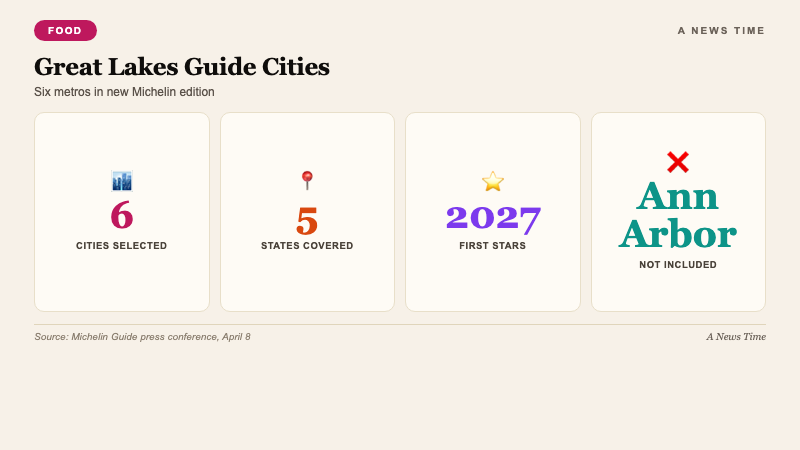
Michelin's announcement of an American Great Lakes edition is the kind of industry news that divides regional food communities into those celebrating and those left out. At a press conference in Milwaukee on , the Michelin Guide named six cities eligible for star ratings in the new regional edition: Cleveland, Detroit, Indianapolis, Minneapolis, Milwaukee, and Pittsburgh. Ann Arbor, Michigan was not on the list. The Detroit Free Press's Lyndsay C. Green reported on , that Ann Arbor chefs were "bummed" by the omission, a characterization that represents both the honest disappointment of a regional restaurant community and a broader question about how Michelin's geographic selection process actually works.
For American food culture, the Great Lakes edition is a meaningful expansion of Michelin's US footprint, which previously focused on New York, California, Washington DC, Miami, Chicago, and a handful of state-level guides. Adding six mid-market metros, five of them new to the guide, recognizes a decade of food-culture investment in cities that have rebuilt their restaurant economies around independent chefs and regional sourcing. The omissions, however, point to the discretionary nature of Michelin's selection process and the way regional food communities compete for a finite pool of international recognition.
Which Six Cities Made the List
The Great Lakes Guide covers a specific geographic arc anchored by the Great Lakes themselves. The six selected cities sit across five states: Ohio (Cleveland), Michigan (Detroit), Indiana (Indianapolis), Minnesota (Minneapolis), Wisconsin (Milwaukee), and Pennsylvania (Pittsburgh). Each of the six is the largest or second-largest metro in its state. Each has a documented restaurant-scene growth story over the past decade, with independent chef-driven establishments as the defining characteristic.
| City | State | Restaurant-scene profile |
|---|---|---|
| Cleveland | Ohio | Steel-city renaissance chef culture |
| Detroit | Michigan | Post-recession independent food boom |
| Indianapolis | Indiana | Growing Midwest independent scene |
| Minneapolis | Minnesota | Twin Cities culinary hub, James Beard density |
| Milwaukee | Wisconsin | Lakefront dining, regional sourcing |
| Pittsburgh | Pennsylvania | Post-industrial food culture rebuild |
The selection criteria Michelin uses for regional guide expansion are not fully public. Broadly, the company considers restaurant density and quality, the presence of a sustainable hospitality infrastructure (hotels, tourism, transit), local tourism-board investment, and the strategic fit with Michelin's broader brand positioning. The six selected cities all have active tourism and convention industries and substantial James Beard Foundation nominations or awards from the past five years, which indicates an independent validation of the local food-culture quality.
Why Ann Arbor Chefs Are Disappointed
Ann Arbor's food community has spent the past decade building a restaurant scene that punches above its population weight. The city is home to the University of Michigan, which brings international faculty and student populations plus significant visitor traffic. Local chefs have been included in recent James Beard Award semifinalist and finalist lists. Zingerman's, the locally founded deli and food-service group, has shaped American artisan-food culture beyond just Ann Arbor. The exclusion from the Michelin Great Lakes Guide puts Ann Arbor in the uncomfortable position of having made the cultural investments but not received the recognition.
"What exactly constitutes Detroit? It had been a mere hour since the Milwaukee press conference where it was announced that the Michelin Guide would launch an American Great Lakes edition next year, and I was asking chefs across the region for reactions."
Lyndsay C. Green, Detroit Free Press, April 19, 2026
Green's piece documented the immediate reaction from Ann Arbor's chef community in the hours after the announcement. The pattern of "bummed to miss out" comments reflects a specific form of industry hurt that goes beyond individual restaurant disappointment. It is the recognition that an entire city's culinary investment, cumulatively worth tens of millions of dollars across a decade of chef-led openings, was not weighted heavily enough to make the guide. For chefs who have been building careers on the expectation that regional recognition would eventually reach them, the omission is a public signal that their city's food culture is not yet visible to the international gatekeepers.
How Michelin Actually Changes a City's Restaurant Economy
The economics of Michelin recognition are well-documented in cities that have received new guides over the past two decades. A Michelin star produces measurable increases in restaurant revenue, tourism booking traffic, and the ability of chefs and hospitality workers to command higher wages. Cities that gain Michelin coverage tend to see a flywheel effect where the guide's presence attracts more investment in restaurant development, which in turn expands the candidate pool for future stars.
The six selected cities will begin seeing the downstream effects before the first stars are actually awarded. Hotel partnerships, restaurant investor interest, and media coverage all start flowing based on the announcement alone. The specific restaurant awards, when they come out in the guide's first edition, will consolidate those gains. Cities not on the list see none of the upside. Ann Arbor's hospitality economy will continue to grow independently, but without the Michelin tailwind.
The Geographic Politics of "Great Lakes"
The Great Lakes geographic label covers a large area that includes substantially more than the six selected cities. The lakes touch eight US states (Minnesota, Wisconsin, Illinois, Indiana, Michigan, Ohio, Pennsylvania, New York) and the Canadian province of Ontario. Toronto, Buffalo, and Chicago have existing Michelin coverage or independent guide status. Within the six-state US footprint, the selected six cities represent the largest and most hospitality-focused metros.
Mid-sized cities within that footprint, including Ann Arbor, Columbus, Grand Rapids, Madison, and Rochester, will likely continue making the case for inclusion in future guide expansions. Michelin has a history of adding cities to existing regional guides once the surrounding infrastructure and restaurant quality reach the internal threshold. Ann Arbor's chef community will now spend the next several years lobbying, improving, and hoping for expansion. That dynamic is exactly the kind of industry-behavior shift the Michelin brand is designed to produce.
What Comes Next for the Six Selected Cities
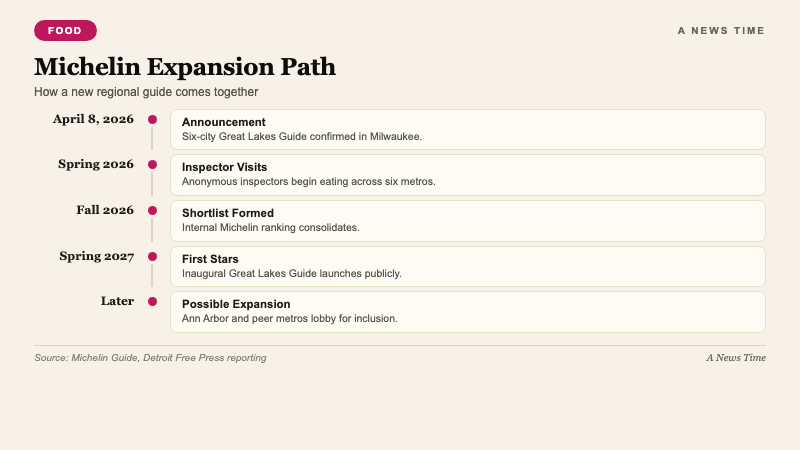
Michelin's typical cadence is to announce a new guide one year before publication, conduct its anonymous inspection process during that year, and release the first edition of stars in a launch event the following spring. On that schedule, the first Great Lakes Guide stars should appear in April or May 2027. Anonymous inspectors have likely already begun visiting the six cities, though the identity of those inspectors and the specific timing of visits is not public.
For chefs in the six selected cities, the next twelve months are the most consequential of their restaurants' histories. Every service could be an inspected service. Every consistent delivery of quality builds the case for recognition. Every operational stumble could count against the restaurant. That pressure, applied to six restaurant scenes simultaneously, produces both stress and visible upgrades in quality as establishments polish their operations in anticipation of scrutiny.
Frequently Asked Questions
What is the Michelin Great Lakes Guide?
An American regional edition of the Michelin Guide announced April 8, 2026, covering restaurants in six cities: Cleveland, Detroit, Indianapolis, Minneapolis, Milwaukee, and Pittsburgh. The first edition of awarded stars is expected in spring 2027.
Why isn't Ann Arbor included?
Michelin's selection criteria are not fully public. Industry observers attribute the Ann Arbor exclusion to metro size, hospitality-infrastructure scale, and strategic fit with the broader Michelin brand rather than any specific judgment about individual Ann Arbor restaurants' quality.
When will the first stars be awarded?
Based on Michelin's typical schedule, the first Great Lakes Guide stars will be announced in spring 2027, roughly one year after the April 2026 guide announcement. Anonymous inspectors conduct visits throughout the year preceding the launch.
How does Michelin recognition affect a city's restaurants?
Studies of previous Michelin expansions document measurable increases in restaurant revenue, tourism bookings, hospitality-sector employment, and investor interest. The downstream economic effects can exceed $100 million for a mid-sized metro over the five years following a new guide's launch.
What is the US Michelin Guide's footprint now?
The Great Lakes Guide brings Michelin's US coverage to New York City, California, Washington DC, Miami, Chicago, and six new Great Lakes metros. Several other states have state-level guides in limited form.
What to Watch
The specific restaurants that win stars in the first Great Lakes Guide will reshape the dining map of the American Midwest. Watch particularly for the distribution across the six cities; an uneven allocation (multiple stars concentrated in one or two metros) would signal Michelin's view of which cities have the deepest quality rosters. Watch also for which Ann Arbor chefs, if any, open satellite locations in Detroit or relocate operations entirely to gain eligibility. The guide's geographic boundaries create incentives that will reshape both individual careers and regional food-culture investment patterns over the next several years.