
The IT certification market as of mid-April 2026 has settled into a shape that is easier to navigate than it was a year ago, and the coordinates for anyone planning the next six months of study time are reasonably clear. AWS expanded its AI certification portfolio and refreshed its Security Specialty in late 2025 and early 2026. Google Cloud rolled out a new Generative AI Leader credential. Microsoft pushed updates to AI-102 and AI-Engineer-Associate. In parallel, a long list of free DevOps certifications has quietly become competitive with paid alternatives for hiring managers. The combined effect is that cloud-AI credentials now sit at the top of the salary tables, DevOps and security remain the strongest mid-career investments, and the days of generic certifications producing reliable salary bumps are largely finished.
For individual practitioners, the planning question is not whether to certify but which stack to commit to. This is a similar dynamic to what online-learning platforms are facing on the course side. Pick a cloud, go deep, then layer AI or security on top. The certifications that pay the most in 2026 are not the ones testing generic knowledge but the ones testing narrow competence in a specific commercial ecosystem.
What Changed on the AWS Roadmap
Amazon Web Services expanded its AI certification portfolio in October 2025 with the launch of the AWS Certified AI Practitioner and the AWS Certified Machine Learning Engineer - Associate. Both credentials have been available at full scale since November 2025 and are now the fastest-growing certifications in the AWS ecosystem. The Practitioner credential is foundational and comparable to AZ-900 in its breadth; the Machine Learning Engineer - Associate sits at the Associate level and assumes working familiarity with SageMaker, Bedrock, and core ML workflows.
The refreshed AWS Certified Security - Specialty, released in February 2026, incorporates AI-security topics for the first time, including responsible AI, prompt injection mitigation, and model-artifact supply-chain integrity. The revision matters because it signals that AWS is treating AI security as part of the broader security curriculum rather than a separate specialty. Hiring managers in regulated industries have begun requesting this specific certification as a proxy for AI-aware security practice.
"The refreshed Security Specialty is the first AWS certification that treats AI security as core infrastructure security. That is the right call. An enterprise deploying Claude through Bedrock is deploying infrastructure, not an app, and the security posture has to reflect that."
Jenny Brinkley, Director of Security Services, AWS
The April 21 Amazon-Anthropic deal, which committed $25 billion more from Amazon into Anthropic and $100 billion from Anthropic into AWS compute, reinforces the case for AWS-specific AI certification. Enterprise Claude deployment runs through Bedrock, which is an AWS native service, and the certifications that validate Bedrock competence now have direct commercial value in a way that was not true twelve months ago.
Free DevOps Certifications That Actually Count
The DevOps certification market has quietly moved in the opposite direction from the cloud-AI market: toward free, vendor-neutral credentials that hiring managers increasingly treat as credible. TechTarget's April 2026 DevOps certification roundup identified ten free credentials with meaningful hiring-manager recognition, led by the Linux Foundation's free intro courses, Docker's free certification path, and Microsoft's DevOps Fundamentals offerings.
| Certification | Vendor | Median US Salary | Difficulty | Current Trend |
|---|---|---|---|---|
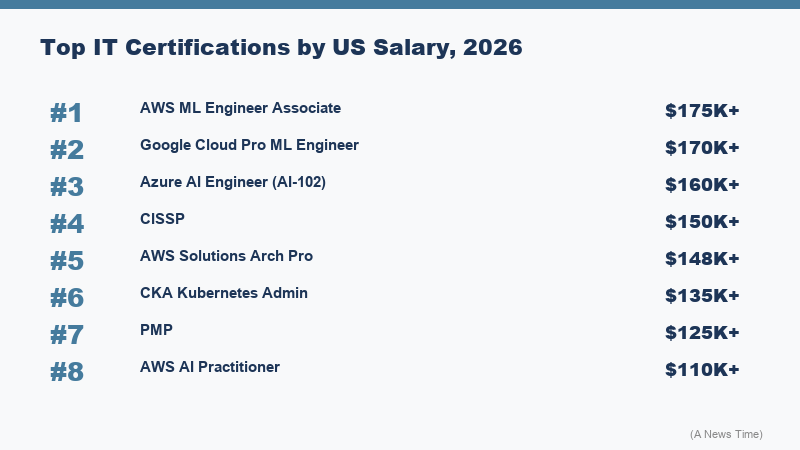
| AWS Certified Machine Learning Engineer - Associate | AWS | $175,000+ | Associate | Fastest-growing |
| Google Cloud Professional ML Engineer | $170,000+ | Professional | Strong growth | |
| Azure AI Engineer Associate (AI-102) | Microsoft | $160,000+ | Associate | Strong growth |
| CISSP | (ISC)² | $150,000+ | Senior | Durable |
| AWS Certified Solutions Architect - Professional | AWS | $148,000+ | Professional | Stable |
| PMP | PMI | $125,000+ | Mid-Senior | Durable |
| AWS Certified AI Practitioner | AWS | $110,000+ | Foundational | Growing |
| CKA (Certified Kubernetes Administrator) | CNCF | $135,000+ | Associate | Stable |
The practical significance for career planners is that the cost-of-entry for a credible DevOps resume has dropped to roughly zero in 2026, as long as the learner is willing to pair free certifications with genuine hands-on project work. A portfolio of free Linux Foundation, Docker, and Kubernetes credentials alongside a GitHub project demonstrating working CI/CD pipelines now out-competes a single paid certification without project work, in most hiring manager responses to Stack Overflow's 2026 developer survey.
The AI-Image-Extender Distraction and Why Certifications Matter More
Part of the reason certifications have become more valuable in 2026 is that AI tooling has flooded the entry-level market with noise. Tools like Airbrush, PhotoCat, Canva, Fotor, and Pixelcut have made specific tasks, from image extension to design automation, accessible to anyone with a subscription. For hiring managers, the signal from a completed certification has grown stronger in that environment, because it establishes that the candidate has structured knowledge that cannot be outsourced to a single consumer AI tool.
That is not a judgment on the tools themselves; it is a market-clearing observation. Paid software and free certifications are moving in opposite directions, and candidates who lean into structured credentials are the ones capturing the premium. For additional reading, see our prior coverage of the three major cloud certifications compared, the most valuable IT certifications by salary, and how certification changes careers in 2026.
A Realistic Twelve-Month Plan
For a mid-career professional with cloud fundamentals, a realistic twelve-month plan looks something like this. Start with AWS AI Practitioner (or the Azure AI-900 equivalent) in month one to establish vocabulary. Use months two through four to work through either the AWS Machine Learning Engineer - Associate or the Google Professional ML Engineer, supplemented with a hands-on portfolio project that deploys a model end-to-end. Spend months five through seven on the refreshed AWS Security Specialty or the Microsoft SC-100 equivalent, if the role involves anything regulated. Use months eight through twelve to build out DevOps credentials, probably starting with the Certified Kubernetes Administrator and layering on free Linux Foundation credentials.
The plan is intentionally conservative in number of certifications and aggressive in project work. The 2026 market rewards depth over breadth in credentials, and hiring managers reliably report that a working GitHub portfolio that demonstrates the skills behind the certification is a stronger signal than three unused certifications stacked on a resume.
What to Watch Through Summer
Three calendar events are worth watching. Google Cloud Next on April 29 is expected to announce new Gemini-linked certifications. Microsoft Build on May 20 will likely publish updates to AI-102 and AI-Engineer-Associate. AWS re:Inforce in June is where AWS typically publishes security-certification updates, and the refreshed Security Specialty is likely to get a further revision that folds in Bedrock-specific responsible-AI content. Any career planner trying to time a certification investment should plan around those three dates.
Frequently Asked Questions
What is the highest-paying IT certification in 2026?
The AWS Certified Machine Learning Engineer - Associate and the Google Cloud Professional Machine Learning Engineer are currently the two highest-paying certifications, with median US salaries above $170,000. The Microsoft Azure AI Engineer Associate (AI-102) follows closely. All three sit above traditional senior security and architect certifications for the first time.
Are free DevOps certifications worth pursuing?
Yes, particularly from the Linux Foundation, Docker, and the Cloud Native Computing Foundation. In 2026 hiring survey data, free credentials from recognized foundations combined with a GitHub project portfolio outperform single paid certifications without project work.
How long does the AWS Certified AI Practitioner take?
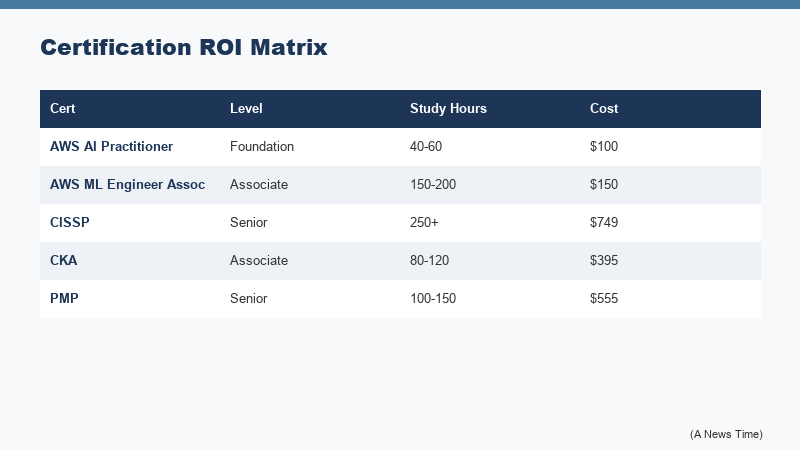
Most learners with basic cloud familiarity complete the Practitioner credential in 40 to 60 study hours. The exam is 90 minutes long and costs $100. The Machine Learning Engineer - Associate requires 150 to 200 study hours for most learners and costs $150.
Is CISSP still worth pursuing in 2026?
Yes. CISSP remains the single most durable security certification, with median salary above $150,000 and consistent recognition across regulated industries. The (ISC)² credential has not been disrupted by the cloud-specific security specialties; the two categories complement rather than substitute for each other.
Should I pursue PMP if I am technical?
For technical professionals moving into management, yes. PMP remains the strongest general-purpose project management credential, and holders consistently earn 20 to 25 percent more than non-PMP peers in equivalent roles. Technical PMs with PMP plus a cloud associate-level certification are among the best-compensated profiles in the 2026 market.