
Fresh leaks from industry sources have pegged Microsoft's Xbox Project Helix, the company's next-generation console and PC hybrid, as performance-equivalent to a $2,000 to $3,000 custom-built gaming PC. The leaked details surfaced on , alongside reporting that Microsoft has moved away from the custom APU architecture it has used for every Xbox generation since the Xbox One.
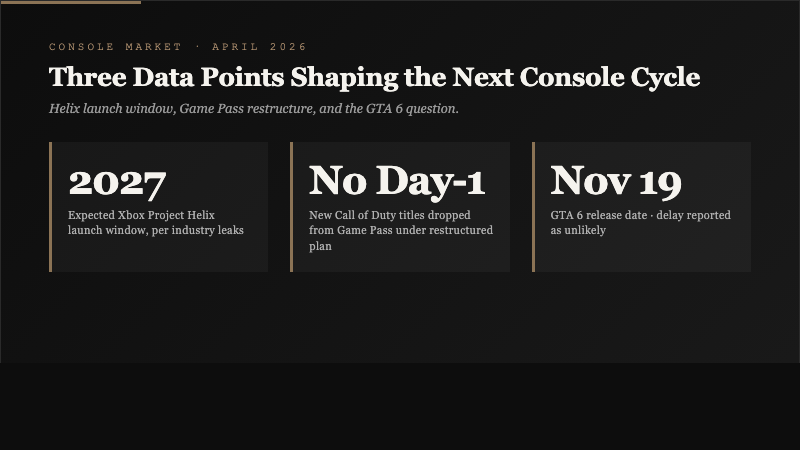
The Helix launch is expected in 2027, positioning it as a direct competitor to Sony's presumed PlayStation 6 and a potential disruption to the traditional console category if Microsoft's hybrid approach delivers on the promise. For a generation of console gamers who have watched PC hardware pull progressively further ahead of console capabilities, the claim that the new Xbox will close that gap is significant if it holds up.
Why Microsoft Ditched Custom APUs
Every Xbox from the Xbox One through the current Xbox Series X and S has been built around a custom AMD APU: a single chip combining CPU cores, a GPU, and shared memory bandwidth specifically tuned for the console's fixed hardware profile. The custom APU approach gave Microsoft tight control over cost, thermals, and the software development environment, and it was the standard approach across the console industry for more than a decade.
Project Helix reportedly abandons that model. According to the leaks reported by TechPowerUp and other industry outlets, Microsoft is using more standard PC silicon, which shifts the hardware from a console-first design to something closer to a gaming PC in a console enclosure. That shift makes sense if Helix is, as widely reported, intended to run Windows-style software alongside traditional Xbox games. A standard silicon path makes PC-level compatibility substantially easier.
"If the reporting holds, Helix is less a successor to Xbox Series X than a reframing of what Xbox is. The custom APU was always a console architecture choice. Standard PC silicon is a statement that Xbox is becoming a PC gaming platform you can also run on a TV."
Industry analyst commentary on the Project Helix leaks
The performance target, equivalent to a $2,000 to $3,000 gaming PC, is worth putting in context. A custom-built PC at that price range in 2027 would likely pair an AMD or Intel CPU with a GPU in the RTX 5080 or equivalent class, 32GB of DDR5 memory, and a fast NVMe solid-state drive. Hitting that performance envelope in a console-sized box with console-grade thermals is an engineering problem Microsoft has a reasonable shot at solving, particularly if Helix ships at a premium price point above the current Xbox Series X.
What the Console-PC Hybrid Model Actually Means
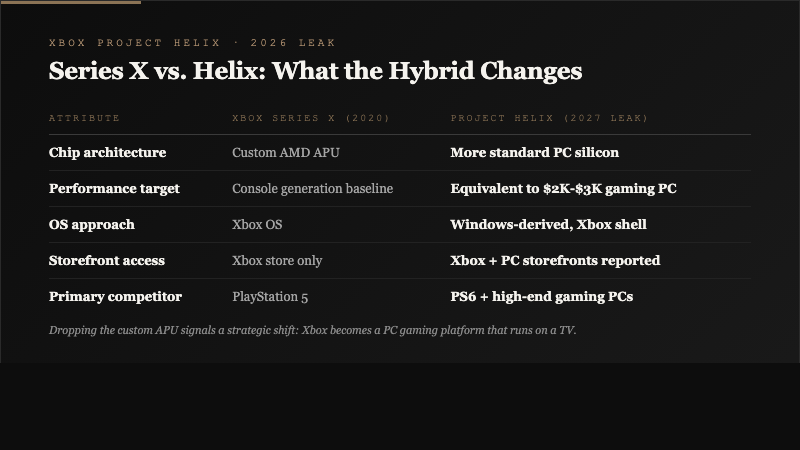
Microsoft has been talking publicly about an Xbox-and-PC convergence since at least Phil Spencer's statements in 2023. Helix is the hardware product that operationalizes that talk. A player who buys Helix would, in the reported configuration, be able to install games from the Xbox store, Steam, the Epic Games Store, or potentially any other PC gaming storefront. The hardware would run a Windows-derived operating system with an Xbox-branded interface layered on top.
| Attribute | Xbox Series X (current) | Xbox Project Helix (leaked) |
|---|---|---|
| Launch year | 2020 | 2027 (expected) |
| Chip architecture | Custom AMD APU | More standard PC silicon |
| Performance target | Console generation baseline | Equivalent to $2,000-$3,000 gaming PC |
| OS approach | Xbox OS (Windows core) | Windows-derived, Xbox shell |
| Storefront access | Xbox store only | Xbox + PC storefronts (reported) |
| Primary competitor | PlayStation 5 | PlayStation 6 and high-end gaming PCs |
The business logic of the hybrid is straightforward. Xbox has been the second-place console globally for a decade, and the PC gaming market has consistently grown faster than the console segment in dollar terms. A hybrid device lets Microsoft compete in both segments from a single hardware SKU, and it sidesteps the awkward question of whether a traditional Xbox successor could meaningfully outsell PlayStation given Sony's structural advantages in exclusive content and market share.
The engineering logic is harder. Console pricing has historically worked because console hardware is cheaper than PC hardware at equivalent performance, largely thanks to the custom APU approach and the subsidy model in which console makers lose money on hardware and recover it through software royalties. Moving to standard PC silicon at a higher performance target means Helix will likely be priced much higher than Xbox Series X launched at, which changes the consumer proposition substantially.
Game Pass Is Also Changing
Alongside the Helix leaks, Microsoft confirmed changes to Xbox Game Pass that take effect before the new hardware arrives. Game Pass is getting cheaper, but the trade-off is that new Call of Duty titles will no longer be included as day-one releases under the updated plan structure. Activision's most popular franchise, which became an Xbox subsidiary in the completed Activision Blizzard acquisition, has been a centerpiece of the Game Pass value proposition since the deal closed.
The Game Pass change is a tell on how Microsoft is thinking about the economics of the service. Day-one releases of flagship titles like Call of Duty are enormously expensive for a subscription platform, because they convert what would have been $70 per-copy purchases into subscription attribution at a fraction of that price. Microsoft has apparently concluded that the subscriber growth associated with day-one flagships does not pay back the revenue loss at current subscription prices.
"The decoupling of Call of Duty from day-one Game Pass tells you something about how Microsoft is valuing the individual dollar of subscription revenue. The fact that the price is coming down at the same time the content is getting lighter means the company is rebalancing toward margin at the expense of the 'everything on day one' pitch that defined the service."
Gaming industry analysis, cited in HotHardware coverage
The GTA 6 Delay Rumor, and Why It Does Not Look Real
A separate gaming news thread through the same 48-hour window focused on persistent rumors of a delay to Grand Theft Auto 6, Rockstar Games's long-awaited sequel. Journalist Dan Dawkins reported that a delay beyond the currently expected November 19, 2026 release date is unlikely, despite online speculation to the contrary.
Rockstar has been quieter than many gaming publishers about the lead-up to GTA 6, which is characteristic of the studio's marketing approach on major releases. Take-Two Interactive, Rockstar's parent company, has a strong commercial interest in holding the November launch window given the title's expected contribution to its fiscal year results. Analysts tracking the release have noted that the relative silence from Rockstar is consistent with a company confident in the release timeline, not one preparing the market for a delay.
For console and PC gamers watching the 2026 release calendar, the GTA 6 date matters because it sets the competitive environment for everything else shipping in the fourth quarter. If GTA 6 holds November, other publishers will continue to maneuver their releases around it. If it slips, the Q4 window opens up for other flagship titles that have been giving it a wide berth.
The Broader Console Market Context
The 2026 console market is going into a transition year. PlayStation 5 is six years into its life cycle and Sony has been quieter about a potential mid-generation refresh than Microsoft has been about Helix. Nintendo's Switch 2, the successor to the best-selling Switch, is a year into its run and is delivering steady but not spectacular sales relative to its predecessor. Steam Deck and its successors continue to define the emerging handheld PC gaming category, and several Xbox-branded handheld devices have been reported in development as a parallel product line to Helix.
Microsoft's strategic bet is that the next console generation is not a better Xbox, but a convergence between the Xbox brand and the PC gaming platform Microsoft already dominates through Windows. Helix is the physical expression of that bet. If the $2,000 to $3,000 gaming PC equivalent claim holds up at a reasonable price point, the device has a real chance to reshape what a "console" means. If the hardware costs balloon or the software experience is worse than a dedicated PC, the bet will have missed.
What to Watch Going Forward
Several specific data points will clarify the Helix picture over the next 12 months. The first is any official Microsoft disclosure about the hardware specifications, which has not yet occurred despite the leaks. The second is the pricing strategy, because a $600 Helix and a $1,200 Helix are very different consumer products. The third is the software library at launch, including whether major PlayStation-exclusive franchises have any presence at all and how robust the PC storefront integration ends up being.
For Sony, the Helix leaks are a prompt to clarify the PlayStation 6 roadmap on whatever timeline Sony prefers. For PC hardware vendors including AMD, NVIDIA, and Intel, the Helix architecture shift may signal new opportunities in the console segment if Microsoft is sourcing more standard parts. And for gamers, the 2027 launch window is now firmly on the calendar as the next inflection point in console hardware.
For related coverage, see our reporting on the current state of the PS5, Xbox, and Switch console race, on the April 2026 game release slate, and on the expanding esports calendar driving gaming industry growth.
Sources
- Leaker Calls Xbox Helix Console Equivalent to $2-3,000 Gaming PC - TechPowerUp
- Xbox Game Pass Just Got Cheaper But No More Day-1 Access to Call of Duty - HotHardware
- Journalist told GTA 6 release date delay is unlikely - Notebookcheck
- Video Game Release Dates: The Biggest Games of April 2026 and Beyond - IGN