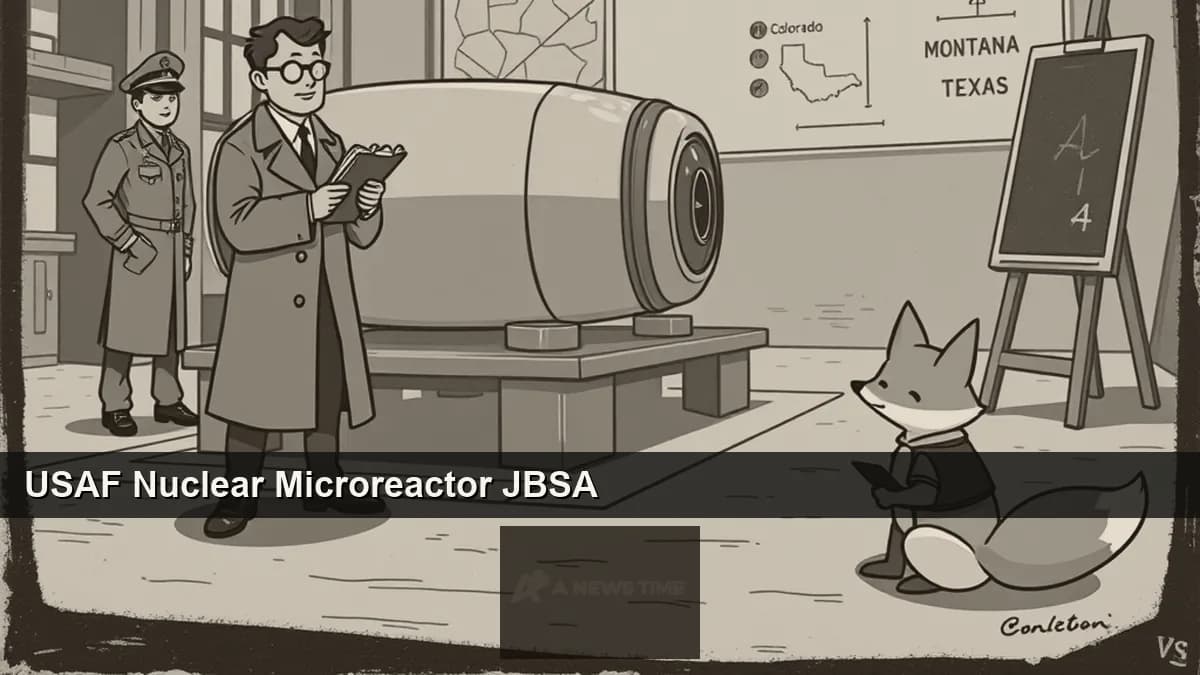
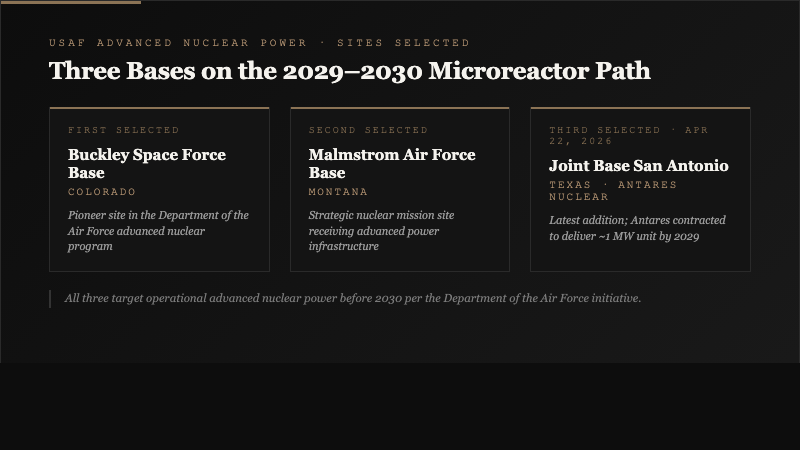
The U.S. Air Force, in conjunction with the Defense Innovation Unit, announced on , that JBSA will be the third potential site for a nuclear microreactor under the Advanced Nuclear Power for Installations initiative. The program targets operational advanced nuclear reactors at Air Force installations before 2030. Antares Nuclear, a Denver-based company founded in 2023, was selected as the commercial partner for the JBSA deployment. The company's head of federal strategy and policy told KSAT 12 that Antares is aiming to bring power online at JBSA in 2029.
The announcement is modest in isolation and significant in context. A single 1-megawatt microreactor powers roughly 250 homes on a hot day, which is not a meaningful fraction of a 120,000-person joint base's total load. But the selection is the third of a sequence, after Buckley Space Force Base in Colorado and Malmstrom Air Force Base in Montana, and it signals that the Department of Defense is moving past feasibility studies into actual vendor contracting for distributed nuclear power at military installations.
What Antares Is Building
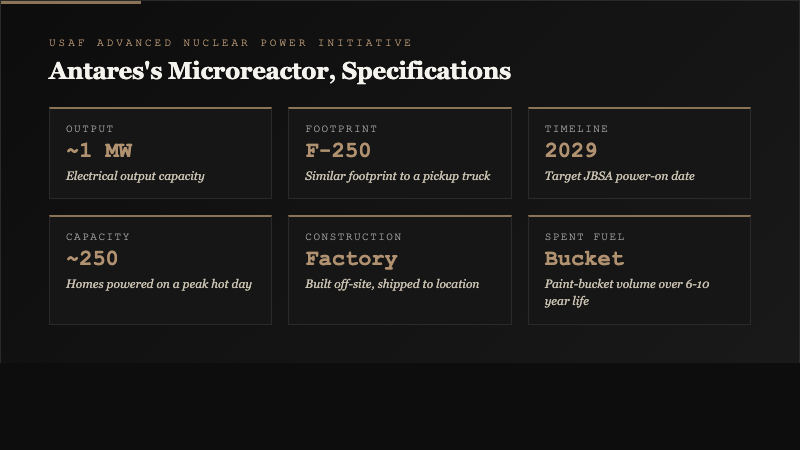
Antares Nuclear's microreactor is approximately the size of an F-250 pickup truck, according to the company's head of federal strategy Tom Mancinelli, and produces roughly 1 megawatt of electrical output. The reactor is designed to be manufactured in a factory and shipped to the deployment site, rather than built on-site like a conventional large-scale nuclear plant. Mancinelli said the company is currently preparing to turn on its first reactor before July 4, 2026, and plans to test its first electricity-producing reactor in 2027.
| Attribute | Specification |
|---|---|
| Electrical output | ~1 megawatt |
| Size comparison | Roughly an F-250 pickup truck |
| Manufacturing approach | Factory-built, shipped to site |
| Homes powered (reference) | ~250 on a hot day |
| JBSA deployment target | 2029 |
| First company reactor turn-on | Before July 4, 2026 |
| First electricity-producing reactor | 2027 |
| Spent fuel per 6-10 years | Size of a paint bucket |
The reactor is distinct from a large-scale commercial nuclear plant in several ways beyond size. The manufacturing model is modular rather than site-specific, which collapses the construction timeline from a decade-long project into a delivery-and-installation process. The deployment is explicitly designed to be contained within the footprint of an existing installation, including its security perimeter, rather than requiring new infrastructure buildout.
"We do tests all the time here at our manufacturing headquarters, and we're looking forward to working in partnership with the Air Force, the Joint Base San Antonio community, to get something that's powering assets on the base in 2029."
Tom Mancinelli, Antares Nuclear head of federal strategy and policy
The JBSA Site Question
JBSA consists of four primary locations: Fort Sam Houston, Camp Bullis, Lackland Air Force Base, and Randolph Air Force Base. Mancinelli told KSAT that Antares is "looking certainly, I think, at the Lackland Air Force Base location" for the reactor. He emphasized that specific siting conversations are still in early stages and will require coordination with the Air Force and the broader JBSA community. The Department of the Air Force said next steps include siting and environmental analyses under the NEPA process.
Local reaction to the announcement has been mixed. Stephen Yates, a neighbor interviewed near JBSA-Lackland by KSAT, said he did not have significant concerns. "It's the military. I hope they know what they're doing. You know what I mean? This isn't a high school chemistry class that's messing around with that." Mari Escamilla, a 40-year resident of the area, said her first reaction was concern about safety. "You can take all the safety precautions, OSHA and things like that, but you just never know. Nothing is guaranteed."
Why the Air Force Is Doing This
Military installations have specific energy requirements that commercial grid supply increasingly struggles to meet. They need reliable power through extended periods, including contingencies where grid supply is disrupted. They operate sensitive systems that require clean, stable power at predictable voltages. And they are increasingly hosting or supporting AI data center workloads and advanced communications infrastructure that demand more power per square foot than any prior generation of military computing.
Bexar County Precinct 3 Commissioner Grant Moody, one of three co-chairs of the Military Transformation Task Force, explicitly linked the JBSA selection to data center power demand. "We're well overdue for a nuclear renaissance. It's been 33 years since a nuclear power plant was put online here in Texas, and so I think that now's the time. Let's exploit this opportunity. It's clean, reliable, dispatchable power. Plus, with the proliferation of data centers, we need on-site production."
The Safety Question
Antares addressed safety concerns directly. Mancinelli called nuclear energy "among the safest sources of electricity available today." He emphasized that Antares's system is designed to turn itself off and prevent meltdown under fault conditions, which is consistent with modern advanced reactor designs that use passive safety features rather than active engineered systems to manage off-normal scenarios. Certification will be handled through the Department of Energy and the Nuclear Regulatory Commission.
"Everything we will do will be certified to the highest rigorous standards of our regulators, the Department of Energy, the Nuclear Regulatory Commission. And we will absolutely make sure that the system is safe and in no way provides any adverse impact on the community."
Tom Mancinelli, Antares Nuclear, KSAT 12 interview
The spent fuel volume is unusually small relative to what most Americans associate with nuclear power. Mancinelli said the amount of spent nuclear fuel produced over a six-to-ten-year operating period is "about the size of a paint bucket." That volume reflects both the microreactor's modest size relative to a conventional power plant and the specific fuel chemistry Antares uses, which is intended to minimize waste generation over the reactor's operating life.
The Broader Initiative
The Advanced Nuclear Power for Installations initiative is a multi-base program. Buckley Space Force Base in Colorado and Malmstrom Air Force Base in Montana were the first two selections, announced prior to the JBSA addition. The initiative targets "operational" advanced nuclear power at military sites before 2030, which is a tighter timeline than most civilian advanced reactor programs have been operating on.
The program sits inside a broader Department of Defense push to reduce military installation dependency on the commercial grid. The driver is partly strategic, about operational continuity during conflict or grid disruption. It is partly operational, about supporting energy-intensive missions that commercial grid supply cannot reliably serve. And it is partly procurement-policy, about using defense contracts to accelerate domestic advanced nuclear manufacturing capacity that the commercial market has been slower to support.
What to Watch
Three specific milestones will determine whether the JBSA selection translates into actual operational power. The first is whether Antares successfully turns on its first reactor at its manufacturing facility before July 4, 2026, as Mancinelli indicated. That event will provide the first data on whether the company's technical approach is viable at the scale it has been promising. The second is completion of the NEPA siting and environmental analysis at JBSA, which typically runs 12 to 24 months and will determine whether the 2029 operational target holds.
The third is the Nuclear Regulatory Commission approval timeline. Microreactors at military installations may follow a different regulatory path than commercial reactors, potentially through Department of Energy authority rather than NRC licensing, but the regulatory specifics have not yet been publicly clarified. The answer to that question shapes whether Antares and other microreactor vendors can credibly commit to the 2029 operational dates they are currently marketing.
For related coverage, see our reporting on Big Tech's separate parallel investment in nuclear power for AI data centers, on the AI infrastructure demand driving power consumption questions, and on DARPA-funded research adjacent to defense compute infrastructure.
Sources
- Air Force selects JBSA as potential site for nuclear microreactor - KSAT 12
- US Air Force Selects Three Microreactor Companies to Power Bases - Bloomberg
- DAF announces next steps in advanced nuclear power for installations initiative - U.S. Air Force
- Buckley SFB, Malmstrom AFB selected for advanced nuclear power for installations - U.S. Air Force