
Chefs across North America are using the week around Earth Day 2026 to unveil spring menus that make sustainability structural, not symbolic. In Chicago, Kindling's Chef Jonathon Sawyer dropped a new spring menu rooted in live-fire cooking and Great Lakes produce on April 17. In Vancouver, Published on Main on Main Street launched its 2026 Green Tasting Menu, and in the UK the Michelin Guide spent Earth Week highlighting the country's strongest vegetarian and vegan restaurants. The common thread is deliberate: a generation of restaurants treating plant-forward, low-waste cooking as the core of the menu rather than a separate column on it.
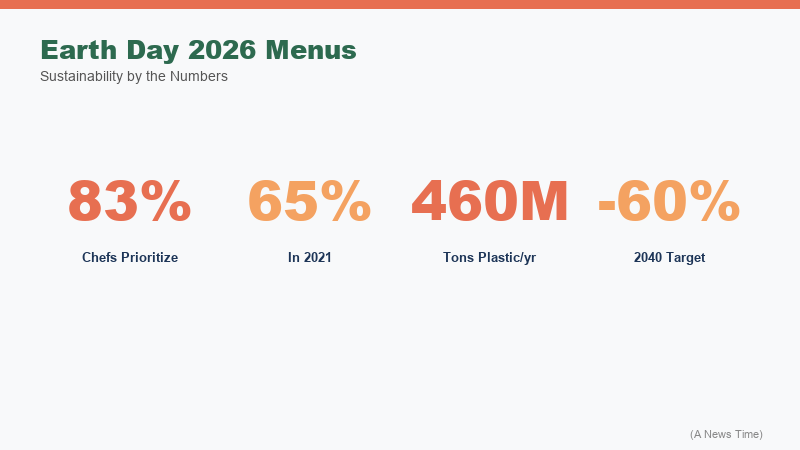
That change is measurable. According to the National Restaurant Association's 2026 What's Hot culinary forecast, 83 percent of American chefs now identify sustainability and local sourcing as a "hot" menu trend, up from 65 percent five years ago. Plant-based entrees surpassed "comfort food" in chef-mention frequency for the first time in the survey's history. The Earth Day timing matters because it is the single day of the year when diners are most receptive to cooking that foregrounds the supply chain behind the plate.
Kindling's Live-Fire Spring Reset
Jonathon Sawyer, the James Beard-winning chef behind Kindling in Chicago's West Loop, launched his new spring menu on April 17, 2026. The menu is anchored in hardwood coals and live fire, which Sawyer has used as a signature since opening, and this season leans hard into vegetables as main-course material rather than garnish. Morel mushrooms over stone-ground polenta, charred spring onion with cultured butter, and fire-roasted asparagus are all built as standalone plates rather than sides to a protein.
"Fire does more for a vegetable than it does for most proteins," Sawyer told Chicago Food Magazine on April 18. "When you put a Michigan asparagus stalk over live coals, you get a flavor that you cannot engineer with a conventional oven. That is the whole point of spring cooking: let the ingredient carry the plate." The menu also introduces a zero-waste fish preparation that uses whole Lake Michigan lake trout, from jowl to tail, across four different courses.
Sawyer's decision to pull the spring menu launch forward to coincide with Earth Week is intentional. Restaurants typically debut spring menus in March; Kindling waited to align with broader sustainability programming. That alignment is now a competitive advantage for restaurants working to reach diners who filter their reservations on Resy and OpenTable by sustainability signal as much as by cuisine tag.
"The reason we are cooking this way is because the supply chain is telling us to. Wasting a quarter of the fish is no longer something the planet can absorb. Cooking whole-animal, whole-vegetable is the only way forward."
Jonathon Sawyer, chef and owner, Kindling Chicago
Vancouver's Green Tasting Menu and the Michelin Validation
North of the border, Published on Main, Gus Stieffenhofer-Brandson's two-Michelin-starred restaurant at 3593 Main Street in Vancouver, unveiled its 2026 Green Tasting Menu on April 10. The menu is fully vegetarian, seven courses, and priced at CAD 175 per guest. The restaurant has run a vegetable-only menu in parallel with its omnivore tasting for several years, but the 2026 iteration is the first where the Green menu has equal prominence on the dining-room chalkboard rather than being offered only on request.
Across the Atlantic, the Michelin Guide UK used Earth Week to publish an inspector-led list of the country's strongest vegetarian and vegan restaurants, including Claude Bosi's Plates in West London, Mana in Manchester, and Silo in Hackney Wick, which holds a Green Star specifically for its zero-waste operation. The Guide's framing matters because it is the first time the UK edition has published a dedicated plant-focused recommendation list during Earth Week, a soft acknowledgment that the anniversary has become a legitimate editorial peg.
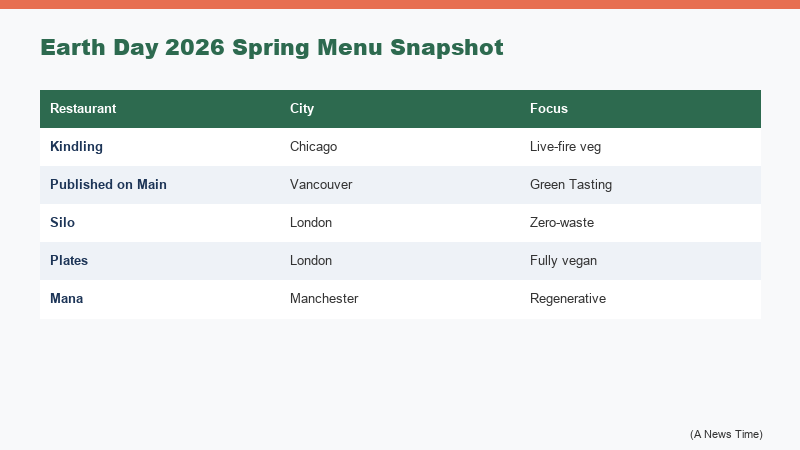
| Restaurant | City | Chef | Focus | Launch |
|---|---|---|---|---|
| Kindling | Chicago | Jonathon Sawyer | Live-fire, vegetables as mains, whole-fish | April 17 |
| Published on Main | Vancouver | Gus Stieffenhofer-Brandson | 7-course Green Tasting Menu (vegetarian) | April 10 |
| Silo | London | Douglas McMaster | Zero-waste operation, Michelin Green Star | Year-round, Earth Week feature |
| Plates | London | Claude Bosi | Fully vegan tasting menu | Year-round, Earth Week feature |
| Mana | Manchester | Simon Martin | Foraged, regenerative, plant-forward | Year-round, Earth Week feature |
A Home-Cook Version, Without the Moralizing
The restaurant shift translates to home cooking in three specific moves that require no new equipment. The first is treating vegetables as the center of the plate rather than the perimeter, which is what Sawyer and Stieffenhofer-Brandson are both modeling. Roast a head of cauliflower whole, slice it like steak, and dress it aggressively. A miso-tahini glaze or a salsa verde built from whatever herbs are about to wilt in the crisper will do more for the dish than any protein.
The second is the nose-to-tail extension into produce: stems, tops, and peels that usually hit the compost can be pickled, fried, or blended into stock. Carrot tops make a credible pesto. Broccoli stems, peeled and shaved thin, are sweeter than the florets. The Michelin Green Star restaurants have been modeling this for years; home cooks can steal the technique without the ceremony.
The third is seasonality as default. Spring menus exist because spring ingredients exist, and peak-season asparagus, peas, rhubarb, and morels simply taste better than their shipped-from-elsewhere alternatives in January. The Earth Day tie-in is that eating what is growing within a few hundred miles of the kitchen is by far the largest single lever a home cook has on the carbon footprint of any given meal, outpacing choices about packaging or food miles in shipping.
For adjacent coverage, see our earlier reporting on Hetty McKinnon's spring vegetable recipes, the grandma-style cooking comeback, and the return of animal-fat cooking, which together sketch the range of the 2026 American culinary conversation.
What to Cook This Week
For readers looking for a one-meal version of the Earth Day thesis, Kindling's online playbook translates cleanly to a home grill. Pick one seasonal vegetable, one acid, one fat, and one finishing herb. Char the vegetable aggressively. Dress with the acid and fat while warm. Finish with the herb torn, not chopped. The structure produces a plate that is recognizably restaurant-quality without requiring the supply chain of a restaurant kitchen.
For a full meal, Published on Main's green menu suggests a structure of three snacks, two small plates, a grain-and-vegetable main, and a simple seasonal fruit dessert. A home version might be crudité with anchovy butter, a grain salad with preserved lemon, a whole roasted cauliflower with tahini, and strawberries with cultured cream. Total cook time: about ninety minutes. Total fish: none.
Frequently Asked Questions
What is the 2026 Earth Day food theme?
The Earth Day Network's 2026 theme is "Planet vs. Plastics," targeting a 60 percent reduction in global plastic production by 2040. In a restaurant context the theme has translated into reduced single-use packaging, bulk ingredient sourcing, and plant-forward menus that reduce meat-intensive supply chains.
Is sustainable cooking more expensive?
At the restaurant level, sustainable sourcing can increase ingredient costs by 8 to 15 percent depending on category, according to industry estimates. At the home level, seasonal cooking is generally less expensive than off-season cooking because peak-season produce is cheaper, and whole-vegetable techniques extract more usable food from each purchase.
What does a Michelin Green Star mean?
The Michelin Green Star, introduced in 2020, is a separate designation from Michelin's traditional 1-3 star ratings. It recognizes restaurants committed to sustainable gastronomy, covering sourcing, energy, waste, and community engagement. Silo in London was among the first UK restaurants to hold one.
Which vegetables are in peak spring season in North America right now?
In April and early May, peak-season spring vegetables in most of North America include asparagus, ramps, fava beans, English peas, rhubarb, morel mushrooms, spring onions, radishes, and early strawberries. These are the ingredients most likely to appear on well-sourced spring menus.
How do I find restaurants with a sustainability focus?
Resy and OpenTable both offer sustainability filters in several major cities. The Michelin Green Star list, the James Beard Foundation's Smart Catch program, and the Eat Greener guide in the UK are also useful starting points. Many cities have local Good Food Guide equivalents that highlight sustainably sourced restaurants.