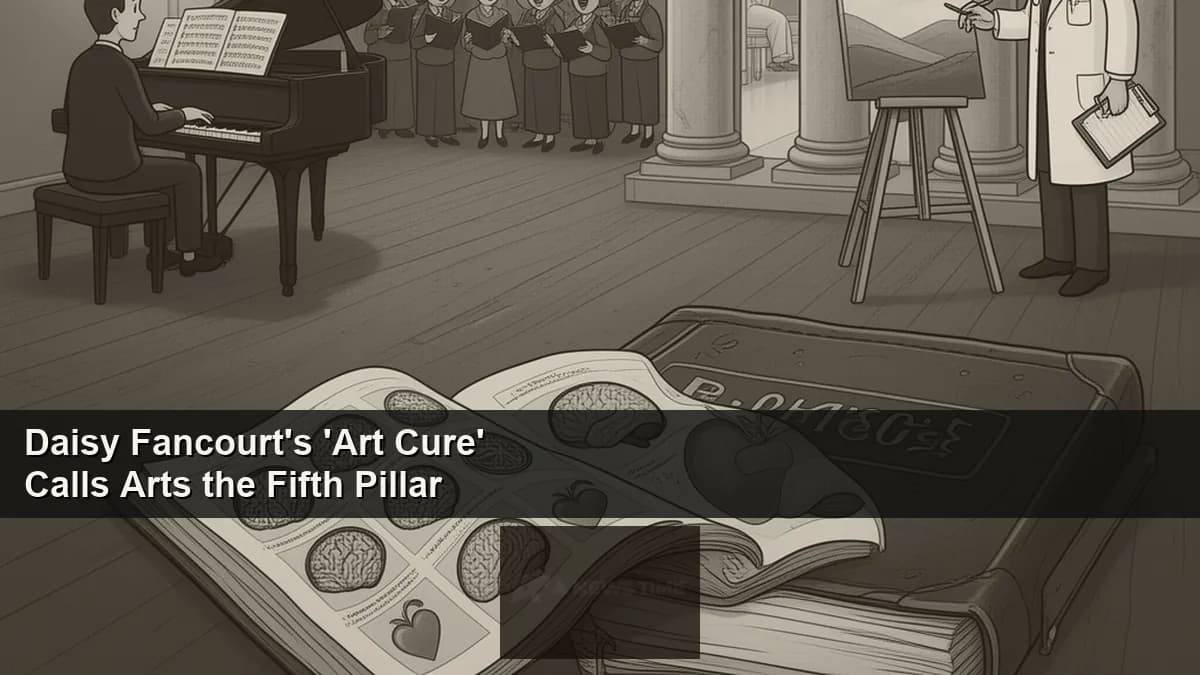
The case that art belongs alongside diet, exercise, sleep, and nature as a foundational input to human health has been building inside the research literature for more than a decade, and it now has its most accessible champion in Daisy Fancourt, the University College London professor of psychobiology and epidemiology whose new book Art Cure: The Science of How the Arts Save Lives argues that regular engagement with the arts is one of the most evidence-backed interventions almost no one talks about. The Los Angeles Times profiled Fancourt and her work on , framing her as the leading public voice for what she calls the forgotten fifth pillar of health.
The credentials behind the argument are unusual. Fancourt directs the WHO Collaborating Centre for Arts and Health, runs one of the world's largest research programs on arts and wellbeing at UCL, and started her career running the performing arts program at Chelsea and Westminster Hospital in London, where she spent her days watching what music, theater, and visual art actually did to patients on dementia wards, accident and emergency departments, and stroke recovery units. The research she does now is the answer to a question she could not stop asking back then.
The clinical observations that started a research career
Fancourt told New Scientist that she can pinpoint the exact comment that pushed her into research. A relative of a patient on the dementia ward complimented her on running "a lovely entertainment programme." The framing missed something obvious to anyone who spent time on the ward.
"In that sing-along session," Fancourt wrote, "I'd seen a patient who couldn't remember the relatives who were visiting her sing along word-perfect to The White Cliffs of Dover and chat away afterwards about her childhood. Earlier that day, I'd seen a child with burns in the accident and emergency department who hadn't needed any morphine once the theatre group started their performance, a premature baby who was crying inconsolably and refusing food but who calmed and started feeding the moment her mother started singing, and a man who'd had a stroke whose walking suddenly increased in speed and symmetry when we put headphones on him."
Those were not entertainment programs. They were biological interventions whose mechanisms were not yet well understood. Fancourt left the hospital to find out what was happening inside the bodies and brains of the patients she had been watching.
What the research has found in the years since
The body of evidence Fancourt has helped build is now substantial enough to take seriously. Engaging in the arts activates reward and pleasure networks in the brain, releasing dopamine and giving the brain a sense of autonomy, control, and emotional regulation. It modulates the autonomic nervous system, leading to lower heart rate and blood pressure over time. It reduces stress hormones in the endocrine system and inflammation in the immune system. It even appears to alter gene expression, dialing down stress-response genes and dialing up genes involved in beneficial cognitive processes like neurogenesis.
The longer-term effects are even more striking. Regular arts engagement is associated with increases in grey matter volume in regions of the brain involved in memory, auditory processing, and motor learning. It produces different patterns of proteins linked to enhanced cognition, reduced depression risk, and lower infection risk. New studies using brain clocks, epigenetic clocks, and physiological aging clocks find that arts engagement predicts a younger biological age relative to chronological age.
Every system in the body is affected by art. So when we breathe through singing, we support our respiratory muscles. When we dance, we reduce our blood pressure and glucose levels. When we look at relaxing paintings, we actually activate our pain analgesic response.Daisy Fancourt, Professor of Psychobiology and Epidemiology, University College London
The population-level findings are the part that should land hardest with skeptics. People who regularly engage in the arts have lower risks of developing depression, chronic pain, frailty, and even dementia, and the relationships hold after controlling for wealth, demographics, past medical history, and other lifestyle factors. The pattern is exactly the kind of consistent, dose-response effect public health researchers look for when they want to call something a determinant of health rather than a correlate.
The head-to-head trials that compare arts to medication
The most provocative finding in the literature, and the one that may end up being the most important, is that some arts interventions outperform standard medical treatments in head-to-head trials. The clearest example involves pre-operative anxiety, which hospitals routinely treat with benzodiazepines. Randomized trials comparing music-listening interventions to benzodiazepines have found that music reduces patient anxiety more effectively than the medication, with fewer side effects.
That kind of result lives at the intersection of medical conservatism and economic logic. If a non-pharmaceutical intervention works better than a drug, it should become the default. In practice, hospital workflows are built around pharmacological tools, and a music-based protocol requires cultural and organizational change that medication does not. Fancourt's work is partly about closing that gap.
Other randomized trials have tested singing classes for stroke patients who have lost speech, magic camps for children with cerebral palsy, dance classes for people with Parkinson's disease, and a long list of other interventions. The results are not uniformly positive. Some trials show no effect. Some show effects only in specific subgroups. But the cumulative direction of the evidence is unmistakable.
The screen-time problem and why it matters
Fancourt is careful about a particular distinction that gets lost in popular coverage of the arts-and-health research. The benefits she documents come overwhelmingly from active engagement and live experiences, not passive screen-based consumption. She compares scrolling through short video clips to eating ultra-processed food. Both deliver something that resembles the real thing without the underlying nutrition.
"When we looked at people going to the cinema versus going to live theater or music gigs," she told the Los Angeles Times, "we found there were no benefits to cognition from regularly going to the cinema as they got older, but they had better cognitive preservation if they were going to live performances instead." The same logic applies to TikTok versus a 30-minute drama. Shorter engagement does not provide the same kind of meaning that longer engagement does.
The implication is uncomfortable. Average museum viewing time, Fancourt notes, is 28 seconds per artwork. The brain needs more than that to do whatever it does when it processes art. The benefit comes from attention, not exposure.
What Fancourt actually recommends
The book is structured around three pieces of practical advice that follow from the research. First, pick the art you want, not the art you think you should. Highbrow art is not categorically better for you. The benefit comes from engagement, and engagement requires interest. A reader who enjoys mystery novels gets more out of mystery novels than out of a half-finished copy of Ulysses.
Second, match the art to your energy level. Exhaustion is the most common reason people default to passive screen time instead of active engagement. The fix is not to push through with high-effort art. It is to substitute lower-effort but still active alternatives. Listen to a concert recording without scrolling on a phone. Read a single chapter of a novel. Sit with one painting for five minutes.
Third, treat arts engagement like food, not like a gym membership. The research suggests daily small doses of art produce better outcomes than weekly intensive sessions. The mental model should be a regular meal rather than a special occasion.
Where this fits in the broader wellness conversation
The framing of arts as the fifth pillar of health is both modest and ambitious. Modest, because Fancourt is not claiming arts engagement replaces sleep, exercise, diet, or time in nature. Ambitious, because the wellness industry has spent the past decade adding new pillars (gratitude practices, cold exposure, supplements, breathwork, biohacking) without nearly the depth of evidence that arts engagement now has.
The contrast matters. The arts-and-health field is unusual in modern wellness research because it is led primarily by university-based scientists publishing in peer-reviewed journals rather than by influencer practitioners selling products. Fancourt herself is explicit about the limits of the research, debunking claims that arts increase babies' IQs or kill cancer cells. The book leaves the unsubstantiated claims out and focuses on the ones that actually hold up under scrutiny.
The cultural moment is helping. Wellness has become a $10 trillion global industry by 2025, and the next phase of growth will likely move away from individual supplements and toward the kind of structural daily practices that art falls under. Our coverage of neurowellness as the top wellness trend of 2026 and exercise as a mental health intervention reflects exactly that shift. Art Cure is the first popular book to make a serious case that the next pillar deserves equal billing.
What to watch through the year
Two things to track. The first is whether public health agencies in the US and UK update their guidance to include arts engagement as a recommended health behavior. The WHO has been moving in that direction for years, and several European countries already issue social prescriptions that include cultural activities. The US is further behind. The second is whether private health insurers begin to reimburse arts-based interventions in clinical settings, particularly for pain management, dementia care, and pre-operative anxiety. The economic logic is there. The institutional inertia is the obstacle.
For now, Fancourt's pitch is straightforward. If a drug had the same catalog of benefits as the arts, every doctor in the world would prescribe it. The fact that the drug in question is going to a concert, joining a dance class, or picking up a book is a feature, not a bug. The next ten years will tell whether the rest of the medical system catches up with what the research is already showing.