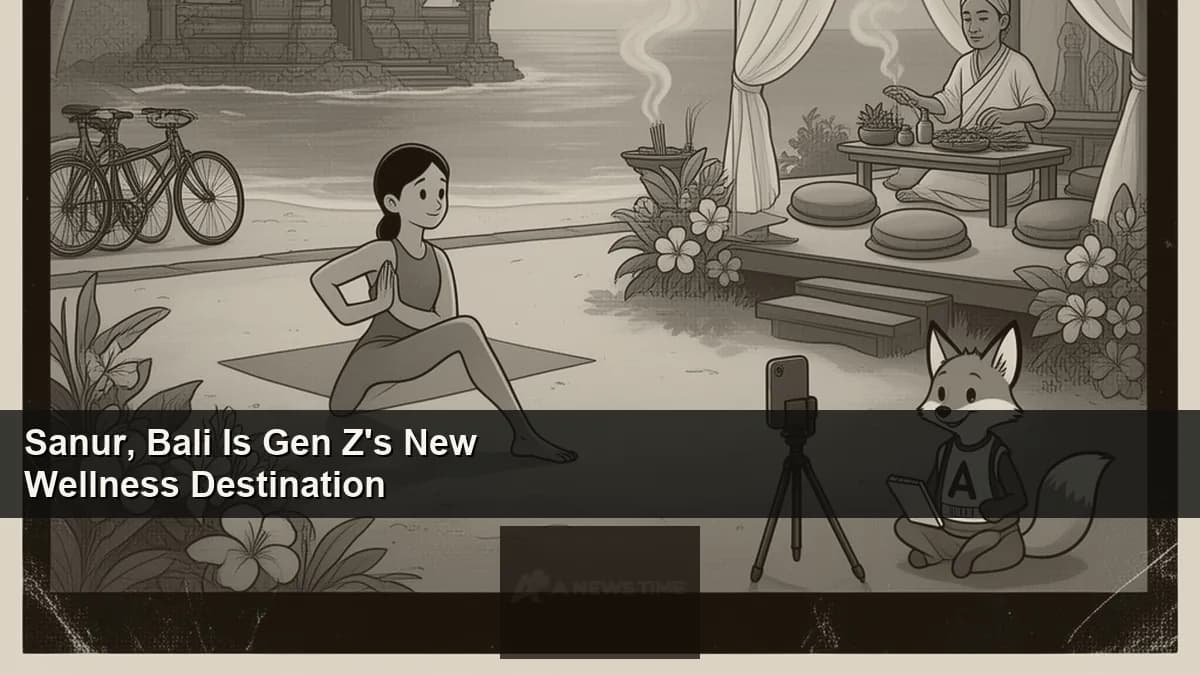
Start with the image that keeps appearing in feeds: a person in warrior pose at the edge of a palm-lined beach at sunrise, the kind of still water behind them that makes you check whether the photo is real. Now zoom out. That beach is in Sanur, on Bali's southeastern coast, and the feed it is appearing in belongs to a 24-year-old who two years ago would have told you she was planning a trip to Kuta. The shift is measurable in follower counts, in hotel occupancy data, and in the trajectory of a town that spent decades as the quiet alternative to Bali's more chaotic resort clusters, drawing families and older travelers while the younger crowd defaulted to Seminyak's sunset cocktails or Kuta's nightlife strip.
That pattern is reversing. Sanur's tourism board reported a 34 percent increase in visitors under 30 between 2024 and 2025, outpacing the island's overall growth rate significantly. The wellness sector is the primary driver, and the mechanisms behind the shift reveal something specific about how Gen Z approaches travel that the industry is still calibrating to understand fully.
What Made Sanur Different, and Why It Matters Now
Sanur's character as a destination has always been defined by what it is not. It does not have Seminyak's restaurant and boutique hotel scene. It does not have Ubud's rice terrace spirituality circuit. It does not have Kuta's surf breaks and nightlife. What it has is a long, calm beach facing sheltered water, palm-lined streets that are genuinely walkable, a coastline built for morning bike rides, and a pace of life that travelers seeking restoration instinctively recognize as different from the stimulation-maximizing model of most resort destinations.
For decades, that character made Sanur appealing to specific demographics: families with children who needed calm water and safe streets, retirees, and experienced Bali travelers who had already done the more heralded areas. What the wellness tourism boom has done is reframe those exact qualities as assets rather than the absence of features. The calm water is now the backdrop for paddleboard yoga. The walkable streets are the setting for morning runs and cycling retreats. The pace of life is not slowness as a limitation; it is stillness as a product.
Dr. Ni Wayan Ariati, a Bali-based cultural wellness practitioner who has consulted for several of Sanur's retreat programs, describes the transition in terms that align with the broader wellness tourism literature.
"Sanur has always held something that the busier areas gave away for convenience. The Balinese concept of sekala and niskala, the visible and invisible dimensions of life, is easier to feel in a place that has not been fully paved over. Young visitors are coming specifically because they sense that difference, even if they do not have a name for it."
Dr. Ni Wayan Ariati, cultural wellness consultant, Sanur, January 2026
The wellness tourism category globally is expanding at a rate that outpaces general tourism by a significant margin. The GWI projected wellness tourism spending to reach $1.3 trillion globally by 2025, with Southeast Asia as one of the fastest-growing regional markets. Bali sits at the center of that regional growth, and within Bali, Sanur's specific positioning is capturing a demographic cohort that the island's other clusters have not been able to convert at the same rate.
Social Media's Role: From Niche Discovery to Algorithm Driver
The mechanism for Sanur's discovery by younger travelers follows the pattern that social media has established for wellness destinations globally, but with a Bali-specific intensity. TikTok and Instagram content featuring Sanur's beach yoga scenes, traditional Balinese healing rituals, and the specific visual grammar of its palm-lined streets began circulating in late 2023 and accelerated sharply through 2024 and into 2025. The content is not primarily marketing material; it is user-generated documentation of experiences that reads as authentic in the way that polished brand content does not.
The distinction matters for understanding Gen Z travel behavior. Research from Morning Consult's 2025 Gen Z Travel Report found that 71 percent of Gen Z travelers identify social media content created by peers and independent creators as their primary source of destination discovery, compared to 18 percent who cite traditional travel publications and 9 percent who cite destination marketing organizations directly. Sanur is benefiting from exactly this dynamic: the content appearing in feeds is being generated by visitors, amplified by the algorithm's preference for aspirational but achievable lifestyle content, and converting into bookings at a rate that traditional marketing cannot explain.
The specific content categories performing best for Sanur on both platforms center on three experiences: yoga and meditation practice in outdoor settings, traditional Balinese healing rituals captured with documentary authenticity, and the lifestyle footage of coastline cycling and morning beach walks. Each of these experiences maps directly to what Sanur's wellness infrastructure actually provides, creating a loop between what visitors document and what the destination delivers that reinforces itself with each generation of content.
The Wellness Offerings: What Sanur Actually Delivers
Sanur's wellness infrastructure has expanded significantly to match the demand it has been experiencing. The destination now offers a range of wellness modalities that puts it in genuine competition with the more established wellness circuits of Thailand's Koh Samui and Phuket, and the premium wellness island packages of the Maldives, at a price point that makes extended stays feasible for younger travelers working within real budget constraints.
| Wellness Category | Sanur Offering | Competitive Position vs. Region |
|---|---|---|
| Yoga and Meditation | Beachside studios, retreat programs (3-21 days), teacher training | Strong: comparable to Ubud, lower cost than Thai resorts |
| Traditional Healing | Balinese massage, Jamu herbal medicine, Balian practitioner sessions | Differentiated: culturally specific, not available in Thailand or Maldives |
| Spa and Bodywork | Full-service resort spas, standalone wellness centers | Competitive: equivalent quality at 30-40% lower price than Maldives |
| Medical Tourism | Cosmetic procedures, dental care, comprehensive wellness checks | Growing: less established than Bangkok but expanding rapidly |
| Active Wellness | Coastline cycling, paddleboard yoga, sunrise beach runs | Strong: calm water and flat terrain are structural advantages |
| Cultural Integration | Temple ceremonies, Balinese cooking classes, cultural festivals | Unique: authentic cultural access distinguishes from resort-only alternatives |
The traditional Balinese healing dimension is the clearest differentiator. The Balian tradition, which encompasses a range of healing practitioners including those working with herbal medicine, energy healing, and ritual ceremony, has been integrated into several of Sanur's retreat programs in ways that are substantive rather than decorative. Visitors are not observing a cultural performance; they are participating in wellness practices that are still in active use by the Balinese community. That distinction is central to the authenticity framing that Gen Z travelers consistently identify as a decision driver.
The Jamu herbal medicine tradition, a practice with centuries of Indonesian history behind it, has seen specific commercial expansion in Sanur as wellness entrepreneurs have recognized the international appetite for traditional plant-based medicine. Morning Jamu ceremonies, where fresh herbal preparations are made and consumed as part of a wellness ritual, have become a documented content category in their own right on TikTok, generating views that convert into bookings at a rate that Sanur's tourism infrastructure is still scaling to accommodate.
Medical Tourism: The Wellness Economy's Expanding Edge
Sanur's medical tourism sector is the less photographed but economically significant dimension of its wellness expansion. Bali's medical tourism industry has historically been anchored in cosmetic surgery, dental care, and comprehensive health screening packages, offered at price points substantially below what the same procedures cost in Australia, the United States, and Western Europe. Sanur is expanding its position within this sector, with several clinics and wellness centers now offering packages that combine medical procedures with extended wellness programming during recovery.
The combination of medical procedure and wellness retreat is a product innovation that addresses a genuine gap in how medical tourism has typically been packaged. Recovery from cosmetic procedures, for instance, maps naturally onto a wellness retreat framework: the patient needs rest, structured nutrition, light activity, and ideally an environment that supports positive mental state during healing. Sanur's calm, restorative character is a structural asset for this use case in ways that Bangkok's urban medical tourism hubs are not. The destination is not trying to be a medical city; it is positioning wellness recovery as a distinct product category.
For travelers whose primary interest is in the wellness and healing dimensions rather than medical procedures, the comprehensive wellness packages now available in Sanur represent a genuine alternative to the higher-cost offerings in the Maldives. A week-long package including accommodation, daily yoga and meditation programming, traditional healing sessions, and nutritional support can be assembled in Sanur at a total cost that the Maldives would charge for accommodation alone. That price differential is a real competitive advantage with the younger traveler segment that has strong wellness intent but realistic budget constraints.
Gen Z's Wellness Travel Logic: Authenticity, Nature, and Real Cost
The conventional wisdom about Gen Z and travel has been dominated by a "experiences over things" framing that is true but incomplete. The more precise version is that Gen Z prioritizes experiences that feel authentic, connect them to nature, and nurture both body and mind in ways they can document and share without feeling like they are misrepresenting what they found. Sanur satisfies all three dimensions in ways that more developed wellness destinations increasingly cannot.
The authenticity dimension is the one that the industry finds hardest to manufacture. Ubud built its wellness reputation on genuine cultural depth, but the saturation of the destination has made parts of it feel like a performance of spirituality for tourist consumption. Koh Samui's wellness market has excellent infrastructure but limited cultural specificity. The Maldives operates at a price point that filters the experience down to pure luxury, which is its own kind of authentic but not the kind that resonates with travelers who are seeking connection rather than insulation. Sanur occupies a specific gap: enough development to provide comfortable infrastructure, enough preserved character to feel genuinely Balinese, and enough relative obscurity (relative to Ubud and Seminyak, at least) that visitors do not feel like they are experiencing a tourism product.
The nature connection dimension is literal. Sanur's beach faces east, making it the best sunrise beach on Bali's southern coast. The calm water enables water-based activity that the rougher beaches of the west coast cannot. The palm-lined main street and beachfront walkway provide an outdoor environment that functions as a wellness amenity in its own right, separate from any organized programming. These are geographic and environmental facts about the destination, not marketing constructions, and they map directly onto what wellness travel research identifies as the highest-value experiences for travelers in the recovery and restoration category.
"Young travelers in 2025 and 2026 are not looking for the same things as the wellness tourists of a decade ago. They want to feel like they have found something real, something that will still be there if they come back, something that connects them to a place rather than just processing them through it. Sanur has that. The question is how long it can hold it."
Dr. Priya Mendez, wellness tourism researcher, speaking at the Southeast Asia Travel Forum, February 2026
The internal wellness connection extends to how Sanur's appeal relates to broader lifestyle shifts among younger adults. The growing interest in yoga specifically among men, documented in our coverage of yoga's health benefits for men, reflects a broader democratization of wellness practices that were previously coded as specific to older women. Sanur's yoga programming is coed by default and structured around outcome rather than demographic, making it accessible to a wider range of visitors than the yoga retreat market of a decade ago.
For travelers interested in the mental and hormonal dimensions of wellness travel, the women's health and emotional wellbeing trends of 2026 provide useful context for understanding how Sanur's healing programs align with where the wellness conversation is heading more broadly. And the organic and biophilic design trends shaping interiors in 2026 mirror exactly the aesthetic that Sanur's best wellness properties have been executing for years.
The Competitive Landscape: What Sanur Wins and Where It Faces Pressure
The honest version of Sanur's competitive story acknowledges both the genuine advantages and the structural pressures. Thailand's wellness destination infrastructure, concentrated in Koh Samui, Chiang Mai, and the Phuket wellness corridor, is more developed, more standardized, and backed by a tourism industry with decades more experience managing international wellness travel at scale. The Maldives offers a level of environmental luxury and exclusivity that Sanur cannot match at any price point. Kuta and Seminyak, Bali's more developed resort clusters, have the nightlife, restaurant density, and accommodation variety that a portion of younger travelers still want despite their expressed wellness preferences.
What Sanur wins is the specific intersection of authenticity, affordability, and genuine Balinese cultural integration. No other major Southeast Asian wellness destination offers traditional Balinese healing practices within a wellness infrastructure that includes modern spa facilities, yoga teacher training programs, and medical tourism options. The cultural specificity is not a niche selling point; it is the primary differentiator against competitors who can match the yoga class and the spa treatment but cannot replicate what happens when those experiences are embedded in a living Balinese community with its own temple calendar, its own ritual life, and its own relationship to healing that predates the wellness tourism industry by centuries.
- Against Thailand: Sanur wins on cultural authenticity and Bali's distinct spiritual geography. Thailand wins on infrastructure scale and accessibility.
- Against the Maldives: Sanur wins decisively on price-to-value for wellness programming. The Maldives wins on pure environmental luxury and exclusivity.
- Against Kuta and Seminyak: Sanur wins on wellness depth, tranquility, and cultural integration. Kuta and Seminyak win on nightlife, restaurant variety, and surf access.
- Against Ubud: Sanur wins on beach access, coastal activities, and relative accessibility. Ubud wins on established spiritual reputation and rice terrace scenery.
The risk Sanur faces is the same risk every wellness destination faces once it crosses the threshold of mainstream discovery: the development pressure that wellness tourism creates tends to transform the qualities that attracted visitors in the first place. Infrastructure investment follows demand; demand follows visibility; visibility follows social media. The cycle can preserve a destination or hollow it out depending on how local authorities and property developers manage the growth.
For now, Sanur is in the window that every wellness destination aspirant is chasing: known enough to be accessible, underdeveloped enough to feel real. The travelers arriving in 2026 are documenting that window, sharing it at scale, and accelerating the arrival of the next wave. How Sanur manages what comes next will determine whether it becomes the next Ubud, a destination that retains its soul through development, or whether it becomes something more generic.
Frequently Asked Questions
Why are Gen Z travelers choosing Sanur over Seminyak or Kuta?
Gen Z wellness travelers prioritize authenticity, nature connection, and restorative experiences over nightlife and commercial resort infrastructure. Sanur's calm beaches, traditional Balinese healing programs, and genuinely serene character align with those priorities in ways that Seminyak's restaurant and boutique scene and Kuta's surf and nightlife strip do not. The price point also matters: Sanur offers more genuine wellness programming per dollar spent than Bali's more developed resort clusters.
What wellness experiences are available in Sanur, Bali?
Sanur offers yoga and meditation retreats ranging from day sessions to three-week immersion programs, traditional Balinese healing modalities including Balian practitioner sessions and Jamu herbal medicine ceremonies, full-service spa facilities, paddleboard yoga on the calm east-facing beach, and cultural integration programs including temple ceremonies and Balinese cooking classes. Medical tourism packages combining cosmetic procedures or wellness checks with retreat programming are also available.
How does Sanur compare to Thailand for wellness travel?
Thailand's wellness infrastructure in Koh Samui, Chiang Mai, and Phuket is more developed and standardized than Sanur's. Sanur's advantage is cultural specificity: traditional Balinese healing practices embedded in a living cultural context cannot be replicated by Thai wellness destinations. Price-to-value is broadly comparable between the two, with Sanur's accommodations and wellness packages running slightly lower for equivalent quality levels in most categories.
Is Sanur good for solo wellness travelers?
Yes. Sanur's walkable beachfront, cycle-friendly streets, and structured retreat programming make it well-suited to solo travelers. The wellness retreat format, where guests participate in scheduled programming with other retreat participants, creates natural social connection without requiring the kind of active nightlife engagement that Kuta and Seminyak expect. Many visitors specifically identify Sanur's atmosphere as more comfortable for solo travel than Bali's more party-oriented clusters.
What is the best time of year to visit Sanur for wellness travel?
Bali's dry season runs from approximately April through October, with July and August representing peak visitor volume. The shoulder months of April, May, September, and October offer favorable weather with reduced crowds and slightly lower accommodation prices. The east-facing beach means Sanur receives morning sun year-round, making it reliably good for sunrise yoga and morning beach activities regardless of season. The wet season from November through March brings occasional heavy rain but also significantly fewer tourists.