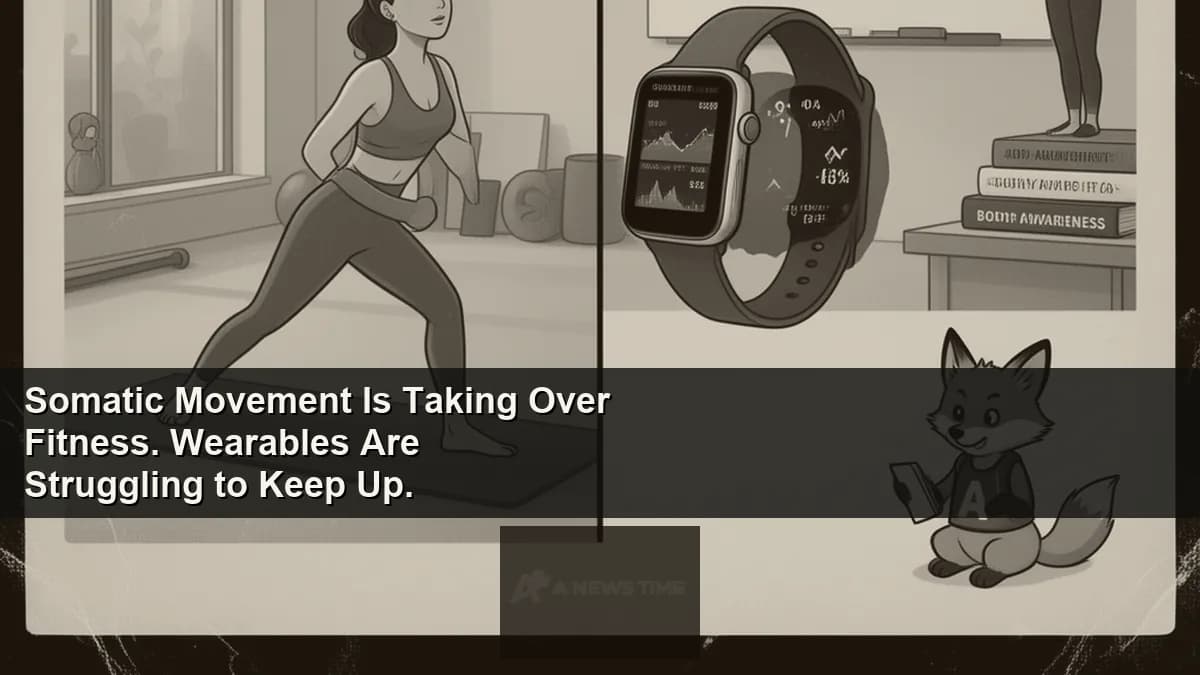
Fitness culture in 2026 is navigating a genuine philosophical tension. On one side: the wearable fitness technology industry, now a $60 billion global market, whose products track everything from heart rate variability to sleep staging to maximum oxygen consumption and package all of it into data dashboards that make movement feel like a professional discipline. On the other: somatic movement, a body-awareness approach rooted in neuroscience and bodywork traditions that is experiencing a mainstream cultural moment precisely because it asks practitioners to put the numbers away and pay attention to how they feel instead.
Somatic movement, which draws on practices including SE therapy, Feldenkrais Method, the Alexander Technique, and forms of yoga and Pilates that emphasize internal sensation over external form, has grown from a niche therapeutic approach into a mainstream wellness category in a remarkably short time. Search volume for somatic-related fitness content grew by more than 340 percent between 2024 and 2026, according to data from Google Trends, and the category has moved from primarily clinical and therapeutic settings into mainstream fitness studios, online classes, and the programming of major wellness platforms including Peloton, Calm, and Headspace.
What Somatic Movement Actually Involves
The word somatic derives from the Greek soma, meaning body, and somatic movement practices are united by an emphasis on interoceptive awareness, the capacity to perceive what is happening inside the body, rather than on performance outputs or external form. Where a conventional fitness class might cue participants to maintain a specific knee angle, achieve a particular depth of squat, or hit a target heart rate zone, a somatic movement session invites participants to notice how the movement feels in their joints, where tension is held in their body, and how their nervous system is responding to the practice.
The scientific rationale for this approach is grounded in research on the body-mind connection, specifically in the neuroscience of proprioception and interoception that has become more widely understood in mainstream health contexts since Bessel van der Kolk's The Body Keeps the Score reached cultural saturation. The premise is that the body holds patterns of tension, compensation, and guarding that influence both physical function and emotional regulation, and that movement practices that bring conscious awareness to these patterns can release them in ways that pure performance-oriented exercise cannot.
"Somatic movement is not about doing less. It is about attending more carefully to what is already happening. The data your fitness watch is collecting is happening to you. Somatic practice is about experiencing it directly rather than reading it on a screen afterward."
Dr. Sarah Novak, somatic movement therapist and researcher at the Somatic Institute, quoted in the New York Times Well section, February 2026
Practical somatic movement sessions vary considerably by practitioner tradition, but commonly include slow, exploratory movements with attention directed inward, body scanning practices that move awareness systematically through different body areas, breathing awareness exercises, and explicit attention to the nervous system states (activation, rest, and recovery) that movement evokes. Sessions are typically quieter and slower than conventional fitness classes, and outcomes are measured in subjective terms, "I felt more grounded," "that released something in my left hip," rather than in the metrics that fitness culture has normalized.
Why Now: The Burnout and Optimization Backlash
The timing of somatic movement's mainstream moment is not coincidental. It is arriving at the end of a decade in which fitness culture became increasingly performance-oriented, data-saturated, and intertwined with productivity culture in ways that have produced measurable burnout in the population of health-conscious adults who took the optimization imperative seriously.
Research on exercise motivation and adherence has consistently found that intrinsic motivation, the internal experience of the activity as pleasurable or meaningful, produces more durable exercise habits than extrinsic motivation based on performance goals, body composition targets, or comparison to others. The data-heavy fitness watch ecosystem, despite its marketing as a motivation tool, tends to reinforce extrinsic motivation: you are doing well if the numbers go up, doing poorly if they do not, and the number is always in view.
Somatic movement offers an explicit counter-proposition. The practice's authority comes from internal experience rather than external validation, making it structurally resistant to the comparison and achievement dynamics that have made performance-oriented fitness exhausting for many practitioners. For an audience of health-conscious adults who have been tracking their steps, their sleep scores, and their zone two heart rate minutes for years and who have found that all that tracking has not made them feel notably better, somatic movement presents an alternative approach that does not require any technology at all to access.
The Wearable Industry's Response: A Pivot Under Pressure
Fitness wearable manufacturers have been watching the somatic movement trend with a mixture of concern and opportunism. The concern is obvious: if the trend's central proposition is that quantification is the problem rather than the solution, the wearable industry's core value proposition is directly challenged. The opportunism is equally predictable: several manufacturers have begun adding features specifically designed for somatic and mindfulness-oriented use cases, attempting to position their devices as compatible with the trend rather than opposed to it.
Apple Watch's newest software update includes a feature called Body Awareness, which uses the watch's existing heart rate and motion sensors to guide users through body-sensing exercises without surfacing the specific numbers that the sensors are recording. The feature is designed explicitly for mindfulness and somatic use cases: you are guided through the practice, the watch is tracking physiological data in the background, but the quantified output is not displayed during the practice and is available only as a historical summary afterward if the user chooses to look at it.
Garmin has taken a different approach, adding a Mindful Movement mode to its fitness tracking platform that records somatic and yoga sessions as workout types with reduced metric display and an emphasis on duration and breath rate over the cardiovascular performance metrics that define the Garmin experience in its primary fitness applications. The feature is a relatively small addition to a product ecosystem built around athletic performance data, and Garmin's core user base has been largely indifferent to it, but it signals that the wearable industry is aware it needs to address users who find constant quantification counterproductive.
| Device/Platform | Somatic/Mindfulness Feature | Data Display During Practice |
|---|---|---|
| Apple Watch (watchOS 12) | Body Awareness mode | Minimal (historical only) |
| Garmin Forerunner | Mindful Movement workout type | Duration and breath rate only |
| Whoop 5.0 | Recovery-first framing | Removed from wrist display |
| Oura Ring Gen 4 | Guided readiness sessions | Not shown during practice |
The Evidence Base: What Research Actually Shows
The somatic movement trend is arriving with a more developed evidence base than previous wellness trends that achieved mainstream adoption without substantial scientific support. Several mechanisms within somatic practice have been studied with clinical rigor in the context of trauma recovery, chronic pain management, and anxiety treatment, and the results are compelling enough to have moved somatic approaches into clinical settings alongside more traditional physical and psychological therapies.
The transfer of that clinical evidence to the general wellness context requires some care. Somatic movement's demonstrated effects in trauma recovery and chronic pain do not automatically imply that the same mechanisms produce the same benefits in healthy individuals pursuing wellness maintenance. The honest position, which most credentialed somatic practitioners take, is that the evidence is strong for clinical populations and promising but less robust for the general wellness population.
What the available research does support is the central premise: interoceptive awareness is trainable, individuals with higher interoceptive accuracy report better emotional regulation, and movement practices that develop body awareness produce measurable differences in self-reported wellbeing. Whether those outcomes require the full somatic practice framework or whether simpler mindfulness-of-movement exercises produce similar benefits is an open research question.
The study that has generated the most discussion in wellness media in 2026 comes from the National Institutes of Health's Interoception and Mind-Body Research Program, which compared outcomes for three groups: individuals doing conventional fitness training with wearable feedback, individuals doing conventional training without data access, and individuals doing somatic movement with explicit attention to internal sensation. At the 12-week mark, all three groups showed comparable physical fitness improvements, but the somatic group showed significantly higher scores on measures of body satisfaction, emotional wellbeing, and self-reported exercise enjoyment. The data-free conventional group outperformed the data-with-feedback group on all three wellbeing measures, which is itself a finding that the wearable industry will not be citing in its marketing materials.
Integrating the Two Approaches
The practical landscape for most fitness-interested adults in 2026 is not a binary choice between quantified performance training and somatic practice. The most productive framing is that different practices serve different functions and that a full-spectrum fitness life includes elements of both: performance-oriented training when strengthening or cardiovascular capacity is the goal, somatic practice when stress regulation, body awareness, or movement quality is the priority.
Several practitioners are building studio programming that explicitly bridges the approaches: strength training classes that incorporate somatic body-awareness cues alongside conventional performance coaching, yoga formats that bring a somatic attention framework to alignment-based traditions, and recovery modalities like yin yoga and myofascial release that are inherently body-awareness-oriented but benefit from data-informed recovery context.
The wearable industry's long-term adaptation to the somatic trend will likely involve products that can be used in an opt-in data mode rather than as continuous monitors. The friction between constant quantification and present-moment awareness is real, and the most successful fitness technology products in the next several years may be those that allow users to choose when data serves them and when turning off the screen is the more appropriate tool for the practice they are engaged in. That is a design problem that no manufacturer has fully solved yet, and whoever gets there first is likely to capture an audience that the current generation of fitness watches is actively alienating.
Sources
- New York Times Well — The Body-Awareness Movement Taking Over Fitness Studios in 2026
- National Institutes of Health — Interoception and Exercise Wellbeing Study 2026
- Somatic Institute — Research and Evidence Base for Somatic Movement Practices
- Google Trends — Somatic Movement Search Volume Growth 2024-2026