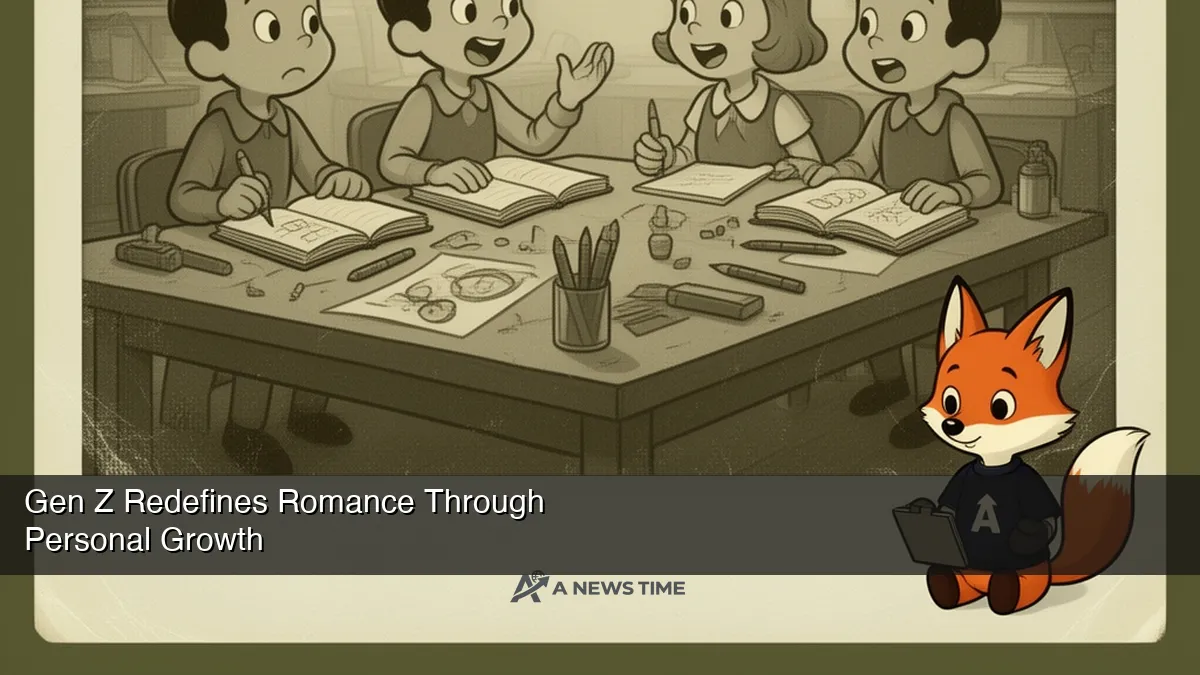
A Human Connection Study, reported by KTVZ and drawing on behavioral data from thousands of young adults, found that Gen Z's relationship to romance is being fundamentally restructured around personal development priorities. The finding is not, on its face, surprising: cultural observers have been tracking a generational shift in relationship attitudes for several years. What the 2026 data adds is specificity: personal growth is not simply an alternative to romantic partnership for Gen Z but is increasingly functioning as a precondition for it, a framework that reshapes everything from dating app behavior to the point at which young adults consider themselves relationship-ready.
The pattern is not uniform across gender lines. Research data shows young women leading the shift, reporting significantly higher resistance to traditional dating timelines and greater emphasis on what researchers describe as "relational prerequisites," their own emotional groundedness, clearly articulated values, and what has become the generational watchword: healthy boundaries. Young men's relationship behaviors are shifting too, but the data suggests the change is less pronounced and in some cases moving in a different direction, a divergence that researchers studying gender and dating are finding significant.
Personal Growth as the New Prerequisite
The concept of personal growth as a dating prerequisite would have been culturally legible in earlier generations, but it has taken on a particular intensity and specificity in Gen Z. Where earlier cohorts might have articulated this as "I need to find myself before I can be with someone," contemporary young adults are deploying a more psychologically sophisticated vocabulary: attachment theory, emotional regulation, nervous system awareness, and the language of therapy. These are no longer niche frameworks borrowed from clinical settings. They are constitutive of how a significant portion of Gen Z understands the preconditions for healthy romantic connection.
Dr. Sarah Hill, a social psychologist who has written extensively on generational shifts in relationship behavior, describes what she sees as a genuine cultural achievement alongside a potential overcorrection. The achievement is that a generation has, in many cases, acquired genuine psychological self-knowledge at an earlier age than previous cohorts. The potential overcorrection is the treatment of personal growth as a destination to be reached before romantic life can begin, rather than as a process that unfolds in parallel with relationship experience.
"What we're seeing in the data is a generation that has internalized the language and some of the tools of psychological development in genuinely sophisticated ways. The question is whether that sophistication is enabling connection or, in some cases, functioning as a reason to defer it indefinitely."
Dr. Sarah Hill, Social Psychologist and Relationship Researcher
This tension is documented across multiple data sources. The University of Zurich's longitudinal study on prolonged singlehood and well-being found that staying single longer is associated with measurable well-being costs, particularly in the late twenties, even as cultural narratives frame extended singlehood as self-development. The two bodies of research are not in direct contradiction, but they create a more complicated picture than either the "stay single for growth" narrative or the "find a partner quickly" narrative would suggest.
Emotional Intelligence as the New Attraction Metric
One of the more concrete shifts documented in the 2026 data involves what qualities Gen Z prioritizes when assessing romantic compatibility. Researchers studying dating behavior report that emotional intelligence has risen substantially as a stated priority, particularly among young women, in ways that represent a significant departure from the trait hierarchies that characterized earlier cohorts' expressed preferences.
Emotional intelligence as a concept encompasses multiple competencies: accurate recognition and naming of one's own emotions, regulation of emotional responses under stress, empathy for others' emotional states, and the ability to navigate conflict without escalation or withdrawal. These are skills that therapists and psychologists have long known predict relationship satisfaction, but they were not historically the primary axis on which romantic attractiveness was assessed in popular culture. The shift toward centering these qualities reflects what some researchers describe as a "therapy-informed" dating culture that has permeated Gen Z through a combination of social media, increased mental health awareness, and greater access to actual therapeutic frameworks.
The rise of "soft skills" as both a professional and romantic metric is not coincidental. Gen Z is the first generation to have been consistently told, through their educational and early professional formation, that emotional intelligence, communication ability, and interpersonal adaptability are the primary differentiators in knowledge-work environments. It follows that these same qualities would migrate into their frameworks for evaluating romantic partners.
Pushing Back Against Traditional Timelines
The generational resistance to traditional relationship timelines is among the most widely documented features of Gen Z's romantic landscape. The normative arc that previous generations largely accepted, dating in the late teens and early twenties, partnership by the mid-twenties, cohabitation and marriage by the late twenties, is being explicitly rejected by a significant proportion of Gen Z young adults, particularly women.
The resistance operates at multiple levels. At the individual level, many young women report deliberately avoiding serious partnership during educational and early career phases, citing research and personal observation about how romantic relationships tend to distribute domestic and emotional labor unequally. At the cultural level, Gen Z has developed a sophisticated critique of what they call "relationship escalator" thinking, the assumption that romantic relationships should follow a predetermined progression toward cohabitation, marriage, and children regardless of whether that progression serves the individuals involved.
This cultural shift has real data correlates. Marriage rates among adults under 30 continue to decline across most Western countries. The average age of first marriage in the United States continues to drift upward. Cohabitation rates have changed as a share of young adult living arrangements, but not uniformly in ways that suggest simply substituting unmarried partnership for marriage. A meaningful cohort is genuinely delaying all forms of formalized partnership in ways that previous generations did not.
The data from the University of Zurich's prolonged singlehood research adds an important counterpoint: the well-being costs of long-term singlehood are real and measurable, and they do not disappear because the cultural framing around singlehood has become more affirming. The gap between the cultural permission structure Gen Z has created around delayed partnership and the psychological reality documented in longitudinal research is one of the more interesting tensions in current social science on this topic.
The Role of Analog Solutions and Micro-Communities
Alongside the personal growth framing, 2026 trend data identifies a complementary development: Gen Z's growing interest in analog social infrastructure as a site for connection. This intersects with the broader social isolation data documented in survey research showing 72 percent of Americans rarely see people they care about, but takes a specific form for younger adults: the emergence of purpose-driven communities organized around shared activity rather than shared demographic identity.
Justin Gurland, founder of the community design organization The Maze, has argued that the most durable connections Gen Z is forming in 2026 are not arising from dating apps or social media platforms but from what he calls "social fitness" environments: spaces where people repeatedly encounter each other in contexts of shared challenge or purpose. The phenomenon spans running clubs, amateur sports leagues, skill-sharing cooperatives, community gardens, and hybrid social-professional co-working environments designed explicitly to facilitate friendship alongside productivity.
The concept of "social fitness" itself, which has emerged in behavioral health discourse, treats social connection as a skill and practice that requires deliberate cultivation rather than passive availability. It reframes the loneliness epidemic not as a failure of individual effort but as an infrastructure problem: the built environment and daily routines of contemporary adult life do not naturally generate repeated, purposeful encounters with the same people over time, which is what research on friendship formation identifies as the primary mechanism through which close bonds develop.
For Gen Z navigating the intersection of personal growth priorities and connection needs, this framing is potentially useful. It de-centers romantic partnership as the primary site of meaningful human connection and re-centers a broader ecosystem of relationships, while still taking seriously the evidence that some forms of intimate connection carry specific well-being implications that friendship and community alone do not fully replicate.
Communication Challenges in the New Landscape
One area where the data suggests genuine complexity involves communication itself. Gen Z has the most extensive vocabulary for relational psychology of any generation, drawn from therapeutic frameworks, social media discourse, and mainstream wellness content. They can discuss attachment styles, love languages, nervous system states, and communication modalities with fluency that would have been unusual outside clinical settings a generation ago.
And yet researchers studying actual communication behavior among young adults consistently document significant challenges in the translation of this vocabulary into practice. The gap between conceptual fluency and behavioral execution is a recurring theme in relationship research. Knowing the theory of non-violent communication does not automatically produce non-violent communication under emotional stress. Understanding attachment theory intellectually does not resolve anxious or avoidant attachment patterns in real relationship dynamics.
Several researchers have noted that the very richness of Gen Z's psychological vocabulary can sometimes create new barriers. When "having healthy communication" becomes a prerequisite that must be definitively established before commitment deepens, the developmental reality that communication skills improve within relationships, through practice and repair, can get lost. The idealized version of a relationship, mutually growth-oriented partners with excellent emotional intelligence and seamless communication, becomes both the stated goal and, for some young adults, the standard against which actual relationships are measured and found wanting.
This dynamic connects to broader patterns in how Gen Z processes information and forms expectations. Understanding how new work environments are shaping young adult social norms offers parallel insight: the idealization of perfect conditions before engagement is a pattern that appears across multiple domains of Gen Z life, not just romance.
What the Data Cannot Resolve
The research on Gen Z and romance in 2026 captures a generation in genuine transition, and genuine transitions are resistant to clean summary. The data supports several overlapping and sometimes contradictory readings. Gen Z is more psychologically sophisticated about relationships than previous cohorts, and that sophistication is, in meaningful ways, an achievement. The emphasis on emotional intelligence, healthy communication, and personal groundedness reflects genuine learning about what makes relationships function well over time.
At the same time, the data on well-being and prolonged singlehood, the broader picture of social isolation in American life, and the documented challenges in translating relationship vocabulary into relationship practice all suggest that the personal growth framing, taken to its logical extreme, can become a different kind of trap: not the trap of premature, unsatisfying commitment, but the trap of indefinite deferral justified by perpetually incomplete self-development.
The most interesting cultural question for this generation may not be whether personal growth is a legitimate priority for young adults considering romance, but how to hold personal development and relational engagement as simultaneously ongoing processes rather than sequentially completed stages. The research literature on healthy relationships consistently finds that people grow most significantly within relationships, through the friction and repair of close contact with another person's full reality, not only in preparation for them.
As this cohort moves through its late twenties and into its thirties, longitudinal data will clarify whether the patterns documented in 2026 represent a durable structural shift in how partnership forms in contemporary Western life or a developmental phase that resolves in ways broadly consistent with previous generations' trajectories. The answer will matter considerably for how researchers, policymakers, and individuals think about the infrastructure of adult social life in the decades to come.
Frequently Asked Questions
What does research show about Gen Z's approach to dating and relationships?
A 2026 Human Connection Study found that Gen Z's pursuit of personal growth is reshaping how the generation approaches romance. Young women in particular report higher resistance to traditional dating timelines and greater emphasis on emotional groundedness, healthy boundaries, and emotional intelligence as relational prerequisites. Both personal development and improved communication skills have become central to how Gen Z frames relationship readiness.
Are Gen Z young women dating less than previous generations?
Data suggests a significant portion of Gen Z young women are deliberately resisting traditional relationship timelines, citing concerns about unequal labor distribution in relationships and a broader cultural critique of "relationship escalator" thinking. Marriage rates among under-30 adults continue to decline, and the average age of first marriage continues to rise, though whether this represents a permanent structural shift or a developmental delay remains an open research question.
What are purpose-driven micro-communities and why are they relevant to Gen Z romance?
Purpose-driven micro-communities are small groups organized around shared activities or goals rather than shared demographics. Community designers and social researchers have found these settings, including running clubs, skill-sharing cooperatives, and community sports leagues, are among the most effective environments for forming adult friendships and, relatedly, romantic connections. Gen Z's growing interest in these analog social structures reflects dissatisfaction with digital platforms as the primary vehicle for meaningful connection.
How does the personal growth emphasis affect well-being for Gen Z singles?
Research presents a complex picture. The University of Zurich's longitudinal study on prolonged singlehood found measurable well-being costs, including declining life satisfaction and rising loneliness, particularly in the late twenties, even when cultural narratives frame extended singlehood positively. The tension between Gen Z's growth-oriented relationship framing and the well-being evidence on social connection is one of the more significant unresolved questions in current relationship research.
Sources
- Human Connection Study: Gen Z Redefines Romance, KTVZ
- Prolonged Singlehood and Well-Being in Emerging Adulthood, Phys.org / University of Zurich
- 2026 Relationship Trends: Analog Solutions and Emotional Intelligence, Medium
- Gen Z Dating and Personal Growth: What the Research Shows, Institute for Family Studies