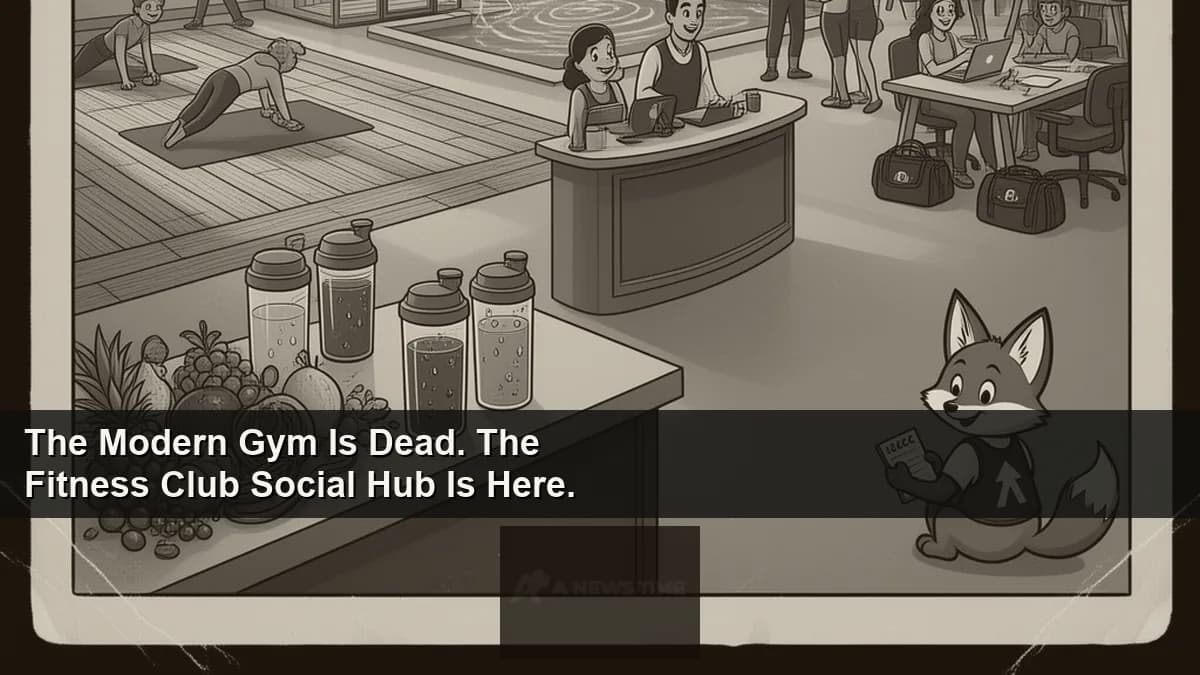
Something has changed about the gym. Not the weights or the treadmills. Those are still there, largely unchanged since the 1990s. What has changed is why people are going, what they are doing when they get there, and what they expect the experience to feel like. The traditional gym, that functional, fluorescent-lit transaction point for purchasing access to equipment, is being replaced by a different kind of institution: the fitness club social hub, where training is one component of a multi-purpose experience that also includes recovery, coworking, community programming, and the kind of social infrastructure that many Americans have been seeking since the pandemic years exposed how fragile most of their community connections actually were.
The data tells the story in aggregate. Nearly 77 million Americans now hold gym memberships, the highest figure on record according to industry tracking from . The global health and fitness club market is projected to surpass $200 billion by 2030. Boutique fitness concepts, the category most associated with the social club model, are growing at nearly double-digit annual rates while traditional big-box gym membership numbers have been flat or declining. The market is not growing uniformly. It is growing specifically where the social club model has taken hold.
The Friction Removal Theory
The conceptual framework behind the fitness club social hub is straightforward once you hear it articulated, and it has been articulated most clearly by the founders and operators running the successful versions of these spaces. The insight is about friction.
Traditional gyms require a specific kind of intentionality to use consistently. You carve out time, drive or commute to the gym, work out, and leave. The gym visit is a discrete event inserted into your day, which means it requires activation energy and competes with everything else competing for your time. When your schedule gets busy, the gym visit is one of the first things that gets cut because it is a standalone block with no other hook into your day.
The fitness club social hub removes that friction by collapsing multiple destinations into one. If the gym is also where you work for two hours after a morning class, have lunch, meet with friends in the evening, and attend a wellness programming event on Saturday, then going to the gym stops being a separate decision. It becomes the place where your day happens. The people building Kollective Social Performance Club and similar concepts around the country have made this logic explicit: one location for training, recovery, answering emails, and connecting with other people creates a consistency that isolated gym visits cannot match.
| Traditional Gym Model | Fitness Club Social Hub Model |
|---|---|
| Equipment access transaction | Multi-use community destination |
| Fluorescent, functional spaces | Designed social and recovery areas |
| Classes as add-ons | Curated programming as core product |
| Member acquisition by price | Member acquisition via community referral |
| Inconsistent usage rates | Consistency through friction removal |
| Transactional membership | Identity-based membership |
The 60% Flexibility Finding and What It Actually Means
Industry surveys from find that 60% of gym members prefer flexible, customizable fitness experiences over fixed-schedule class structures or equipment-only models. This figure, which has been cited by boutique fitness operators and industry analysts alike, requires some interpretation. "Flexible" and "customizable" mean different things to different members.
For some, flexibility means the ability to drop into any class format without commitment to a specific weekly schedule. For others, it means choosing between different modalities, a strength session one morning, a yoga class the next afternoon, a cold plunge and sauna recovery session when their body needs it. The common thread is not a rejection of structure but a rejection of inflexibility imposed by the gym rather than chosen by the member.
The social club model accommodates this more naturally than traditional gyms because its physical design anticipates different uses at different times. A space that has a cycling studio, a free weight area, a recovery zone, a coworking lounge, and a juice bar can serve the same member across multiple use cases in a single visit or across multiple visits with different purposes. The infrastructure is designed for breadth rather than optimization around a single fitness modality.
The Community Acquisition Phenomenon
One of the most striking data points in the boutique fitness industry's current performance is how new members are finding these clubs. Over 80% of new boutique fitness members are acquired through community-driven channels, meaning word of mouth, personal referrals, and social network recommendations, rather than digital advertising or promotional offers. That figure stands in sharp contrast to the acquisition economics of traditional gyms, which rely heavily on promotional pricing, digital advertising, and gym-adjacent retail partnerships to attract new members.
The community acquisition pattern reflects something specific about the social club model: its members are genuinely advocates rather than mere customers. If the club has functioned as a social infrastructure provider, the member's social network increasingly overlaps with their gym community. Recommending the club to a friend is not just a product endorsement. It is an invitation into a social circle. That dynamic creates significantly stronger word-of-mouth than any advertising campaign can manufacture.
The implication for the industry is that the competitive advantage of social club fitness operators is not primarily operational. It is social. A competitor can copy the coworking lounges and cold plunge pools. It cannot easily copy the established community that makes an existing club the gravitational center of a social network in a specific neighborhood or city. The early movers in social club fitness have a kind of community incumbent advantage that traditional competitive analysis misses.
Recovery as a Core Product
One of the most significant changes in the social club fitness model relative to traditional gyms is the integration of recovery infrastructure as a primary offering rather than an amenity. Ice baths, infrared saunas, contrast therapy, compression therapy, red light therapy, and massage services are present in the most developed social clubs not as extras for premium members but as central features of the space that members use regularly and that inform their decision to join.
The recovery turn in fitness culture has been building for several years. Elite athletic training long emphasized recovery as equal to training in performance terms. The democratization of that insight, the recognition that non-athletes benefit from deliberate recovery infrastructure too, has filtered into the consumer fitness market at a pace that traditional gyms were not positioned to capture. A traditional gym could add a sauna. Turning a gym into a recovery destination requires different infrastructure and different programming, and it changes the revenue model because recovery services carry different pricing than equipment access.
The overlap between recovery programming and the wellness culture more broadly is relevant here. The art and culture wellness research published in from a large-scale study found that regular participation in experiences designed for mental and emotional wellbeing, including creative activities and community rituals, produces measurable improvements in cognition, blood pressure reduction, and stress hormone levels. The social club fitness model is, implicitly, capturing some of these same wellbeing effects by embedding its members in a community with shared rituals and meaningful social connection.
For context on where fitness culture intersects with broader wellness trends, our earlier coverage of the somatic movement and fitness tracking integration trend of 2026 addresses a parallel development: the shift toward movement modalities that emphasize internal experience over performance metrics. The social club model and the somatic movement trend are both responses to the same underlying shift in what people are seeking from fitness.
The Boutique Business Model: Why It Works Now
The economics of boutique fitness at the social club end of the market are more complex than traditional gym economics, and they depend on assumptions that traditional gym operators have historically rejected as too risky. Premium boutique fitness clubs charge significantly more per member than traditional gyms, often 3x to 10x the monthly cost, on the assumption that members who are embedded in the social community and deriving significant lifestyle value from their membership are substantially less price-sensitive than traditional gym members whose primary motivation is equipment access at low cost.
The assumption has proven largely correct for the leading operators. Churn rates at social club fitness concepts are meaningfully lower than at traditional gyms, where January signup spikes typically reverse by March as members who joined to get in shape slide back into pre-New Year patterns. Members who attend a club primarily for community and social connection rather than fitness accountability are less vulnerable to motivation fluctuations because their reason for going is not dependent on whether they feel like exercising on a given day.
The coworking component that some social clubs have integrated adds a different economic dynamic. Members who work from the club during business hours are drawing on infrastructure with real costs, comfortable seating, reliable wifi, good coffee, meeting spaces, that the club must provide and maintain. But they are also spending more time in the space, consuming food and drink, and deepening the social connections that make them good community advocates. The economics work when the premium membership pricing accounts for the full cost of the infrastructure the member is actually using.
Who Is Building This
The social club fitness model is being built by a diverse set of operators, ranging from single-location independents in specific urban neighborhoods to regional chains attempting to scale the concept without losing the community texture that makes it work at the unit level.
The scaling challenge is real. The community that makes a social club fitness concept successful is inherently local and personal. A club that works in one neighborhood because a specific community gravitates to it does not automatically transfer to another neighborhood because the company builds a second location. The operators who have scaled successfully have been careful about site selection and community building at each location, treating each club as a distinct community rather than a branded product rollout.
Private equity has noticed the category. Several boutique fitness concepts with social club characteristics have received significant growth capital over the past 18 months, enabling faster expansion than self-funded growth would permit. The capital influx is creating tension between the community-first values that make these concepts work and the unit economics and expansion timelines that PE investors typically impose. Which side of that tension wins at each company will determine which operators are still describing themselves as community clubs in five years and which have evolved into something closer to the franchised boutique fitness model that existed before the social club iteration.
The broader wellness industry context is relevant for understanding where fitness clubs are heading. Our recent coverage of April 2026 wellness trends including the cabbage core and line dancing revival illustrates how wellness culture is continuing to democratize and diversify in ways that support the social club model's premise that wellness is a social behavior rather than an individual discipline.
What This Means for Traditional Gyms
The rise of the social club model does not mean the death of the traditional gym. The market is stratifying rather than converting wholesale. Budget gym operators, Planet Fitness and its equivalents, continue to grow their membership bases at price points that the social club model cannot reach. The traditional gym's value proposition, maximum equipment access at minimum cost, remains real for a substantial segment of the fitness market.
What is being disrupted is the middle market: the mid-tier traditional gym that charged $40 to $80 per month for equipment access and classes without building the community infrastructure that would justify that pricing in the current environment. These operators are being squeezed from below by cheaper budget gyms and from above by social clubs that charge more but deliver a categorically different experience. The mid-tier traditional gym is the segment of the fitness market under the most competitive pressure in 2026.
Some traditional gym operators are attempting to reposition by adding social infrastructure, coworking spaces, improved recovery areas, and more deliberate community programming. The challenge is that these additions work best when they are present from a club's inception, shaping its physical design and member culture from the beginning. Retrofitting social club infrastructure into a traditional gym that members already relate to as a transactional equipment destination is harder than building the social identity from the ground up.
What 77 Million Members Actually Signal
The record 77 million American gym members figure deserves one more moment of attention. The United States has never had this many people holding gym memberships simultaneously. But the meaningful question is not how many people have memberships. It is how many are actually using them, and whether the definition of "using" a gym membership has expanded to include activities that traditional gyms never anticipated.
If a significant portion of the membership growth is concentrated in social club and boutique fitness concepts where members spend multiple hours per week in the space across multiple use cases, then the 77 million figure reflects something more substantial than the gym membership inflations of previous decades. The January joiners who stopped going in March were counted in historical membership figures the same as consistent users. If the social club model is genuinely producing higher-consistency members, the 77 million is a different kind of statistic than its predecessors.
The fitness industry's transformation from equipment transaction to social infrastructure is not complete, and it is not evenly distributed across markets or demographics. Urban professionals with premium incomes are the current primary market for social club fitness. Whether the model can extend its reach to different economic strata, whether the friction-removal insight can be implemented at lower price points, is the question that will determine whether 2026's transformation becomes a durable realignment of American fitness culture or a premium-market evolution that leaves most gym members in traditional facilities.
Sources
- Fitness Club as Social Space: The New Gym Model - Men's Fitness via Yahoo Lifestyle
- Global Health and Fitness Club Industry Overview - Statista
- International Health, Racquet and Sportsclub Association - 2026 Industry Report
- Regular Arts Participation and Health Outcomes Study - Los Angeles Times, April 2026