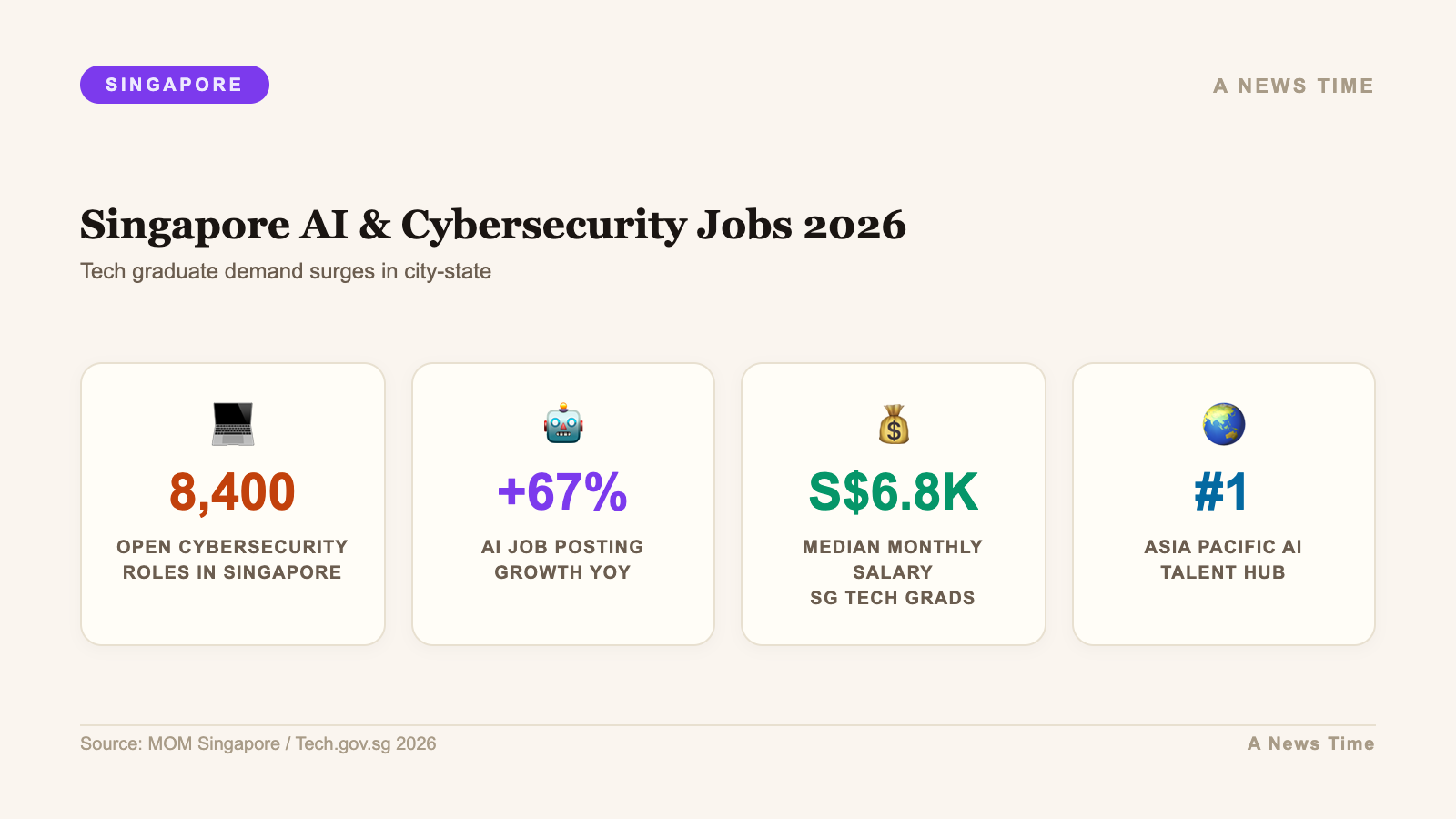
Singapore's government moved quickly and deliberately on , announcing a dedicated job portal for university undergraduates in technology courses at the inaugural AI conference of the Singapore Computer Society, held at the Mandarin Oriental hotel. The portal, named the Tech Elevation and Career Hub (TECH), launched with approximately 800 job listings and is operated by the Infocomm Media Development Authority (IMDA) and the Employment and Employability Institute. The announcement was made by Senior Minister of State for Digital Development and Information Tan Kiat How, who framed the move as a deliberate response to AI disruption that is already reshaping the nature of entry-level tech work.
"For our students, this means a simpler and more facilitated journey into the workforce. Instead of navigating multiple platforms, they can go to one place to find tech jobs and internships, access career coaching, and identify training opportunities that can strengthen their employability," said Mr. Tan.
What the portal actually offers
The TECH portal aggregates entry-level positions across three core technical domains: cybersecurity, artificial intelligence, and data analytics. Current listings include roles from NCS Singapore, ST Engineering, and Shopee, companies that span government-linked enterprise, defense technology, and e-commerce, giving undergrads a broad cross-section of Singapore's tech employment landscape in one place.
The portal is not just a job board. IMDA is pairing the listing aggregation with career coaching access and training opportunity identification, the idea being that a student who does not yet qualify for a listed role can use the same platform to identify what additional credential or experience would close the gap. The design reflects a genuine understanding of how early-career tech job seeking actually works: the barrier is often not finding postings but knowing what to do about the gap between current qualifications and what employers want.
Beyond the portal itself, the expanded program will provide graduates with domain knowledge in financial services, healthtech, and the public sector. The reasoning is practical. Employers are not simply looking for computer science graduates with technical skills. They are looking for individuals who understand how to apply and integrate AI into their specific domain, preferably from day one. A cybersecurity professional who understands the regulatory environment of a Singapore bank is more employable than one who does not, regardless of technical equivalence.
The program it expands: TIP Alliance
The TECH portal is built on the foundation of the TechSkills Accelerator for ITE and Polytechnics, or TIP Alliance, a program launched in 2022 specifically for polytechnic and Institute of Technical Education students in information and digital technology disciplines. Since its inception, TIP Alliance has offered over 1,000 tech job listings and facilitated more than 2,300 internship placements for ITE and polytechnic students.
The expansion to university undergraduates, now rebranded TIP Alliance+, reflects both the program's success and the recognition that AI disruption is not concentrated at the diploma-holder level. University graduates in computing, data science, and information systems are facing many of the same entry-level anxieties as their polytechnic counterparts. The decision to extend support upward in the credential hierarchy is a signal that the government sees the disruption as spanning educational tiers rather than being limited to specific qualification levels.
TIP Alliance+ will also offer graduates access to tech-related internships lasting 10 to 12 months. The length is deliberate. A 10 to 12 month placement gives an employer enough time to actually train a graduate and derive meaningful productivity, which makes the placements more attractive to employers than shorter internships where the training cost exceeds the contribution window.
The workforce data behind the policy
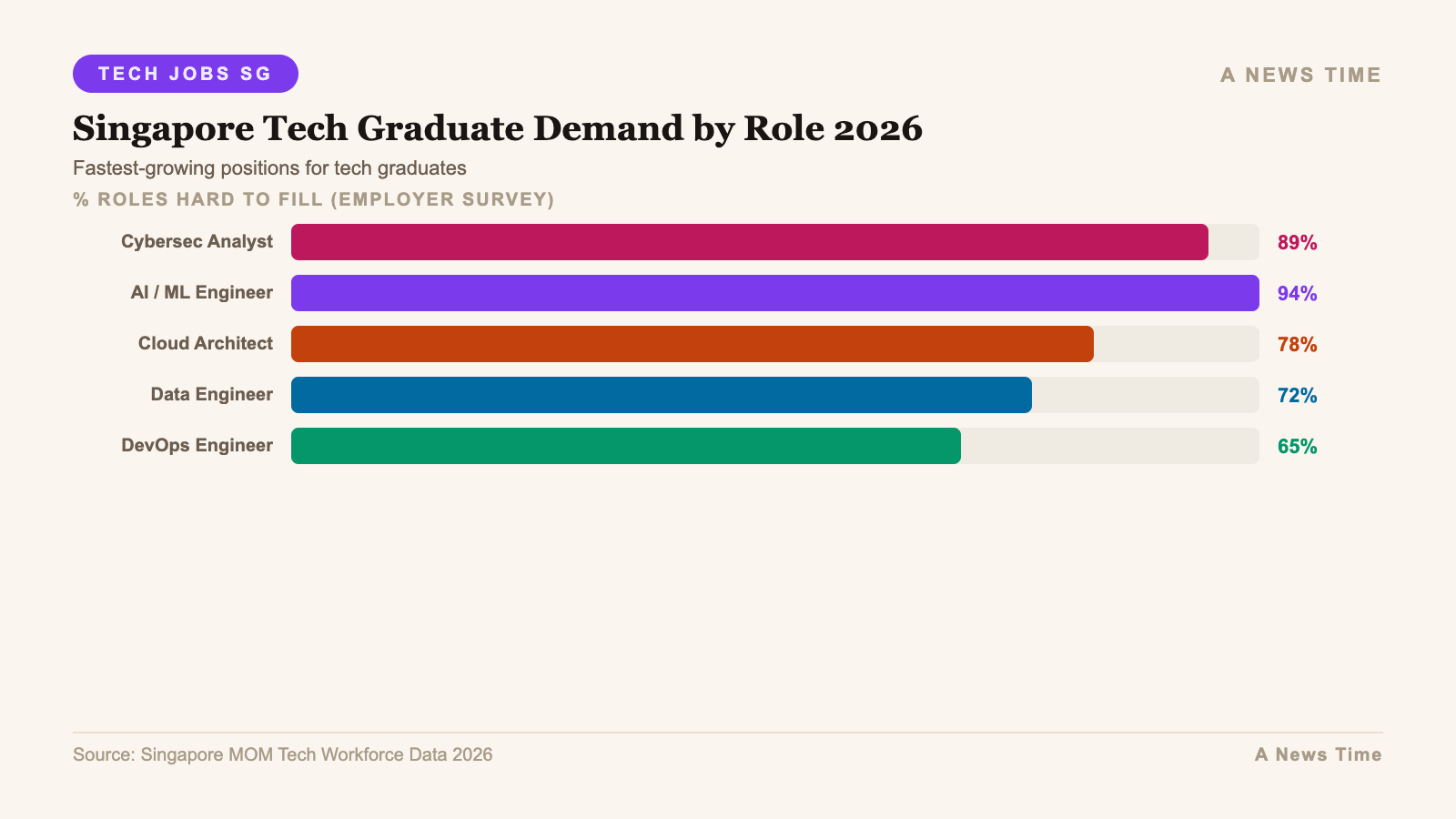
Singapore's government is not operating on instinct. IMDA's Singapore Digital Economy Report, released in October 2025, revealed that the local tech workforce grew from 208,300 in 2023 to 214,000 in 2024. The fastest-growing roles were AI and data specialists and cybersecurity professionals. More telling is the distribution of that growth: tech roles in non-tech sectors grew 3.9 percent from 2023 to 2024, outpacing the 1.1 percent increase in tech companies themselves.
That gap reflects a fundamental shift in where tech talent is actually being absorbed. Singapore's financial services firms, healthcare systems, and government agencies are digitalizing aggressively and adopting AI in their workflows. They need tech professionals who understand both the technology and the domain, not just engineers who can code in isolation. The domain knowledge initiative embedded in TIP Alliance+ is a direct policy response to that data.
The Government Tech Pathway initiative, a collaboration between IMDA, the Government Technology Agency of Singapore (GovTech), and the Singapore Computer Society, offers stackable short modules that teach students how the Singapore government builds and operates its digital infrastructure, including security requirements and deployment processes. This gives students a direct pathway into public sector tech roles while also making them more informed professionals when they end up in the private sector.
Why Singapore is moving faster than most countries
Singapore's response to AI-driven tech disruption is structurally distinct from how most countries are handling the same problem. Rather than leaving the transition between education and employment to chance, or delegating it entirely to market forces, the government has built a deliberate intermediary infrastructure: a joint pathway from learning to workplace exposure to employment to continued skills deepening, designed by schools, employers, and government working together.
Mr. Tan's framing made the policy logic explicit. "Responsibility cannot fall squarely on one party because schools cannot prioritise industry-ready skills at the expense of strong foundations, while companies can no longer be expected to shoulder all basic on-the-job training as AI automates many junior tasks." The argument is that AI disruption has broken the traditional internship-to-employment pipeline because the junior tasks that used to justify bringing entry-level workers in are increasingly being done by AI. Which means someone else has to fund the transition layer between classroom and productive employee.
Singapore's answer is that the government funds it, through IMDA, in partnership with employers who commit to the placement programs. This is a meaningful departure from the US model, where the cost of that transition falls primarily on the graduate, through internships that may be unpaid or minimally paid, and where the quality of the resulting employment outcome is highly variable.
The anxiety this is designed to address
Mr. Tan acknowledged openly that the launch comes amid AI disruption that has changed the nature of many entry-level roles and fuelled anxieties over graduates' job prospects and the relevance of their skills. That acknowledgment is politically significant. Singapore's government does not habitually make public statements about workforce anxiety without having a policy response ready, and the TECH portal is the response.
The anxiety is real and documented. Young workers rank among the most worried about AI affecting jobs according to Randstad survey data cited by The Straits Times. In Singapore specifically, the combination of a small domestic labor market, high educational attainment, and rapid enterprise AI adoption creates a particularly concentrated version of a problem that is global. More graduates competing for fewer entry-level roles in a market where AI is handling the work those roles used to involve.
The pressure is also coming from a different direction. With non-technical professionals now using AI-enabled tools to launch, automate, and scale businesses, from telehealth providers to resume builders, the bar has been raised for tech professionals. Being technically competent in 2026 means competing not just with other computer science graduates but with business professionals who have upskilled into AI tools. The domain knowledge component of TIP Alliance+ is a direct response to that pressure.
Implications for tech education globally
Singapore's approach offers a template that other governments and universities are watching. The core elements are replicable: a sector-specific portal that aggregates verified entry-level listings, paired with career coaching and domain knowledge training, supported by long-duration internship placements that give employers enough time to make the investment worthwhile. None of these elements require uniquely Singaporean institutions.
What they do require is the willingness to coordinate between government, employers, and educational institutions in a way that US and European systems tend to resist. The coordination cost is real. But so is the cost of the alternative: graduates with expensive degrees and no pathway into the industries those degrees were supposed to prepare them for.
Singapore's tech workforce data suggests the investment is tracking well. Growing from 208,300 to 214,000 tech workers in a single year in a city-state of 5.6 million people is a significant expansion rate. The distribution of that growth into non-tech sectors, where AI-adjacent roles are proliferating, confirms that the pathway the government is building connects to genuine labor market demand rather than artificially supported placements.
For tech graduates in other countries watching this unfold, the Singapore model raises a practical question: what does the equivalent infrastructure look like where they are, and who is building it? In the absence of government coordination, the work falls to universities, professional associations, and individual employers. The urgency is the same everywhere. The mechanisms for addressing it are not.
What to watch
Three things to follow. The first is the TECH portal's placement rate at six and twelve months. IMDA has the data infrastructure to track this, and publishing it publicly would give the policy genuine accountability. The second is whether TIP Alliance+'s domain knowledge modules, particularly the Government Tech Pathway, generate measurable increases in public sector tech hiring from the 2026 and 2027 cohorts. The third is whether other ASEAN governments, particularly Malaysia and Indonesia, adopt similar portal structures given Singapore's proximity and the regional competition for tech talent. Singapore's approach to AI-era workforce transitions is becoming as much a soft power export as a domestic policy, and the 2026 launch marks the clearest articulation yet of what that model looks like.