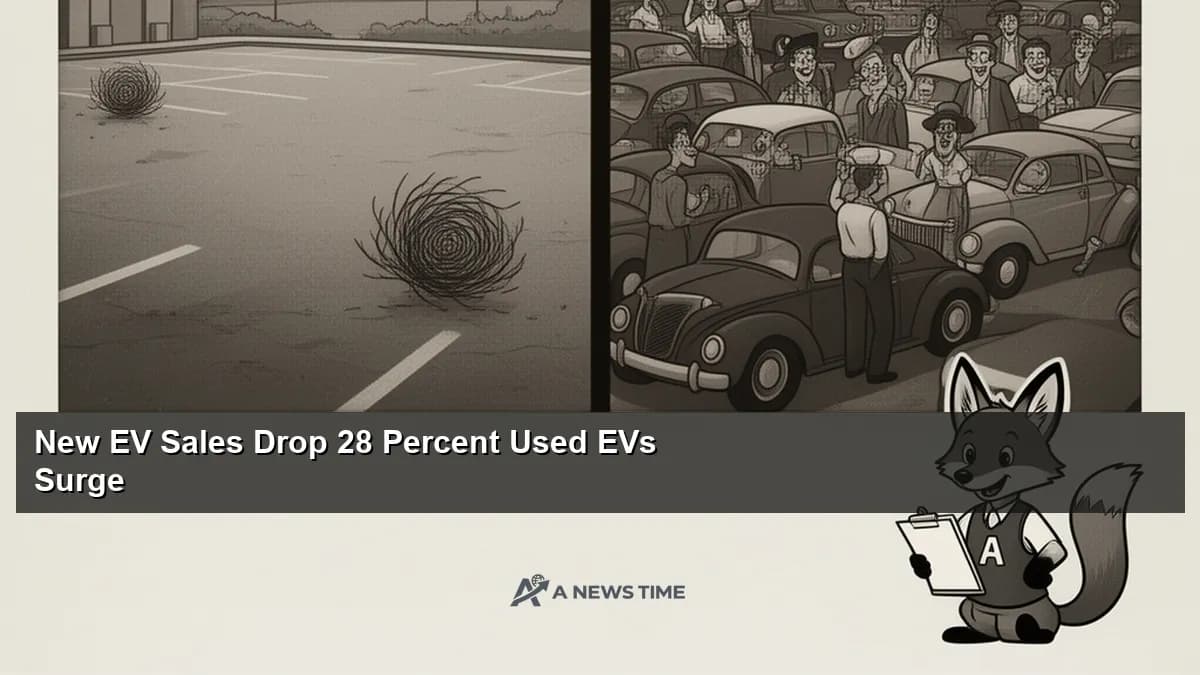
The American electric vehicle market split into two sharply diverging stories in the first quarter of 2026. New EV registrations dropped 28 percent year-over-year to approximately 212,600 units, the steepest quarterly decline since EVs became a meaningful share of the U.S. auto market. At the same time, used EV sales surged roughly 12 percent to near-record levels, driven by plummeting resale values that have made secondhand electric vehicles some of the most compelling bargains in the entire automotive market. The result is a bifurcated landscape where new EVs are struggling to find buyers while used EVs are flying off dealer lots.
New EV Sales: The Numbers Behind the Drop
To understand the 28 percent decline, you need to look at what happened in Q1 2025, which serves as the comparison baseline. Early 2025 was the tail end of the EV incentive rush, with buyers accelerating purchases to lock in federal tax credits before anticipated policy changes. That pulled demand forward, creating an artificially inflated baseline that makes the 2026 comparison look worse than the underlying trend might suggest.
But even adjusting for that pull-forward effect, the numbers are genuinely soft. Analysts at Cox Automotive estimated that the "pull-forward adjusted" decline was still in the range of 18 to 20 percent, meaning that roughly half the drop reflects timing effects and the other half reflects a real contraction in new EV demand.
The brand-level breakdown reveals where the pain is concentrated:
| Brand | Q1 2026 Units | Q1 2025 Units | YoY Change | Market Share |
|---|---|---|---|---|
| Tesla | ~98,000 | ~148,000 | -34% | 46.1% |
| Hyundai/Kia/Genesis | ~28,500 | ~33,000 | -14% | 13.4% |
| Ford | ~18,200 | ~24,500 | -26% | 8.6% |
| GM (Chevy/Cadillac) | ~16,800 | ~21,000 | -20% | 7.9% |
| BMW | ~11,400 | ~12,800 | -11% | 5.4% |
| Mercedes-Benz | ~8,900 | ~10,500 | -15% | 4.2% |
| Rivian | ~7,600 | ~9,200 | -17% | 3.6% |
| All Others | ~23,200 | ~36,000 | -36% | 10.9% |
Tesla's 34 percent decline is the most significant in absolute terms, representing roughly 50,000 fewer units than Q1 2025. Some of that reflects the aging Model 3 and Model Y product cycles, but brand sentiment also appears to be a factor. Multiple consumer surveys in early 2026 showed declining purchase consideration among politically liberal buyers, a demographic that historically over-indexed in EV purchases. Whether this is a temporary sentiment dip or a structural shift in Tesla's brand equity remains one of the most debated questions in the industry.
Among non-Tesla brands, BMW and Mercedes-Benz showed the most resilience, with relatively modest declines. Their premium positioning means they compete less directly on price, and their buyers tend to be less sensitive to the cost-of-ownership calculations that are deterring mainstream buyers from new EVs.
Used EVs: The Other Side of the Coin
While new EV showrooms have been quiet, used EV lots have been busy. Used EV transaction volumes rose approximately 12 percent year-over-year in Q1 2026, reaching near-record levels that surprised even bullish analysts. The driver is simple economics: used EV prices have fallen so dramatically that they now represent genuine value propositions for cost-conscious buyers.
The average transaction price for a used EV in March 2026 was approximately $24,800, down from $31,200 in March 2025 and a peak of $43,900 in March 2023. That three-year price decline of 43 percent far outpaces the depreciation curve of comparable used gas vehicles, which fell roughly 12 percent over the same period. A three-year-old Tesla Model 3 Long Range, which sold new for $47,000-$52,000, is now trading in the $22,000-$26,000 range on the used market. A two-year-old Chevrolet Equinox EV can be found for under $22,000.
For buyers willing to navigate the used market, the value equation has flipped. A used EV purchased at $24,000 with 250 miles of range offers dramatically lower per-mile fuel and maintenance costs than a comparable used gas vehicle. The typical used EV buyer is saving $1,200 to $1,800 per year on fuel alone (based on national average electricity and gasoline prices as of March 2026), and maintenance costs for EVs remain significantly lower due to fewer moving parts, no oil changes, and regenerative braking that extends brake pad life.
Why New EV Prices Are Not Falling Fast Enough
The obvious question raised by the used EV surge is: why are buyers choosing used EVs over new ones? If new EV demand is soft, why are manufacturers not cutting prices to clear inventory?
Some are. Tesla has conducted multiple rounds of price cuts since 2023, and several other brands have offered aggressive lease deals and dealer incentives. But there are structural limits to how much new EV prices can fall. Battery packs remain the single most expensive component in an electric vehicle, typically accounting for 30 to 40 percent of the total vehicle cost. Tariffs on battery materials have pushed pack costs back above $155 per kWh, as detailed in reporting on the broader wave of EV program cancellations. Until pack costs drop meaningfully, there is a floor below which new EVs cannot be profitably sold.
The result is a price gap between new and used EVs that is wider than in any other vehicle segment. A new 2026 Tesla Model Y starts at approximately $44,990. A 2023 Model Y with 30,000 miles can be purchased for $24,000-$27,000. That $18,000-$21,000 gap is a powerful incentive for budget-sensitive buyers, and it explains why the used market is absorbing demand that new EVs cannot capture at current pricing.
There is also a psychological dimension. New car buyers are risk-averse about emerging technology, and the barrage of headlines about EV depreciation has made some consumers wary of buying a new electric vehicle only to watch it lose 30-40 percent of its value in two years. Used EV buyers, by contrast, are purchasing vehicles that have already absorbed the steepest portion of their depreciation curve. The downside risk feels smaller, even though the vehicle is functionally identical to a new one with a few years of wear.
The Depreciation Spiral and What Drives It
EV depreciation rates have been a persistent concern since 2023, and the dynamics feeding them are worth understanding in detail because they affect both new and used markets.
Three primary factors drive the unusually steep depreciation:
Rapid technology iteration. Unlike gas vehicles, where a 2023 model and a 2026 model may differ only in minor trim and feature updates, EVs have seen meaningful improvements in battery chemistry, charging speed, and software capability in short timeframes. A 2022 EV may charge at a maximum of 150 kW, while its 2025 replacement charges at 250 kW. That kind of functional obsolescence depresses the value of older models more aggressively than normal wear and tear would suggest.
Manufacturer price cuts on new models. When Tesla cut the Model Y price by $13,000 between early 2023 and late 2024, every used Model Y on the market instantly lost a corresponding chunk of value. This is unusual in the auto industry, where new car prices tend to be stable or slowly rising. The cascading price cuts created a self-reinforcing depreciation cycle that eroded consumer confidence in EV residual values.
Federal tax credit structure. The Inflation Reduction Act's $7,500 new EV tax credit creates an artificial price advantage for new vehicles that used vehicles cannot match (the used EV credit is capped at $4,000 and subject to income limits). Paradoxically, this incentive structure may actually accelerate depreciation by making the new-to-used price gap feel smaller at the point of purchase, which reduces the willingness of used buyers to pay premium prices for recent-model-year EVs.
Regional Patterns: Coasts vs. Interior
The new vs. used EV split also has a geographic dimension. New EV sales have held up relatively better in California, the Pacific Northwest, and the Northeast corridor, where charging infrastructure is denser, electricity is often cheaper than gasoline on a per-mile basis, and state-level incentives supplement federal credits. California alone accounts for roughly 35 percent of all new EV registrations in the United States, a concentration that has intensified rather than diluted as national demand has softened.
Used EV sales, by contrast, are growing fastest in markets where new EVs were previously rare: the Southeast, the Midwest, and parts of Texas. These are regions where the average household income is lower, price sensitivity is higher, and the appeal of a $22,000 used EV with minimal fuel costs resonates strongly with buyers who might never have considered a $45,000 new one. Dealers in these markets report that used EVs are attracting a different buyer profile than the traditional EV demographic: pickup truck owners looking for a cheap commuter vehicle, retirees on fixed incomes drawn to low operating costs, and young buyers priced out of the new car market entirely.
This geographic shift has implications for charging infrastructure. As used EVs spread into markets where Level 2 and DC fast charging stations are sparse, the charging experience for those new owners will be meaningfully different from the experience in well-served coastal markets. Whether this creates a new wave of dissatisfied owners or drives organic demand for charging buildout in underserved areas remains to be seen. The economic headwinds from rising oil prices could accelerate the shift in either direction.
Manufacturer Responses and Inventory Dynamics
Automakers are responding to the bifurcated market in different ways, and those responses reveal their strategic priorities.
Tesla has leaned into aggressive pricing and lease deals, offering a $299/month lease on the Model 3 in some markets, a price point designed to compete directly with midrange gas sedans. The company has also expanded its certified pre-owned program, a tacit acknowledgment that the used Tesla market is now a competitive battleground rather than an afterthought.
Ford has taken a different approach, reducing production volumes on the Mustang Mach-E and F-150 Lightning to avoid dealer inventory pileups while increasing incentive spending on existing stock. Ford's EV inventory days-supply stood at 112 days in March 2026, well above the industry average of 75 days for all vehicles, but down from a peak of 140 days in November 2025.
Hyundai and Kia have pivoted marketing budgets toward their plug-in hybrid offerings while maintaining modest EV production volumes. The Hyundai Ioniq 5 and Kia EV6 remain competitive vehicles, but the brands are clearly managing expectations around EV volumes while PHEVs take a larger share of their electrified mix.
GM has perhaps the most complex position. The company invested billions in its Ultium battery platform and dedicated EV factories, making a hard pivot away from EVs more financially painful than for competitors with more flexible manufacturing. GM's response has been to hold pricing relatively steady while offering substantial financing incentives, essentially subsidizing the monthly payment rather than cutting the sticker price.
What This Means for Buyers Right Now
For consumers shopping for a vehicle in spring 2026, the current market creates distinct opportunities depending on what they prioritize.
Buyers comfortable with the used market are looking at one of the best value environments in recent automotive history. A three-year-old EV with modern battery technology, over-the-air update capability, and 200-300 miles of range can be purchased for less than an equivalently equipped new compact gas sedan. The savings on fuel and maintenance over a typical ownership period of 5 to 7 years can offset the original purchase price difference by $6,000 to $12,000, depending on driving patterns and local electricity rates.
New EV buyers, meanwhile, should be looking carefully at incentives rather than sticker prices. The combination of manufacturer rebates, dealer discounts, state incentives, and the federal tax credit can reduce the effective price of some new EVs by $12,000-$18,000 below MSRP. The best car deals for March 2026 include several compelling EV offers that are worth evaluating against used alternatives.
Buyers who are not ready for a full EV but want to reduce fuel costs should seriously evaluate plug-in hybrids, which offer the electric commuting experience without range anxiety for longer trips. The current PHEV lineup from Toyota, Hyundai, BMW, and others represents a mature, well-engineered middle ground.
The Outlook: Two Markets Converging or Diverging Further
The central question for the remainder of 2026 is whether the new and used EV markets will converge or continue to diverge. There are plausible scenarios in both directions.
The convergence case rests on new EV prices eventually falling enough to close the gap with used EVs. If battery costs resume their historical decline trajectory and tariff pressures ease, manufacturers could bring new EVs closer to the $30,000 price point, which would narrow the new-to-used gap and shift some used buyers back to new. The introduction of several new affordable EV models planned for late 2026 and 2027 could also expand the addressable market.
The divergence case argues that the current dynamics are self-reinforcing. High depreciation on new EVs feeds the used market with attractively priced inventory, which reduces the incentive to buy new, which softens new demand, which leads to more manufacturer price cuts, which accelerates depreciation further. Breaking this cycle requires either a supply shock (manufacturers dramatically cutting production to restrict used supply) or a demand shock (a surge in buyer interest driven by gas price spikes or policy changes).
The most likely outcome sits somewhere in between: a gradual narrowing of the gap as manufacturers slow new EV production to match actual demand, which will eventually tighten used supply and stabilize depreciation. But that process could take 18 to 24 months, which means the current bifurcated market is likely to persist through the end of 2026 and into 2027.
What is not in doubt is that Americans are buying EVs. The combined new and used EV market in Q1 2026 actually grew by roughly 3 percent year-over-year when both segments are counted together. The growth is just coming from a different place than the industry planned for.
Sources
- Electrek - Q1 2026 EV sales data and analysis
- Cox Automotive - Used EV transaction prices and market intelligence
- Kelley Blue Book - Vehicle valuation and depreciation data
- J.D. Power - 2026 EV purchase consideration surveys