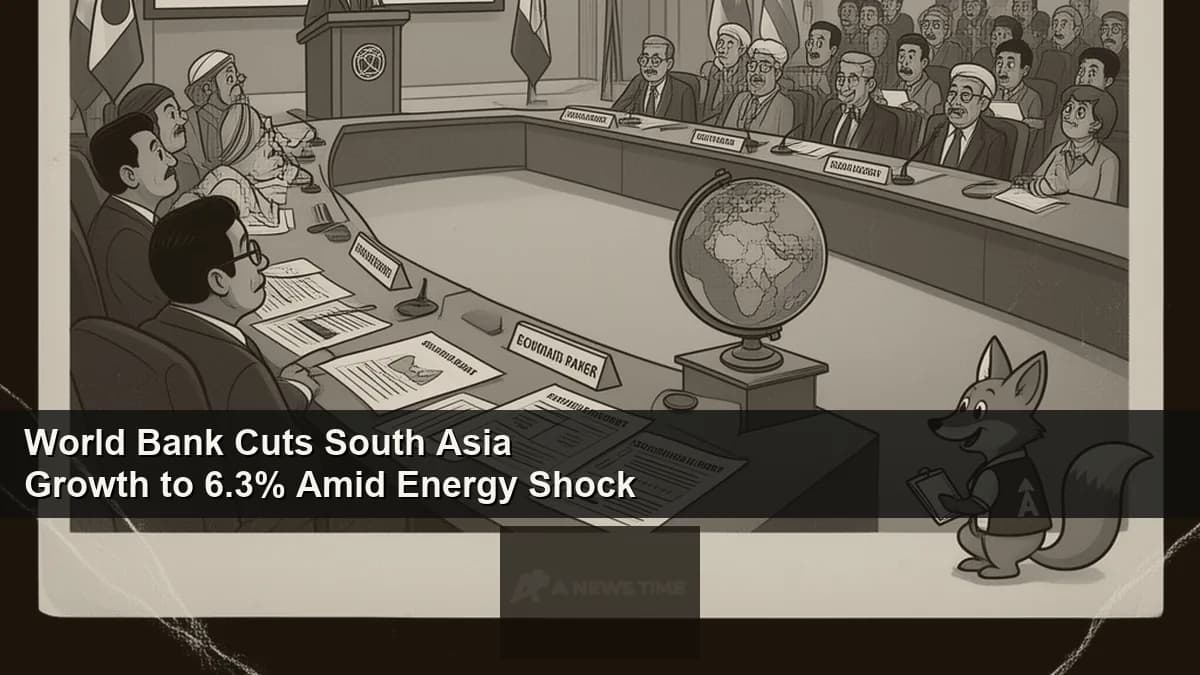
The World Bank released its April 2026 South Asia Economic Update on , projecting regional GDP growth of 6.3 percent for the year, a deceleration from the prior trend driven directly by dislocations in global energy markets. South Asia remains the fastest-growing region among all EMDEs, but the qualifier that follows that headline is telling: the distinction belongs almost entirely to India. Strip out India and the rest of the region grows at just 4.1 percent in 2026, placing it squarely in line with the broader EMDE pack and offering no particular bragging rights.
The report, titled "Working with Industrial Policy," was published from Washington, D.C. by the World Bank's South Asia regional economics team. It arrives at a moment when the global economy is navigating an energy shock triggered by the escalating conflict in the Middle East, with crude oil prices elevated and shipping route disruptions adding cost and uncertainty to supply chains. For South Asia, whose nations are among the most dependent on imported energy of any region on earth, the timing is consequential.
The Energy Vulnerability Problem, By the Numbers
The World Bank's data on South Asia's energy dependence sets up the growth forecast in stark terms. The region imports more oil and gas as a share of GDP than any other EMDE grouping. That structural fact, which did not appear in the headline 6.3 percent figure, is the mechanism through which rising global energy prices translate directly into slower growth and wider current account deficits in countries like Pakistan, Bangladesh, and Sri Lanka.
Consider the transmission chain. When Brent crude rises, the import bill for South Asia's oil-dependent economies rises in parallel. That increase drains foreign exchange reserves, pressures currencies, and forces either painful subsidy expansions (straining already-constrained fiscal budgets) or price pass-throughs to consumers (reducing purchasing power). Either path hits growth. The World Bank's modeling suggests the effect is not marginal: the April 2026 update identifies "more persistent global energy market dislocations" as the single most dangerous downside risk to the regional forecast.
The Deloitte Global Economics Research Center, in its April 6 weekly economic update, provides corroborating context: the Middle East conflict has sent crude oil prices soaring, driven by investor concern about "the potential duration and intensity" of the fighting. Deloitte economist Ira Kalish noted that the eurozone saw consumer price inflation surge to 2.5 percent in March partly on energy costs, with energy prices up 4.9 percent year-over-year. If that dynamic persists, South Asia's import bill will remain elevated through the second half of 2026.
| Region / Economy | 2024 (Actual) | 2025 (Estimate) | 2026 (Forecast) | 2027 (Forecast) |
|---|---|---|---|---|
| South Asia (total) | 6.8% | 6.5% | 6.3% | 6.6% |
| South Asia (excl. India) | 4.4% | 4.3% | 4.1% | 4.6% |
| Other EMDEs (average) | 4.1% | 4.0% | 4.1% | 4.3% |
| India | 7.5% | 7.0% | 6.7% | 7.0% |
Source: World Bank South Asia Economic Update, April 2026. India figures use fiscal year basis. Projections subject to revision.
India Carries the Region, but Its Own Slowdown Is Real
India's outsized role in regional aggregates deserves a direct accounting. The country accounts for the majority of South Asia's combined GDP, and its projected 6.7 percent growth rate for fiscal year 2026 would, on any other continent, be considered an exceptional performance. But the Bank's analysis situates India's trajectory in the right frame: this is a step down from the 7.5 percent recorded in fiscal 2024 and the 7.0 percent estimated for fiscal 2025.
The causes of India's own deceleration parallel the regional story. Energy import costs are rising. Global financial turbulence, if it materializes into a full risk-off episode, would tighten external financing conditions for India's corporate sector, particularly for issuers in the dollar bond market. The Bank also flags "domestic weaknesses" as a potential amplifier of external shocks, a phrase that in economic diplomacy typically refers to structural vulnerabilities in the banking sector, subnational fiscal positions, or labor market absorption.
"South Asia remains the fastest-growing EMDE region thanks to India. South Asia's growth prospects could be dampened by more persistent global energy market dislocations or a bout of global financial turbulence transmitted to the region and magnified by domestic weaknesses."
World Bank South Asia Economic Update, April 2026, Chapter 1
The Bank does identify upside levers. India's pending free trade agreements with the European Union and the United Kingdom represent the most significant. The April 2026 update models the first-order effects of the India-EU FTA and the India-UK CETA and finds broad-based real income gains across the entire household income distribution, with the largest benefits flowing to rural consumers of manufactured goods. Sri Lanka's planned phase-out of para-tariffs produces a similar distributional profile in the Bank's modeling.
These trade reforms are not priced into the 6.3 percent headline forecast, because FTA implementation timelines remain uncertain. They represent a potential upside scenario, not a baseline assumption. That framing matters for investors and policymakers evaluating South Asia's medium-term growth potential.
Industrial Policy: Doing More, Getting Less
The second major theme of the April 2026 update is industrial policy, and the Bank's findings warrant careful reading by anyone who assumes that more policy intervention produces better economic outcomes. The data, covering 2022 through 2025, shows that South Asian countries implemented industrial policies at roughly twice the rate of the average EMDE. That activism has not translated into proportional gains.
The composition of those policies tells a specific story. Approximately half targeted manufacturing, with a tilt toward sectors that employ larger numbers of workers, pay higher wages, or host larger and more productive firms. More so than other EMDEs, South Asia deployed trade-related measures: import restrictions and export promotion. The results were asymmetric in a damaging way. Import-restricting policies succeeded at their stated objective, with imports declining significantly in response. Export-promoting measures, however, produced no statistically significant gains in export volumes. South Asian countries, in effect, got half of an industrial strategy: the protective half without the growth-generating half.
| Policy Category | Share of Total Measures | Type Predominance | Measurable Impact |
|---|---|---|---|
| Manufacturing (all types) | ~50% | Trade-related | Mixed |
| Import restrictions | Largest sub-category | Protective | Imports fell significantly |
| Export promotion | Second-largest | Liberalizing | No significant export gains |
| Infrastructure / skills | Smaller share | Cross-cutting | Priority for acceleration |
The Bank's conclusion is not that industrial policy is wrong in principle, but that South Asia is deploying it in the wrong form and at insufficient scale in the areas where it could work. Cross-cutting investments in infrastructure, workforce skills, and the business environment, which are less politically visible but more economically productive than sector-specific trade measures, remain underfunded relative to what the Bank considers optimal.
AI Exposure and the Hiring Slowdown
One of the more provocative findings in the April 2026 update concerns the impact of artificial intelligence adoption on South Asian labor markets. The Bank's data shows that higher AI exposure is associated with slower hiring, a finding consistent with what other researchers have documented at the global level. What is specific to South Asia is the mechanism through which this effect travels.
A significant portion of the AI-related hiring slowdown in South Asia is not driven by local firms adopting AI directly. It is driven by what the Bank calls "spillovers from foreign AI adoption." South Asian firms that supply goods and services to more AI-exposed foreign companies have experienced slower hiring, because their multinational clients are reducing demand for the types of labor-intensive business services that South Asian firms provide. This is the global value chain transmission of automation: you do not need to adopt the technology yourself to feel its effects on your business.
"AI is reshaping firms and jobs in South Asia, with its adoption proceeding rapidly since 2022. Higher AI exposure is associated with slower hiring, especially among multinational affiliates. Value chain upgrading through faster AI adoption and skills development will be critical for firms to remain competitive."
World Bank South Asia Economic Update, April 2026, Box 2.1
This dynamic has particular implications for India's IT services sector, which has historically served as one of the country's primary engines for creating high-quality employment and generating foreign exchange from exports. If multinational companies automate the functions they previously outsourced to Indian IT firms, the knock-on effects on wages, employment volumes, and India's current account surplus could be material. The Bank frames this as a challenge for "value chain upgrading," which translates in practice to moving up the technology stack before automation makes the current position untenable.
For a related analysis of how the broader global economy is processing these disruptions simultaneously with geopolitical shocks, see our coverage of the IMF's concurrent warning on war supply disruptions and global growth.
Winners and Losers Within the Region
The April 2026 update's country-level findings separate winners from losers with enough specificity to be useful for anyone tracking South Asian sovereign credit, equity markets, or trade flows.
- India is the clear regional winner, with projected 6.7 percent growth anchored by domestic demand, potential trade deal upside, and a government that has maintained fiscal credibility relative to its EMDE peers. The Bank notes, however, that India's subnational labor market disparities are severe, with wage premiums in more connected, higher-skilled regions being "persistent and self-reinforcing" in the Bank's language.
- Bangladesh receives a country development update (April 2026) that reflects continued recovery from the political and economic disruptions of recent years, but external vulnerability from energy imports and export-sector concentration in garments remains a key risk.
- Sri Lanka gets credit for its planned para-tariff phase-out, which the Bank's modeling suggests will produce meaningful household income gains, but its economic recovery is described as "incomplete." The IMF program still anchors the fiscal adjustment path.
- Nepal has an April 2026 country profile that reflects modest growth, constrained by remittance income volatility and infrastructure gaps that limit private sector investment.
- Pakistan is the most exposed to the energy price shock in the region, given its level of import dependence, limited foreign exchange reserves, and the ongoing (if improving) stabilization process under the IMF.
The wage differential data in the report adds another dimension. South Asia has some of the widest within-country regional wage gaps of any EMDE grouping. Those gaps, the Bank finds, are not random. They correlate with transport connectivity, workforce skill levels, firm size, and service sector activity. Regions with better infrastructure pay more. That finding has direct implications for the Bank's infrastructure investment recommendations: closing the wage gap and closing the infrastructure gap are, at the subnational level, largely the same problem.
The Fiscal Policy Constraint
Running through the April 2026 update is a recurring theme that constrains almost every recommendation the Bank makes: limited fiscal space. South Asian governments, with the partial exception of India, carry debt levels and deficit trajectories that make large-scale public investment politically difficult and financially risky in a rising interest rate environment.
This constraint shapes the Bank's industrial policy prescription. Rather than advocating for the large-scale sectoral subsidies that China deployed during its manufacturing ascent, or the export credit and SEZ programs that drove South Korea's industrialization, the Bank recommends that South Asian governments concentrate their limited fiscal resources on broad-based development policies: infrastructure, education, health, and regulatory reform. Targeted industrial policy, where it is used at all, should focus on correcting specific market failures rather than picking winners.
The tension in that advice is real. South Asian countries are competing in global markets against China, Vietnam, and other manufacturers that have benefited from exactly the kind of active government support the Bank is cautioning against. The Bank's response, implicit in the data, is that South Asia's industrial policy has not been working. Doing more of what has not worked is not obviously a better strategy than doing less of it more efficiently.
"Given limited fiscal space and regulatory capacity, South Asia's priority is broad-based development policies, while industrial policy can focus on addressing market failures."
World Bank South Asia Economic Update, April 2026, Chapter 2
The intersection of energy market pressure and fiscal constraint creates a specific near-term risk scenario: if oil prices remain elevated through the second half of 2026, South Asian governments will face pressure to expand energy subsidies to protect households. Those subsidies are fiscally expensive and crowd out the productive investment the Bank recommends. The countries with the weakest fiscal positions (Pakistan being the most acute case) face the starkest version of this tradeoff.
This dynamic is already visible in the broader global context. The Deloitte economic update for the week of April 6 noted that US consumer confidence surveys found consumer inflation expectations rising "sharply in March to the highest level since August 2025," a shift the report attributed to the Middle East situation feeding directly into consumer price expectations. South Asian households, more directly exposed to energy cost increases, face similar expectation dynamics with less of the institutional protection that US consumers benefit from.
For context on how energy market shocks have already been reshaping Western financial markets, see our coverage of Goldman Sachs raising US recession odds to 30 percent on oil surge and the Fed rate hike probability hitting 52 percent on oil-driven inflation.
The Bigger Picture: What Comes After 6.3 Percent
The World Bank's 2027 forecast for South Asia sits at 6.6 percent, a modest recovery from the 2026 slowdown. That recovery depends on two things that are currently uncertain: a resolution or significant de-escalation of the energy market disruptions, and a successful implementation of the trade reforms the Bank identifies as upside levers.
The India-EU and India-UK FTAs, if finalized and implemented on schedule, represent a structural upgrade to India's export connectivity that could accelerate growth beyond the baseline for several years. The Bank's first-order estimates show broad household income gains across all quintiles, not just the export-producing formal sector. That kind of distributional breadth is relatively rare in trade deal modeling and suggests the agreements, if they close, have political economy durability that purely sectoral deals lack.
The AI challenge is slower-moving but potentially larger in its consequences. South Asia's labor market absorption story has historically relied on manufacturing employment for low-skill workers and services employment for educated graduates. AI's demonstrated impact on services hiring among multinationals and their South Asian suppliers represents a threat to the second of those channels. If the value chain upgrading the Bank prescribes does not happen at speed, the region could face a scenario in which its demographic dividend, the large and growing working-age population, translates into underemployment rather than productive growth. That is a political and social risk that sits behind the economic projections.
South Asia's 6.3 percent growth rate, even in a year of headwinds, puts it ahead of virtually every other region in the world. The question is not whether South Asia is growing. The question is whether it is building the structural capacity, in trade connectivity, in skills, in energy independence, and in effective policy institutions, to sustain that growth when the next shock arrives. The April 2026 World Bank update suggests the answer is: not yet, but the path is visible.
Frequently Asked Questions
- Why is South Asia particularly vulnerable to global energy market shocks?
- South Asia imports a higher share of oil and gas relative to GDP than any other EMDE region. When global energy prices rise, the import bill for countries like Pakistan, Bangladesh, Sri Lanka, and India increases directly, draining foreign exchange and forcing governments to choose between expensive subsidies and cost pass-throughs to consumers. Both options slow growth.
- What is driving the difference between South Asia's 6.3 percent headline growth and the 4.1 percent rate excluding India?
- India accounts for the dominant share of South Asia's combined GDP. India's projected 6.7 percent growth rate in fiscal 2026 pulls up the regional average significantly. Without India, the remaining South Asian economies grow at roughly the same pace as the broader EMDE average, losing the region's standing as the world's fastest-growing EMDE bloc.
- What did the World Bank find about industrial policy effectiveness in South Asia?
- South Asian countries implemented industrial policies at twice the average EMDE rate between 2022 and 2025. Of those, import-restricting measures succeeded in reducing imports, but export-promoting measures produced no statistically significant export gains. The Bank recommends prioritizing cross-cutting investments in infrastructure and skills over sector-specific trade interventions.
- How is AI affecting South Asian labor markets?
- AI adoption is associated with slower hiring, particularly at multinational affiliates operating in South Asia. Notably, the effect also reaches firms that have not adopted AI themselves: South Asian companies supplying goods and services to AI-exposed multinationals are seeing reduced demand for their services. The Bank calls for faster AI adoption and skills upgrading to maintain competitiveness.
- What are the main upside risks to the 2026 forecast?
- The two primary upside scenarios are a resolution of the global energy market disruptions (which could restore growth closer to the prior trend) and successful implementation of India's free trade agreements with the EU and UK, plus Sri Lanka's para-tariff phase-out. The Bank's modeling shows these trade reforms would produce broad household income gains across all income levels.
Sources
- World Bank: South Asia Economic Update, April 2026 — "Working with Industrial Policy"
- World Bank Press Release: South Asia Economic Update, April 2026
- Deloitte Insights: Weekly Global Economic Update, Week of April 6, 2026 (Ira Kalish)
- World Bank: South Asia Economic Update April 2026 — Executive Summary (PDF)
Written by James Calloway, Business & Automotive Writer