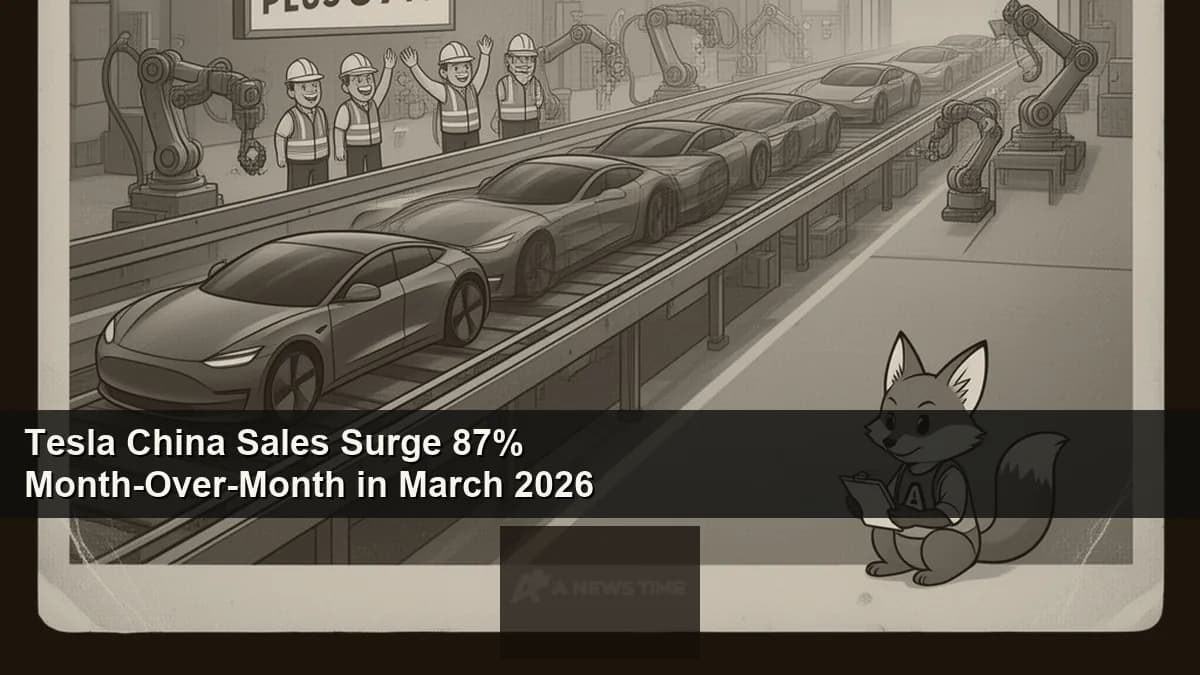
Tesla's Shanghai Gigafactory delivered 85,670 vehicles in March 2026, the company's strongest monthly China output in four quarters, according to data released by the China Passenger Car Association on . The figure represents an 8.7% increase year-over-year and, more strikingly, a 46.2% increase month-over-month from February's numbers. The sequential surge is partly explained by February's compressed calendar from the Chinese New Year holiday period, but the year-over-year comparison provides the more informative picture of Tesla's competitive position in the world's largest electric vehicle market.
The March data brings Q1 2026 China deliveries to a level 23.5% above Q1 2025, marking five consecutive monthly gains for Tesla's China manufacturing operation. The trend runs counter to the narrative of Tesla's global struggles with competition and brand issues that has dominated Western business coverage. In China, the story is different: Tesla is growing, not contracting, and growing at rates that suggest its competitive positioning in that specific market remains substantially stronger than the domestic competitor headlines would imply.
What's Driving the Growth: Model Y Refresh and Pricing Strategy
Two factors dominate the explanation for Tesla's China sales trajectory in early 2026: the refreshed Model Y Juniper, which launched in China in late 2024, and Tesla's aggressive local pricing adjustments that have kept the Model Y's price position competitive against the rapidly expanding domestic Chinese EV market.
The Model Y Juniper refresh addressed criticisms of the original Model Y that had been present in China specifically: interior quality, feature set compared to domestic alternatives, and the perception that the vehicle had not received sufficient localization investment. The updated model's interior improvements, including a redesigned dashboard, enhanced sound system, and features specifically valued by Chinese consumers, directly addressed those criticisms. In a market where BYD and other domestic brands have consistently led on interior quality and technology feature density, the Juniper refresh moved Tesla closer to competitive parity on those dimensions without surrendering its powertrain and software advantages.
| Period | China Deliveries | YoY Change |
|---|---|---|
| Q1 2025 | ~72,000 | Decline vs Q1 2024 |
| Q2 2025 | ~78,000 | Recovery begins |
| Q3 2025 | ~81,000 | Continued growth |
| Q4 2025 | ~82,000 | Q1 2026 baseline set |
| Q1 2026 | ~89,000 total | +23.5% YoY |
| March 2026 (alone) | 85,670 | +8.7% YoY, +46.2% MoM |
The pricing dynamic in China is competitive in a way that is different from any other major Tesla market. China has more than 100 actively competing electric vehicle brands, many of which are subsidized by local governments or operate as part of larger industrial conglomerates with tolerance for below-market pricing during market share development phases. Tesla has repeatedly adjusted its China pricing to maintain volume, accepting lower per-vehicle margins to protect its scale position in the market. The gross margin implications of this strategy have been visible in Tesla's China-specific financial disclosures, but the company has consistently treated volume maintenance as the strategic priority over short-term margin optimization.
The Competitive Landscape: How Tesla Stacks Up Against BYD
BYD sold approximately 370,000 NEVs in China in March 2026, dwarfing Tesla's 85,670 deliveries and underlining the gap between China's domestic EV champion and the American market leader. The comparison is important context but also somewhat misleading: BYD competes across multiple price segments including low-cost micro-EVs where Tesla does not compete at all, while Tesla is concentrated in the premium and near-premium segments where BYD's Han and Seal models are the primary competitors.
In the specific price segment where the Model Y competes, the relevant comparison is with BYD's Han EV, the Seal, Nio's ET5, and Li Auto's models, all of which are competing for the same 200,000-to-350,000 RMB purchase decision. In that segment, Tesla's share has remained more resilient than its overall China market position suggests, because the Model Y's resale value, safety scores, Supercharger network, and over-the-air software update capability maintain preference among buyers who are specifically cross-shopping premium alternatives rather than price-sensitive micro-EV buyers.
The trade relationship between the United States and China creates a background risk for Tesla's China operation that is distinct from competitive pressures. American companies operating in China are subject to retaliatory policy risk when US-China trade tensions escalate, and the Liberation Day tariffs have created a more adversarial bilateral environment than existed two years ago. Tesla's local manufacturing at the Shanghai Gigafactory provides structural insulation from direct tariff effects, but policy uncertainty about how Chinese authorities treat American brands in their domestic market is a risk that cannot be fully managed through manufacturing localization alone.
Shanghai Gigafactory: The Production Infrastructure Behind the Numbers
The 85,670 March deliveries from Tesla's China operation reflect the capacity of the Shanghai Gigafactory, which has become Tesla's highest-volume manufacturing facility globally. The factory produces Model Y and Model 3 vehicles for the China domestic market and for export to Europe and other markets, with domestic China sales representing the dominant share of its output.
The Shanghai facility's production efficiency has been central to Tesla's ability to maintain competitive pricing in China without fully sacrificing margin: the plant's per-vehicle production cost is lower than Tesla's US factories partly because of labor cost differences and partly because of the manufacturing process improvements implemented over several years of operation. The facility operates with a high degree of local supplier integration, reducing import cost exposure and supply chain complexity relative to the company's earlier China operations.
"The Shanghai factory's cost structure is fundamentally different from the US operations, and that difference is what allows Tesla to compete on price in China while maintaining its global financial structure. The China manufacturing isn't just about avoiding tariffs; it's about competing in a market where the cost baseline is set by domestic manufacturers who have decades of local supplier relationship advantage."
Automotive industry analyst covering Tesla China operations, Reuters reporting, April 2, 2026
Global Context: China's Strength Against Domestic Challenges
The 8.7% year-over-year China growth stands in contrast to Tesla's performance in other markets. US sales, while not separately broken out in the March data, have faced headwinds from the combination of increasing domestic competition from Ford, GM's EV lineup, and the emerging US presence of Korean brands, as well as the brand association challenges created by Elon Musk's political activities, which polling data consistently shows are affecting purchase consideration among segments of the US consumer market.
Europe presents a different challenge: the combination of increasing competition from European domestic brands as their EV transitions accelerate, and the potential for EU-China trade tensions to affect Tesla's Shanghai-to-Europe export economics, has created a more complex outlook than the pure China volume numbers suggest. Tesla's global delivery total for Q1 2026 will be released in the first week of April, at which point the full picture of how China growth balances against other market performance will be available.
The Cybercab's production launch, which we cover separately in our Cybercab production analysis, represents Tesla's attempt to open a new revenue category that is less exposed to the EV competition dynamics that are compressing its conventional vehicle margins globally. The China EV numbers provide evidence that Tesla's core business remains competitive where it has invested in local product relevance and cost optimization. Whether that foundation is sufficient to maintain Tesla's premium valuation while the Cybercab business case is being validated is the central question for the next 18 months.