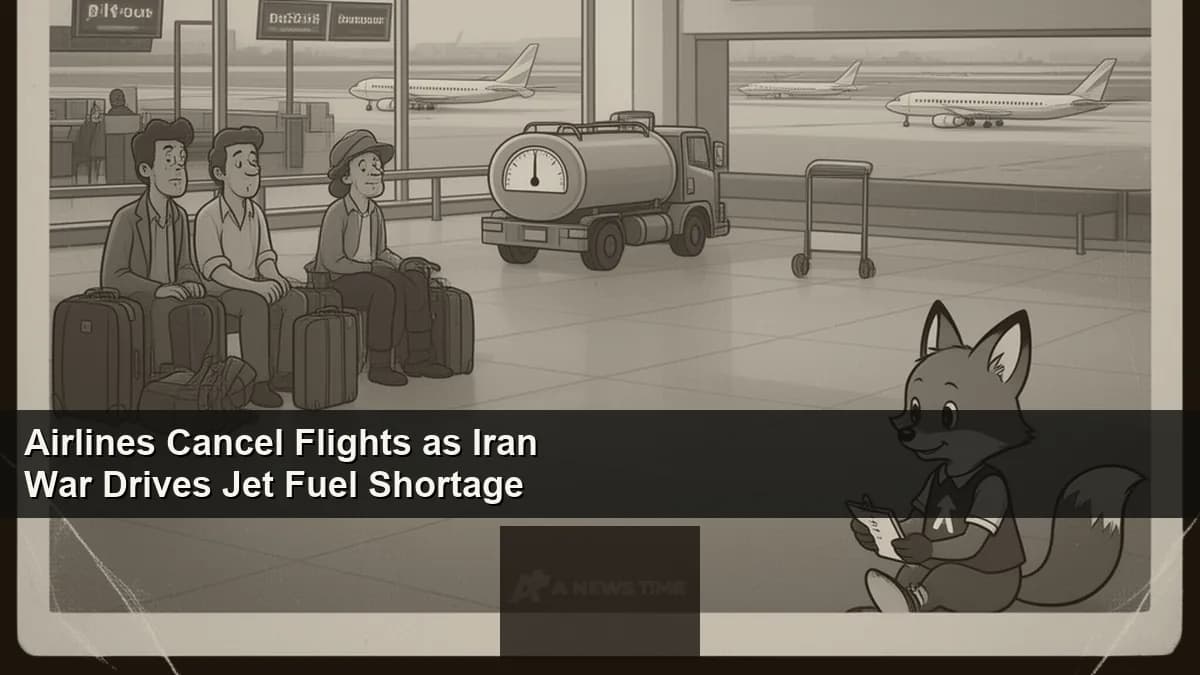
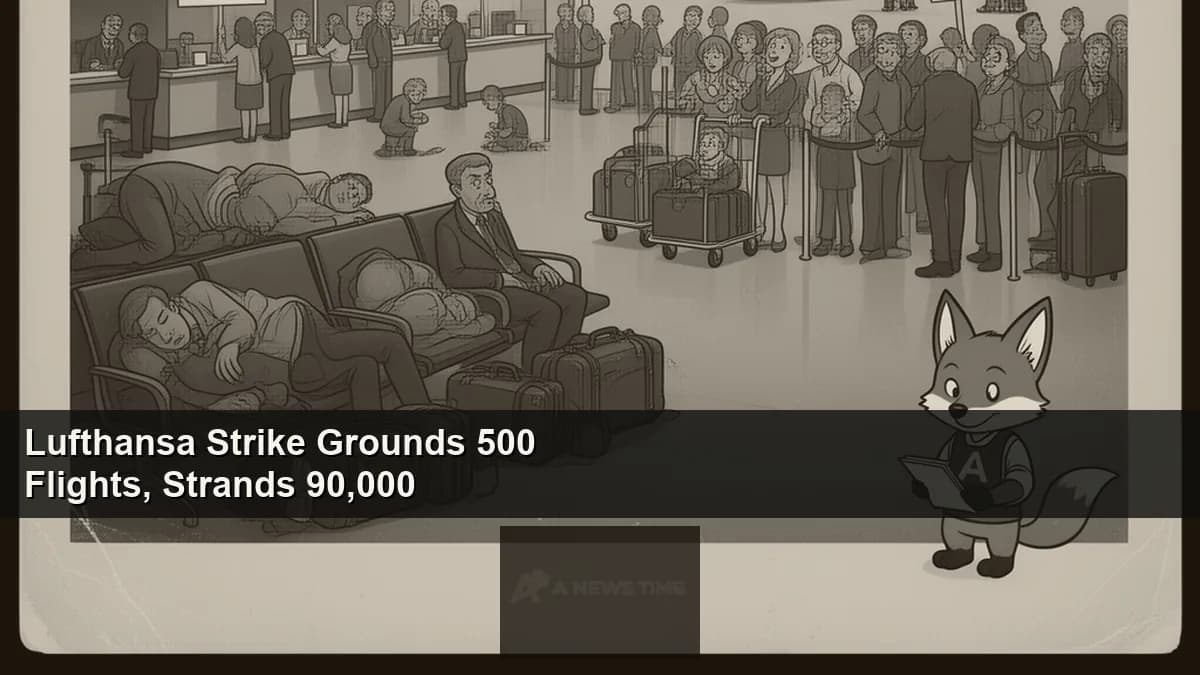
The moment the walkout notice landed at Lufthansa Group operations on the morning of , the arithmetic was already ugly. Easter weekend had loaded the system to the edge. Families from across the continent were queuing at return gates, their rolling bags packed with Lanzarote sunburn and duty-free olive oil. Business travelers were rehearsing Monday pitch decks. Students had arranged their entire semester around a departure window that would now quietly disappear.
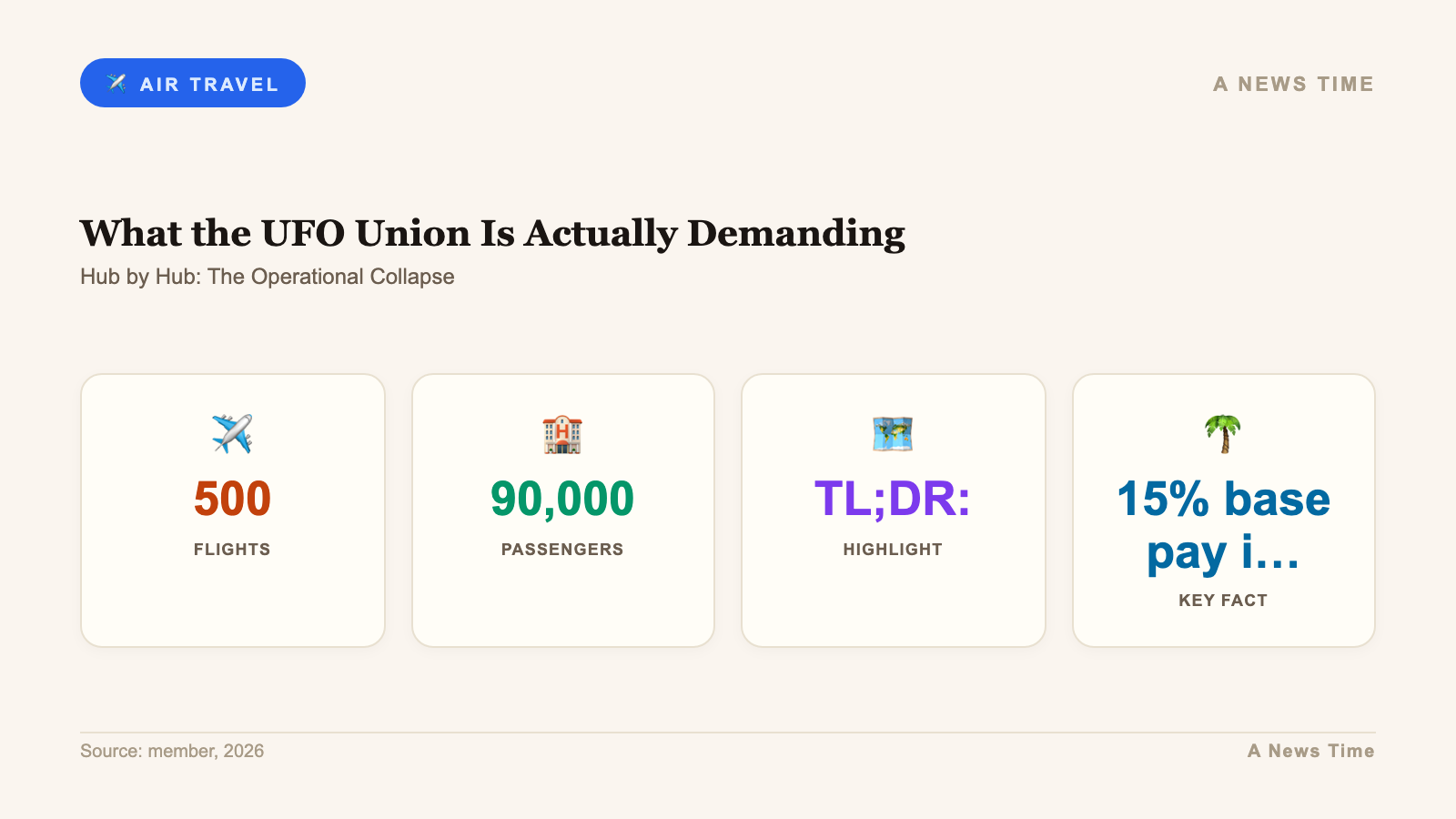
The UFO union had timed its post-Easter walkout with surgical precision. Two primary hubs, Frankfurt (FRA) and Munich (MUC), seized simultaneously. Within hours, the Lufthansa Group's hub-and-spoke model had done what it was never designed to do: collapsed inward. Five hundred flights cancelled. Ninety thousand passengers stranded. Star Alliance partners United Airlines and Air Canada watching their connections evaporate. Deutsche Bahn reporting panic booking on its intercity lines before the day was out.
This is not Lufthansa's first cabin crew strike. It likely will not be its last this season. But for the passengers in the middle of it, the mechanics of why are cold comfort standing at a gate with no departure board update in sight.
What the UFO Union Is Actually Demanding
The UFO union represents Lufthansa cabin crew independently of the larger ver.di services union. Its membership skews toward long-haul flight attendants who have watched the airline post record operating profits in 2024 and 2025 while their real wages eroded through sustained inflation. The demands on the table are not symbolic.
UFO is seeking a 15% base pay increase effective immediately, plus a one-time €3,000 inflation compensation payment per member. The union argues that front-line cabin staff have absorbed years of compressed wage growth during the pandemic recovery, then watched fuel-cost increases redirect any surplus away from labor settlements. Lufthansa management countered with a staggered pay offer the union characterized as structurally insufficient: the proposed annual increments, UFO argues, do not compensate for compounding inflation losses already banked.
The timing of the action immediately following Easter reflects something the aviation industry calls the "return-window vulnerability." Post-holiday travel loads run close to 95% capacity, there is no schedule slack to absorb cancellations, and alternative routing options are already consumed by normal demand. The union knows this. So does every airline operations team that has ever dealt with a post-holiday strike notice.
"Front-line cabin crew have carried this airline through the worst operational years in aviation history. What we are asking for is not extraordinary. It is the correction of a wage trajectory that has run below inflation for four consecutive years."
UFO union spokesperson, April 13, 2026
Lufthansa's public position is that the union's demands, if met in full, would materially affect the airline's cost structure during a period of high jet fuel prices. The broader context matters here: fuel prices have more than doubled since early 2026 following Middle East supply disruptions, and carriers across the industry are running thinner operating margins than their headline profits suggest. For more on how jet fuel costs are reshaping European aviation this spring, see our full analysis of the airline industry's fuel crisis.
Hub by Hub: The Operational Collapse
Understanding why 500 cancellations produced 90,000 stranded passengers requires a brief lesson in hub geometry. Frankfurt Airport is Europe's third busiest by passenger volume. Munich is its tightly connected southern complement. The Lufthansa Group routes the majority of its intercontinental traffic through one or both. When both hubs go down simultaneously, the network does not degrade gracefully. It breaks.
| Hub | Flights Cancelled | Primary Impact | Partner Disruption |
|---|---|---|---|
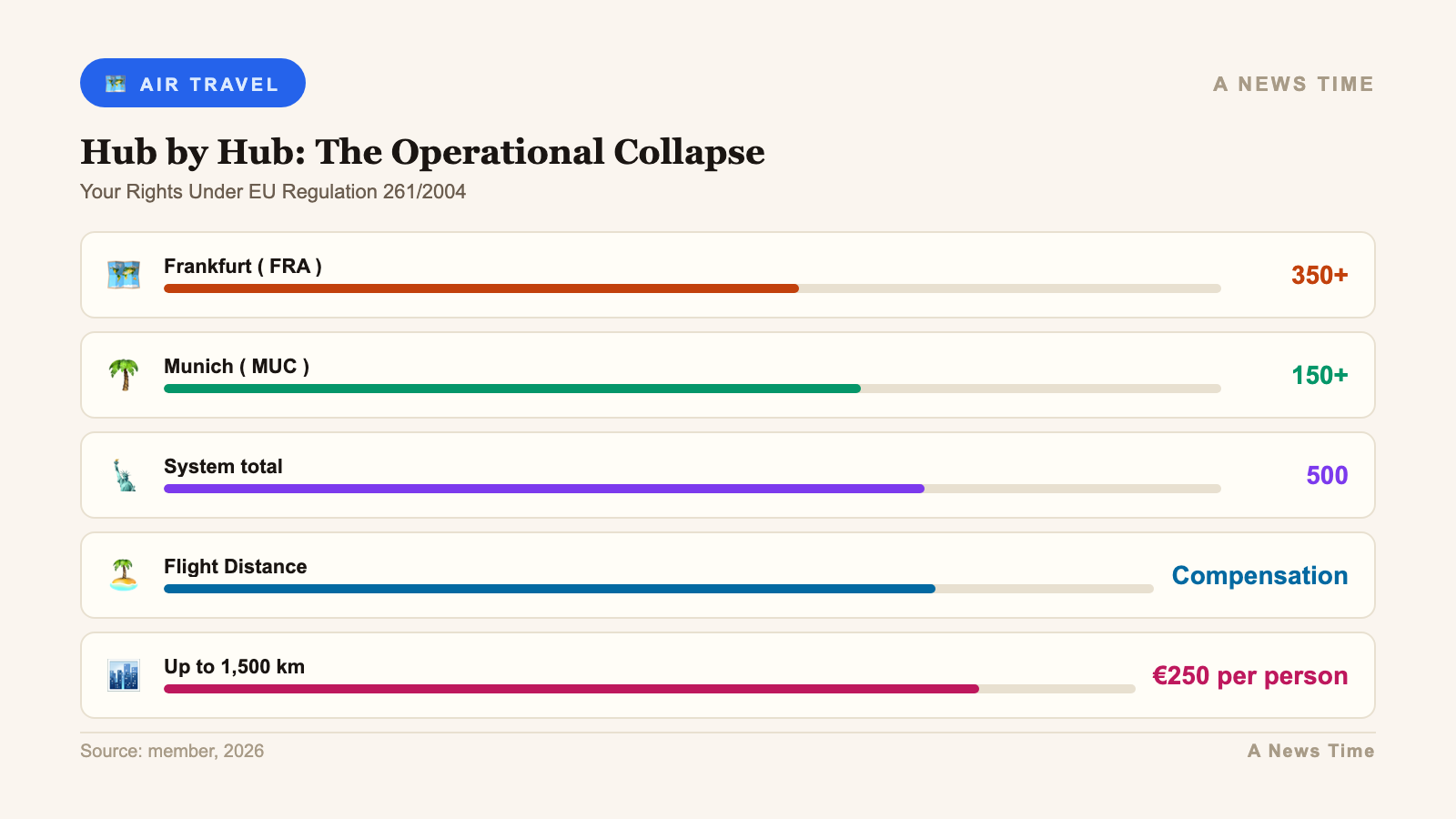
| Frankfurt (FRA) | 350+ | Transatlantic and Asia routes | United Airlines, Air Canada Star Alliance connections |
| Munich (MUC) | 150+ | European and feeder routes | Lufthansa CityLine regional operations |
| System total | 500 | Full Lufthansa Group paralysis | Deutsche Bahn rail surge booking |
Frankfurt's exposure was heaviest on transatlantic routes. The long-haul widebodies sitting idle at FRA gates on Monday morning represent some of the highest revenue-per-seat flights in the network. A single cancelled New York or Tokyo service doesn't just displace its passengers. It displaces onward connections in both directions, creates re-accommodation queues that can persist for two to three days, and generates rebooking costs the airline absorbs under EU 261/2004.
Munich's profile was different. The CityLine regional feeds that connect smaller German cities to intercontinental connections at MUC ground dozens of short-sector flights with outsized knock-on effects. A passenger flying from Nuremberg to connect to a Lufthansa Singapore service does not easily find an alternative when both the feeder and the trunk route cancel simultaneously.
One stranded passenger at Frankfurt described the terminal atmosphere as "organized chaos without the organized part." Communication from gate staff was minimal in the first hours, partly because the airline's own operational teams were still processing the scale of the walkout. The airline subsequently opened dedicated helpdesks and directed passengers to its app for rebooking, but the initial information vacuum left thousands without clear guidance during the critical morning window.
Your Rights Under EU Regulation 261/2004
This is where most coverage of aviation strikes becomes unhelpfully vague. EU Regulation 261/2004 is a remarkably powerful piece of passenger protection law, and understanding exactly what it does and does not cover is the difference between recovering your costs and absorbing them.
The critical legal question in any strike-related cancellation is whether the disruption qualifies as an "extraordinary circumstance" under EU 261/2004. Extraordinary circumstances exempt the airline from paying fixed compensation. The European Court of Justice has consistently held that strikes by an airline's own employees, including cabin crew, do not qualify as extraordinary circumstances. They are inherent to the carrier's operations. This means Lufthansa cannot use the UFO walkout to avoid the compensation obligation.
| Flight Distance | Compensation | Conditions |
|---|---|---|
| Up to 1,500 km | €250 per person | Cancellation notified fewer than 14 days before departure |
| 1,500 km to 3,500 km | €400 per person | Cancellation notified fewer than 14 days before departure |
| Over 3,500 km | €600 per person | Cancellation notified fewer than 14 days before departure |
Separate from the fixed compensation, EU 261/2004 also mandates that airlines provide "duty of care" to stranded passengers regardless of whether extraordinary circumstances apply. This covers meals and refreshments appropriate to the waiting time, hotel accommodation if an overnight stay becomes necessary, and transport between the airport and hotel. Save every receipt. Photograph them. The airline must reimburse reasonable documented expenses.
Re-routing rights are equally important. The airline must book you on the earliest possible alternative to your destination, including on rival carriers if Lufthansa's own schedule cannot accommodate you within an acceptable timeframe. If you are rebooked on a competitor's service and pay the difference yourself, submit the cost for reimbursement within 30 days with your booking confirmation and receipt.
One practical note on claims: Lufthansa's direct claims process typically takes four to six weeks to resolve. Third-party claims services (AirHelp, ClaimCompass, Flightright) operate on a no-win-no-fee basis and take a commission of roughly 25 to 30 percent but handle the bureaucratic friction for passengers who want to avoid the process entirely.
Getting Home: The Practical Alternatives
If you are currently stranded at Frankfurt or Munich, the options hierarchy runs roughly as follows, from fastest to slowest depending on your destination.
For intra-European passengers, Deutsche Bahn's intercity and high-speed rail network is the most reliable near-term alternative for destinations within roughly a four-hour radius. Berlin, Amsterdam, Paris, Zurich, Vienna, and Brussels are all reachable from Frankfurt Hauptbahnhof, which sits directly below Terminal 1 via S-Bahn. The ICE trains are running normal schedules and DB has extended its booking window for same-day travel. Book online or via the DB Navigator app rather than queuing at the station ticket hall.
For medium-haul European routes, other carriers operating from Frankfurt or Munich may have capacity. Ryanair operates from Frankfurt's secondary terminal (Frankfurt-Hahn is distant but Frankfurt Airport's Terminal 2 has Ryanair service), easyJet from both hubs, and Eurowings from Munich. These carriers are not obligated to accommodate Lufthansa passengers at Lufthansa's expense, but Lufthansa should rebook you on them if they have available seats on your route. Insist on this at the customer service desk or call center rather than accepting a Lufthansa-only rebooking.
For transatlantic passengers, the situation is more complex. Non-stop alternatives to North American destinations from German airports are limited. If you hold a flexible or premium fare, ask about re-routing through Amsterdam (KLM), London Heathrow (British Airways, Virgin Atlantic), or Paris Charles de Gaulle (Air France) where transatlantic capacity is fuller. The Star Alliance network gives Lufthansa rebooking access to United, Air Canada, and other partners, so push for this option rather than accepting a three-day wait for the next available Lufthansa service.
Rental cars and private transfers are expensive but available for those with tight deadlines. The journey from Frankfurt to Amsterdam Airport Schiphol takes approximately four hours by road, and flights from Amsterdam to North America are operating normally.
What Star Alliance Partners Need to Know
The Lufthansa Group's position at the center of the Star Alliance creates a ripple effect that extends well beyond Lufthansa-ticketed passengers. Travelers flying United, Air Canada, Singapore Airlines, All Nippon Airways, or other Star Alliance members on codeshare itineraries transiting through Frankfurt or Munich are also affected.
The rebooking rules in these situations depend on who issued the ticket and which metal was operating the affected flight. If your ticket was issued by United and you were connecting to a Lufthansa metal flight at Frankfurt, United's customer care team handles re-accommodation. If Lufthansa issued the ticket for the whole itinerary and United operated a segment, the obligation flows back to Lufthansa.
The key document is your booking confirmation, specifically the operating carrier designation. If your itinerary says "operated by Lufthansa" on the cancelled segment, Lufthansa owns your re-accommodation. If it says "operated by United" or another carrier, contact that carrier's customer line directly. The EU 261/2004 obligation applies to the operating carrier, not the marketing carrier.
For passengers connecting beyond the EU who hold through-tickets, international conventions (Montreal Convention) provide additional protections for consequential losses, though the thresholds and claim process differ from EU 261/2004. Travel insurance that covers trip interruption is the cleaner protection mechanism here, as EU law becomes more complicated once the journey moves outside European airspace.
The Longer Pattern: More Strikes Expected
UFO has been explicit that the April 13 action was a "warning strike." The union's language leaves little ambiguity about its intentions if Lufthansa does not move substantively on the pay demands by the end of April. The Pentecost travel window, which falls in late May, and the early June summer booking peak represent the next pressure points where a repeat walkout would carry maximum disruption leverage.
Lufthansa's broader labor environment is complicated. The airline has separate ongoing negotiations with the Vereinigung Cockpit pilots' union and the ver.di ground staff union. The UFO cabin crew action is taking place against this backdrop of simultaneous pressure from multiple labor groups, all of whom have watched the airline's management report record revenues while arguing that cost pressures limit wage settlements.
For travelers with Lufthansa bookings through May and June, the practical advice is to review change and cancellation policies on your ticket before the situation escalates. Full-flex fares can be rebooked without fees at any point. Restricted economy and basic fares typically require a fee to change dates. If you are in the four-to-six-week window before your travel dates and UFO has not reached a deal with management, check the union's public communications and the airline's service notifications regularly.
Travelers who have flights connected to Lufthansa Group services (SWISS, Austrian Airlines, Brussels Airlines, Eurowings) should also monitor whether sympathy actions spread within the group. UFO's membership is Lufthansa-mainline focused, but labor solidarity has historically applied pressure across the group's entities during extended disputes.
The Industry Context: Why Cabin Crew Disputes Are Intensifying
The Lufthansa strike does not exist in isolation. Across European aviation, cabin crew labor disputes have intensified throughout 2025 and 2026. The pattern is consistent: airlines posted strong recovery profits in 2023 and 2024 on the back of post-pandemic travel demand, but the distribution of those profits into cabin crew wages has been uneven at best.
Inflation eroded real wages across the continent in 2022 through 2024. Airlines that emerged from pandemic restructurings with reduced headcounts and leaner cost bases found themselves negotiating from positions of strength that cabin crew unions have grown increasingly unwilling to accept. The aviation labor market has also tightened: experienced long-haul cabin crew are harder to recruit and train than they were five years ago, which is shifting the negotiating dynamics.
The EU 261/2004 framework matters here too. The regulation's firm protections for stranded passengers create tangible financial consequences for airlines that allow labor disputes to produce disruption. Every cancelled flight in a labor dispute generates compensation liability, duty-of-care costs, and rebooking expenses. For a carrier the size of Lufthansa, a single major strike day can cost tens of millions of euros in direct passenger-related obligations before the operational losses are counted. This financial calculus is part of why airlines ultimately settle labor disputes, though the process is rarely quick.
For the traveler standing at gate B22 with an empty departures board, the systemic context doesn't change the immediate situation. What it does suggest is that this kind of disruption will remain part of the European aviation landscape through 2026. Planning for it means understanding your rights, booking with change flexibility where possible, and keeping travel insurance that covers trip interruption in your standard travel toolkit. The broader pattern of European flight disruptions this year makes that toolkit more important than in any recent season.
Frequently Asked Questions
- Am I entitled to compensation for a strike-cancelled flight?
- Yes, if Lufthansa cabin crew went on strike, the cancellation is not an "extraordinary circumstance" under EU law. You can claim €250 to €600 per person depending on flight distance, provided the cancellation was notified fewer than 14 days before departure.
- What if I rebooked myself on another airline?
- Lufthansa must cover the cost of re-routing you on the earliest available alternative to your destination, including on competitor airlines. Keep your receipt and original booking confirmation and submit for reimbursement within 30 days.
- Does EU 261/2004 cover me if I hold a non-EU airline ticket?
- The regulation covers any flight departing an EU airport, regardless of which airline issued your ticket. It also covers flights arriving at EU airports if operated by an EU carrier. Lufthansa is an EU carrier.
- When will negotiations resolve?
- UFO has given Lufthansa until end of April to move substantively. If no deal is reached, further strikes are expected during the Pentecost travel window in late May. Monitor UFO's public communications directly.
- Will my travel insurance cover strike disruption?
- Many policies cover trip interruption caused by airline strikes. Check your policy's "trip disruption" or "travel delay" section and the definition of covered causes. Some basic policies exclude strikes. Call your insurer before making alternative arrangements to confirm coverage and pre-authorize expenses.