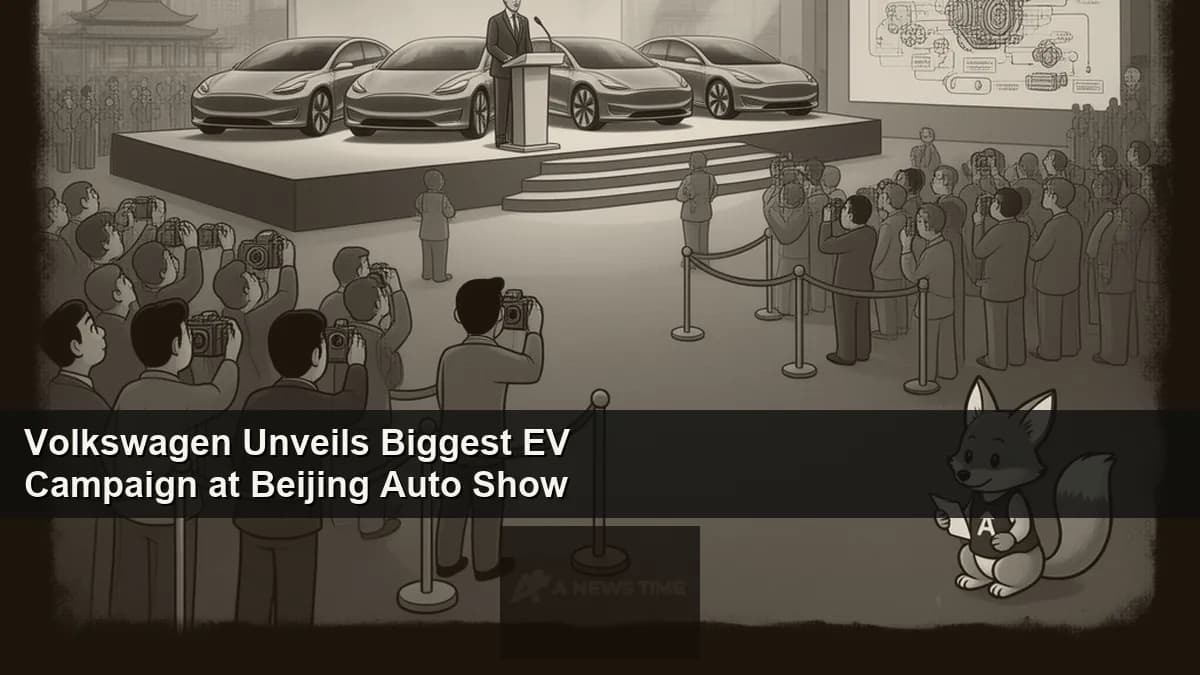
Volkswagen Group will hold its Media Night at at Auto China 2026 in Beijing, unveiling what the company is calling its largest-ever electric vehicle product campaign. Ten electrified models from four VW Group brands will be shown at the event, headlined by four world premieres that span the group's joint venture architecture and its still-evolving software partnerships in China. The show's motto, chosen with the deliberate optimism of a company that needs a narrative reset, is "Rise Up."
The scale of the push is real. Whether it is enough is less certain.
Four World Premieres: What VW Is Actually Showing
The headline additions to VW's Chinese lineup break across the group's joint venture structure. Understanding what each product represents, beyond the press release language, requires mapping them against the partnerships and technology platforms behind them.
| Model | Brand | Development Partner | Platform / Note |
|---|---|---|---|
| JETTA EV show car | JETTA (FAW-VW sub-brand) | FAW Volkswagen | Budget EV segment, concept stage |
| VW ID. UNYX | Volkswagen | XPENG | 24-month co-development, XPENG software stack |
| FAW-VW ID. AURA | Volkswagen (FAW-VW JV) | FAW Volkswagen | CEA platform, developed in China |
| AUDI E7X | Audi | SAIC Volkswagen / Audi | Exterior debut only, production timeline unconfirmed |
The ID. UNYX is probably the most strategically significant of the four. Volkswagen and XPENG signed a technology agreement in and have been co-developing the vehicle for roughly 24 months, integrating XPENG's EEA (Electrified and Electronic Architecture) software platform with VW's hardware structure. What VW is attempting with this collaboration is a shortcut: rather than building competitive in-vehicle software from scratch, the company is licensing capability from a Chinese tech-forward automaker that is already competitive in the areas where VW has historically struggled, specifically driver assistance integration and over-the-air update cadence.
The FAW-VW ID. AURA, developed on the CEA platform, is a different kind of product. CEA is a China-specific architecture that VW developed with its FAW joint venture to enable vehicles engineered and manufactured entirely within China, without depending on the MEB platform that underpins European-market ID. vehicles. The objective is cost reduction and localization speed, not premium positioning.
The Audi E7X is the most preliminary of the four: the Beijing show marks only an exterior debut, meaning Audi is revealing the vehicle's styling direction while holding back interior, powertrain, and production timeline details. That staged reveal approach is common for vehicles still 18 to 24 months from production readiness, and suggests the E7X will not reach Chinese showrooms before late 2027 at the earliest.
The "In China, For China" Strategy at Year Three
Volkswagen Group's China head Ralf Brandstatter has been the public face of what the company calls its "In China, for China" localization strategy since taking the role in . The strategy is a direct acknowledgment of a problem VW spent too long minimizing: the company's global vehicle architectures and development timelines were too slow and too Europe-centric to compete in a Chinese market moving at technology startup speed.
"We have developed a completely new product portfolio in under 36 months. That was only possible because we are working with local partners, using local talent and local technology."
Ralf Brandstatter, President and CEO, Volkswagen Group China
The 36-month claim is worth examining. VW's traditional development cycle for a new vehicle platform runs five to seven years from concept to production. Compressing that to three years requires accepting tradeoffs: relying on partner architectures (as with the XPENG collaboration), using existing JV platforms (CEA), or staging reveals strategically to buy additional time (the E7X exterior-only debut). None of those approaches is wrong, but they are not equivalent to having developed competitive software and platforms from scratch.
CEO Oliver Blume, speaking ahead of the Beijing show, framed the China push in global competitive terms rather than purely as a China market recovery story.
"Our progress in China strengthens our competitiveness worldwide. The innovations we develop here, with our Chinese partners, will benefit Volkswagen customers everywhere."
Oliver Blume, CEO, Volkswagen Group
That argument has surface logic: software capabilities, battery integration know-how, and cost-efficient EV platforms developed in China can in principle migrate to European and North American products. Whether VW's organizational structure can actually execute that kind of reverse technology transfer, given the internal politics of a company that still operates largely through separate regional fiefdoms, is a different question. The company has announced the ambition before.
VW Group's China operations have been under consistent financial pressure. The company's China deliveries fell roughly 15 percent in 2024 compared to their peak years, with local brands including BYD, SAIC-owned Roewe, and newer entrants taking share across every segment VW historically dominated. The ID. series, which was supposed to anchor VW's EV transition in China, has sold below initial projections for three consecutive years, prompting multiple price cuts that have squeezed margins while still not fully closing the gap with comparably priced Chinese alternatives on software features, range efficiency, and charging speed.
Twenty-Plus New Vehicles in 2026: The Cadence Plan
The Beijing announcement is not limited to the four world premieres. VW Group is committing to more than 20 new electrified vehicles plus updated ICE models for the Chinese market across 2026, a pace that works out to, as the company itself stated, a new vehicle on average every two weeks starting this year.
That cadence is primarily possible because VW is not launching entirely new platforms at that rate. Many of the 20-plus vehicles are variants, facelifts, or derivative models built on existing architectures, including MEB, CEA, and the various JV-specific platforms developed with FAW and SAIC. The distinction matters for evaluating the competitive impact: refreshing a derivative model every two weeks creates product catalogue breadth, but it does not automatically translate into competitive products in segments where Chinese brands have structural advantages.
Porsche, which operates as a semi-independent brand within VW Group, is using the Beijing show to debut a new electric variant of the Cayenne. The Cayenne has been one of Porsche's strongest sellers in China, and an electric version positions the brand against the growing cohort of premium Chinese SUVs, including models from NIO, Li Auto, and HUAWEI-backed Seres, that have been making inroads in the luxury segment. Porsche has not announced pricing or range figures for the electric Cayenne variant ahead of the Beijing reveal.
The volume brands carry the more difficult competitive task. In a Chinese market where BYD's Seal sells for under $22,000 with competitive range and software features, VW's ID. series has struggled to justify pricing that runs 20 to 35 percent higher. The ID. AURA, developed on the CEA platform specifically for cost efficiency, is VW's most direct attempt to close that pricing gap, but the company has not published target retail pricing ahead of the Beijing show.
CARIZON and the Software Problem
VW's hardware product strategy at Beijing is the visible part of the story. The less visible, and arguably more consequential, part is the company's effort to build software competency in China through its CARIZON technology center.
CARIZON is VW's China-specific software development operation, tasked with building ADAS capabilities and, eventually, higher-order autonomous functions. According to VW Group's own disclosures, CARIZON is currently developing Level 2 driver assistance features for near-term deployment and is advancing its own SoC design for Level 3 and Level 4 autonomous capability. The SoC development is notable because it represents VW attempting to control the computational core of its autonomous stack, rather than remaining dependent on third-party chips from suppliers like NVIDIA or Qualcomm.
The challenge is timeline and competitive distance. Chinese EV makers are not standing still on software. XPENG, the company VW is already partnering with for the ID. UNYX, ships its XNGP driver assistance system on current production vehicles and has been iterative on feature releases roughly every two to three months. Huawei's ADS 3.0 system, available in vehicles like the Aito M9, claims city-level navigation without high-definition mapping in more than 400 Chinese cities. BYD's DiPilot 100 system ships across multiple price points. VW's CARIZON is building toward capability that Chinese competitors are already shipping.
That gap is not necessarily fatal for VW's China business, because a meaningful segment of Chinese buyers still purchase on brand, comfort, and reliability rather than cutting-edge software features. But that segment is shrinking as younger Chinese consumers, for whom software capability is a primary purchase criterion, form a larger share of the premium and mid-market buyer pool. VW's window to close the software gap without permanent market share losses is probably three to four years, not indefinite.
Market Context: A Show Arriving at a Complicated Moment
Auto China 2026 is happening against a market backdrop that complicates the "Rise Up" narrative. Global EV sales fell 11 percent year-over-year in February 2026, according to data tracked by EV analysts including those at CleanTechnica, with weakness concentrated in Western markets. China remains the world's largest EV market by volume and continued to grow in absolute terms through early 2026, but growth rates have decelerated significantly from the 30-plus percent annual expansions of 2022 and 2023.
The slowdown in Western EV markets is relevant to VW's global calculus even for a China-focused show. A company that can turn its China operations from a drag into a profit center, using vehicles and technology developed locally, has a meaningful financial advantage heading into whatever the next phase of the EV transition looks like. VW's European operations are under simultaneous pressure from tariffs on Chinese exports (the EU's provisional tariffs on Chinese EVs, including those from VW's JVs, have added cost complexity to the group's China-to-Europe logistics plans) and from slowing domestic EV adoption that has led VW to cancel or delay several European-market EV programs since 2024.
For comparison, BYD's battery and software technology advances have continued to accumulate competitive advantages that VW, for all its resources, has not fully neutralized. The Super e-Platform charging speeds, the in-house SoC development, and BYD's vertical integration from cell chemistry to vehicle software remain genuine differentiators rather than marketing claims. VW is a larger and more globally diversified company than BYD, but in the specific arena of Chinese EV competition, BYD holds most of the structural advantages.
There is also the tariff dimension that VW Group's China strategy must navigate. The tariffs that have cost global automakers more than $35 billion since 2025 affect VW's non-China operations directly, particularly its North American production footprint. Investing heavily in China-specific vehicles and platforms while simultaneously absorbing tariff costs in other markets requires capital allocation discipline that VW's recent history, including the Cariad software division failures and multiple strategic pivots in Europe, does not fully support.
What the Beijing Show Actually Tells Us
Strip away the event staging and the product announcements resolve into a reasonably legible story about where VW Group stands in its China turnaround attempt.
The company has done the hard work of building a localization infrastructure: joint venture CEA platforms, a CARIZON software center, and technology partnerships with XPENG that give VW access to competitive driver assistance software faster than internal development would allow. The product pipeline is real: 10 models at Beijing, 20-plus planned for the year, including variants and facelifts across a price range from the budget-oriented JETTA EV to the premium Audi E7X.
What VW has not yet demonstrated is commercial execution. Announcing vehicles is not selling vehicles. The ID. series has been on sale in China for four years with consistent underperformance against projections, not because the products are bad, but because VW has been slower than local competitors on pricing, software features, and sales channel responsiveness. The JETTA EV show car is still a concept. The E7X exterior debut has no production timeline attached. The ID. UNYX, which is the most genuinely new product in the lineup, is also the one most dependent on a technology partner whose own commercial trajectory involves its own uncertainties.
VW Group's China operation has a history of setting ambitious targets and then managing investor expectations downward six to twelve months later. The "Rise Up" motto is more aspirational statement than commercial guarantee. The Beijing show gives VW a credible narrative for . Whether deliveries reflect that narrative is the data point that will matter.
Volkswagen's Media Night at Auto China 2026 begins . The show opens to the public on . Production and pricing details for the ID. UNYX and ID. AURA are expected at or shortly after the show. Details on the broader landscape of upcoming vehicles to watch in 2026 continue to evolve across all major brands.
Frequently Asked Questions
What is the VW ID. UNYX and how is it different from other ID. models?
The ID. UNYX is a Volkswagen electric vehicle co-developed with XPENG over approximately 24 months. Unlike other ID. vehicles built on VW's global MEB platform, the UNYX integrates XPENG's EEA software architecture, giving it access to more advanced driver assistance and over-the-air update capabilities. It is designed specifically for the Chinese market and will not be sold in Europe or North America.
What is the CEA platform that the FAW-VW ID. AURA uses?
CEA stands for China Electric Architecture, a vehicle platform developed by Volkswagen and its FAW joint venture specifically for Chinese-market EV production. It allows VW to produce electric vehicles engineered and manufactured entirely within China, enabling faster development cycles and lower costs than using the globally developed MEB platform.
How many new vehicles is VW Group launching in China in 2026?
VW Group has committed to more than 20 new electrified vehicles and updated internal combustion models for the Chinese market in 2026, across brands including Volkswagen, Audi, JETTA, and Porsche. The company has described the cadence as roughly one new vehicle every two weeks on average across the year.
What is CARIZON and what is VW trying to build there?
CARIZON is Volkswagen Group's China-based software and technology development center. It is currently focused on developing Level 2 advanced driver assistance features for near-term deployment, while working on proprietary System on Chip (SoC) designs that would underpin Level 3 and Level 4 autonomous capability in future vehicles.
Why are global EV sales declining if VW is expanding its EV lineup?
Global EV sales fell approximately 11 percent year-over-year in February 2026, with the decline concentrated in Western markets including the United States and parts of Europe. China's EV market continued to grow in absolute terms but at a slower rate. VW's Beijing expansion targets Chinese consumers, where demand conditions differ from Western markets, while the company simultaneously faces softer EV demand in Europe and North America.
Sources
- Volkswagen Group Unveils Largest-Ever EV Campaign at Auto China 2026 - CleanTechnica
- VW's ID. UNYX and the XPENG Partnership: What Beijing Reveals - The EV Report
- Volkswagen's China Bet: Can CARIZON Close the Software Gap? - Seeking Alpha
- Auto China 2026: Volkswagen Group Media Night, April 21 - Volkswagen Newsroom