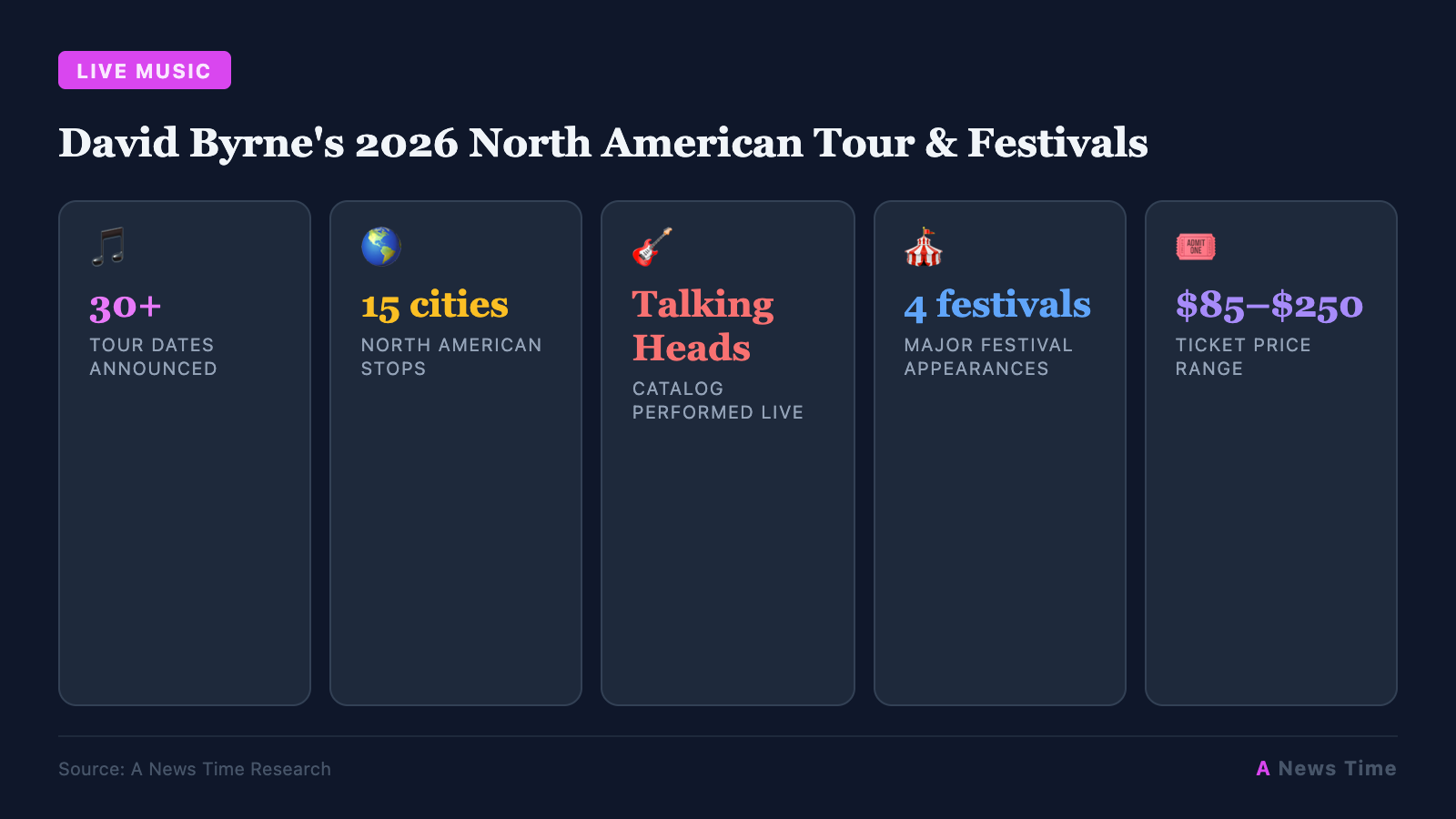
David Byrne is 73 years old and is performing 90-minute sets across 32 North American dates this spring. That fact alone tells you something about the enduring physical and creative energy of a man who has spent the better part of five decades finding new ways to make people move. The Who Is the Sky tour launched April 4 in Vancouver and runs through May 17 in Baltimore, threading through major festivals, outdoor amphitheaters, and intimate theaters in a schedule that reflects both Byrne's commercial reach and his refusal to fit neatly into any single category of touring artist.
The tour supports his seventh solo studio album, Who Is the Sky?, released September 5, 2025, on Matador Records. The album is built on themes of optimism, collective possibility, and the kind of outward-facing curiosity that has characterized Byrne's work since the Talking Heads era. It features thirteen tracks developed in collaboration with Ghost Train Orchestra, the New York City-based ensemble that serves as his live band and has been central to the sonic identity he has developed in the years since American Utopia.
Coachella and the Festival Circuit
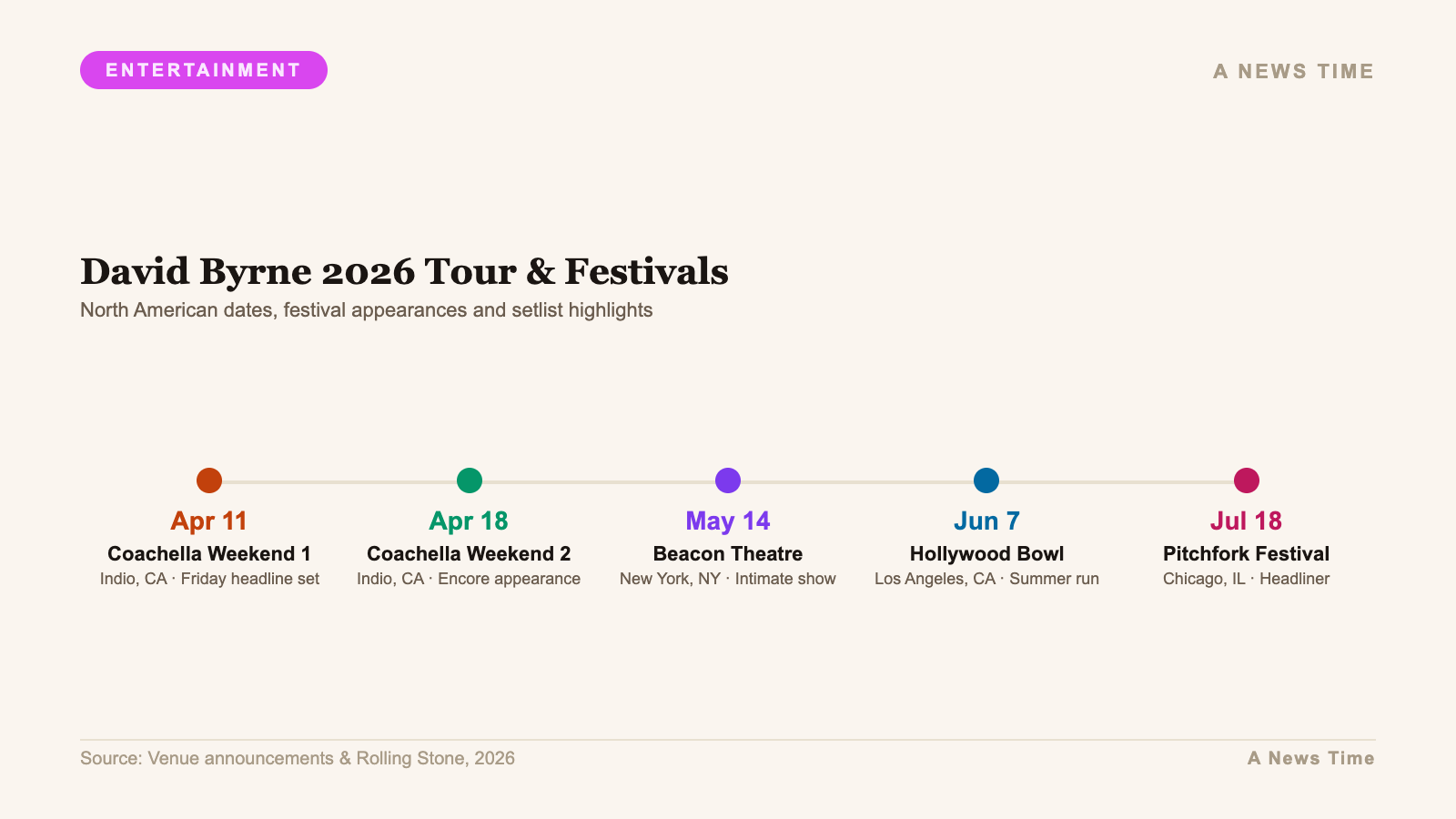
The tour's festival centerpiece comes on April 11, when Byrne performs at Coachella Valley Music and Arts Festival in Indio, California, followed by a return engagement on April 18 for Weekend 2. The dual Coachella bookings position him as one of the festival's most distinctive presences this season, occupying a slot that acknowledges his artistic legacy while placing him in direct conversation with a lineup dominated by current pop figures and experimental electronic artists.
Playing Coachella twice in the same April, across both weekends, is not unusual for artists at certain points in their careers, but it marks a deliberate choice about audience reach. The festival's demographic extends significantly younger than Byrne's core fanbase, and the booking serves as a natural introduction for listeners who know Talking Heads by reputation more than by deep catalog familiarity. Byrne has historically been uninterested in playing the nostalgia card as his primary offering, and the Who Is the Sky material gives him new work to anchor the performance around.
The broader tour route moves through Las Vegas (The Colosseum at Caesars Palace, April 20), Phoenix, Houston, and a mid-May push through the Midwest before finishing on the East Coast. Santa Barbara Bowl on April 14 and Starlight Theatre in Kansas City on May 5 round out the accessible outdoor venue options for fans across different regions. The final date, Baltimore's Hippodrome Theatre on May 17, closes the North American leg before Byrne and Ghost Train Orchestra carry the tour into Europe through the summer festival season.
Who Is the Sky and Its Themes
Who Is the Sky? lands in the lineage of work Byrne has been developing since Everything That Happens Will Happen Today in 2008, which was his collaboration with Brian Eno and arguably the record that established the tone of his mature solo career. Where that album was meditative and hymn-like, Who Is the Sky? moves with more rhythmic energy and outward joy. The album's central concern, as Byrne has described it in promotional materials, is the relationship between individual consciousness and collective experience, specifically how music functions as a technology for making people feel less alone.
That is not an unusual subject for a pop album. What distinguishes Byrne's treatment is the specificity of the arrangements. Ghost Train Orchestra's contribution is not decorative. The ensemble's layered percussion, horn voicings, and string arrangements are structural, giving the songs an architecture that is more jazz-adjacent than rock-adjacent, more ensemble-centered than guitar-centered. Live, this architectural quality becomes the dominant experience. You are not watching a rock band. You are watching something more like a theater piece that happens to contain pop songs.
The thirteen tracks are designed for live performance in a way that allows the band to stretch and breathe without losing structural coherence. Byrne has consistently expressed preference for albums that function as blueprints rather than as definitive statements, and the Ghost Train Orchestra arrangements reflect that preference: the songs can be rendered differently each night without becoming unrecognizable.
Ghost Train Orchestra and the Live Experience
Ghost Train Orchestra is worth understanding as an entity distinct from a conventional backing band. Founded by arranger and trumpeter Brian Carpenter, the New York City ensemble has a primary identity as a jazz and early American music collective with deep roots in archival performance and composition. Their collaboration with Byrne draws on that background while adapting it for a pop performance context that requires sustained energy across a full arena set.
The combination produces something that reviewers of the European and Australian legs of the American Utopia follow-up tours consistently described as overwhelming in the best sense: a stage full of musicians performing intricate arrangements with what appears to be genuine enjoyment rather than professional obligation. Byrne's touring philosophy, which emphasizes movement and choreographic integration of the musicians, means that Ghost Train Orchestra members are not stationary. The physical staging is part of the performance, and the ensemble's discipline and experience allow them to execute it without sacrificing musical precision.
Ticket prices for the North American run range from $58 to $150 plus fees depending on venue and section. Ticketmaster is the primary vendor. StubHub, SeatGeek, and Vivid Seats offer secondary market options for sold-out dates. Presale codes through the Laylo platform were distributed in December 2025, with general admission following immediately. Several theater dates are already at limited availability.
The American Utopia Connection
Any accounting of why the Who Is the Sky tour carries the cultural weight that it does has to contend with the long shadow of American Utopia, both the 2018 album and the 2019 Broadway production that Spike Lee adapted into a 2020 HBO concert film. That production is one of the most celebrated live performance documents of the past decade, and it established a standard for what a David Byrne concert could aspire to be in the current era: physically exhilarating, intellectually stimulating, politically engaged without being propagandistic, and above all technically immaculate.
The Broadway residency and the film version brought Byrne's live work to an audience that had never seen a conventional concert film quite like it, partly because it was not quite a concert film. Lee's direction approached the stage material cinematically rather than documentarily, and the result was a collaboration between film and performance that functioned as its own art object rather than as a record of an event.
Who Is the Sky? does not have an equivalent theatrical production attached to it, at least not at the time of the North American tour announcement. But the precedent set by American Utopia shapes how the new tour is perceived and what expectations audiences bring to it. Byrne is working in the productive condition of having demonstrated something exceptional previously, which creates both pressure and possibility: the pressure to maintain a standard and the possibility that the new material will generate its own exceptional form of documentation down the line.
From Talking Heads to 2026
The Talking Heads' 1984 concert film Stop Making Sense, directed by Jonathan Demme, is broadly regarded as the greatest rock concert film ever made. That assessment has held for more than four decades and through every subsequent revision of the canon. Byrne has spent the intervening years building a solo career that is, by most measures, as creatively productive as the band work that produced it, while remaining distinctly his own rather than a continuation or extension of the Talking Heads aesthetic.
The distance he has traveled from the angular post-punk of Fear of Music (1979) and Remain in Light (1980) to the optimistic ensemble writing of Who Is the Sky? is significant and not reducible to the simple narrative of an artist mellowing with age. The formal interests, the concern with rhythm, with collective performance, with the relationship between bodies and music, have been consistent throughout. What has changed is the emotional register: the anxiety and dissociation that characterized the Talking Heads' most celebrated period have given way to something more generative and expansive.
Whether that shift represents artistic growth or artistic change depends on what you value in the earlier work. Listeners who came to Byrne through Stop Making Sense or More Songs About Buildings and Food will hear in Who Is the Sky? a consistent intelligence applied to different emotional material. Listeners encountering him first through Coachella in April 2026 will simply hear an artist who has figured out how to make 90 minutes feel like 20.
European Festival Season to Follow
After the North American leg closes in Baltimore in May, the Who Is the Sky tour continues through the European summer festival circuit. Confirmed appearances include Latitude Festival in the UK, Roskilde in Denmark, Mad Cool in Spain, and Cruilla in Barcelona. The tour also covers dates across Ireland, Norway, Sweden, the Czech Republic, Hungary, Poland, and Portugal before closing in midsummer 2026.
The European festival season positions Byrne's work in a context where his critical reputation is arguably even stronger than in North America. European festival audiences in the Latitude and Roskilde mold tend toward the musically adventurous, and the Ghost Train Orchestra's arrangements, with their jazz-influenced textures and theatrical physical staging, align well with festival environments that reward formal ambition alongside pop accessibility.
For North American fans, the spring window is the only opportunity to see this tour domestically. Dates in Portland, Stanford, Las Vegas, Phoenix, Houston, St. Louis, Indianapolis, Milwaukee, and Baltimore complement the Coachella festival appearances and offer regional access points for listeners who cannot travel to the California desert. For those who can only make one show, the theater dates tend to offer the most intimate version of the experience, and Baltimore's Hippodrome is among the most celebrated historic theater venues on the East Coast. See the full most anticipated April 2026 albums list for more on the spring music calendar, and our coverage of The Strokes' new album announcement from the same Coachella weekend.