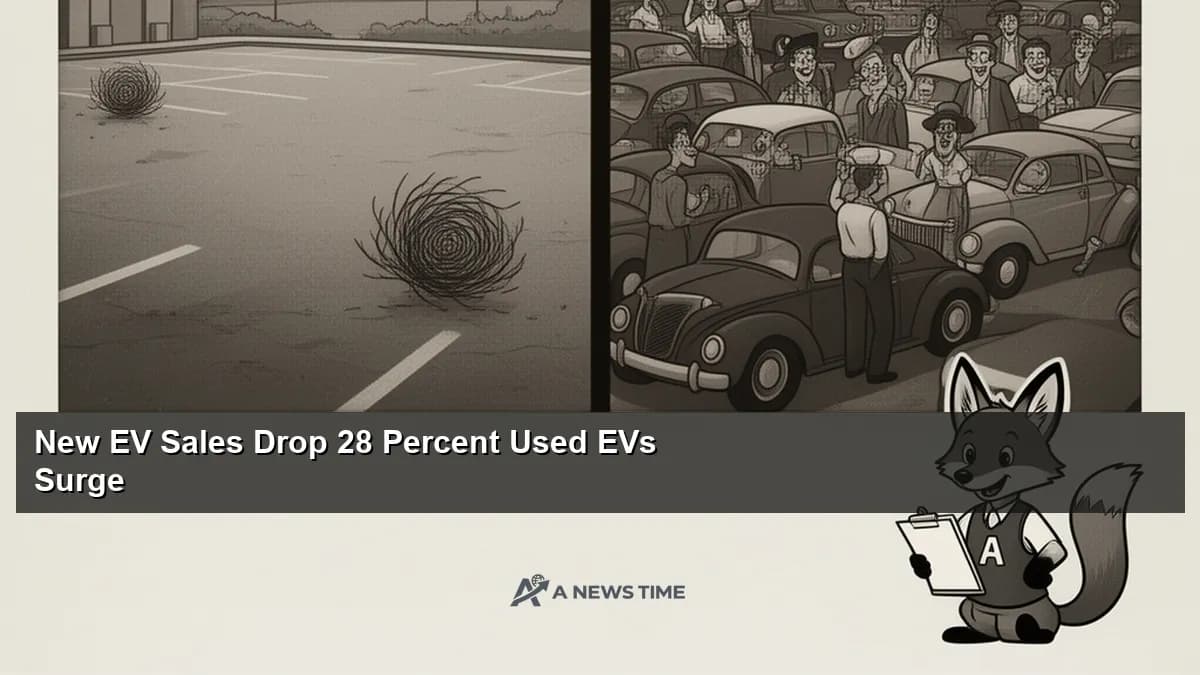
Europe's used electric vehicle market is experiencing an unexpected acceleration, driven not by government incentive programs or manufacturer marketing campaigns but by the oldest force in automotive economics: the price of fuel. As the ongoing military conflict between the United States, Israel, and Iran has disrupted Persian Gulf oil shipments and pushed Brent crude above $110 per barrel, European petrol prices have surged to their highest levels since the 2022 energy crisis. That price spike is sending consumers straight to used EV lots, where secondhand electric vehicles are selling at rates not seen since the peak of the post-pandemic car shortage.
The Fuel Price Shock and Its European Impact
The Iran conflict's impact on global oil markets has been well documented, but its specific effect on European consumers deserves close examination because the dynamics differ significantly from the American experience.
Europe imports roughly 20 percent of its crude oil from Middle Eastern sources, and the conflict has disrupted Strait of Hormuz transit at unpredictable intervals since January 2026. Insurance premiums on tanker shipments through the strait have quadrupled, and several major shipping companies have rerouted vessels around the Cape of Good Hope, adding 10 to 14 days to delivery times and significant per-barrel transport costs.
The result at the pump has been dramatic. Average petrol prices across the EU reached approximately 1.92 euros per liter in mid-March 2026, up from 1.58 euros per liter in September 2025, a 22 percent increase in six months. In the United Kingdom, which has among the highest fuel duties in Europe, petrol prices crossed the psychologically significant 1.70 pounds per liter threshold in February, triggering widespread media coverage and consumer alarm. For context, the 2022 peak during the initial Ukraine conflict reached roughly 1.91 pounds per liter in the UK, and current prices are tracking toward that level.
| Country | Sep 2025 (per liter) | Mar 2026 (per liter) | Change | Annualized Cost Impact* |
|---|---|---|---|---|
| Germany | €1.62 | €1.96 | +21% | +€510/year |
| France | €1.71 | €2.04 | +19% | +€495/year |
| UK | £1.42 | £1.71 | +20% | +£435/year |
| Italy | €1.74 | €2.08 | +20% | +€510/year |
| Netherlands | €1.89 | €2.21 | +17% | +€480/year |
| Spain | €1.48 | €1.78 | +20% | +€450/year |
*Based on average annual driving of 15,000 km at 7.5 L/100 km consumption.
The annualized cost column matters because it translates abstract per-liter prices into the concrete household budget impact that drives purchasing decisions. An extra 450 to 510 euros per year in fuel costs may not sound transformative in isolation, but for households already stretched by inflation and elevated energy bills, it is the kind of incremental burden that tips decision-making. And unlike the 2022 spike, which felt temporary and tied to a single geopolitical event, the current increase is occurring against a backdrop of persistent Middle Eastern instability with no clear resolution timeline.
Used EV Sales Data: What the Numbers Show
The response in the used EV market has been swift and measurable. Data from the European Automobile Manufacturers' Association (ACEA) and multiple national vehicle registration databases show a clear inflection in used EV transaction volumes beginning in January 2026, accelerating through February and March.
In Germany, Europe's largest car market, used EV registrations rose 18 percent year-over-year in the January-March 2026 period. In the UK, used EV sales climbed 15 percent over the same comparison period, with the Society of Motor Manufacturers and Traders (SMMT) reporting that used EV transaction times, the average number of days a used EV sits on a dealer lot before sale, dropped from 42 days in Q4 2025 to 29 days in Q1 2026.
France showed an even more dramatic shift: used EV sales surged 23 percent year-over-year in Q1 2026, boosted by particularly high petrol prices (France applies both carbon tax and standard fuel duty, making pump prices among Europe's highest) and by a government-backed "bonus ecologique" program that extends modest incentives to used EV purchases for lower-income buyers.
The contrast with new EV sales is striking. New battery-electric vehicle registrations in Europe grew only 4 percent year-over-year in Q1 2026, a sharp deceleration from the 22 percent growth rate seen in the same quarter of 2025. The decoupling of new and used trends mirrors what is happening in the United States, where new EV sales fell 28 percent while used EVs surged, though the European version of this divergence is less extreme because new EV sales in Europe remain in positive territory.
What Is Selling and Who Is Buying
The composition of the used EV market in Europe reveals important details about which vehicles are finding buyers and who those buyers are.
The best-selling used EVs across Europe in Q1 2026 were dominated by models that are three to four years old and positioned in the compact to midsize segments:
| Rank | Model | Avg. Used Price | Avg. Age | Avg. Range (WLTP) |
|---|---|---|---|---|
| 1 | Tesla Model 3 | €22,400 | 3.1 years | 350-490 km |
| 2 | Volkswagen ID.3 | €18,900 | 2.8 years | 345-425 km |
| 3 | Renault Zoe | €12,200 | 3.9 years | 300-395 km |
| 4 | Hyundai Kona Electric | €19,500 | 3.2 years | 305-484 km |
| 5 | Peugeot e-208 | €16,800 | 2.6 years | 340-400 km |
| 6 | Tesla Model Y | €28,600 | 2.1 years | 390-533 km |
| 7 | Volkswagen ID.4 | €24,300 | 2.5 years | 345-520 km |
| 8 | BMW iX1/i4 | €31,200 | 1.8 years | 410-590 km |
The Renault Zoe's presence at number three is particularly telling. The Zoe is a small city car with relatively modest range by current standards, and Renault discontinued new production in 2024. But at an average used price of just 12,200 euros, it represents an entry point to electric ownership that is accessible to a much broader economic demographic than premium models. For urban and suburban commuters who drive 30-50 km daily, the Zoe's 300-km-plus range is more than adequate, and the fuel savings at current petrol prices pay back the purchase price rapidly.
Buyer demographics have also shifted. Industry data from AutoTrader UK and Mobile.de (Germany's largest used car platform) indicate that the average used EV buyer in Q1 2026 was notably different from the typical new EV buyer: older (average age 47 vs. 39 for new EV buyers), with lower household income (median of approximately 42,000 euros vs. 68,000 euros for new), and more likely to describe the purchase as "financially motivated" rather than "environmentally motivated" in post-purchase surveys.
This is significant because it represents the democratization of EV ownership that industry advocates have been predicting for years, just arriving through the used market rather than the new one. The practical effect is the same: more electric vehicles on European roads, driven by more diverse populations, replacing more internal combustion kilometers with electric ones.
The Petrol Price Psychology: Why This Spike Feels Different
Europe has experienced fuel price shocks before, most recently during the 2022 energy crisis triggered by the Russia-Ukraine conflict. That spike was severe but proved relatively short-lived as European governments released strategic reserves, negotiated alternative supply contracts, and imposed temporary fuel duty reductions. Consumer behavior adjusted temporarily but largely reverted once prices stabilized.
The current situation carries a different psychological weight for several reasons. First, it follows the 2022 shock rather than existing in isolation. European consumers who lived through 1.90 euro petrol in 2022, watched it recede, and are now watching it climb back toward 2.00 euros are experiencing a pattern that suggests volatility rather than a one-time event. The lesson consumers are drawing is not "petrol will be expensive this year" but "petrol will be unpredictable going forward." That distinction favors structural changes in purchasing behavior, like switching to an EV, over temporary adjustments like driving less.
Second, the conflict driving the current spike has no clear end date. The 2022 Ukraine-related spike had identifiable (if optimistic) resolution scenarios that allowed consumers to wait it out. The Iran conflict involves multiple state actors, nuclear-related tensions, and Strait of Hormuz chokepoint dynamics that analysts broadly assess as likely to persist for months or years rather than weeks. This extended uncertainty timeline makes the "wait for prices to drop" strategy feel less viable.
Third, electricity prices in Europe have actually declined modestly since their 2022-2023 peak, as renewable capacity additions and improved LNG supply have stabilized the power grid. The gap between the per-kilometer cost of petrol driving and electric driving has therefore widened from both directions: petrol is getting more expensive while electricity has gotten slightly cheaper. Across the EU, the average cost per kilometer for a BEV is now roughly 60 to 65 percent lower than for a comparable petrol vehicle, up from approximately 45 to 50 percent lower in 2024.
Charging Infrastructure: Still a Constraint but Improving
Europe's charging infrastructure remains uneven, and it continues to be the single largest practical barrier to EV adoption outside of purchase price. However, the network has improved substantially since 2023, and that improvement is making used EVs more viable for buyers who might have dismissed them two years ago.
ACEA data shows approximately 730,000 public charging points across the EU-27 as of January 2026, up from roughly 580,000 in January 2025, a 26 percent increase. More importantly, the share of those chargers rated above 150 kW (the threshold for genuinely useful highway fast charging) has grown from 12 percent to 19 percent of the total network. The Netherlands, Germany, France, and the Nordics lead in absolute numbers, while Southern and Eastern European countries lag significantly.
For the typical used EV buyer, who according to demographic data is an urban or suburban commuter, home or workplace charging is the primary charging method. The public fast-charging network matters less for daily use and more for the occasional longer trip. The continued buildout of highway charging corridors, particularly through EU-mandated requirements under the Alternative Fuels Infrastructure Regulation (AFIR), is gradually reducing the practical range anxiety that deterred earlier adopters.
The expanding European infrastructure stands in contrast to the venture capital pouring into energy tech startups on both sides of the Atlantic, much of which is directed toward charging solutions and grid integration technologies.
Government Policy and the Used EV Opportunity
Several European governments have recognized the used EV market as a tool for accelerating electrification among lower-income populations and are crafting policies to support it.
France's "bonus ecologique" already extends to used EVs, offering up to 1,000 euros for lower-income buyers. Italy launched a similar program in January 2026, offering incentives of up to 2,000 euros for used EV purchases by households with income below 30,000 euros. Germany's approach has been more market-oriented, with reduced VAT rates on used EV sales rather than direct subsidies.
The UK, which is no longer part of the EU framework, has taken a different path. Rather than subsidizing used EV purchases directly, the UK government has focused on reducing the benefit-in-kind (BIK) tax rate for company cars that are electric, which feeds a steady supply of two-to-three-year-old EVs into the used market as corporate leases expire. This "trickle-down" approach has been effective: the UK has one of the youngest average ages for used EVs in Europe, reflecting the rapid cycling of corporate fleet vehicles into the secondhand market.
The policy conversation is also beginning to address the warranty and consumer protection dimensions of used EV sales. Battery health transparency is a particular concern, since the battery is the most expensive component and its degradation directly affects vehicle range and value. The EU is expected to finalize regulations in 2026 requiring a standardized "battery health passport" for all used EV sales, providing buyers with certified data on remaining capacity, charge cycle history, and projected remaining useful life. This kind of standardization could significantly boost buyer confidence in the used EV market by reducing the information asymmetry that currently favors sellers.
Manufacturer Implications: The Fleet-to-Used Pipeline
For automakers, the surge in used EV sales creates both opportunities and challenges. On the opportunity side, a robust used market supports residual values over time, which makes leasing more attractive and reduces the total cost of ownership for new buyers. Strong used demand also means that the total population of EVs on European roads is growing, which builds familiarity, normalizes the technology, and creates organic demand for the services and accessories that generate aftermarket revenue.
On the challenge side, every used EV sale is potentially a lost new EV sale. If a buyer can get a three-year-old VW ID.3 for 18,900 euros, the incentive to spend 38,000-42,000 euros on a new one is significantly reduced. Manufacturers are essentially competing with their own past production, a dynamic that is familiar in the broader auto industry but feels more acute in the EV segment because of the rapid depreciation rates.
Some brands are responding by attempting to differentiate new models more aggressively from their used predecessors. Over-the-air software updates help in this regard, since a 2023 vehicle that has received continuous software improvements feels less dated than its manufacturing year might suggest. But hardware improvements in charging speed, battery capacity, and efficiency are harder to retrofit, and these remain the primary selling points for new models over used ones.
Looking Ahead: Petrol Prices as EV Catalyst
The correlation between fuel prices and EV adoption is not new, but the current European data provides some of the clearest evidence yet of how directly the relationship operates in the used market. When petrol crossed 1.80 euros per liter in Germany in January 2026, used EV inquiry volumes on Autoscout24, Europe's largest online vehicle marketplace, jumped 31 percent within two weeks. Similar patterns were observed across other markets, with a lag time between price spike and purchase activity of roughly three to six weeks, consistent with the typical consumer decision timeline for a vehicle purchase.
If the Iran conflict continues to pressure oil markets through the summer of 2026, which most geopolitical analysts consider likely, the used EV sales trend should strengthen further. Seasonal driving patterns in Europe also favor EVs during warmer months, when battery range performance is at its best and road trip season creates visible demand for charging infrastructure.
The irony is that the geopolitical instability causing economic pain across Europe may inadvertently accelerate the continent's transition to electric transportation. Not through government mandates or manufacturer marketing, but through the simple, powerful logic of household economics. When filling a petrol tank costs 90 to 110 euros and charging an EV at home costs the equivalent of 15 to 25 euros for the same distance, consumers do the math. And increasingly, the math is pointing them toward the used EV lot.
Sources
- Reuters - European used EV sales data and fuel price reporting
- ACEA - European Automobile Manufacturers' Association registration data
- SMMT - UK vehicle sales and used EV market data
- International Energy Agency - European electricity and fuel price tracking