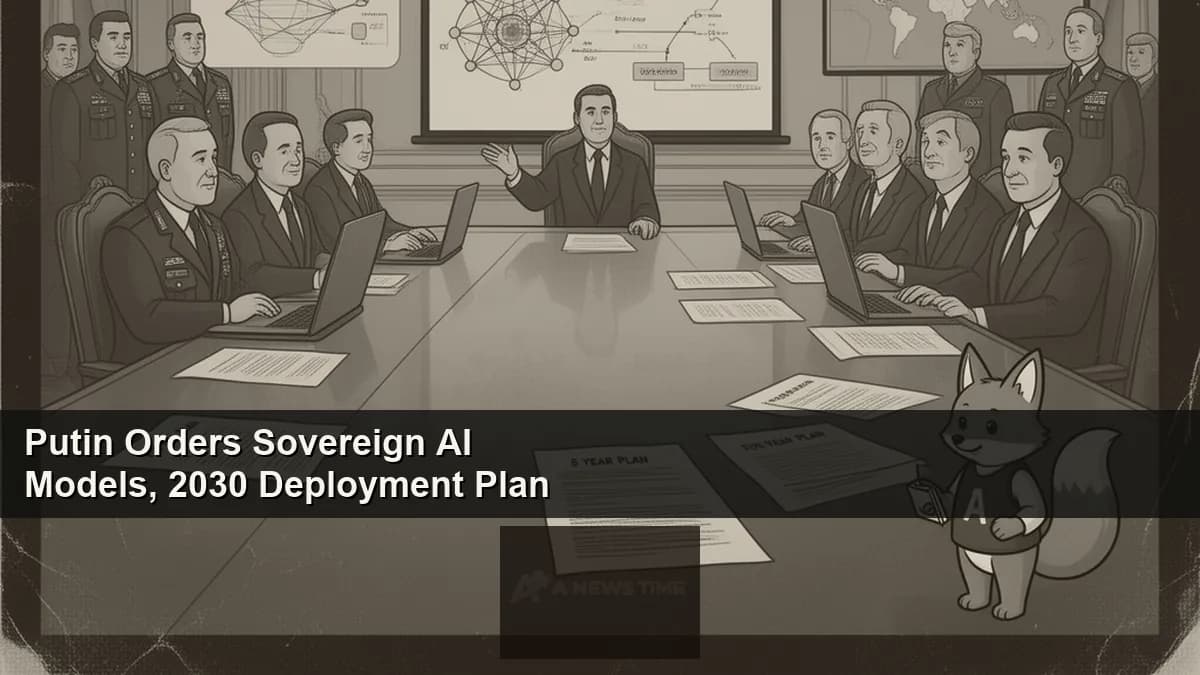
Russian President Vladimir Putin chaired a high-level meeting at the Kremlin on , declaring that AI technology is no longer a strategic priority but an existential one, using language that framed the country's ability to develop and deploy sovereign AI systems as a condition for the continued existence of the Russian state. The meeting, which ran late into Friday evening and included the heads of Russia's top technology companies, the Minister of Finance, the Minister of Defence, and senior presidential staff, produced a five-point action agenda with a hard 2030 deadline for economy-wide AI deployment.
The session drew immediate attention outside Russia's borders for two reasons. First, the explicit linking of domestic foundation language models to military and defense applications, a framing Western AI companies have largely avoided in public. Second, the direct instruction to the government to develop "financial architecture" for the project by mobilizing both public and private funding, citing the defense-sector model used by AI leaders abroad as the template to follow.
What Putin Actually Said at the Kremlin Table
The Kremlin published a full transcript of Putin's opening remarks. Several passages went beyond the standard political speech about innovation and competitiveness and into specifics that analysts would want to read carefully.
On the pace of AI progress, Putin noted that foundation language models had recently passed a threshold: in the majority of controlled experiments, participants could not distinguish machine responses from human dialogue. He called this a significant milestone and projected that AI agents would soon pass "physical-world tests," using the example of whether a vehicle is being driven by a human or an autonomous AI pilot.
"The sovereignty of the Russian state in the near future, and without exaggeration, its very existence, depends on our ability to keep pace with these global transformations."
Vladimir Putin, Kremlin AI Strategy Meeting, April 10, 2026
That sentence is worth sitting with. Statements about AI as a competitive priority are common from heads of state. Statements that frame AI capability as a prerequisite for national survival are considerably rarer, and they tend to influence how governments allocate resources in ways that normal procurement cycles do not.
Putin also addressed open-source AI development directly, acknowledging that domestic Russian AI efforts rely on shared global libraries of algorithms and that this "cooperative resource should be used effectively," while insisting that any AI architecture borrowing from foreign sources must still guarantee Russian control over "key parameters" of the systems. It is a nuanced position: use what is available globally, but maintain full technical ownership of the final output.
The Five-Point Commission Agenda: Defense to Education
Putin assigned the new Presidential Commission on AI, chaired jointly by Deputy Prime Minister Dmitry Grigorenko and Deputy Chief of Staff Maxim Oreshkin, five specific task areas. The executive order establishing the commission had already been signed in February 2026. What is new from this meeting is the explicit scope of what the commission is expected to deliver by year-end.
| Priority Area | Stated Objective | Target Horizon |
|---|---|---|
| Economic deployment | Accelerated AI rollout across manufacturing, logistics, energy, public administration | 2030 (all sectors) |
| Education and workforce | Modernize training, retraining, and all education levels to match AI-era requirements | Comprehensive solutions by end of 2026 |
| Risk and threat assessment | Identify main risks from AI in sensitive sectors, propose mitigation measures | Comprehensive solutions by end of 2026 |
| Defense and national security | Develop sovereign domestic AI solutions for military and security applications | Ongoing, classified scope |
| International expansion | Promote Russian AI systems and services in CIS, SCO, and BRICS partner markets | Comprehensive framework by end of 2026 |
The defense item is the most opaque. Putin said "we must possess cutting-edge technologies and rely on sovereign, domestically developed products" in the defense context, and then noted that certain specifics and nuances in that area would be discussed outside the portion of the meeting published in the transcript. That closing parenthetical, "which we will now, of course, discuss further," is the only hint at what the closed-session agenda contained.
The international expansion item is arguably the most geopolitically complex. Russia pushing AI products into CIS and BRICS markets is a direct play for technological influence in countries that are already navigating between Western and Chinese technology ecosystems. An AI platform built on Russian foundation models, integrated into government administration and logistics in those markets, creates dependency relationships that are hard to unwind. The strategic logic is identical to how Huawei used telecommunications infrastructure to build influence in emerging markets before Western governments began restricting its access.
The Open-Source Problem: Borrowing From Partners You Do Not Trust
One passage in Putin's remarks captures a genuine tension that every national AI strategy currently faces, not just Russia's. He acknowledged that Russia's domestic AI development relies on open-source foundations built through global collaboration, then said those resources must be used while ensuring that "any further steps in building artificial intelligence architecture will guarantee solutions to security and defence challenges."
Think of it like this: open-source AI is a shared workshop where thousands of engineers have contributed tools, code, and techniques. Anyone can walk in, use the tools, and build something. But if you are building something you want to keep exclusively yours, for purposes you do not want others to understand or interfere with, you have a problem. The workshop is still accessible to everyone. The contributions you used to build your product are visible to the people who made them. And the updates to those tools arrive from developers whose interests may not align with yours.
Putin's instruction to "use the cooperative resource effectively" while maintaining full domestic control over key parameters is technically achievable. You fork the open-source base, stop accepting outside contributions, and develop the system internally from that point forward. Several large technology organizations have done something similar with internal models derived from open foundations. The cost is that you fall behind the community as it continues to evolve, unless you have the engineering capacity to match the pace of development independently. Russia is signaling it intends to build that capacity.
The presence of Sberbank CEO German Gref at the meeting is notable here. Sberbank, Russia's largest state-owned bank, has been building its own AI stack for several years and operates GigaChat, one of the most developed Russian-language large language models currently available. Gref was seated in the published photographs alongside the Head of the Federal Service for Technical and Export Control. The pairing of Russia's primary commercial AI developer with its export control regulator in the same room suggests that the line between commercial AI development and national security AI development is being deliberately blurred.
How This Compares to Other National AI Strategies
National AI strategies have proliferated since the United States published its first one in 2019. By now, most G20 countries have published formal frameworks. What distinguishes the Russian approach from, say, the European Union's AI Act or the United States executive orders on AI, is the explicit subordination of commercial AI development to national security and defense requirements.
| Country / Bloc | Primary Framing | Defense AI Stance | Open-Source Posture |
|---|---|---|---|
| United States | Innovation and competitiveness | Pentagon-funded programs, some open research | Mixed: supports open models with national security carve-outs |
| European Union | Risk management and fundamental rights | Member-state controlled, limited bloc-level coordination | Broadly supportive of open-source AI |
| China | National capability and social governance | Civil-military fusion doctrine; dual-use by design | Selective; proprietary models for sensitive applications |
| Russia (April 2026) | Sovereignty and national survival | Explicit domestic defense AI development mandate | Use open-source as foundation; fork and control internally |
Russia's framing is closer to China's civil-military fusion model than to the Western approaches, but with a more explicit acknowledgment of the sovereignty problem. China's approach assumes domestic technology companies are effectively extensions of state capacity. Russia's April 10 meeting is, in part, an attempt to construct that same relationship more formally, through a commission structure that includes both government agencies and private technology companies, and through the explicit reference to the financial architecture model used by defense agencies abroad.
For context on how the United States is approaching similar questions about AI in sensitive government applications, our coverage of the CIA's plans to embed AI coworkers in every analyst platform shows the parallel logic on the Western side: both governments are moving toward AI-assisted and eventually AI-autonomous operations in classified environments, with the primary difference being who controls the models and under what oversight framework.
The 2030 Deadline and What "All Sectors" Actually Means
Putin said explicitly that by 2030, AI technologies and products based on them "should be deployed across all sectors, including manufacturing, logistics, energy, public administration, and education." He also said that heads of ministries and agencies should report annually on AI implementation, not through written reports but through public presentations at Sberbank's annual AI Journey conference.
The accountability mechanism is worth noting. Requiring public ministerial presentations at a specific industry conference is an unusual choice for a government that does not generally emphasize public accountability. The practical effect is that each ministry will need to demonstrate visible, deployed AI applications on a fixed annual cadence, in front of an audience that includes the technology companies building those applications. It creates pressure to show genuine deployment rather than paper plans.
"I am not referring to formal written reports, but to open, public presentations showcasing the actual solutions in use."
Vladimir Putin, addressing ministry reporting requirements, April 10, 2026
Whether this produces genuine adoption or carefully staged demonstrations is an open question. Russia's track record on ambitious technology modernization deadlines, from previous digital government initiatives to import substitution programs following the 2022 sanctions, has been uneven. The sanctions environment also complicates the hardware side of any large-scale AI deployment. Training and running large foundation models requires significant compute infrastructure, specifically high-end GPUs, and Russia's access to that hardware through legitimate channels has been heavily restricted since 2022.
Nvidia's chips, which power the majority of AI training infrastructure globally, are subject to export controls that prevent their sale to Russia. China-made alternatives are advancing but have not yet matched the performance and software ecosystem of the leading Western chips. This hardware gap is the most concrete practical constraint on Russia's 2030 ambitions, and it was notably absent from the published portion of Putin's remarks. The ongoing Nvidia backlog situation and the global demand for AI compute infrastructure underscore just how supply-constrained the market already is for buyers who do have unrestricted access.
Industry Reaction: Caution Outside Russia, Signal Inside It
Western AI policy researchers have noted the significance of the April 10 meeting but are watching for what follows rather than treating the published remarks as a finished picture.
"The meeting formalizes what has been apparent for some time: Russia is building an AI strategy explicitly designed for a world in which it cannot rely on Western technology supply chains. The question is whether it has the domestic engineering base to execute it."
Senior fellow at a Washington-based technology policy institute, speaking on background, April 2026
Within Russia's technology sector, the signal is being read differently. The explicit government backing for domestic foundation model development, combined with the commission structure and the financial architecture instruction, amounts to a state commitment to fund and coordinate the effort. For companies like Yandex, which has been building its own large language models through its YandexGPT series, and Sberbank's GigaChat team, this represents potential access to government resources and procurement that could accelerate work they were already doing.
The comparison Putin drew to how defense agencies abroad "allocate resources to implement such programmes" and how "both public and private funding is mobilized" is a reference to the DARPA model, the US Defense Advanced Research Projects Agency approach of funding high-risk foundational research through a combination of government grants and defense contracts. Russia is describing an intention to build a functional equivalent, with the explicit goal of matching the output of the organizations it named as leaders.
- Foundation model development: State-backed funding for domestic training of sovereign large language models, with Sberbank's GigaChat and Yandex's YandexGPT as the most developed starting points
- Defense AI applications: Classified development track for military and intelligence applications of foundation models, with full domestic control over key parameters
- Economic sector deployment: Government procurement requirements that favor domestic AI solutions, creating captive markets for Russian-built AI products
- Education alignment: Curriculum and retraining programs built around operating AI tools, from primary school through workforce development
- BRICS and CIS expansion: Export framework for Russian AI products and services, targeting markets where Western and Chinese competition is less entrenched
The structure mirrors, in compressed form, what took the United States two decades to build through DARPA, the national labs, and the academic-industrial pipeline that produced the current generation of AI leaders. Whether Russia can compress that timeline under current sanctions conditions is the central empirical question the commission will face when it convenes to develop the financial architecture Putin requested.
For anyone tracking the broader geopolitics of AI infrastructure, this meeting is a data point in a pattern that also includes China's acceleration of domestic chip development following US export controls, and the debate inside the United States about what kinds of AI constraints are permissible in government procurement contexts. Every major power is now drawing lines between AI tools it trusts and AI tools it does not, and beginning to fund the development of the former.
Frequently Asked Questions
- What is Russia's specific 2030 AI target?
- Putin instructed the government to deploy AI technologies across all sectors of the economy and social sphere by 2030, including manufacturing, logistics, energy, public administration, and education. The National Plan for AI Implementation, developed jointly by the federal government and regional authorities, is meant to operationalize this target.
- Who is running Russia's new AI commission?
- The Presidential Commission on the Development of Artificial Intelligence Technologies is chaired jointly by Deputy Prime Minister Dmitry Grigorenko and Maxim Oreshkin, Deputy Chief of Staff of the Presidential Executive Office. The executive order establishing the commission was signed in February 2026. The commission includes representatives from the Presidential Executive Office, ministries and agencies, leading technology companies, and the State Council.
- What is the hardware problem for Russia's AI ambitions?
- Training large foundation models requires high-end GPU chips, primarily from Nvidia, which are subject to export controls that ban their sale to Russia. Russia must either develop domestic chip alternatives, source hardware through third countries (which carries legal and technical risks), or accept a significant compute disadvantage relative to US and Chinese AI developers. Putin's remarks did not address this constraint directly in the published transcript.
- How does Russia's approach differ from China's AI strategy?
- China's civil-military fusion doctrine treats AI companies as dual-use assets whose output can be directed toward state purposes. Russia is attempting to formalize a similar relationship through a commission structure and financial architecture that combines state funding with private sector participation. The key difference is timing: China built this framework over two decades as its tech sector matured, while Russia is attempting to construct it rapidly under sanctions pressure.
- What Russian AI models already exist?
- Sberbank's GigaChat is the most developed Russian-language large language model currently deployed at scale. Yandex has built the YandexGPT series. Both were present at the April 10 meeting in the form of their corporate leadership. The commission's work will likely center on how to coordinate, fund, and scale these existing efforts rather than starting from scratch.
Sources
- Meeting on development of AI technologies, Official Website of the President of Russia, April 10, 2026
- Presidential Commission on the Development of Artificial Intelligence Technologies established, Kremlin, February 26, 2026
- Reuters: Russia's AI strategy and domestic technology development context
- Brookings Institution: Russia's AI ambitions under sanctions constraints
Written by Marcus Holloway, Technology & Gaming Writer