The summer of 2025 was supposed to be Tottenham's reset moment. They had just won the Europa League, which meant Champions League football for the first time since 2020 and the departure of a few of the more difficult figures in a dressing room that had fractured badly in the latter stages of the Ange Postecoglou era. Son Heung-min was politely sent off to Los Angeles. Thomas Frank, the Brentford manager who had built one of the more coherent footballing identities in the Premier League on a fraction of Spurs' resources, came in. The infrastructure was being put right. The vibes, as they say in these circumstances, were immaculate.
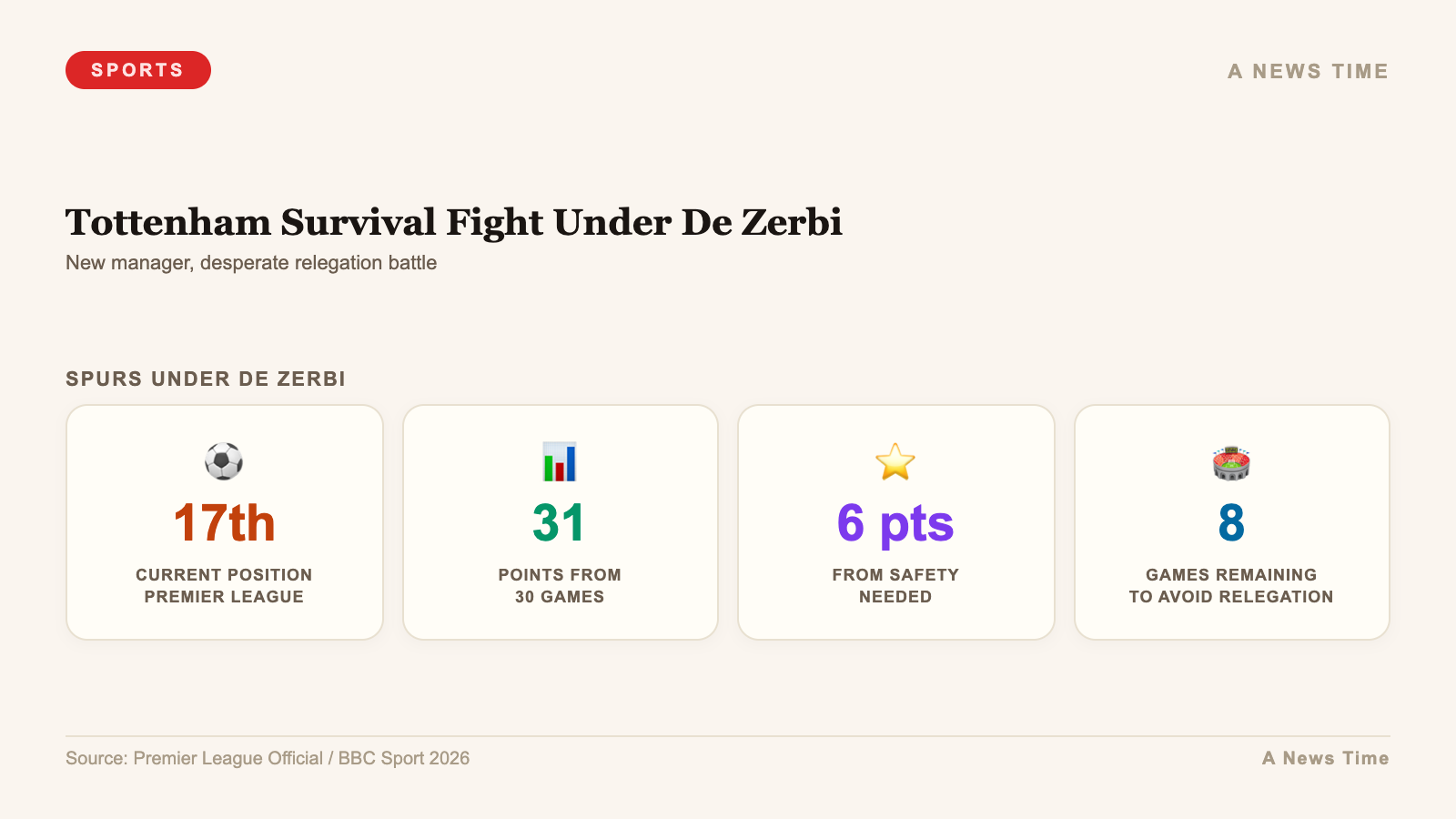
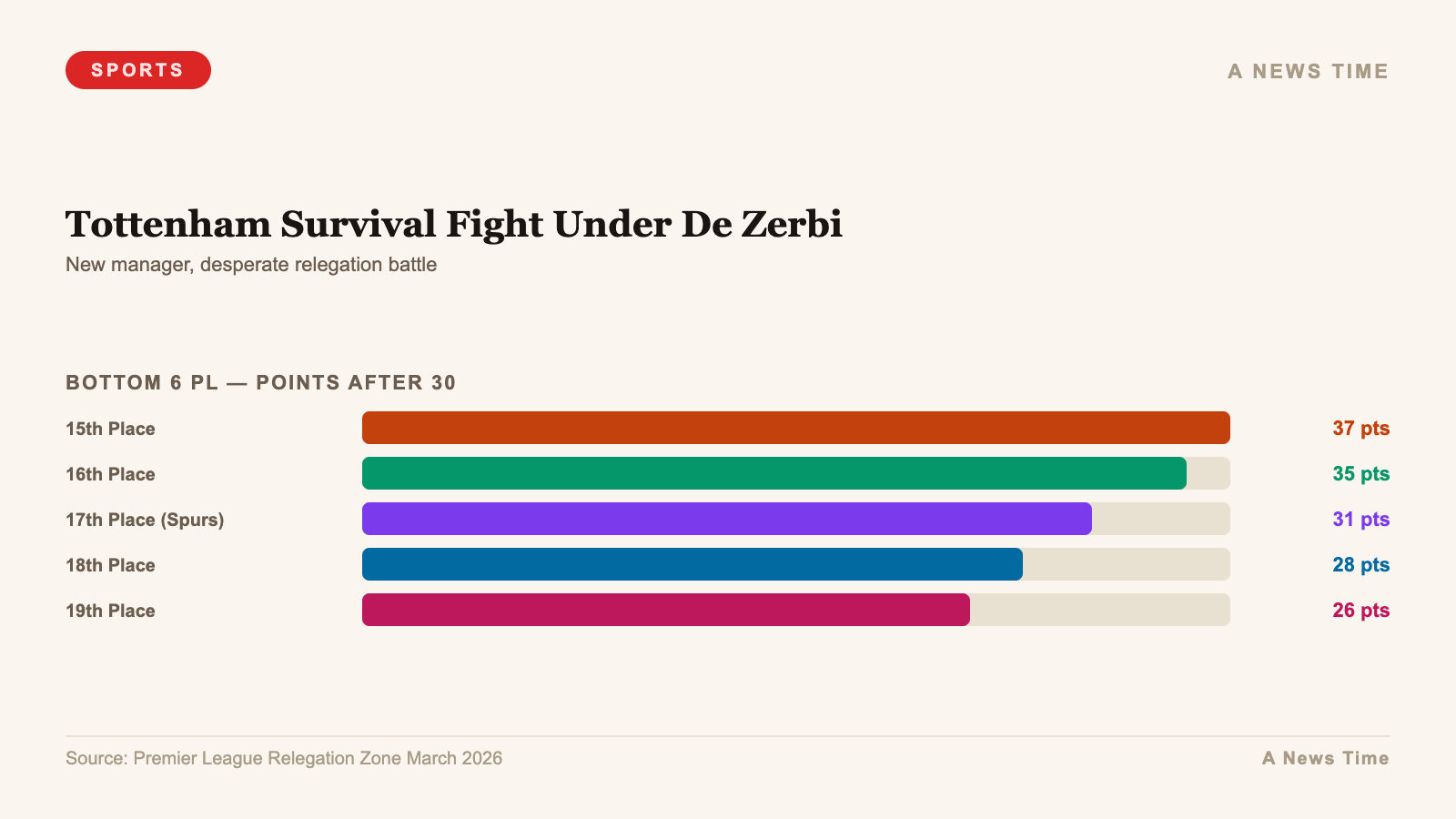
Eleven months later, Tottenham are 18th in the Premier League table, two points from safety after West Ham beat Wolves, and on their third manager of the season. It would be the first relegation in the club's Premier League history. The scale of the collapse is not fully explained by any single factor, which is what makes it so difficult to fix, and what makes Roberto De Zerbi's arrival at the end of March 2026 one of the most genuinely uncertain managerial appointments in recent English football history.
How Did Spurs Get Here
Thomas Frank lasted until December. The specific causes of his dismissal have been documented extensively, but the essential story is that the Brighton template he had built at the Amex, a high-energy pressing system that relied on specific positional discipline and a squad bought to execute it, did not transfer to a Tottenham squad assembled around different principles and containing significantly more expensive players with significantly different expectations. Frank's tenure produced some decent performances and some genuinely bad ones, and the club moved at the point where the trajectory was clearly downward.
The interim appointment of Igor Tudor lasted 44 days and produced results that ranged from mediocre to catastrophic. Tudor is an experienced manager with solid records at Lazio and Verona, but the situation he inherited was already fragile, and his tactical approach, which emphasized physical intensity over technical organization, was not well-matched to a squad that had been purchased and developed under entirely different assumptions. By the time Spurs played their 44th day under Tudor, everyone involved had concluded that the arrangement needed to end.
De Zerbi was appointed March 31, 2026, on a five-year contract that includes a reportedly significant bonus for keeping Spurs in the top flight. The length of the deal is the interesting part. A five-year contract for a manager taking over a team in a relegation battle is either a statement of extraordinary confidence or an acknowledgment that the short-term situation should not define the project's scope. Probably both.
What De Zerbi Brings
Roberto De Zerbi's managerial record contains two striking demonstrations of his capacity: at Brighton, where he guided a club to their highest ever Premier League finish and their first European campaign in a single debut season; and at Marseille, where he transformed a historically underperforming club into Ligue 1 runners-up in 2024-25, earning a Champions League place. Both achievements were built on the same philosophical framework: deep positional play, deliberate ball circulation, and an emphasis on individual technical quality within collective structure.
The question at Tottenham is specific: can he do what he has never convincingly done before? His mid-season record at struggling clubs is not reassuring. When he took over Benevento early in a difficult period, he did not win any of his first nine games. A mid-season intervention at Palermo in 2016 produced one win in thirteen games. The circumstances at Tottenham are not identical to either of those situations, but they share the fundamental challenge of inheriting a squad with low confidence, unclear tactical identity, and a results crisis that requires immediate improvement.
De Zerbi is reported to be deliberately simplifying his approach at Tottenham rather than implementing his full tactical system. That pragmatic instinct is encouraging. The expansive, technically demanding football he builds at clubs over full preseasons requires time and specific squad construction. Trying to install it in seven weeks into a squad that has had three different tactical frameworks this season would be counterproductive. What he needs from these players is clarity about their roles and enough confidence to execute under pressure, which is a different and more achievable ambition than building a new footballing identity from scratch.
The Injury Picture
Tottenham's injury situation has been central to their collapse, and it offers both explanation and cautious optimism heading into the run-in. The treatment room has been crowded since August, and several of the absences have been long-term losses that would have damaged any Premier League club's season.
Dejan Kulusevski, the Swedish attacking midfielder who has been one of the most consistent performers in Spurs' squad since his arrival, has not played this entire season due to a patella injury. His absence removes a level of technical quality and attacking directness that none of the squad's available options have been able to replicate. Wilson Odobert suffered a serious knee injury requiring surgery and will not return before late 2026. James Maddison, who tore his ACL in late 2025, is progressing in his recovery and could return in May, though his availability for the relegation run-in remains uncertain.
The international break provided a window for several players to complete their recoveries. Pape Matar Sarr and Mathys Tel both pulled out of international duty due to injury but are expected to be available for the trip to Sunderland on April 12. Tel is particularly significant: before his groin issue, he had been one of the few consistently positive contributors in what has been a generally flat attacking unit, offering the kind of quick direct running that breaks defensive lines. Mohammed Kudus and Guglielmo Vicario are expected back for the Brighton home fixture on April 18. Rodrigo Bentancur, whose midfield presence has been a glaring absence throughout the season, could return before the end of April.
The Fixtures: A Closer Look
Seven games remain. The run-in, on paper, is more manageable than Spurs' current position might suggest, and more forgiving than the fixtures their relegation rivals face in the same period.
The trip to Sunderland on April 12 is De Zerbi's first game in charge. Sunderland have been inconsistent at home and are a Championship club newly promoted, not a team with the defensive organization that makes away trips punishing. Three points is an achievable target that would immediately shift the psychological weight that has been suffocating this Tottenham squad since January.
Brighton at home on April 18 is the fixture with the most narrative complexity: De Zerbi managing against the club where he built his Premier League reputation, facing a side that knows his methods well and has been specifically coached to work against them since his departure. It is simultaneously a fixture Spurs should be capable of winning at home and one that carries unique tactical complication.
Wolves away and Leeds at home are the two fixtures most central to Spurs' survival arithmetic. Wolves are mired in their own relegation battle and have fewer resources to navigate it than Spurs. The Leeds game on May 9 is the fixture everyone around the club has circled: a direct relegation six-pointer at Tottenham Hotspur Stadium that will be, if Spurs are still in danger at that point, the most pressurized occasion they have faced this season.
Aston Villa away and Chelsea away represent the fixtures where points are hardest to collect. Villa have been one of the better-organized sides in the top half and are playing with confidence; Chelsea, despite their own inconsistencies, are significantly more capable than Spurs in their current form. The realistic target from those two games is one point rather than four. If Spurs take care of the games they are expected to win, those two away losses are survivable.
Everton at home in the final game of the season is the closing fixture everyone hopes never becomes definitive. If it does, the atmosphere at Tottenham Hotspur Stadium will be unlike anything the ground has previously hosted.
The Europa League Winners and the Relegation Zone
The specific cruelty of Tottenham's situation is the proximity to last season's success. The Europa League win in Bilbao in May 2025 was the club's first major trophy since the League Cup in 2008, and it arrived after a period of sustained near-misses that had made the fanbase deeply skeptical of the club's capacity to win anything. That victory was supposed to begin something rather than mark the end of it.
What followed is now one of the Premier League's defining cautionary tales about the fragility of footballing momentum. The departure of Son, the manager change, the injury accumulation, the tactical instability, and the failure of expensive squad additions to deliver the kind of performances they had produced elsewhere: all of these factors combined to produce a points total that is the club's worst since the Premier League era began.
For context, the only Premier League clubs to win a major European trophy and then face relegation in the following season are extremely rare. Tottenham are positioned to become the most dramatic example of that specific failure mode in the league's history. That historical weight is part of what De Zerbi is managing alongside the tactical and psychological challenges: a squad that knows it is operating in unprecedented territory and a fanbase that is oscillating between disbelief, fury, and the particular exhaustion of watching something go wrong that should not be going wrong at all. For related context, see our recent piece on the 2025-26 Premier League title race and where the table stands with the season's final weeks approaching.
The Verdict
The verdict from the source material covering De Zerbi's appointment is cautiously optimistic, and that caution is earned. Tottenham have the fixtures to stay up. They have the returning players to give De Zerbi tools he currently lacks. They have a manager with the tactical intelligence and force of personality to generate the kind of short-term reaction that mid-season appointments sometimes produce.
What they do not have is margin. Every team below them in the table has fewer resources and, in most cases, less playing quality. But Spurs are the only Premier League club yet to win a game in calendar year 2026, which means the confidence problems are systemic rather than situational, and no manager, however talented, can guarantee that a new training session and a different tactical structure will immediately solve a psychological fragility that has been building for four months.
The Leeds game is the line in the sand. Win it, and Spurs are almost certainly safe. Lose it, and the final two games become a genuine crisis. Everything between now and May 9 is preparation for that fixture, whether or not it ends up meaning what everyone fears it might. De Zerbi knows this. His players know this. The only question is whether knowing it is enough to change what happens when the whistle blows.