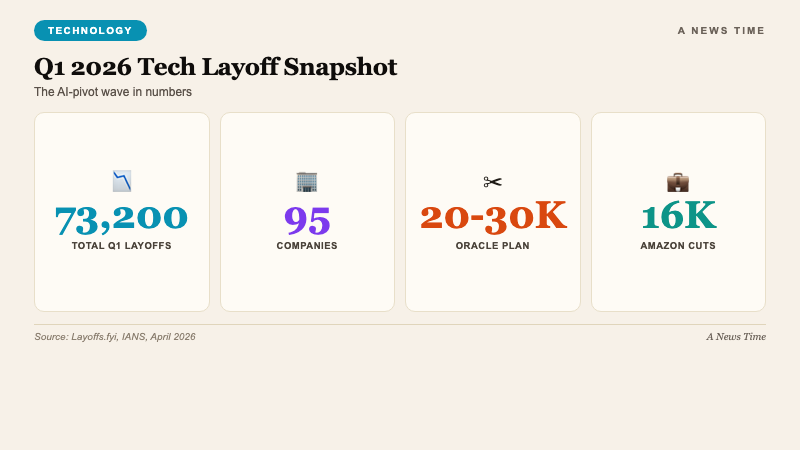
Global technology firms accelerated job cuts in the first quarter of 2026, with over 73,200 layoffs logged at 95 companies according to industry data compiled by Layoffs.fyi and reported on . The past two weeks alone produced a fresh wave of headcount reductions across Snap, The Walt Disney Company, Meta Platforms, and Oracle, each of which framed the cuts as part of an operational shift toward artificial intelligence rather than a general austerity move. Oracle's plan to cut 20,000 to 30,000 roles while expanding AI data-center capacity is the clearest recent example of the new pattern: companies are not just reducing costs, they are reallocating capital from human labor to AI infrastructure.
For anyone tracking the tech labor market, the Q1 number matters less as a point estimate than as a trendline. The last quarter with comparable layoff volume across roughly the same scope of tech companies was Q1 2023, when post-pandemic overstaffing drove large-scale reductions at Meta, Amazon, and Google. The 2023 cuts were about unwinding pandemic excess. The 2026 cuts are about funding AI infrastructure and automating white-collar work that was previously considered out of reach for software substitution.
The Companies Making the Biggest Cuts
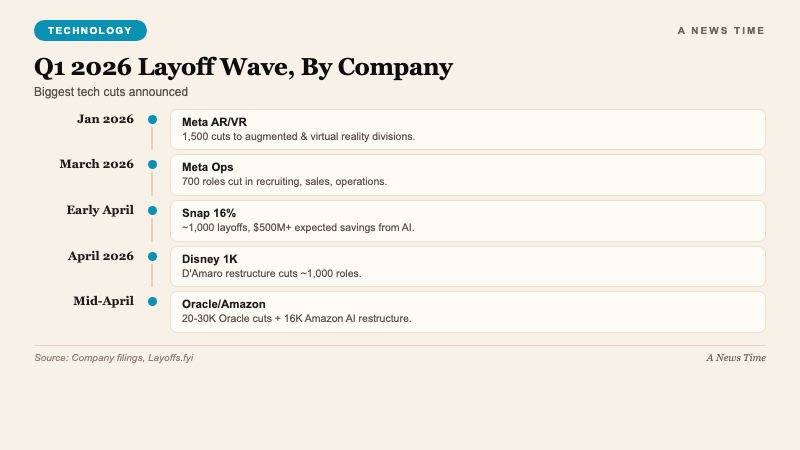
Snap Inc. announced it would cut about 1,000 jobs, roughly 16% of its workforce, and eliminate over 300 open roles to boost efficiency and accelerate growth. Chief Executive Officer Evan Spiegel said advances in AI were enabling automation of repetitive tasks and that the company expects savings of over $500 million by the second half of 2026, with severance costs estimated at $95 million to $130 million. Snap confirmed four months of severance pay, continued healthcare, and accelerated equity vesting for US-based employees.
"Advances in AI are enabling automation of repetitive tasks. With streamlining operations, the company expects savings of over $500 million by the second half of 2026."
Evan Spiegel, Snap Inc. chief executive officer, in the company's layoff announcement
The Walt Disney Company plans to cut around 1,000 roles in its first major restructuring under new chief executive Josh D'Amaro, according to multiple reports. Meta Platforms announced 198 additional layoffs at its California offices in Burlingame and Sunnyvale, following a March cut of 700 roles across recruitment, sales, and operations, plus January's 1,500 reductions in augmented and virtual reality divisions.
| Company | Headcount cut | Stated rationale |
|---|---|---|
| Oracle | 20,000-30,000 | Expand AI data-center capacity |
| Amazon | 16,000 | AI restructure |
| Snap | ~1,000 (16%) | AI automation of repetitive tasks |
| Disney | ~1,000 | D'Amaro restructure |
| Meta (combined) | ~2,400 YTD | AR/VR downsizing, operations |
| Q1 2026 total (95 cos) | >73,200 | Layoffs.fyi aggregate |
Oracle's plan is the most financially consequential. The company plans to cut 20,000 to 30,000 jobs to expand AI data-center capacity. India is among the hardest-hit regions, with estimates suggesting around 12,000 employees affected across cloud, healthcare, sales, and NetSuite divisions. Amazon's 16,000-role reduction, announced earlier in the quarter, similarly cites AI restructuring as the driver.
What Is Different This Cycle
The 2023 tech layoff wave was a balance-sheet event. Companies had over-hired during the pandemic, cost of capital rose, and cutting headcount was the most direct lever to restore operating margin. The 2026 wave is harder to read that cleanly. Revenues at most of the companies cutting jobs are still growing. Cloud divisions are showing the highest margins in their histories. Several of the same companies cutting jobs are simultaneously raising AI-related capex guidance by $10 billion to $30 billion per year.
The pattern resolves if you treat AI as a labor-substitution technology rather than a productivity complement. An engineering team that writes and ships software faster with AI-assisted tooling needs fewer engineers for the same output. A customer service function that routes tickets through generative AI needs fewer agents. A back-office operation that uses large language models to read, summarize, and draft correspondence needs fewer analysts. The tech industry is the first sector to experience that substitution at scale because it has both the AI infrastructure and the white-collar density to make the arithmetic work.
The 12-to-18-month framing is aggressive. Most economists tracking the labor market would put the timeline somewhere between two and five years before AI automates a meaningful share of white-collar functions, and even that estimate assumes the current model-capability trend continues. But the industry is already acting as if the shorter timeline is the planning assumption. Oracle's data-center capex plan does not pencil out if the AI business does not grow 3x to 5x over the next three years. Snap's $500 million savings projection assumes automation delivers what Spiegel's internal team has modeled.
Geographic Distribution Matters
The layoffs are not hitting every country equally. India is disproportionately exposed because it hosts the largest outsourced back-office operations for many of the affected companies. Oracle's 12,000 estimated India cuts are concentrated in exactly the functions most susceptible to AI automation: cloud support, healthcare back-office, sales operations, and enterprise resource planning implementation.
The United States and Europe are also affected but with different dynamics. US layoffs skew toward recruiting, HR, and mid-level management roles. European cuts are slower because of stricter labor regulations, which delays the effect but rarely reverses the direction. The aggregate result is a labor market rebalancing that is measurable in regional employment statistics with a lag of roughly two to four quarters after the layoff announcements.
What It Means for Workers
Severance packages across the major cuts have been generous by US historical standards. Snap is offering four months of pay plus continued healthcare and accelerated equity vesting. Amazon and Oracle have similar structures in the US, with shorter packages in other regions based on local requirements. The severance generosity reflects both the legal environment and the fact that companies are deliberately shedding headcount rather than responding to a liquidity crisis.
The reemployment picture is more complicated. Engineers with AI-related skills are still in acute demand, and salary offers for machine learning, AI infrastructure, and AI research roles have held or increased. Workers in recruiting, operations, customer support, and middle management are facing the hardest reemployment environment in the tech sector since 2001. Reskilling programs exist, but the speed required to transition from, say, an enterprise support role to an AI engineering role is unrealistic for most workers affected by these cuts.
What Comes Next
Three signals will determine whether Q1 2026 is the leading edge of a sustained restructuring or a concentrated one-time event. First, whether Q2 and Q3 layoff volumes stay elevated at the Q1 pace (roughly 25,000 per month). Second, whether the companies making cuts deliver on the margin and capex guidance that justifies them. Third, whether the white-collar labor market more broadly starts to feel the spillover, particularly in legal services, financial analysis, and professional services where AI substitution is at a similar maturity stage.
The most honest summary is that the tech sector is running an experiment on itself at the labor-allocation level. The results of that experiment, measured in margins, revenue per employee, and the actual capability of AI systems to replace specific functions, will be visible in 2027 earnings reports. The layoffs happening now are the front end of that experiment, not the conclusion.
Frequently Asked Questions
How many tech layoffs happened in Q1 2026?
Over 73,200 layoffs at 95 tech companies in the first quarter of 2026, according to data from Layoffs.fyi reported on April 19. The Q1 figure represents a significant acceleration over the prior several quarters.
Which tech companies made the biggest cuts?
Oracle's planned 20,000 to 30,000 job cuts is the largest single announcement. Amazon announced 16,000 cuts. Snap cut about 1,000 roles, or 16% of its workforce. Disney is cutting around 1,000 roles. Meta has been cutting roles across quarters for a combined 2,400-plus in Q1.
Why are tech companies cutting jobs during a period of revenue growth?
Unlike the 2023 layoffs driven by pandemic over-hiring, the 2026 cuts are paired with AI infrastructure investment. Companies are reallocating capital from headcount to data-center capacity, computation, and automated systems that replace specific white-collar functions.
How much is Oracle cutting and why?
Oracle plans to cut 20,000 to 30,000 roles to expand AI data-center capacity. India is among the hardest-hit regions, with an estimated 12,000 employees affected across cloud, healthcare, sales, and NetSuite divisions.
Will AI really replace white-collar jobs within 12 to 18 months?
Several tech executives have said so publicly. Economists tracking labor markets generally put the realistic timeline for meaningful substitution at two to five years. Either estimate depends on AI capability continuing to improve at roughly the current pace, which is not guaranteed.
What to Watch
The most informative signal over the next two quarters is whether revenue per employee at the companies making cuts starts rising faster than the industry average. If it does, the AI-substitution thesis has some empirical support. If it does not, the layoffs will look in retrospect like a premature bet on technology that had not yet delivered the productivity gains the business models assumed. Either way, the workforce implications are already here.