Joshua Gross, the software engineer who shipped Thinking Machines Lab's flagship Tinker product from zero to one, left the Mira Murati startup for Meta Superintelligence Labs this week, according to his LinkedIn profile and reporting from Invezz. He is the fifth founding member of the 18-month-old startup to exit for Meta, which means a company that raised a record $2 billion seed round last year at a $12 billion valuation has already lost roughly the equivalent of its founding engineering nucleus.
The pattern is not unique to Thinking Machines. It is the shape of the entire current cycle in artificial intelligence, and the numbers underneath it tell a story that the press releases about billion-dollar funding rounds largely hide.
What the compensation math actually looks like
Industry observers say the gap between what startups can offer and what Big Tech can offer is no longer a comparison, it is a rout. Public companies including Meta, Google DeepMind, and OpenAI are paying top AI researchers packages in the high six- and seven-figure range for base and bonus, with stock grants that vest on accelerated schedules. A researcher joining Meta today can reasonably expect to convert equity into cash inside a year. A researcher joining a Series A startup is looking at a three-to-five-year vesting cliff on paper wealth that depends on an exit that may never happen.
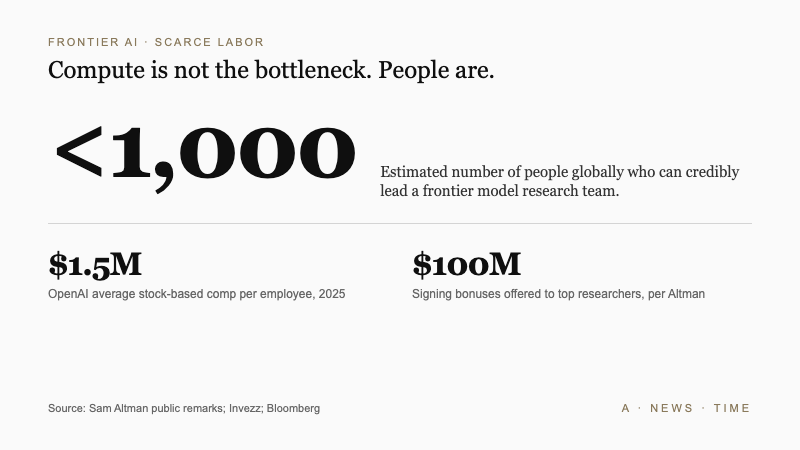
The top of the market has gotten extreme. CEO Sam Altman said publicly that OpenAI has seen signing bonuses of up to $100 million offered to lure specific frontier researchers, and OpenAI's own average stock-based compensation was around $1.5 million per employee in 2025. That is an average, which means the median hire is worth less than the headline figure and the top of the distribution is substantially higher.
Estimates suggest fewer than 1,000 people worldwide can credibly lead a frontier model team. That scarcity, not capex, is the actual bottleneck on AI progress right now. Nvidia chips can be purchased. The people who know how to turn them into working pre-training runs cannot.
Meta's specific playbook
Meta's AI hiring has moved past regular poaching into something closer to strategic dismantling of competitors. Mark Zuckerberg personally led the buildout of Meta Superintelligence Labs over the past year, which included the $14 billion investment in Scale AI and the recruitment of its co-founder Alexander Wang. Meta has separately hired Daniel Gross away from Ilya Sutskever's Safe Super Intelligence startup, alongside the string of Thinking Machines departures.
The Tinker work Gross led before leaving is not abstract. It was the product Thinking Machines shipped to prove its technology in the market. Losing the engineer who built it to the single largest current competitor for researchers, after four co-founders had already departed, sends a signal both inside the company and outside it. The signal is that a $12 billion valuation is not, by itself, enough protection against a trillion-dollar firm deciding it wants your people.
The creative destruction creates a tremendous amount of opportunity.
Matthew Jacobson, partner at Iconiq, speaking to Bloomberg about the current AI investment cycle
The reverse acquihire, formalized
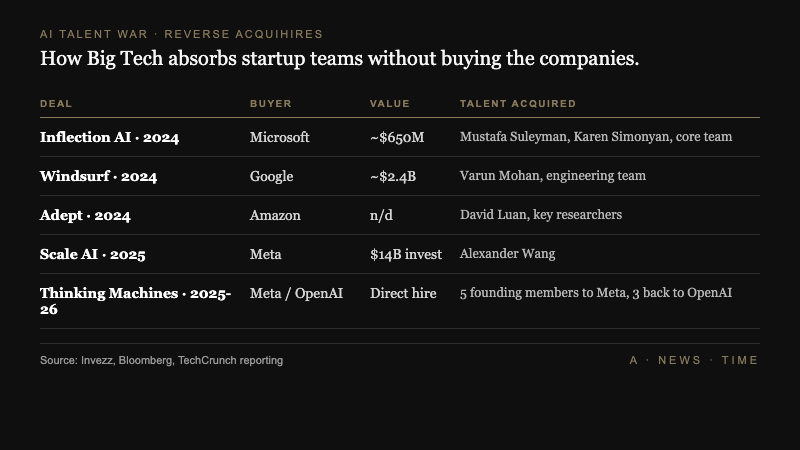
The talent war has also reshaped how deals get structured. The clearest recent template is the Microsoft-Inflection arrangement from 2024, where Microsoft paid a reported $650 million to Inflection AI in exchange for hiring co-founders Mustafa Suleyman and Karen Simonyan plus much of their team, and licensing Inflection's technology. It was not a merger. It was, functionally, a lateral team move dressed up as commercial agreement.
Google followed with a roughly $2.4 billion deal in 2024 to bring in Varun Mohan, co-founder of AI coding startup Windsurf, under a similar structure: no equity purchase, a licensing payment, and a team transfer. Amazon reached a comparable arrangement with Adept. Microsoft AI has separately recruited dozens of researchers directly from Google DeepMind.
What makes these deals useful to the big players is the same thing that makes them brutal for the startup ecosystem. The venture investors in a target startup get a return that looks like an exit, the founders get to work at scale on frontier problems, and the hyperscaler acquires the talent without the regulatory friction of a full acquisition. What does not happen is the product the startup was building actually shipping in the form its customers were promised.
| Deal | Buyer | Value | Talent acquired |
|---|---|---|---|
| Inflection AI (2024) | Microsoft | ~$650M | Suleyman, Simonyan, core team |
| Windsurf (2024) | ~$2.4B | Varun Mohan, engineering team | |
| Adept (2024) | Amazon | Undisclosed | David Luan, key researchers |
| Scale AI (2025) | Meta | $14B investment | Alexander Wang |
| Thinking Machines (2025-2026) | Meta / OpenAI | Direct hiring | 5 founding members (Meta), 3 to OpenAI |
What this does to the frontier-lab thesis
The venture capital pitch for new AI labs has been that a small team of exceptional researchers, armed with enough compute and capital, can ship a competitive frontier model. That thesis has not been falsified yet, but the margin of safety on it is narrowing fast.
Thinking Machines is the clearest current test. The company raised its $2 billion seed at a $12 billion valuation on the strength of Murati's pedigree and the team she assembled. It is reportedly in discussions for a new round at up to a $50 billion valuation, on the back of a much thinner team than the one that commanded the earlier raise. Investor enthusiasm has not priced in the talent drain yet. Whether it should is the question any limited partner in a new AI fund has to be asking this quarter.
Safe Super Intelligence, Ilya Sutskever's lab, faces a milder version of the same challenge. OpenAI itself is not immune. Mira Murati, Barret Zoph, and Luke Metz all left OpenAI before landing variously at Thinking Machines or elsewhere, and OpenAI has also seen Kevin Weil and Bill Peebles depart this week as the company sheds side projects.
The concentration of frontier research inside four or five firms looks increasingly structural rather than cyclical. That has implications for competition policy, for the shape of enterprise AI procurement, and for the investor class that has been pouring capital into startups betting the opposite trend would hold.
Why the AI labs cannot just pay more
The obvious counterargument is that a well-funded startup can simply match Meta's package. The math does not work, and understanding why is the clearest window into what is actually happening in the sector.
Public-company stock has a liquid market price and an accelerated vesting schedule. A Meta restricted stock unit that vests in six months is money. A startup stock option at a $50 billion valuation is a bet on a future liquidity event, discounted by the probability that event happens at or above the strike. When the public market is paying $1.5 million per engineer in cash-equivalent and the startup is paying theoretical $5 million in equity that vests over four years and converts only on IPO, the rational career move is the public-company job. Even if the equity upside is nominally larger, the risk-adjusted compensation favors the incumbent.
Add the non-financial factors. Big Tech can offer access to clusters with 100,000-plus GPUs, production-grade infrastructure, stable leadership, and colleagues who have shipped frontier models before. Startups are offering more autonomy and the chance to own something, which matters to some researchers but not enough of them to close the gap.
What to watch next
Three signals will tell you whether the current talent dynamic breaks or hardens over the next six months. First, whether Thinking Machines closes its next funding round at the rumored $50 billion valuation and whether that round brings in new research hires rather than just more departures. A successful round with genuine team retention reverses the narrative. A round that closes on capital alone extends the fiction.
Second, whether the FTC or the DOJ scrutinizes the reverse acquihire structure. If regulators start treating these as de facto acquisitions subject to merger review, the template that allowed Microsoft, Google, and Amazon to absorb startup teams at scale breaks, and smaller labs regain a margin.
Third, whether Meta's Superintelligence Labs actually ships a frontier model that justifies the hiring spree. Zuckerberg has spent more on this cycle than any previous Meta AI investment. Results so far are promising but not definitive. If Superintelligence Labs fails to produce a model that competes with OpenAI's and Anthropic's top tier within 12 months, the signal to the rest of the industry is that even infinite talent acquisition has limits.
The AI industry is telling itself a story about compute being the bottleneck. The compensation numbers say the bottleneck is people, and the people are consolidating fast. Whether the next generation of AI labs can hold their teams together, or whether they become pipelines feeding Meta and Microsoft and Google, is the defining structural question of the sector this year.
Frequently Asked Questions
How many founding members has Thinking Machines Lab lost?
At least five founding members have departed the 18-month-old startup, with Joshua Gross the most recent to leave for Meta Superintelligence Labs. Earlier exits include co-founder Andrew Tulloch, plus returns to OpenAI by Barret Zoph, Luke Metz, and Sam Schoenholz.
What are AI researchers being paid?
OpenAI's average stock-based compensation was roughly $1.5 million per employee in 2025. Top-tier frontier researchers at Meta, Google DeepMind, and OpenAI can command packages in the high six- and seven-figure range, with Sam Altman confirming signing bonuses up to $100 million for specific hires.
What is a "reverse acquihire"?
A deal where a large company pays a startup a licensing fee and hires most of its team, without buying the company or taking an equity stake. Microsoft's $650 million Inflection AI arrangement and Google's $2.4 billion Windsurf deal are the clearest templates.
Why can't startups match Big Tech packages?
Public-company stock vests on accelerated schedules and has a liquid market price, while startup equity depends on a future liquidity event that may not happen. Even when nominal startup packages look larger, the risk-adjusted value favors established firms.
How many people can build frontier AI models?
Industry estimates put the number under 1,000 globally. That scarcity, not access to compute or capital, is the actual bottleneck on progress at the frontier of AI development.