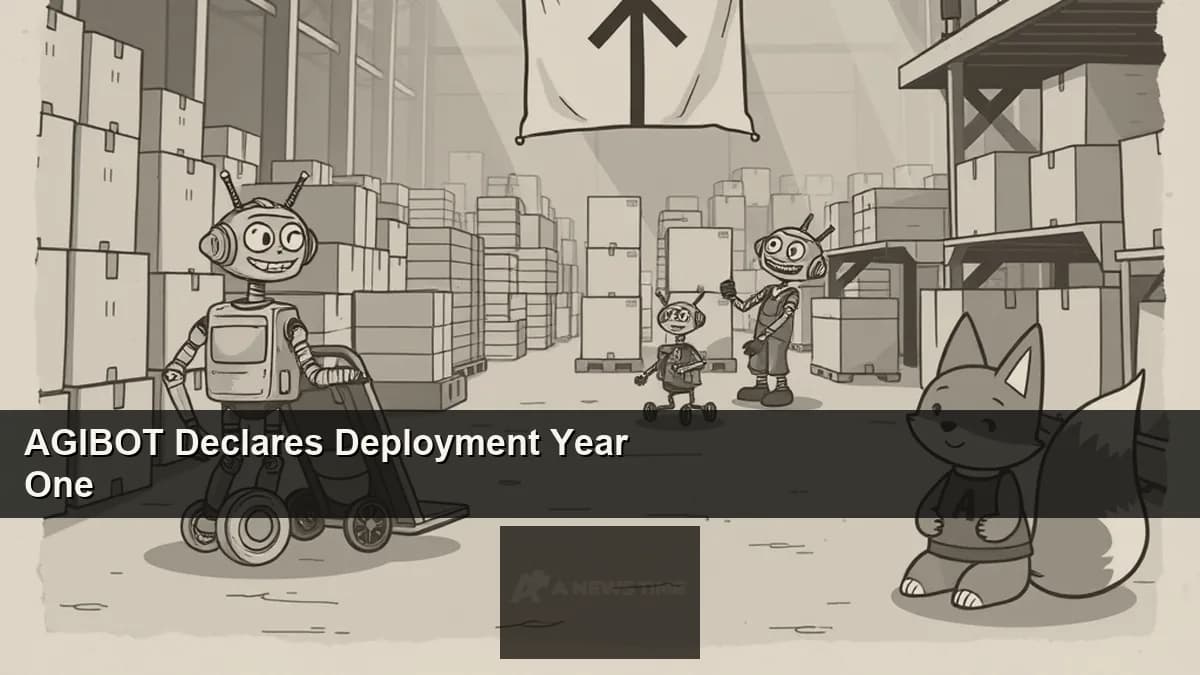
AGIBOT, the Shanghai-based embodied AI company founded by former Huawei engineer Edward Deng, used its AGIBOT Partner Conference (APC) in Shanghai on to formally label this year "Deployment Year One" for commercial embodied AI. The framing is a bet: that the physical-AI industry is leaving the phase of choreographed demos and entering the phase of measurable output, and that 2026 is the specific year the transition becomes visible on shop floors and in warehouses.
The claim comes with numbers. AGIBOT announced that it shipped its 10,000th robot in , introduced seven productized deployment packages aimed at specific industry scenarios, and launched an open embodied-AI stack called AIMA that the company wants the wider industry to build on top of. Combined with a five-year 2 billion RMB ecosystem commitment, the announcements amount to AGIBOT claiming the architecture role in a market where most competitors are still proving their hardware works.
What "Deployment Year One" Actually Means
AGIBOT put forward a three-phase framework it calls the XYZ curve for embodied intelligence. The X curve, covering 2022 through 2026, is about building hardware that reliably walks, grasps, and perceives. The Y curve, 2026 through 2030, shifts the primary metric from capability demonstration to productivity contribution, meaning a robot is not successful because it moved a box, it is successful because the unit economics of moving that box work without a human in the loop. The Z curve, 2030 onward, is where AGIBOT argues robots begin outperforming humans in selected domains.
The distinction matters because most embodied-AI reporting still conflates the three. A backflipping humanoid, a cinematic demo of a robot folding laundry, and a warehouse robot moving 400 pallets per shift are different economic objects. AGIBOT's framing tries to force the conversation into the third category, which is the category the company believes it can win on.
"The industry is moving from proving what robots can do, to proving what value they can consistently deliver at scale. At AGIBOT, we focus on making embodied intelligence deployable, combining motion, interaction, and manipulation intelligence into one system that can operate under real-world constraints. Our goal is not just to build capable robotic machines, but to turn them into reliable units of productivity that can be scaled across industries."Edward Deng, Founder, Chairman and CEO, AGIBOT
Seven Productized Solutions, Not Custom Builds
The announcement that probably matters more for the industry than the XYZ theory is the shift in go-to-market. AGIBOT introduced seven standardized solutions, each with a fixed hardware configuration, software stack, and deployment package. The seven cover loading and unloading, industrial handling, logistics sorting, retail guidance, retail service stations, security patrol, and industrial and commercial cleaning.
This is a meaningful departure from how most humanoid and embodied-AI programs have been commercialized to date. The dominant pattern in the sector has been custom integrations negotiated one customer at a time, often with the manufacturer absorbing integration cost to win a logo. AGIBOT is betting the market is mature enough for productization, meaning a buyer picks from a menu rather than co-designing.
| AGIBOT productized solution | Target scenario |
|---|---|
| Loading and unloading | Manufacturing line-side operations |
| Industrial handling | Factory-floor material movement |
| Logistics sorting | Warehouse and parcel sortation |
| Retail guidance and assistance | In-store customer wayfinding |
| Retail service stations | Unattended transaction points |
| Security patrol | Commercial and industrial site monitoring |
| Industrial and commercial cleaning | Facility floor and surface cleaning |
The unstated comparison is to Tesla's Optimus, Figure, 1X, and a cluster of Chinese competitors including Unitree and Fourier. Most of those programs are still releasing video of a capability, rather than a bill of materials for a deployed unit. AGIBOT's pitch is that it is already on the other side of that transition.
AIMA: An Open Embodied-AI Stack
AGIBOT used the conference to announce AIMA, which it describes as the first complete open technology system for embodied intelligence. The architecture is structured as "1+3+X": a unified robot operating system called Link-U OS, three development platforms (LinkCraft for motion, LinkSoul for interaction, and Genie Studio for task design), and an extensible ecosystem layer.
Open-sourcing in embodied AI has been uneven. NVIDIA's Isaac platform is widely used but proprietary. Boston Dynamics has historically shared limited tooling. Unitree has released trained models for specific behaviors. AGIBOT's move is toward something closer to what Android was for smartphones, a stack the company owns but invites third parties to build on, with the business model coming from hardware and reference integrations rather than licensing the stack itself.
The question is whether AIMA attracts developer gravity. Embodied-AI development tooling is currently fragmented, with most serious robotics labs running some combination of ROS 2, in-house simulation, and custom training pipelines. A Chinese-origin stack with full vertical integration has a harder path with Western developers than a U.S. or European one would, and export-control and dual-use regulations are likely to shape adoption outside China.
Why 10,000 Robots Is the Real Headline
AGIBOT's disclosure that it had shipped its 10,000th robot by March is the single most important number in the conference. Most competitors are still counting units in the hundreds or low thousands. Tesla has not disclosed Optimus shipments to external customers. Figure's commercial deployments remain limited. Even Unitree, which has the widest distribution of humanoids commercially available, has not reported a comparable figure.
Ten thousand units is the threshold at which manufacturing learning effects start compounding. Yield improves. Component costs negotiate downward. Field service data starts flowing back into design. At that scale the company begins to behave like a manufacturer rather than a prototype shop, which is the actual transition Deng was pointing at in his "productivity, not capability" framing.
The caveat is verification. AGIBOT's 10,000 figure counts all form factors, including wheeled platforms and multi-form robots, not solely full humanoids. The mix matters. A fleet that is 80% wheeled logistics robots is a different commercial reality from a fleet that is 80% bipedal humanoids. The company did not break out the ratio.
Ecosystem Spending and the Five-Year Horizon
Over the next five years, AGIBOT committed to investing more than 2 billion RMB, roughly $275 million at current exchange rates, to expand its partner ecosystem. The money is earmarked for university partnerships, developer enablement, and integration subsidies for early industry deployments. The spend is modest next to what U.S. hyperscalers are putting into AI infrastructure broadly, but it is meaningful inside the specific slice of embodied AI where customer acquisition cost for industrial buyers is high.
AGIBOT's stated goal for 2030 is what the company calls "widespread adoption" of embodied intelligence, with robots becoming a foundational layer of industrial productivity. That is a crowded ambition. NVIDIA's Jensen Huang has made the same claim using Isaac as the proof point. Tesla's Elon Musk has made it using Optimus. What distinguishes AGIBOT's version is the specificity of the near-term: seven productized solutions, a disclosed shipment count, and a framework that explicitly excludes the next four years from "widespread adoption" and places it in the productivity-contribution stage instead.
How This Fits the Broader AI Picture
AGIBOT's announcement lands the same week that Forrester flagged AI's move into the physical world as its defining emerging-technology trend of 2026, and during the same cycle in which frontier language-model progress continues to accelerate on the digital side. The two arcs are converging in the same calendar year, not a coincidence.
The open question is whether Chinese embodied-AI firms like AGIBOT, Unitree, and their peers maintain the manufacturing lead they currently hold, or whether U.S. and European programs catch up once their own supply chains stabilize. The next concrete checkpoint is whether any of the seven AGIBOT productized solutions posts a publicly disclosed customer reference with audited productivity metrics over the next six months. Demonstrations are easy. Disclosed unit economics are the milestone that matters.