Iconiq Capital, the San Francisco financial firm that has quietly managed the personal fortunes of Mark Zuckerberg, Satya Nadella, and Sheryl Sandberg for over a decade, deployed more than $3 billion into AI startups in 2025, according to Bloomberg's reporting this week. That deployment rate puts the firm on par with the better-known Sand Hill Road venture funds, and it keeps climbing. Iconiq is now raising billions for a new fund that would push its total venture assets past $26 billion.
The outlet for most of that capital has been Anthropic. Iconiq has invested roughly $4 billion in the AI lab across its last two funding rounds, and Anthropic's valuation has since doubled to $380 billion, with investors approaching at levels above $800 billion. If those marks hold through a 2026 IPO, Iconiq's stake alone would be worth several multiples of the firm's entire 2013 venture fund.
Who Iconiq actually is
Iconiq is not a traditional venture firm. It started in 2011 as a wealth management outfit built around long-term relationships with Silicon Valley's early tech billionaires, founded by Divesh Makan, Michael Anders, and Chad Boeding after Makan's time at Morgan Stanley and Goldman Sachs. Zuckerberg was one of the first clients and, in effect, the company's growth flywheel. The network expanded to include former Meta COO Sheryl Sandberg, LinkedIn co-founder Reid Hoffman, and Facebook co-founder Dustin Moskovitz.
Today the firm reports roughly $100 billion in assets under management, per Bloomberg's sourcing. Its client list has grown to include global royal families, Middle Eastern sovereign wealth offices, and high-profile public figures like Tom Cruise and Pharrell Williams. Jensen Huang, currently the eighth-richest person in the world, has recently signed on as a client as well.
What Iconiq is not is scalable in the usual venture-capital sense. Its median client has around $1 billion in assets, and the firm makes a point of screening potential entrants for fit, including reputational risk. The firm reportedly declined to work with Kanye West in 2021 over public relations concerns, before his most publicized scandals.
Why the Anthropic bet matters more than the rest
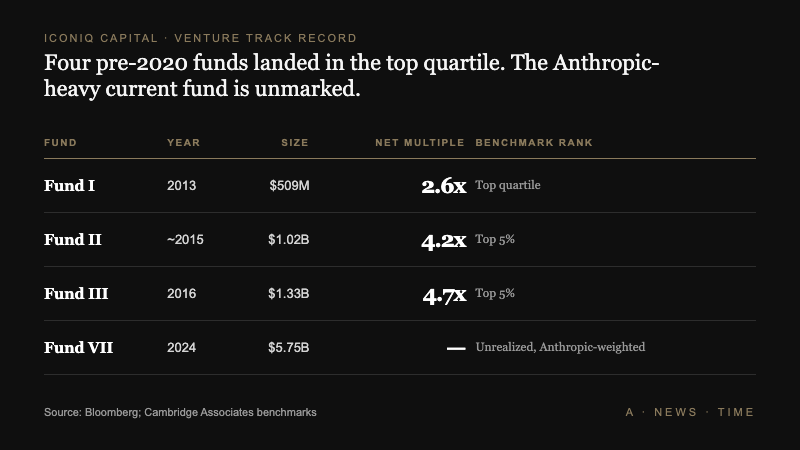
The concentrated position in Anthropic is the single most consequential venture decision Iconiq has made. Roughly 75% of the firm's $5.2 billion in AI investments to date sits in one company, which is deliberate. Iconiq tends to pick a small number of winners rather than spray capital across a sector, and it prefers to lead rounds so it can build a multi-round relationship.
Iconiq first met with Anthropic in 2023 but did not invest. It re-entered in 2025, leading the company's Series F at a $183 billion valuation, then participated in the February 2026 round co-led with MGX that doubled the valuation to $380 billion. Makan has joined the Anthropic board as an observer, which is the kind of access that turns a capital relationship into a governance position.
If you're a large-scale AI company, you need to get to know some of the deepest pools of capital, the heads of state, the biggest players. A partner like Iconiq can facilitate those discussions probably better than anyone else in the world.
Matthew Jacobson, partner at Iconiq Capital, speaking to Bloomberg
The Middle East pipeline
The reason Iconiq sits in the middle of Anthropic's capital structure is not just that it writes big checks. It is that the firm has spent a decade building relationships with Gulf sovereign wealth funds, Asian government investment offices, and a tight circle of international ultra-high-net-worth clients who collectively control some of the largest pools of private capital in the world.
Last year Iconiq organized a trip that took Anthropic CEO Dario Amodei and a small executive team to Qatar and Abu Dhabi. Photos circulated of Amodei meeting with Mubadala Capital's Ibrahim Ajami, but the organizer was not visible in the coverage. Anthropic was not actively raising at the time, but the trip laid the groundwork for the February round that brought in Qatar Investment Authority and MGX as participants.
Iconiq has done similar introductions for ElevenLabs CEO Mati Staniszewski and Legora CEO Max Junestrand. In Staniszewski's case, an Iconiq event pairing him with Tom Cruise turned into commercial work on AI translation for Cruise's films. That is the specific value Iconiq sells: access plus capital plus the ability to make commercial introductions to enterprise customers its clients control.
The venture track record, and its caveats
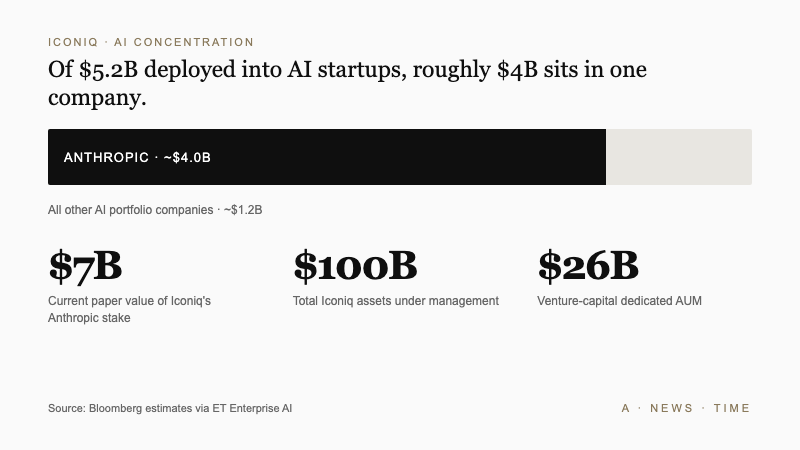
Iconiq's first four venture funds, all launched before 2020, rank in the top quartile of their peer groups per Cambridge Associates benchmarks, according to a person familiar with the returns. Fund I, a $509 million 2013 vehicle, returned 2.6 times investors' money. Fund II, at $1.02 billion, delivered 4.2 times, placing it in the top 5% of its vintage. Fund III, a $1.33 billion 2016 effort, returned 4.7 times driven by bets on Snowflake, GitLab, and Procore.
| Fund | Year | Size | Net multiple (end-2025) |
|---|---|---|---|
| Fund I | 2013 | $509M | 2.6x |
| Fund II | ~2015 | $1.02B | 4.2x |
| Fund III | 2016 | $1.33B | 4.7x |
| Fund VII | 2024 | $5.75B | Unrealized, Anthropic-weighted |
The more recent funds, including the $5.75 billion Fund VII that houses most of the Anthropic exposure, are not yet marked in published benchmarks. The paper case looks strong: ElevenLabs has climbed from roughly $3 billion to $11 billion in valuation since Iconiq's entry, Sierra (the customer service startup led by former Salesforce co-CEO Bret Taylor) is valued at $10 billion, and Legora's mark has risen substantially since the seed investment. Anthropic is the outlier only in its scale.
The conflict-of-interest question
Iconiq's dual role as wealth manager and venture investor generates the structural tension any multi-strategy firm faces. Its securities filings mention "conflict of interest" 21 times. The obvious risks are steering wealth clients into Iconiq funds over external alternatives, and advising startups and clients that compete in the same markets.
The firm addresses this with what it calls strict confidentiality between its VC and wealth teams. Jacobson told Bloomberg that information from portfolio companies that compete with client companies never crosses the boundary, and that there have been cases where clients wanted to acquire portfolio companies that Iconiq declined to sell. Co-founder Chad Boeding left in 2018 to launch a competitor that specifically committed not to peddle its own funds to wealth clients, which is itself evidence that the question is live inside the firm.
The second conflict question is specifically about Anthropic. Iconiq also holds a stake in OpenAI, having put more than $150 million into the company directly and via its earlier investment in Statsig, which OpenAI acquired. Jacobson's position is that the two companies' success is not zero-sum. Whether the capital advice Iconiq gives to either side reflects that, or whether it tilts toward the company in which it has the larger position, is unverifiable from outside the firm.
What the new fund signals
The fundraising that pushed Iconiq's VC assets under management past $26 billion, and the new vehicle currently in market, signals that the firm sees the current AI cycle as a multi-year deployment window rather than a peak. The direction of travel inside the venture arm tells a similar story. Iconiq has historically focused on software-as-a-service, but is now moving into capital-intensive sectors including robotics, earlier-stage investments, and even its first-ever internal incubation of a startup led by one of its partners.
For founders, the practical consequence is that a firm with access to Qatari sovereign capital and a board observer seat at Anthropic is now also writing early-stage checks and issuing introductions to Tom Cruise. For the broader venture ecosystem, the consequence is that a behind-the-scenes operator has become one of the five largest startup capital providers in the country, with a customer list that no one else can match.
The Anthropic IPO, if it happens at anywhere near the $800 billion mark currently being floated, will be the test of the entire strategy. A successful listing converts Iconiq's largest current bet into one of the single best venture trades of the decade. A down-round or delayed IPO exposes the concentration risk in what is, at the fund level, still a bet on one company. The answer will arrive inside twelve months.
Frequently Asked Questions
What is Iconiq Capital?
Iconiq is a San Francisco financial firm founded in 2011 that combines wealth management for tech billionaires and international ultra-high-net-worth clients with a growing venture capital arm. It reports roughly $100 billion in assets under management and $26 billion dedicated to venture investments.
Who are Iconiq's clients?
Clients have included Mark Zuckerberg, Satya Nadella, Sheryl Sandberg, Reid Hoffman, Dustin Moskovitz, Tom Cruise, Pharrell Williams, and recently Nvidia CEO Jensen Huang. The firm also manages money for global royal families and Middle Eastern sovereign-adjacent funds.
How much has Iconiq invested in Anthropic?
Approximately $4 billion across Anthropic's Series F and subsequent rounds. At the startup's current $380 billion valuation, Iconiq's stake is worth roughly $7 billion on paper, and would rise substantially if Anthropic lists at the $800 billion level currently rumored.
How do Iconiq's earlier venture funds rank?
Funds I through III all ranked in the top quartile of their peer groups, with Fund II (4.2x) and Fund III (4.7x) placing in the top 5% of their vintages. Returns for the later funds holding most of the AI exposure are not yet published.
What are the conflict-of-interest risks?
Iconiq's securities filings acknowledge conflicts 21 times, reflecting the tension between its wealth management and venture businesses. The firm says it maintains strict confidentiality between the two arms, and has turned down client-initiated acquisitions of portfolio companies.