Samsung Electronics used its 15th annual European Tech Seminar in Frankfurt, Germany, running through , to showcase the full scope of its 2026 AI-powered TV, display, and audio innovations ahead of their global market launch. The most significant announcement was not any single product but a strategic decision: Samsung is expanding AI-powered capabilities to all TV models in 2026, moving intelligent features from a premium-tier differentiator to a baseline expectation across the entire range.
Vision AI Companion Turns the TV Into a Context-Aware Hub
At the center of Samsung's 2026 strategy is Vision AI Companion (VAC), an integrated AI platform designed to make the television more intuitive, context-aware, and useful beyond passive content consumption.
VAC works as an always-available assistant that understands what is on screen and can surface relevant information in real time. Watching a cooking show? VAC can pull up the recipe. Watching a travel documentary? It can help plan the trip. The ambition is to transform the TV from a content display device into a central smart home hub that connects entertainment with everyday utility.
The practical implications depend on execution. AI assistants built into TVs have existed in various forms since the early smart TV era, but they have historically been clunky, limited, and rarely used. Samsung's bet is that the combination of modern language models, on-device processing through its latest chipsets, and a more natural interaction model will make VAC genuinely useful rather than a feature that sounds good in a product brief but gathers dust in real-world living rooms.
"This year, we are expanding advanced AI across our full lineup, from premium to more accessible models, while embedding Samsung's distinctive AI capabilities throughout the entire screen experience. By bringing innovation to picture quality, sound and connectivity, we are redefining what users can expect from AI-powered screens."Hun Lee, Executive Vice President, Visual Display Business, Samsung Electronics
AI Picture and Sound Processing for Movies, Sports, and Gaming
Beyond VAC, Samsung's 2026 lineup introduces upgraded AI processing across picture and audio. The three headline features target specific use cases that matter most to consumers:
- AI Upscaling Pro: Sharpens low-resolution content with enhanced clarity, depth, and contrast. This matters because a significant percentage of streaming content, particularly older catalogs, is still delivered at resolutions below 4K.
- AI Soccer Mode Pro: Adapts picture and sound in real time to match the speed and intensity of live play. With the starting in June, this is a timely addition that Samsung will likely feature heavily in marketing.
- AI Sound Controller Pro: Analyzes dialogue, background music, and sound effects separately, allowing users to fine-tune individual elements like crowd noise and commentary volume. This addresses one of the most common complaints about modern TV audio: dialogue buried under music and effects.
Each of these features builds on Samsung's existing AI processing pipeline but adds a layer of real-time adaptation that previous generations lacked. The soccer mode, in particular, represents a category that consumer electronics manufacturers have been chasing for years: sports-specific processing that actually makes a visible difference during fast-motion content.
Micro RGB Achieves 100% BT.2020 Color Coverage
On the display technology side, Samsung showcased its latest Micro RGB technology, which represents a significant step forward in color precision and contrast performance. The system is powered by the Micro RGB AI Engine Pro, which continuously refines color and contrast in real time.
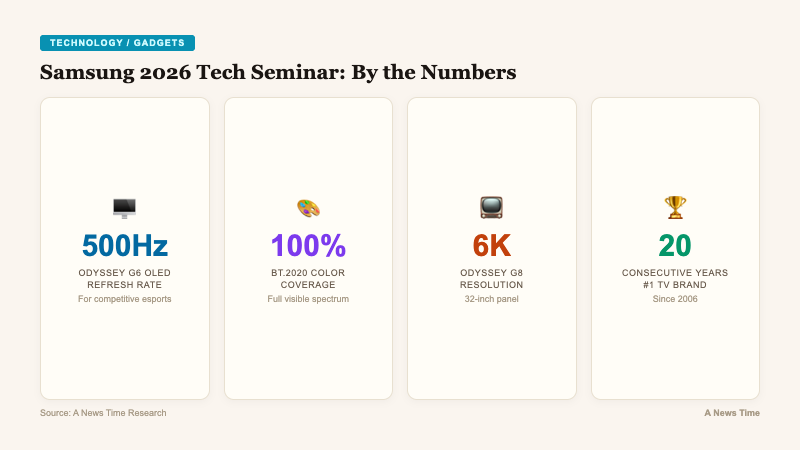
The standout specification: 100% color coverage of the BT.2020 color space, a benchmark that represents the full range of colors visible to the human eye under standard viewing conditions. Achieving full BT.2020 coverage has been a goal for display manufacturers for years, and Samsung's demonstration on a 75-inch model at the seminar marks one of the first consumer-facing implementations.
For context, most current high-end TVs cover the DCI-P3 color space, which represents approximately 75% of BT.2020. The jump to full BT.2020 is most noticeable in deep greens, cyans, and certain reds that DCI-P3 cannot reproduce. Whether consumers will perceive the difference in typical viewing conditions is debatable, but for content mastered in wide color gamut (increasingly common with HDR productions), the capability matters.
2026 OLED Lineup: S99H, S90H, and S85H Compared
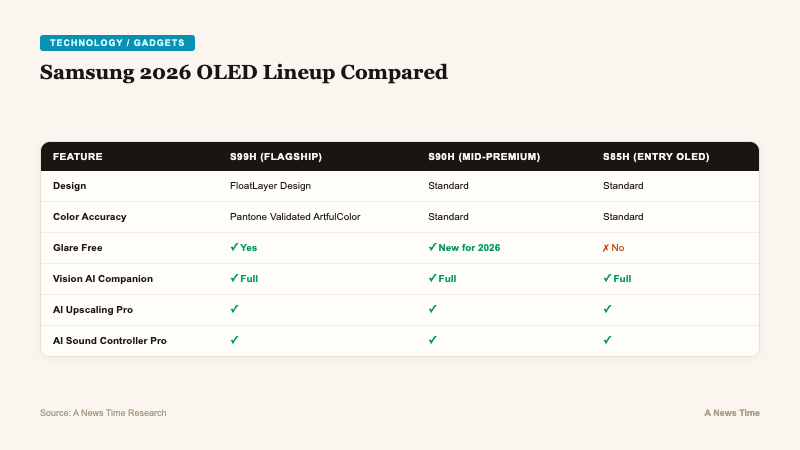
Samsung's OLED range for 2026 spans three tiers, each targeting a different segment of the market:
| Model | Tier | Key Feature | Notable Spec |
|---|---|---|---|
| S99H | Flagship | FloatLayer Design, Pantone Validated ArtfulColor | Lighter form factor, most accurate color |
| S90H | Mid-Premium | Glare Free technology (new for 2026) | Reduced reflections in bright rooms |
| S85H | Entry OLED | Full AI feature suite at lower price | AI capabilities across all models |
The flagship S99H introduces the FloatLayer Design, a mounting and chassis approach that creates a lighter, more elevated physical presence on the wall or stand. It also carries Pantone Validated ArtfulColor certification, which guarantees color accuracy against the Pantone color matching system used in design and printing industries.
The more notable move for most buyers is the extension of Glare Free technology to the S90H. Anti-reflection coatings have become increasingly important as consumers mount TVs in living rooms with large windows, and Samsung's Glare Free tech specifically addresses the reflections that make OLED panels hard to view in bright environments. Previously limited to the top-tier model, bringing it to the mid-premium tier significantly broadens its accessibility.
Gaming Monitors Push Refresh Rates to 500Hz
Samsung also showcased its display portfolio beyond TVs, with two gaming monitors that push specifications into territory that would have seemed absurd a few years ago.
The Odyssey G6 OLED (model G60FS) features a 500Hz refresh rate, targeting competitive esports players who operate at the extreme edge of what human visual perception can process. At 500Hz, each frame lasts just 2 milliseconds, reducing motion blur and input lag to levels that competitive players consider materially advantageous.
The Odyssey G8 (model G80HS) takes a different approach, delivering 6K resolution on a 32-inch panel. The pixel density at that size and resolution is extraordinary, targeting content creators, CAD professionals, and users who want maximum visual clarity in a desktop form factor. The G8 represents Samsung's push into the high-end productivity monitor segment that Apple's Pro Display XDR currently dominates.
Both monitors reflect a broader trend in the gaming display market: consumer electronics companies are pushing specifications further because the competitive gaming audience, while small relative to the total TV market, drives disproportionate brand perception and willingness to pay.
Music Studio Speakers Expand Samsung's Audio Footprint
The audio side of Samsung's seminar featured two new lifestyle speakers designed to compete in the growing premium home audio category.
Music Studio 7 delivers a 3.1.1-channel configuration with enhanced Q-Symphony technology, which synchronizes audio across connected Samsung devices. The 3.1.1 setup includes a dedicated center channel for dialogue clarity and an upfiring driver for height effects, providing spatial audio capability without requiring a full surround sound installation.
Music Studio 5 offers a more compact form factor with AI Dynamic Bass Control, which uses real-time processing to deliver deeper, more balanced low frequencies without the distortion that typically plagues smaller speakers. The design-forward approach targets consumers who want better audio than a TV's built-in speakers but are unwilling to tolerate the visual presence of a traditional soundbar.
The Music Studio line positions Samsung against Sonos, Bose, and Apple's HomePod in the lifestyle audio segment, a market where design aesthetics and smart home integration matter as much as pure sound quality.
Twenty Years as the World's Top TV Brand
Samsung enters the 2026 product cycle holding a distinction no other manufacturer can claim: 20 consecutive years as the world's number one TV brand by sales volume, according to market research data. That streak, which began in 2006, spans the transition from plasma and LCD to OLED and now to Micro RGB, and has survived competitive challenges from LG, Sony, TCL, and Hisense.
The company's strategy of pushing AI features across all price tiers, rather than reserving them for premium models, is a direct response to the competitive pressure from Chinese manufacturers like TCL and Hisense, which have been gaining market share in the mid-range and budget segments. By making AI a baseline feature rather than a premium upsell, Samsung is attempting to maintain differentiation at every price point.
Whether the strategy works will depend on whether consumers perceive the AI features as genuinely useful or as marketing overlay on incremental hardware improvements. The broader AI industry faces the same question at a different scale: the technology's potential is clear, but consumer adoption hinges on delivering experiences that feel helpful rather than gimmicky. Samsung's Vision AI Companion will be the company's most visible test of that proposition when the 2026 lineup reaches stores in the coming weeks.