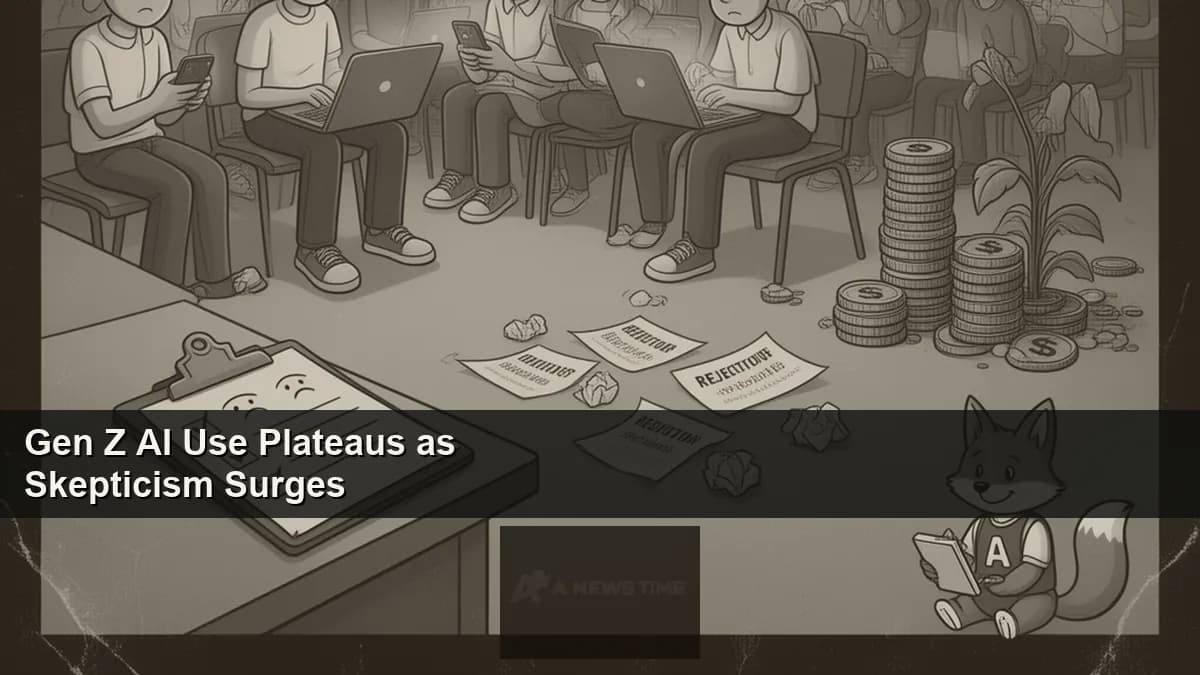
A new Gallup survey released this week delivers a striking data point for the artificial intelligence industry: the generation most expected to embrace AI is actively cooling on it. More than 1,500 people aged 14 to 29 told Gallup that excitement about AI has fallen 14 percentage points since the same poll was conducted in 2025, hopefulness has dropped 9 points, and anger toward the technology has climbed 9 points in the same period. Use of AI tools has plateaued entirely. The credibility gap between what the industry promises and what young people are actually experiencing is widening.
This matters because it lands in the same week that Amazon CEO Andy Jassy announced his company plans to spend approximately $200 billion on AI infrastructure in 2026. Big Tech's conviction about AI's transformative potential has never been louder. The generation being handed this technology has rarely been quieter about its enthusiasm for it.
What the Gallup Data Actually Shows
The headline numbers from the Gallup poll are clear enough, but the breakdown by usage is where the picture gets interesting. Among Gen Zers who have never used AI tools, 60% report feeling anxious about widespread AI adoption, and only 2% describe themselves as hopeful. That is a staggering trust deficit in a group that has grown up with smartphones and social media and is accustomed to adopting new technology quickly.
Daily AI users tell a different story, though not a reassuring one for the industry. Even among young people who use AI every day, 28% report feeling anxious, and only 38% describe themselves as hopeful. The more experience Gen Z has with AI, the more their feelings split rather than converge toward enthusiasm.
The poll also surfaced some of the specific concerns driving this skepticism. 38% of working Gen Zers say AI does more harm than good for creativity. A nearly identical 42% say the same about critical thinking. These are not abstract fears about robots taking over factories. Young people who use AI regularly, often for writing, coding, or research tasks, are questioning whether the tools are actually making them better at what they do, or whether they are eroding capacities they need.
The trust data is the sharpest part of the survey. Asked about their preferences for AI-generated versus human-made work, 69% of Gen Z respondents said they would trust 100% human-made work. Only 3% said they trust fully AI-generated output. This is not a small gap. It is a canyon, and it exists within the generation that every AI company is building for.
The Employment Factor Is Central to This Shift
Understanding why Gen Z is souring on AI requires looking at what AI is actually doing to early-career job markets. The polling coincides with a growing body of evidence that AI automation is specifically targeting the types of entry-level tasks that new graduates have historically used to build skills and careers.
Ireland's government drew a direct line between AI adoption and slowing employment for young workers earlier this year, citing the technology as a contributing factor to declining job placements for recent graduates. Federal Reserve Chair Jerome Powell acknowledged in early 2026 that AI is "probably a factor" in what he called dismal employment rates for young graduates, a remarkably candid statement from someone who typically speaks in careful economic qualifiers.
The mechanism is intuitive: AI tools have proven most capable at the tasks that junior employees traditionally handle. Summarizing documents, drafting initial versions of reports, answering routine customer queries, writing boilerplate code, doing basic research. When AI handles those tasks efficiently, the entry-level roles that generate them shrink. The generation entering the workforce right now is not watching AI automate manufacturing jobs in a factory somewhere else. They are watching it compete for their first jobs, in offices and studios and newsrooms.
| Gen Z Sentiment | 2025 | 2026 | Change |
|---|---|---|---|
| Excited about AI | ~52% | ~38% | -14 pts |
| Hopeful about AI | ~46% | ~37% | -9 pts |
| Angry about AI | ~18% | ~27% | +9 pts |
| Anxious about AI | 40% overall (current) | Elevated | |
The Industry Is Saying the Opposite
The contrast between what Gen Z is reporting and what AI companies are planning could hardly be more pronounced. In his annual shareholder letter published on , Amazon CEO Andy Jassy outlined plans to spend approximately $200 billion in capital expenditures in 2026, with AI infrastructure as the primary driver. He described AI as a "once-in-a-generation" shift and said Amazon is investing "not on a hunch" but based on customer demand for AWS AI services.
That level of conviction from the industry's largest players is not unusual. What makes the Gallup numbers significant is that they complicate the standard AI adoption narrative. The implicit promise of generative AI has always been that younger, more digitally native generations would be its most enthusiastic adopters, which would then pull older users along. The data suggests that pipeline may be leaking.
There are also internal tensions within the industry about what AI adoption is actually supposed to look like. Nvidia CEO Jensen Huang has publicly stated he is against the complete automation of human work, arguing that meaningful AI augmentation requires humans to remain central to decision-making. OpenAI, meanwhile, published a paper this week calling for AI-enabled four-day workweeks, framing AI productivity gains as a path to more leisure rather than job elimination. These two positions are not identical, and Gen Z appears to be noticing the gap between productivity-tool framing and automation-at-scale reality.
"The global AI industry is making the largest capital bets in technology history based on a user adoption curve that may not materialize the way the models assume. Gen Z is not just skeptical. They are telling us something specific: the tools aren't earning their trust."
Analysis, Gallup Gen Z AI Survey, April 2026
Where the Residual Optimism Lives
The Gallup data is not uniformly grim for AI advocates. Among Gen Zers who use AI daily, a majority still believe the technology has practical benefits, even as their emotional response has become more mixed. 56% still say AI speeds up their work, down 10 points from 2025 but still a majority position. 46% believe AI helps their learning, down 7 points from last year.
These numbers suggest that functional utility and emotional trust are diverging. Young people recognize that AI tools can make specific tasks faster. They are not convinced that speed is the same as quality, or that faster work is better for their development as professionals. A student who uses AI to outline a paper might acknowledge it saved two hours while simultaneously worrying that writing that outline themselves would have made them a stronger thinker. Both things can be true at once, and the Gallup data suggests many Gen Zers are holding both ideas simultaneously.
The distinction matters for how companies think about building trust with this cohort. Features that make AI faster, more confident in output, or more polished in presentation address only one half of the concern. The other half, the question of what relying on AI does to the humans using it, is harder to solve with a product update.
For a closer look at how AI trust issues play out in professional settings, see our earlier analysis of how sycophantic AI behavior affects decision-making in the workplace, which found that models including ChatGPT, Gemini, and Claude frequently validate poor choices when users signal a preference. That dynamic is unlikely to help AI's credibility with a generation already wondering whether the tools are making them sharper or softer.
The Gallup Survey's Limitations
Worth noting: surveys about sentiment are not the same as behavioral data. Gen Z may tell Gallup they distrust AI-generated work while simultaneously using AI-generated output in their daily lives, whether they recognize it or not. Social desirability bias, the tendency to give answers that sound responsible rather than answers that reflect actual behavior, is a real factor in polling about technology that carries cultural weight.
The plateau in reported AI use is also not necessarily permanent. Adoption curves for transformative technologies rarely move in straight lines. The early enthusiasm for the internet in the mid-1990s followed by dot-com skepticism after 2000 did not indicate the internet was going away. It indicated that hype cycles correct and then the actual utility builds more slowly than the hype suggested.
AI may be in that middle phase now for Gen Z: past peak hype, not yet at the point where the tools are good enough and embedded enough that emotional objections recede in front of practical dependence. The question for the industry is how long that middle phase lasts, and whether trust can be rebuilt during it. The scrutiny over big tech AI spending is intensifying precisely because investors are asking the same question investors always ask: where are the users, and are they staying?
What Employers and Educators Are Watching
The downstream effects of this trust gap are being felt in hiring and education. Companies that have built AI-first workflows into their onboarding processes are discovering that entry-level candidates have complicated feelings about the tools they are expected to use immediately. Universities adding AI literacy requirements to curricula are finding that the students most likely to have used AI extensively in high school are also the most likely to express concerns about AI's effects on their education.
The Irish and American employment data suggests some of this is not just attitudinal. If AI genuinely is absorbing early-career work, the path from education to employment changes in ways that compound over time. Entry-level jobs are not just income. They are how most people build the skills, networks, and portfolios that let them advance. Compress that phase and you compress the formation of the next generation of mid-career professionals.
Policymakers have largely not caught up to this dynamic. The conversation about AI and employment at the federal level still tends to focus on manufacturing automation and the industrial Midwest, which is a story about the previous decade's technology transition. The Gallup data points toward a different story: white-collar, service-economy, early-career disruption happening right now, affecting exactly the people who voted for the first time in 2024.
For context on how the education sector is responding to AI's disruption of young people's career pathways, the recent surge in self-taught skills among Gen Z is directly related, as young people respond to uncertain job markets by building expertise outside traditional credentialing systems.
What Comes Next
The AI industry faces a version of a problem every technology company eventually faces: building something impressive enough that it moves fast, then watching the cultural reaction to that speed create drag on adoption. For AI in 2026, the drag is coming from the generation that was supposed to carry it forward.
The path through this is not obvious. Better products help, but the concerns in the Gallup data are not primarily product complaints. They are concerns about employment, about trust, about what relying on AI means for human development. Those are not features. They are structural questions about what AI adoption at scale does to the people doing the adopting.
What to watch over the next 12 to 18 months: whether the employment data for young college graduates improves as AI tools stabilize at their current capability level, or continues to worsen as capabilities advance; whether any major AI company makes a serious public commitment to protecting early-career roles rather than automating them; and whether the trust numbers in Gallup's next survey begin to recover or keep falling. The industry has been very good at explaining what AI can do. The harder problem, now visible in the data, is explaining what it should do, and to whom, and when.
The Gallup finding that 42% of students are reconsidering their majors because of AI suggests the same generation expressing skepticism in workplace contexts is also rethinking its educational investments. That combination, doubt about AI's benefits and uncertainty about AI-era credentials, points toward a generation that is not rejecting technology but is demanding that technology justify itself in terms that actually matter to their lives.
Sources
- Gen Z's Use of AI Is Plateauing, and It's Feeling Less Hopeful About the Tech - Gizmodo
- Gallup Gen Z AI Sentiment Survey, April 2026 - Gallup
- Amazon CEO Andy Jassy's 2026 Shareholder Letter - Wall Street Journal
- Federal Reserve Chair Powell remarks on AI and graduate employment, 2026 - Federal Reserve