

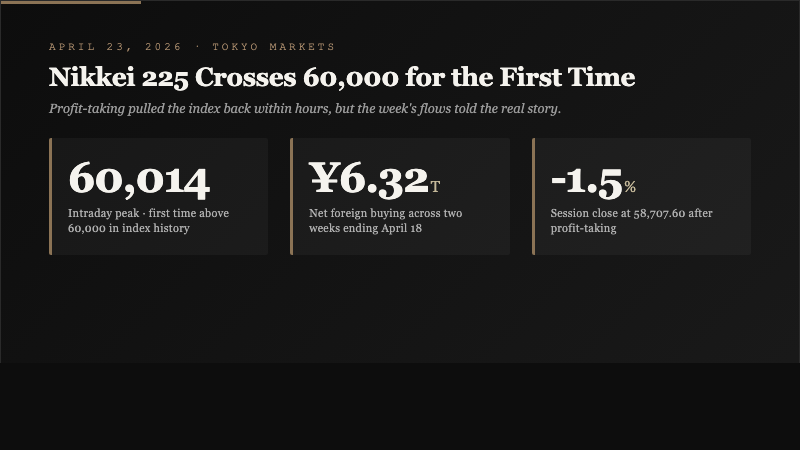
The Nikkei 225 briefly topped 60,000 for the first time in its history on Thursday, , before profit-taking dragged the index back below the milestone within the same session. The move capped a two-week buying spree by foreign investors who have pumped a combined 6.32 trillion yen into Japanese equities, pulled in by artificial intelligence exposure and improving odds that the U.S.-Iran war ends without further escalation.
According to data from Japan's Ministry of Finance released the same morning, foreign investors bought a net 2.38 trillion yen (roughly $14.92 billion at 159.49 yen to the dollar) of Japanese stocks in the week ending . That follows a record 3.94 trillion yen net purchase the prior week. The Nikkei touched 60,013.98 at its intraday peak before closing down 1.5 percent at 58,707.60 as traders locked in gains.
What Pushed the Nikkei Through 60,000
Two forces converged to drive Japanese equities to the milestone. The first was a concentrated rally in AI-exposed technology stocks. SoftBank Group gained 19.83 percent over the prior week. Advantest, which makes semiconductor test equipment used heavily by TSMC and other AI chip suppliers, climbed 11.52 percent in the same stretch. South Korea's Kospi briefly crossed 6,500 on the same dynamic before settling down 0.1 percent at 6,414.57.
The second was a broader shift in risk appetite after President Donald Trump indefinitely extended the U.S.-Iran ceasefire on , removing an immediate downside catalyst that had been weighing on global equities. Both moves compounded inside a single trading window, which is why Japanese stocks moved faster than most other regional markets.
The AI thesis matters more than the ceasefire headline for longer-term positioning. South Korea separately reported a better-than-expected 1.7 percent annualized gross domestic product growth rate for the January-through-March quarter, boosted specifically by exports of chips tied to global AI data center buildout. That print reinforced what foreign institutional buyers were already paying for: Japanese and Korean exposure to the AI capital cycle that has been reshaping U.S. equity indexes for two years.
The Profit-Taking Inside the Rally
The reversal below 60,000 within hours of crossing it is not unusual at round-number psychological levels, but it also reveals how concentrated the rally has been. When a relatively small group of large-cap AI names carries an index to a historic level, retracements tend to be sharp because the same institutions that drove the move are the first to take profits.
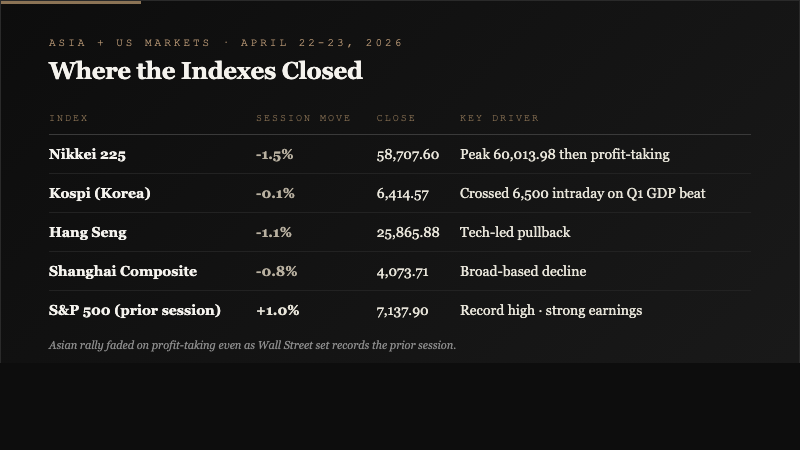
| Index | Session Move | Close | Notable Driver |
|---|---|---|---|
| Nikkei 225 | -1.5% | 58,707.60 | Intraday high of 60,013.98, then profit-taking |
| Kospi (Korea) | -0.1% | 6,414.57 | Briefly crossed 6,500 before Q1 GDP release |
| Hang Seng (Hong Kong) | -1.1% | 25,865.88 | Tech-heavy pullback |
| Shanghai Composite | -0.8% | 4,073.71 | Broad-based decline |
| S&P 500 (prior session) | +1.0% | 7,137.90 | Record high on strong earnings |
Wall Street set the table. The benchmark S&P 500 closed the Wednesday session at 7,137.90 after rising 1 percent, surpassing its prior record high set the previous Friday. The Dow Jones Industrial Average gained 0.7 percent to 49,490.03 and the Nasdaq composite rose 1.6 percent to 24,657.57, also a record. GE Vernova jumped 13.7 percent after reporting quarterly profits that beat expectations, helped by data center equipment orders tied to the same AI buildout pulling foreign money into Japan.
By the time Tokyo opened Thursday, the rally had extended to Japan and Korea on follow-through demand, then reversed across most of Asia as funds rotated out of winners to cover stretched positions.
The Foreign-Flow Story Foreign Investors Do Not Always Tell
The size of the foreign inflow is the headline worth pulling apart. Japan's Ministry of Finance tracks equity flows through designated reporting banks, and the 2.38 trillion yen figure for the week ending April 18 came on top of a 3.94 trillion yen net purchase the week before, which itself had been a record. That is 6.32 trillion yen of foreign buying in a fourteen-day window, and it represents a decisive vote from global asset allocators on Japanese exposure to the AI infrastructure trade.
The same institutions sold 298.2 billion yen of Japanese long-term bonds in the week, snapping a two-week net-buying trend, and bought 1.89 billion yen of short-term bills. Japanese investors moved the other way, buying 338.1 billion yen of foreign equities for a ninth consecutive weekly net purchase. They sold 183.3 billion yen of foreign debt.
"The rally is real, but the composition tells you this is a positioning trade rather than a broad rerating. When foreign buyers concentrate in a handful of AI-exposed megacaps and take duration exposure out of the mix, you get a faster index move and a sharper reversal."
Gaurav Dogra, Reuters markets analyst, cited in Ministry of Finance reporting
That dynamic, combined with the dollar trading at 159.53 yen, means U.S.-based foreign buyers are getting a currency tailwind on top of equity appreciation. The yen's weakness, which has persisted throughout 2025 and 2026 as the BOJ has held rates below what the Federal Reserve is paying on short Treasuries, has been a structural feature of the inflow story.
Oil, Commodities, and the Iran War Overhang
The ceasefire extension is not the same as a resolution. Iran seized two ships in the Strait of Hormuz on Wednesday after firing on three, tightening its grip on a waterway that carried roughly 20 percent of global oil and liquefied natural gas supplies before the war began in late February. Brent crude traded at $103.39 a barrel early Thursday, up 1.5 percent from the prior close and well above the $70 level that prevailed before the war. West Texas Intermediate was up 1.8 percent at $94.66.
Gold slipped 0.6 percent to $4,722.70 per ounce. Silver fell 2.3 percent to $76.17 per ounce. The precious-metals pullback is consistent with an incremental reduction in geopolitical hedging demand after the ceasefire extension, even though the underlying supply disruption is unresolved.
For Japanese equities specifically, oil matters through two channels. The first is the obvious cost-side drag on Japan's heavily export-oriented manufacturing sector, which imports nearly all of its energy. The second is the feedback loop into global growth expectations. If oil stays above $100 for an extended period, the ECB and other developed-market central banks have less room to cut rates, which tends to cap the equity rerating that the AI trade is riding on.
"As hopes for a resolution between the U.S. and Iran faded and peace talks stalled, the oil market is having to reprice expectations. As hopes fade, the reality of the supply disruption will set in, leaving further upside for prices."
Warren Patterson and Ewa Manthey, ING Bank strategists, research note
What the 60,000 Level Actually Means
Round-number psychological levels do not move markets on their own, but they do tell you something about positioning. The Nikkei 225 crossing 60,000 puts the index approximately 48 percent above where it traded at the start of 2024, a move that has been driven by three overlapping factors: yen weakness that boosted earnings translated back into dollars and euros, corporate governance reform that pushed Japanese companies to return more capital to shareholders, and sustained buying of AI-exposed hardware names as global capex picks up.
For U.S. investors holding Japanese equity exposure, the return profile has been strong but volatile. The Mag 7 comparison is imperfect because the Japanese market is more diversified by sector than the U.S. large-cap index. But the concentration risk is real: a significant share of the year-to-date Nikkei gain has come from a narrow basket of semiconductor equipment and telecom conglomerate names.
Strategists who have tracked the inflow pattern note that 6.32 trillion yen of net foreign buying in two weeks typically precedes a period of consolidation rather than continued straight-line appreciation. The question for the second half of 2026 is whether domestic Japanese institutional investors, who have been net sellers of stocks for most of 2025 and 2026, rotate back into equities at current levels or continue their preference for foreign assets.
What to Watch Next
Three specific catalysts will determine whether the Nikkei reclaims 60,000 on a sustainable basis. The first is the BOJ's upcoming policy meeting, where the central bank's guidance on the pace of rate normalization will either support the carry trade driving yen weakness or begin to unwind it. The second is the next round of U.S.-Iran negotiations, which Iran's judiciary has not confirmed it will attend, and the related question of when Strait of Hormuz shipping returns to pre-war levels. ING's own base case puts that timeline no earlier than June, and only in the event of a firm political settlement.
The third is the trajectory of AI infrastructure capital spending among U.S. hyperscalers. GE Vernova's 13.7 percent post-earnings move is a tell on this front: the market is pricing in continued acceleration in data-center orders, which flows directly into the Japanese and Korean semiconductor supply chain that has powered the Nikkei's latest leg higher. Any sign of a pause in that spending would hit Advantest and SoftBank first, and the index second.
For related market coverage, see our reporting on the Strait of Hormuz supply dynamics driving oil and equity volatility, on the S&P 500's record-setting April run, and on the AI chip supply chain tied to the broader 2026 semiconductor cycle.
Sources
- Foreign investors buy Japan stocks on US-Iran peace hopes, AI rally - Asahi Shimbun / Reuters
- Asian stocks retreat and oil tops $100 despite fresh records on Wall St - Associated Press
- Oil prices edge lower with no progress on US-Iran talks - Reuters
- Japan's Nikkei crosses 60,000 level for first time on tech rally - Reuters