

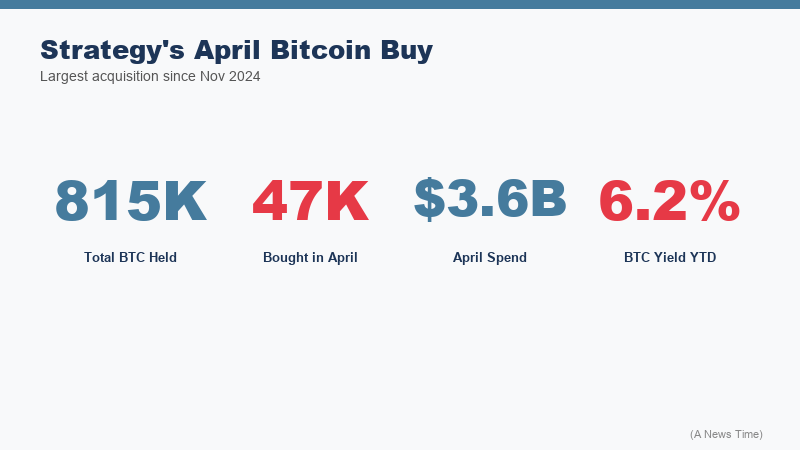
Strategy, the Nasdaq-listed software and Bitcoin treasury company, disclosed on that it had accumulated 47,079 Bitcoin in the first three weeks of the month alone, pushing its total holdings to 815,061 BTC and generating a BTC yield of 6.2 percent for the quarter to date. The company, led by executive chairman Michael Saylor, said the April acquisitions are worth approximately $3.6 billion at current prices, marking the company's most aggressive single-month buying pace since the November 2024 post-election surge that sent Bitcoin to its all-time high near $108,000. Bitcoin itself closed Tuesday at $75,733 after briefly touching $76,483, up 1.5 percent on the day as Iran signaled progress on Pakistan-hosted ceasefire talks and equities staged a broad relief rally.
The timing and scale of Strategy's disclosure landed at a moment when Bitcoin's narrative was already shifting. A week of macro tailwinds, including a softening in geopolitical risk and a pullback in the dollar index, had begun moving BTC back toward technical resistance that had capped the asset since February. Strategy's filing confirmed what on-chain analysts had speculated: the largest corporate Bitcoin buyer was not waiting for a lower entry. It was accumulating into strength.
The Scale of the April Acquisition in Context
Strategy has already purchased 62.8 percent of its entire 2025 Bitcoin haul in the first four months of 2026 alone. That figure, drawn from the company's own April 21 disclosure, underscores a deliberate acceleration in treasury strategy that management has signaled to shareholders through several 8-K filings in 2026. The company has been funding these acquisitions through a combination of at-the-market equity offerings and convertible note issuances, a capital structure approach that effectively turns Bitcoin price appreciation into a self-reinforcing acquisition engine.
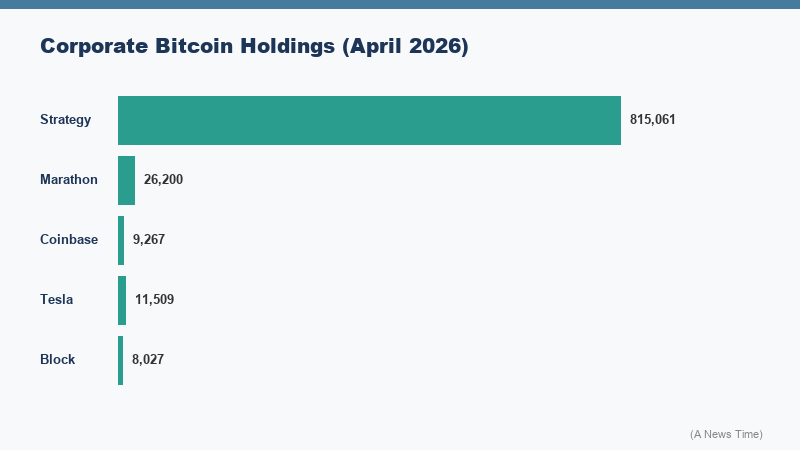
At 815,061 BTC, Strategy now controls approximately 3.9 percent of Bitcoin's fixed supply of 21 million coins. That concentration is significant. For context, the next largest corporate holder, Marathon Digital Holdings, holds fewer than 50,000 BTC. Strategy's position is not just the largest corporate treasury allocation in Bitcoin; it is in a different category from every other institutional or corporate holder.
"MicroStrategy reported a 6.2% BTC yield and a gain of 47,079 Bitcoin in the first three weeks of April. The firm's total holdings now stand at 815,061 BTC, valued above $62 billion with BTC trading near $76,483."
BeInCrypto, April 21, 2026
The BTC yield metric that Strategy reports is not a traditional yield in the income-investing sense. It measures the percentage increase in Bitcoin per diluted share, a figure that adjusts for the equity dilution created by the company's ongoing share offerings. A 6.2 percent BTC yield through April 21 means that on a per-share basis, Strategy shareholders are exposed to more Bitcoin than they were at the start of the year, even accounting for new shares issued to fund purchases. Saylor has framed this as the core value proposition: dilution that buys harder assets creates net accretion rather than destruction.
What BTC at $76,000 Means for the Strategy Bull Case
Bitcoin's move back through $75,000 and toward $76,500 on April 21 came on the back of several converging factors. Iran's signal that it would send a delegation to the second round of Pakistan-hosted talks with the United States helped ease the geopolitical risk premium that had weighed on dollar-denominated risk assets since late February. Brent crude slipped back below $95 ahead of the Wednesday ceasefire deadline, which historically correlates with reduced safe-haven demand for the dollar, a condition that tends to support Bitcoin on a relative basis.
CoinDesk reported that Bitcoin traded at $75,733 on Tuesday morning, up 1.5 percent over 24 hours, with the asset having briefly touched $76,483. Ethereum, for its part, moved to $2,307, reinforcing the pattern of altcoin strength that typically accompanies BTC gains above key psychological levels. The rally placed BTC within roughly 30 percent of its all-time high near $108,000, a distance that Strategy's average cost basis of approximately $60,000 per coin makes commercially comfortable even in a sustained drawdown scenario.
| Metric | Value | Context |
|---|---|---|
| Total BTC holdings | 815,061 BTC | Largest corporate treasury globally |
| Portfolio value (at $76,483) | ~$62.3 billion | Exceeds most S&P 500 companies' cash positions |
| April acquisition (3 weeks) | 47,079 BTC | Largest monthly pace since November 2024 |
| April acquisition value | ~$3.6 billion | Funded via equity offerings and convertible notes |
| BTC yield (Q2 to date) | 6.2% | Per-share BTC accretion after dilution |
| 2026 buys vs. 2025 full year | 62.8% in 4 months | Accelerated acquisition pace vs. prior year |
| BTC as percent of fixed supply | ~3.9% | No other corporate entity holds more than 0.25% |
The average cost basis question is material to how investors assess Strategy's risk profile. If Bitcoin were to retest the $60,000 level, Strategy's entire position would still be in positive territory on a cost basis, though the mark-to-market loss would run into the billions and create pressure on the convertible note holders who hold claims against the company's equity. Below $50,000, the calculus changes materially. Strategy has no plan B that does not involve Bitcoin maintaining value above its acquisition costs, which is a feature, not a bug, from Saylor's perspective, but it concentrates risk in a way that has no precedent in corporate finance.
Corporate Treasury Bitcoin: Winners and Structural Questions
Strategy's aggressive April acquisition raises a set of structural questions that the broader market is still working through. The first is what happens to Bitcoin's price mechanics when a single corporate buyer is absorbing tens of thousands of coins per month. Strategy's purchases do not occur on public exchanges in a way that creates immediate visible price impact, but the volume removed from circulating supply is measurable. Bitcoin's daily trading volume across major exchanges runs roughly 500,000 to 700,000 BTC on an active day. Strategy's April purchase of 47,079 BTC over three weeks represents a non-trivial share of that flow, absorbed off-market at undisclosed counterparties.
The second question is what Strategy's behavior signals to other corporate treasurers. The company's April disclosures arrived in the same week that the RWA tokenization market reached $27.65 billion in total value locked, a separate but related signal that institutional comfort with digital-asset balance sheet exposure is expanding. Strategy is not a lone actor in a vacuum; it is the most visible expression of a trend that includes Japan-listed Metaplanet, several smaller Nasdaq-listed mining companies that hold treasury Bitcoin, and an increasing number of family offices that have begun treating BTC as a long-duration inflation hedge.
The third structural question is what the acquisition pace implies about capital markets access. Strategy's ability to issue equity and convertible notes at scale requires that investors believe the underlying Bitcoin treasury is worth more than the paper claims against it. As of April 21, MSTR traded at a premium to its net asset value, meaning the market is assigning strategic value above and beyond the raw BTC holdings. That premium has historically compressed when Bitcoin underperforms and expanded when BTC rallies. The 6.2 percent BTC yield figure is, in part, a mechanism to justify that premium: management is arguing that the yield creation from leveraged accumulation adds value that pure spot exposure would not.
Ethereum and the Broader Crypto Context on April 21
While Strategy's disclosure dominated the crypto news cycle on , the broader digital-asset market was also moving. Ethereum crossed $2,307, up sharply from the sub-$2,100 prints it had recorded during the late-February and early-March selloff driven by Iran war-related risk aversion. The staked Ether ETF that launched earlier in 2026 has been steadily accumulating assets under management, providing a new source of institutional ETH demand that had no equivalent in prior market cycles. For related coverage, see our earlier analysis of how the staked ETH ETF launch shifted institutional allocation.
Bitcoin dominance, the share of total crypto market capitalization represented by BTC alone, has remained above 58 percent through most of April, a level that historically precedes "altseason" rotations but that has so far held, partly because Strategy's buying is structurally BTC-specific. Every dollar Strategy allocates goes to Bitcoin, not Ethereum, not Solana, not any other digital asset. That is both a choice and a constraint: Saylor has been explicit that the company's thesis is Bitcoin specifically, not digital assets as a class, and that position concentrates rather than diversifies the corporate treasury exposure.
The practical implication for retail and institutional crypto participants is that Strategy's disclosures now function as a regular data point in the BTC supply-demand framework. When a company with $62 billion in BTC announces it has absorbed another 47,079 coins in three weeks, the announcement itself carries informational content about where management thinks the risk-reward sits, regardless of whether the purchases were executed at average prices above or below the disclosure date's spot price.
"MicroStrategy has already purchased 62.8% of its entire 2025 Bitcoin haul in the first four months of 2026 alone, an acceleration that signals management conviction rather than opportunistic dip-buying."
Lockridge Okoth, BeInCrypto, April 21, 2026
What to Watch Next for Strategy and BTC
The next material data point for Strategy's Bitcoin thesis is the company's Q1 2026 earnings release, expected in early May. That filing will include detailed disclosures on the funding structure behind the April acquisitions, including which tranches of convertible notes were used and at what terms. Investors focused on the balance sheet will want to confirm that the debt-service obligations remain manageable at current Bitcoin prices and that the company has not taken on duration risk that would become problematic if BTC were to pull back sharply before maturities.
For Bitcoin itself, the $76,500 level that was briefly touched on April 21 represents a meaningful technical marker. A clean close above that level on volume would open a path toward the $80,000 zone that technical analysts have flagged as the next key resistance. The macro context is supportive in the short term: easing Iran war rhetoric, softer dollar, and a broad equity risk-on environment all correlate with BTC outperformance. The counterargument is that Bitcoin's correlation to equities, which had been falling in early 2026, tends to reassert itself sharply during risk-off episodes, and the ceasefire situation remains fragile. For related analysis on the intersection of Bitcoin prices and macro risk, see our earlier work on Bitcoin's 46 percent decline from all-time high and the key April catalysts.
The question that Strategy's April disclosure leaves open is not whether Saylor is right about Bitcoin. It is whether the corporate treasury model can sustain its capital markets access through a full cycle that includes a prolonged BTC drawdown. Every convertible note has a maturity date. Every equity offering has a price. The model works elegantly in rising markets and faces its hardest test when it does not.
Frequently Asked Questions
How many Bitcoin does Strategy hold as of April 2026?
As of April 21, 2026, Strategy holds 815,061 Bitcoin, valued at approximately $62 billion at prices near $76,483. The company has been the world's largest corporate Bitcoin holder since late 2020 and has no close competitor in that category.
What is Strategy's BTC yield and how is it calculated?
Strategy's BTC yield measures the percentage increase in Bitcoin per fully diluted share. A 6.2 percent BTC yield through April 21, 2026 means that shareholders hold more Bitcoin exposure per share than they did at the start of the year, even after accounting for the equity dilution from new share issuances used to fund acquisitions. It is not a cash dividend or income yield.
How is Strategy funding its Bitcoin acquisitions?
Strategy funds Bitcoin purchases primarily through at-the-market equity offerings, where it sells newly issued shares into the market, and through convertible note issuances, where investors provide debt capital that converts to equity at a premium if the stock reaches certain prices. The April 2026 acquisitions totaling approximately $3.6 billion were funded through this combination of equity and debt instruments.
Why did Bitcoin rally toward $76,000 on April 21, 2026?
Bitcoin rose 1.5 percent to trade around $75,733, briefly touching $76,483, on April 21 as Iran signaled it would send a delegation to the second round of Pakistan-hosted ceasefire talks. The easing geopolitical tension also pushed Brent crude lower and supported a broad risk-on move in equities, conditions that historically benefit Bitcoin's short-term price action.
How does Strategy's Bitcoin position compare to other corporate holders?
Strategy's 815,061 BTC is in a different category from every other corporate holder. Marathon Digital Holdings, the second-largest publicly traded corporate BTC holder, holds fewer than 50,000 coins. Strategy's position represents approximately 3.9 percent of Bitcoin's total 21 million coin supply, a concentration that has no precedent in any other commodity, currency, or asset class.
Sources
- MicroStrategy Reports Massive Bitcoin Gain and Yield in April - BeInCrypto via Yahoo Finance
- Bitcoin Reclaims $75,000 as Iran Ceasefire Talks Advance - CoinDesk
- Bitcoin Price Surpasses $76,000 Milestone in Major Market Rally - CryptoRank
- Strategy (MSTR) 8-K Filings - U.S. Securities and Exchange Commission