

Wall Street enters the week of facing the most consequential stretch of corporate earnings it has seen in at least three years. Meta Platforms, Microsoft, Alphabet, Amazon, and the backdrop of Apple's own Q1 print all converge within a ten-day window that will either validate or fundamentally challenge the AI investment narrative that has driven big-technology valuations for the past two years. The collective market capitalization of those five companies exceeds $7 trillion. Their aggregate capital expenditure guidance will set the tone for every hyperscaler, enterprise software vendor, and AI infrastructure supplier through the rest of 2026. When these companies speak, the market listens in a way that central bank policy statements can barely match.
The context is not comfortable. Microsoft's stock declined approximately 23 to 25 percent in the first quarter of 2026, its largest quarterly drawdown since the 2008 financial crisis, according to data compiled from multiple market reports. Apple's stock fell 2.7 percent on April 21 alone after Tim Cook's surprise announcement that he would step down as CEO in September, leaving the market to assess what an executive transition means for a company whose tariff-exposed supply chain is already under strain. Against that backdrop, the question for earnings week is whether Q1 results and, more importantly, forward guidance can provide the evidence that AI infrastructure spending generates real revenue rather than simply generating each other's capacity utilization.
Meta Platforms: The 92% Probability Print
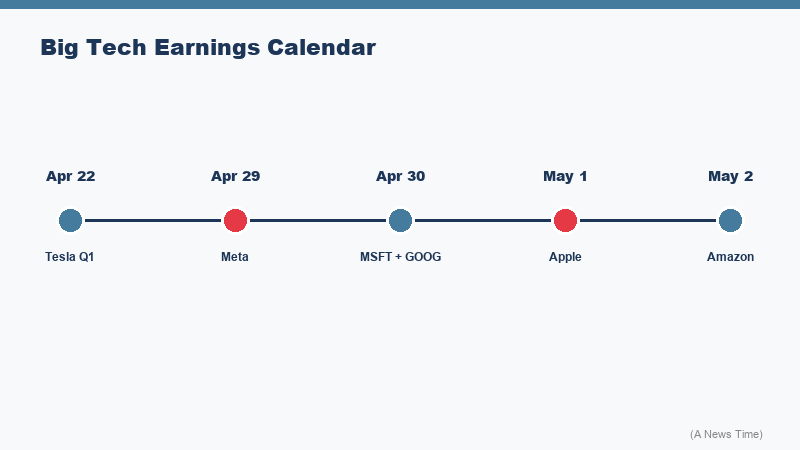
Meta Platforms reports on , and prediction markets assigned a 92 percent probability of an earnings beat as of April 21, the highest confidence reading among the major technology reporters this week. That near-certainty reflects the combination of Meta's advertising revenue dominance and the company's demonstrated ability to beat consensus estimates across multiple consecutive quarters. The harder question is not whether Meta beats on earnings per share but what the company says about its AI capital expenditure program and whether top-line revenue guidance reflects any macro softness from tariff-driven advertiser caution.
Meta's AI investment cycle is real and large. The company has committed to spending between $60 billion and $65 billion on CapEx in 2026, a figure that represents a step-change from prior years and that is flowing into data center construction, custom silicon, and the infrastructure for training foundation models that underpin the Llama family of open-source releases and Meta's advertising ranking systems. The bull case is that this spending is already generating revenue: Meta AI, the company's consumer-facing assistant embedded across WhatsApp, Instagram, Facebook, and Messenger, has been cited by management as a driver of engagement metrics that correlate with advertising pricing power.
"The hyperscalers, Microsoft, Alphabet, Amazon, Meta, are still expected to spend big on AI infrastructure. And any sign of hesitation will send shockwaves through the entire technology supply chain."
Interactive Brokers Campus, Earnings Season Reality Check, April 2026
The bear case is that advertising markets are showing early signs of softness from tariff-related uncertainty. If retailers and consumer-goods companies are pulling back on marketing budgets as they absorb supply chain cost increases from the current 10 percent global baseline tariff, Meta's revenue guidance could disappoint even if Q1 numbers come in ahead of consensus. Advertisers typically respond to macro uncertainty by cutting variable costs before fixed costs, and digital advertising is one of the most variable cost lines in a marketing budget. A 1 to 2 percent revenue guidance cut would not be a disaster for Meta, but it would trigger a reassessment of the valuation multiples the stock has commanded on AI growth expectations.
Microsoft: Recovering From a 23-25% Q1 Decline
Microsoft's situation entering earnings week is the most complex of the group. The stock shed 23 to 25 percent in the first quarter of 2026, its largest quarterly decline since 2008, driven by a combination of macro risk aversion, AI spending skepticism, and the broader technology selloff that accompanied Iran war-related uncertainty. The company reports alongside Alphabet on , and the pairing will create an immediate and involuntary comparison of how the two hyperscalers are faring on cloud growth, AI monetization, and the trajectory of their respective CapEx programs.
For Microsoft, the single most-watched metric is Azure growth. Azure has been the company's primary growth engine, and AI-enhanced Azure services, including the OpenAI partnership products like Copilot and Azure OpenAI Service, have been cited as drivers of accelerating cloud consumption. The consensus expectation among sell-side analysts is for Azure to report year-over-year growth in the high-20s to low-30s percent range. Anything below 25 percent would be read as a deceleration that questions whether AI demand is translating into cloud revenue at the expected pace. Anything above 32 percent would validate the AI-infused cloud thesis and likely trigger a meaningful recovery in the stock.
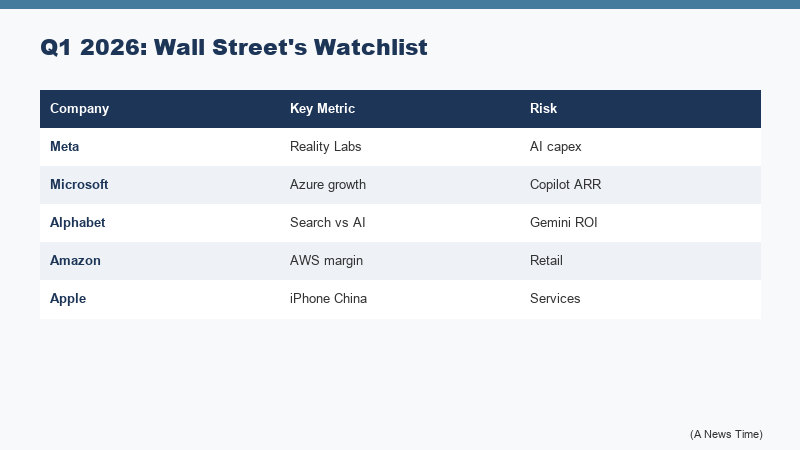
| Company | Report Date | Key Metric | Bull Case | Bear Case |
|---|---|---|---|---|
| Meta Platforms | April 29 | Revenue guidance | Advertising holds, AI products drive engagement | Tariff-driven ad budget pullback |
| Microsoft | April 30 | Azure growth rate | 30%+ YoY driven by AI cloud demand | Sub-25% signals AI demand deceleration |
| Alphabet | April 30 | Google Cloud revenue | 35%+ YoY, Search AI features boost advertising | Search share erosion from AI competitors |
| Amazon | Early May | AWS operating margin | 40%+ margins, AI capacity fills at premium | CapEx surge compresses near-term margins |
| Apple | TBA | iPhone demand + supply chain | Tariff absorb via India shift, Services holds | China revenue falls, margins compress |
Microsoft's other disclosure to watch is the cadence of its AI CapEx guidance. The company has been guiding to a full-year CapEx program in the $75 to $80 billion range, flowing into data centers globally. Any indication that this guidance is being revised upward would be read as a signal of confidence in AI demand. A downward revision would be a significant warning sign for the entire AI infrastructure supply chain, including Nvidia, AMD, and the data center real estate investment trusts that have been priced as AI infrastructure beneficiaries.
Alphabet: The Search Defensibility Question
Alphabet reports alongside Microsoft on April 30, and the company faces its own distinct set of pressures. Google Search, which remains the dominant revenue driver for the parent company, has been navigating the existential question of whether AI-powered search alternatives, principally from OpenAI's ChatGPT search integration and from Perplexity, are meaningfully eroding its query share. Internal data from Alphabet's own management discussions has suggested that Search remains dominant, but the narrative risk is real and has pressured the stock's forward multiple.
Google Cloud is the offset. GCP has been posting revenue growth in the 30 to 35 percent range in recent quarters, and the AI-enhanced products within the Google Cloud suite, including Vertex AI and the Gemini model family, have been converting enterprise interest into actual contract signings. If Google Cloud's Q1 2026 result comes in at or above consensus and Alphabet management can make a credible case that Search's AI features are expanding the addressable market rather than cannabilizing it, the stock has a reasonable path to recover from the year-to-date pressure. The MSN analysis of "Microsoft vs. Meta: Which AI stock is a better buy" captured the market's framing well: Azure growth and Google Cloud growth are now the primary metrics through which investors assess whether AI monetization is real.
Alphabet's advertising segment will also be watched for tariff-driven softness. Google Search advertising revenue is more diversified than Meta's, spanning e-commerce, financial services, travel, and healthcare advertisers who respond differently to macro uncertainty. But the retail and e-commerce component, where tariff impacts are most direct, represents a meaningful share of Search advertising spend. If Alphabet's Q1 advertising revenue shows any year-over-year deceleration relative to Q4 2025, the question of whether tariff effects are bleeding into digital advertising will become a central narrative for the entire sector. For broader context on tariff impacts on market valuations, see our earlier analysis of how the 2026 tariff landscape maps to sector winners and losers.
Amazon: The AWS Margin Story
Amazon's Q1 2026 earnings, expected in early May, carry a different primary variable than the other three. For Amazon, the headline is AWS operating margin and whether the company can maintain the 35 to 40 percent operating margin range that AWS has delivered in recent quarters while simultaneously accelerating its AI infrastructure investment. Amazon has committed to CapEx spending of approximately $100 billion in 2026, a figure that exceeds Microsoft and Alphabet individually and that is flowing into data center construction across North America, Europe, and Asia.
The market tension around Amazon's CapEx program is whether the spending is generating capacity that fills at premium AI pricing or whether it is creating oversupply that compresses AWS margins. Historical AWS margin dynamics have been favorable because cloud spending in general has grown into available capacity. The AI-specific question is whether AI compute capacity, which carries higher capital costs per unit than traditional cloud compute, can be priced at a sufficient premium to maintain or expand margins. If AWS Q1 operating margin comes in above 35 percent while the company confirms it is on track for $100 billion in CapEx, the thesis is intact. If margins compress below 30 percent, the AI infrastructure bear case gets empirical support.
The broader earnings-week framework was well-articulated by the Interactive Brokers analysis: "Markets are jittery about tariffs, oil prices, and the health of the US consumer. But company results and guidance will sort out what's real and what's not." That is an accurate description of where the market sits. The AI investment cycle has been built on projections and management guidance for two years. This week's earnings reports from the companies doing the actual investing will begin to provide the real-world financial evidence that either confirms or challenges those projections.
"Strong Azure growth is helping drive impressive double-digit revenue and earnings-per-share growth at Microsoft. Meta's top-line momentum has been a consistent positive, but investors are now weighing those results against increasingly expensive AI ambitions."
MSN Financial Analysis, Microsoft vs. Meta Earnings Preview, April 2026
One additional element that will shape the earnings narrative is the Amazon CEO announcement. Andy Jassy has been a consistent advocate for AI infrastructure investment and has argued that AWS's first-mover advantage in enterprise AI will compound as customers build their applications on AWS infrastructure. Any change in that messaging, or any indication that the $100 billion CapEx commitment is being reconsidered, would be a material negative for the sector. For context on the kind of AI capex commitments that set this week's stakes, see our earlier reporting on how banks are deploying agentic AI, a downstream use case that depends entirely on the cloud infrastructure being built this year.
What to Watch and What It Means
The practical framework for evaluating this earnings week is simpler than the noise suggests. Three questions will determine how the market reads the results. First: do the four primary hyperscalers collectively reaffirm their AI CapEx guidance, or does any one of them signal a reduction? A single CapEx cut would be a sector-wide negative even if the cutting company frames it as discipline. Second: do Azure, Google Cloud, and AWS deliver cloud growth rates in the high-20s to mid-30s percent range that are consistent with AI demand being real rather than theoretical? Third: does Meta's advertising revenue guidance for Q2 show any softness that can be attributed to tariff-driven macro uncertainty rather than Meta-specific factors?
If all three answers are favorable, the AI bull case gets another six months of runway and the technology sector has its foundation for recovering the ground lost in Q1. If any one answer disappoints, the market will be asking whether the AI investment cycle has entered a period of reckoning. The tariff overlay makes the read more complex than usual: a guidance cut that can be attributed purely to macro uncertainty from tariffs is less damaging than a guidance cut that signals demand is not materializing on the AI side. Management teams will be carefully parsing their language this week to make that distinction as clear as possible.
The Amazon Web Services earnings report is also an indirect read on broader enterprise cloud spending, including from the banks, healthcare companies, and manufacturers that are building AI applications on top of hyperscaler infrastructure. If enterprise cloud consumption is strong despite macro uncertainty, it suggests businesses are treating AI infrastructure investment as a priority cost rather than a discretionary one, which is the structural shift that would justify the hyperscaler spending programs. That distinction, between priority spending and discretionary spending, is what earnings week will ultimately reveal.
Frequently Asked Questions
When do Meta, Microsoft, Alphabet, and Amazon report Q1 2026 earnings?
Meta Platforms reports on April 29, 2026. Microsoft and Alphabet both report on April 30. Amazon's Q1 2026 earnings are expected in early May. Apple has not yet announced its exact report date but is expected to report within the same window.
What is the most important metric for each hyperscaler this earnings week?
For Meta: revenue guidance for Q2 and whether ad budgets show tariff-related softness. For Microsoft: Azure year-over-year growth rate versus the consensus expectation of high-20s to low-30s percent. For Alphabet: Google Cloud growth and Search advertising revenue trend. For Amazon: AWS operating margin and whether the $100 billion CapEx commitment is reaffirmed.
Why did Microsoft's stock fall 23-25% in Q1 2026?
Microsoft experienced its largest quarterly stock decline since the 2008 financial crisis in Q1 2026, driven by macro risk aversion related to Iran war uncertainty, broader technology sector selling, and investor skepticism about whether AI infrastructure spending would generate commensurate revenue. The stock's recovery depends heavily on strong Azure growth and maintained CapEx guidance in the April 30 report.
How much are the hyperscalers spending on AI infrastructure in 2026?
The four primary hyperscalers are collectively projected to spend between $250 billion and $300 billion on capital expenditure in 2026. Meta has guided to $60-65 billion, Microsoft to $75-80 billion, and Amazon to approximately $100 billion. Alphabet has guided to a similarly large program. This combined figure represents the largest single-year technology infrastructure investment in history.
What would a guidance cut from a major hyperscaler mean for the market?
Any reduction in AI CapEx guidance from a major hyperscaler would likely trigger a sector-wide selloff across the AI infrastructure supply chain, including Nvidia, AMD, and data center real estate investment trusts. The logic is that hyperscaler CapEx is the primary revenue driver for AI chip and infrastructure companies; if the buyers slow down, the entire supply chain reprices lower. Conversely, reaffirmed or raised guidance would broadly support the sector.
Sources
- Consider This Your Earnings Season Reality Check - Interactive Brokers Campus
- Meta's Earnings Report Is Coming Up - AOL Finance
- Microsoft vs. Meta: Which AI Stock Is a Better Buy Headed Into Earnings - MSN Money
- Tech Stocks Today: Apple Stock Falls as Wall Street Sizes Up New CEO John Ternus - Yahoo Finance