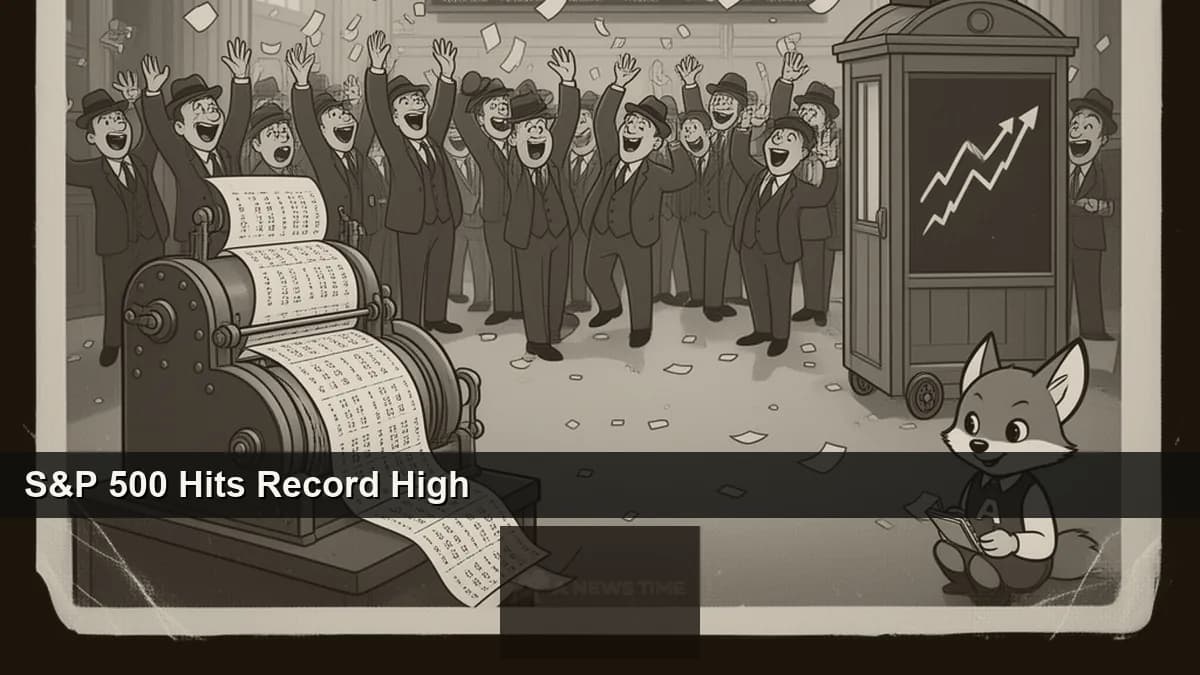
The S&P 500 reclaimed all-time highs on , and closed Thursday 0.3% higher at another record, erasing the roughly 8% drawdown that followed the escalation of the US-Iran war in March. On the same day the benchmark printed its fresh peak, Goldman Sachs released its quarterly hedge fund industry report showing long-short stock pickers are up 7.7% month-to-date in April, their strongest monthly performance since the bank began tracking the data at the start of 2016. The combination of record indexes and record-setting hedge fund returns is the clearest signal yet that institutional positioning has flipped from defensive to aggressive in the span of three weeks.
What Changed Between March and April
The reversal is stark. In March, macro traders took broad losses as oil prices spiked and equity volatility surged after the Iran conflict entered its active phase. Hedge funds across all strategies were down 1.8% that month, though they absorbed only 35% of the drawdown a 60/40 stock/bond portfolio took, which is low relative to industry benchmarks. Volatility-linked funds dumped equities. Commodity trading advisors ran short. Institutional investors broadly moved to conservative positioning.
By mid-April, nearly every one of those positions had been unwound. Commodity trading advisors (CTAs) bought roughly $20 billion of U.S. equities over the past week, according to Nomura. Levered exchange-traded funds added another $27.5 billion. Options markets swung from their most defensive three-month call skew in nearly three years to their most bullish positioning in three months.
"There was a dramatic reset in positioning in March. That is why we are seeing such a violent chase, referring to recent aggressive bullish options flows."Chris Murphy, co-head of derivative strategy, Susquehanna Financial Group
The mechanical flows from systematic strategies are the largest single source of the rebound, and the positioning data suggests they have room to run. Nomura cross-asset strategist Joanna Wang estimated that systematic positioning in U.S. equities remains "historically light," meaning the technical buying pressure could continue without immediately creating the kind of over-exposure that typically precedes sharp reversals.
The Hedge Fund Performance Split
| Strategy | April 2026 MTD | YTD 2026 | FY 2025 Return |
|---|---|---|---|
| Long-short equity (all) | +7.7% | +6.7% | N/A |
| Market-neutral | N/A | N/A | +10.3% |
| Healthcare-focused | N/A | N/A | +33.6% |
| Asia-focused | Leading category | Leading category | +28.1% |
| All strategies average (Q1) | N/A | +1.6% (Q1); -1.8% (March) | N/A |
The 7.7% April return for long-short funds is not evenly distributed across the industry. Goldman's report noted that Asia- and China-focused fund managers are leading the year-to-date performance tables, continuing a trend that emerged in late 2025 as China's domestic equity market outperformed the U.S. on a currency-adjusted basis for the first time in several years. Equity long-short funds also attracted their largest inflows since 2022 during the March quarter, suggesting allocators bet on active management precisely when the market was at its most volatile.
Dispersion between individual funds rose in March to the highest level in three years, reflecting the gap between funds that positioned correctly for the Iran shock and those that did not. That dispersion is usually a leading indicator for industry-wide returns in the subsequent quarter, because managers who miss the first move tend to chase performance and add to momentum in a way that extends the rally.
What the Historical Data Says About Rallies From Pullbacks
The Reuters analysis of LSEG data covering every S&P 500 record high since 1957 following a 5% to 10% pullback produced a reassuring result for bulls. In 38 such instances, the index tended to extend gains over the subsequent two weeks and one month. Median returns were +0.66% two weeks after the record and +1.01% one month later, with roughly two-thirds of the cases producing positive returns.
The one-third of cases where stocks faltered still produced relatively contained declines, with median drawdowns of 1.46% at two weeks and 3.38% at one month. Notably, in none of the 38 historical cases did the S&P 500 fall back below the previous pullback low within two weeks or one month of hitting the new record. That is a powerful base rate for anyone deciding whether to chase the current rally.
Options market pricing now reflects that base rate. OptionMetrics head quantitative analyst Garrett DeSimone said equity implied volatility and skew have normalized even as the Iran conflict persists, consistent with the market pricing an eventual resolution rather than escalation. That pricing is not a guarantee of an outcome, but it reflects a consensus view that the geopolitical tail risk has been at least partially discounted.
The Economists Are More Cautious Than the Traders
The dissonance between the market rally and the macroeconomic backdrop is the quiet undercurrent of this week's headlines. Oil futures are roughly $30 higher than they were in late February. Benchmark 10-year Treasury yields are about 35 basis points higher. Expectations for Federal Reserve rate cuts in 2026 have collapsed to near zero. The University of Michigan consumer sentiment index is at a record low. Under ordinary circumstances, that combination would be associated with a selloff, not a rally.
"If I told you at the end of February that by mid-April oil futures would be $30 higher, bond yields would be about 35 basis points higher, expectations for two rate cuts would evaporate, and consumer sentiment would be at record lows, would you have reasonably expected major equity indices to be flirting with all-time highs by the end of that timespan? I'm pretty sure that's a no. When momentum rules, fundamentals are optional."Steve Sosnick, Chief Strategist, Interactive Brokers
Sosnick's framing captures the tension that every allocator now has to decide what to do about. The mechanical and sentiment-driven buying is real and has momentum behind it. The fundamental case is thinner than it was three months ago. Funds that lean into the rally get paid this quarter. Funds that hedge against a reversal underperform their benchmarks if the momentum holds.
Nationwide's chief market strategist Mark Hackett noted the speed of the sentiment shift as a contributing factor.
"First, there was overwhelming pessimism and conservative positioning among institutional investors."Mark Hackett, Chief Market Strategist, Nationwide
That pessimism has now partially reversed, but only partially. Systematic strategies are still underexposed relative to historical norms, and discretionary portfolio managers who sat in cash during March are under performance pressure to buy. The combination can extend rallies well past the point that pure fundamental analysis would justify.
The Signs of Froth That Bears Are Watching
Not every data point is reassuring. Shares of Allbirds surged more than five-fold on Wednesday after the struggling footwear maker announced it was raising capital and pivoting toward AI computing infrastructure, a move that echoed the late-cycle meme-stock rallies of 2020-2021. The Nasdaq's AI-driven concentration in a handful of mega-cap names has widened further during the rally. And the options market's move from defensive to bullish positioning happened in three weeks, a pace that typically signals crowding.
For context, the S&P 500's level itself is approximately unchanged from late January. What has changed is the positioning underneath. Markets that trade flat while positioning moves from defensive to aggressive are historically more vulnerable to sharp reversals than markets where both price and positioning move together. The test of whether the rally can endure will come from two sources: the actual trajectory of the Iran conflict, which both major parties and the market are now pricing as increasingly likely to end with a negotiated ceasefire, and the Q1 earnings season, which kicks into gear over the next two weeks with the megacaps reporting through early May.
What to Watch Next
The immediate catalysts are earnings and the Fed. Big Tech Q1 results will test whether the AI capex that has driven the Nasdaq's outperformance is producing the revenue follow-through investors have been pricing in. The Fed's May 6-7 meeting is unlikely to produce a rate change, but the accompanying economic projections will signal how seriously the Fed is taking the inflation impulse from higher oil and supply chain pressures.
On the hedge fund side, the second-quarter reporting cycle will show whether the April surge is the beginning of a durable run or a single-month outlier. Goldman's dispersion data suggests the gap between winners and losers will widen through Q2, which is historically the pattern that precedes either industry-wide performance consolidation or a broad washout. The bulls on the Reuters interviewees' side of the tape have the data. The bears have the macro. The rally's answer will emerge over the next eight weeks.
Sources
- Stock market bulls see signs rally could endure after S&P 500 back at highs - Reuters
- Hedge funds on track for best monthly returns in over a decade, Goldman says - Reuters
- S&P 500 Hits Record High as Stock Market Looks Beyond Iran War - New York Times
- Dow rises, S&P 500 and Nasdaq notch fresh records as war resolution hopes grow - Yahoo Finance