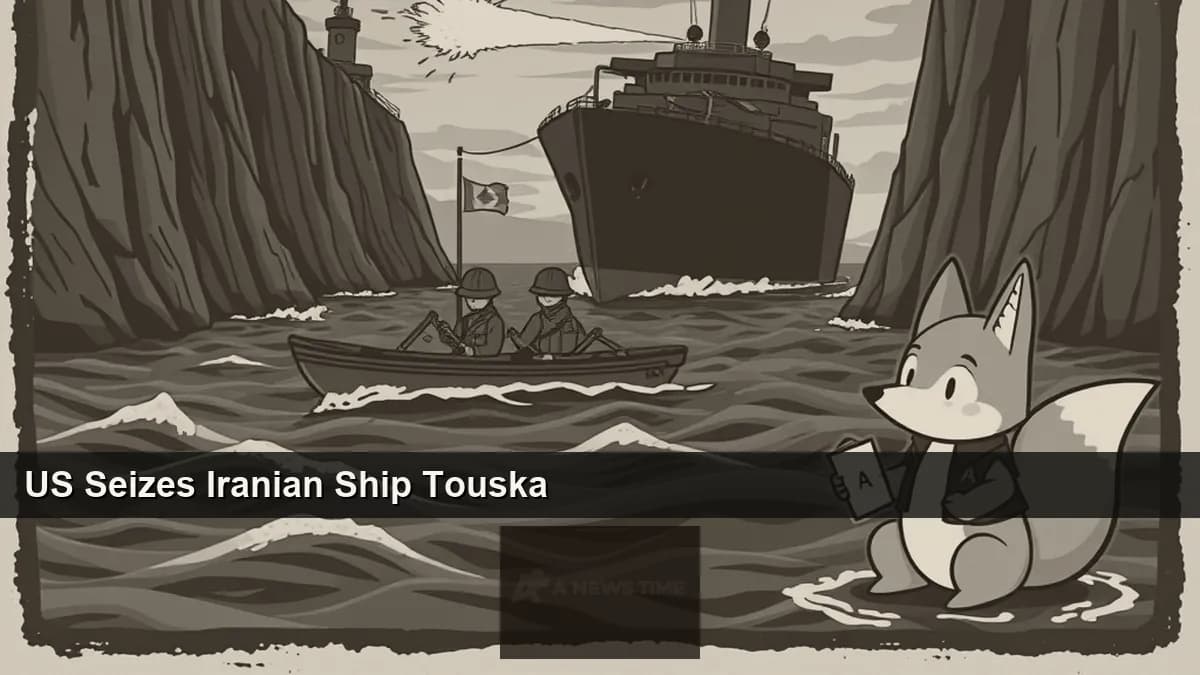
Iran's Foreign Ministry confirmed on that Tehran has no plans to participate in a second round of Pakistani-hosted peace talks with the United States, a decision that collapses the most important scheduled diplomatic event of the seven-week US-Iran war. Foreign Ministry spokesman Esmail Baqaei cited the previous day's US naval seizure of the Iranian cargo ship Touska in the Gulf of Oman, which Iran has called "aggression" and "piracy" and which its armed forces have pledged to retaliate against. The White House confirmed it was still sending a US delegation to Islamabad. The resulting diplomatic asymmetry, one side traveling to talks the other side is skipping, is the clearest public signal yet that the war's path is narrowing.
For markets, the diplomatic collapse matters as much as the naval incident. A contained skirmish at sea with active talks running in parallel prices as manageable. A skirmish followed by the target country refusing to negotiate prices as a structural shift. Two-week ceasefire arrangements that expire without a successor framework have historically led either to fresh kinetic phases or to formal conflict resolution on terms set by whichever side won the prior round. Which of those two paths opens this week is the question that will define energy, equity, and sovereign credit pricing through April and into May.
What Iran Actually Said
At his weekly Foreign Ministry press briefing on Monday, Baqaei said Iran "has no plans to participate in a second round of peace talks with the United States" and that Iran "will make the appropriate decision on continuing the path of negotiations by prioritizing national interests and concerns." He called the US seizure of the Touska an act of "aggression" and said Iranian authorities were investigating the incident. A senior Iranian official, speaking anonymously to Reuters, added that "the differences over the nuclear program remain unresolved and the gaps have not narrowed."
"The continued US naval blockade undermines Iran-US peace talks. Iran's defense capabilities, including its missile program, are non-negotiable."
Senior Iranian official, speaking to Reuters on condition of anonymity, April 19, 2026
Iran's semi-state Fars News Agency, close to the Islamic Revolutionary Guards Corps, reported that no final decision had been made, but framed the conditions for the talks as "not particularly positive" and said Tehran would not consider meeting in Islamabad if the US blockade of the Strait of Hormuz continued. The semi-official Tasnim News Agency reported that Iran had "no current plan to send a negotiating delegation." Official news agency IRNA went further, saying Iran rejected participation because of "Washington's excessive demands, unrealistic expectations, constant shifts in stance, repeated contradictions, and the ongoing naval blockade, which it considers a breach of the ceasefire."
The three-tier messaging, official Foreign Ministry, semi-official Fars, and official IRNA, is typical of Iranian diplomatic signaling under pressure. The Foreign Ministry offers the formal no. The IRGC-linked press offers the blunter version with cited grievances. The official news agency records the version for history. All three pointed in the same direction on Monday.
The Pakistan Mediation Channel
Pakistan's Prime Minister Shahbaz Sharif took a 45-minute phone call with Iranian President Masud Pezeshkian on Sunday night to try to preserve the Islamabad diplomatic channel. Sharif said afterward that he "appreciated Iran's engagement, including its high-level delegation to Islamabad for the historic talks" and updated Pezeshkian on his own conversations with leaders from Saudi Arabia, Qatar, and NATO member Turkey. The readout did not indicate when a substantive second round might resume.
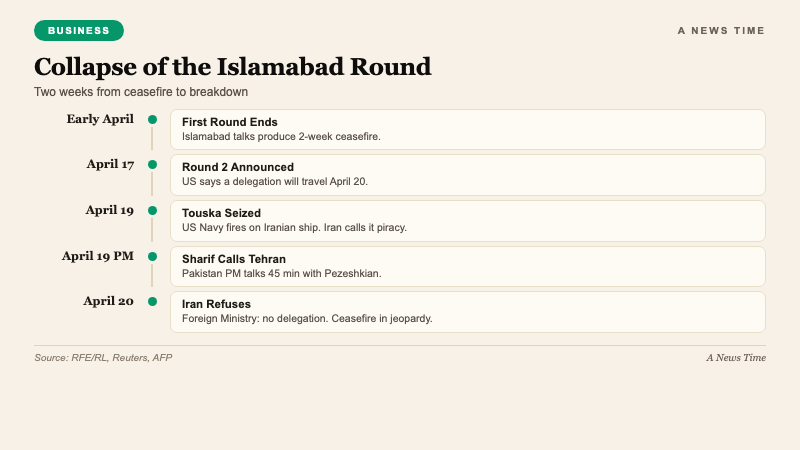
| Date | Event |
|---|---|
| Early April 2026 | First Islamabad round ends without agreement |
| Two-week ceasefire | Continues in principle through April 21 |
| April 17-18 | US announces second round for April 20 |
| April 19, 2026 | US Navy seizes Iranian cargo ship Touska |
| April 19, 2026 (evening) | Sharif calls Pezeshkian for 45 minutes |
| April 20, 2026 | Iran Foreign Ministry rejects participation |
Security in Islamabad was visibly tightened on Sunday ahead of the expected Monday talks. Authorities announced road closures and traffic restrictions, barricades appeared at major hotels including the Serena Hotel where the last round of talks took place, and heavy transport was suspended "until further orders." Those visible signals of preparation are part of what makes Iran's Monday pullout more consequential politically than a private cancellation would be.
Why the Two-Week Ceasefire Window Matters
The current ceasefire, agreed during the first round of Islamabad talks, was structured as a two-week arrangement subject to renewal based on progress. It expires this week. Without a second round, there is no procedural mechanism to formally extend the ceasefire, which leaves both sides with default behavior. For the United States, default behavior under the current administration has meant enforcement of the naval blockade with kinetic escalation for violators, as demonstrated Sunday. For Iran, default behavior has historically meant proxy action through Houthi forces in the Red Sea, targeted missile launches, or maritime interference in the Persian Gulf.
The practical market question is which default sequence activates first. Gulf shipping war-risk insurance rates, the cleanest real-time indicator of perceived regional risk, have already begun repricing according to industry trackers. A sustained elevation would indicate that institutional shippers are pricing this as a multi-month disruption rather than a one-week incident.
Iran's Domestic Calculation
Domestic constraints matter as much as foreign policy in Iran's current posture. The judiciary announced on the execution of two more people for alleged "connections with Israel" and espionage, the latest in what human rights organizations have called a sharp rise in wartime executions. Iran's Treasury Department issued a circular authorizing ministries and state-owned companies to sell or exchange war-damaged government buildings, a tacit acknowledgment of the physical cost of US and Israeli strikes since the start of the war.
A government refusing peace talks during a war whose infrastructure cost is substantial and climbing is doing political math, not diplomatic math. Accepting a second-round invitation after an opposing-navy seizure of a flagged merchant vessel would project weakness to both domestic hardliners and regional partners. Rejecting it while continuing back-channel diplomacy through Pakistan and Qatar preserves the option space without incurring the political cost of public negotiation under pressure.
What Washington Does Next
The White House has three realistic options. First, it can proceed with the Islamabad trip and meet with Pakistani mediators in the absence of an Iranian delegation, accepting that the public optics will be awkward but preserving the channel for when Tehran decides to return. Second, it can cancel the trip and wait for Iran to signal engagement through a less visible venue, likely Doha or Muscat. Third, it can escalate the blockade and press toward a shorter, more forceful end state that does not require Iranian negotiating cooperation.
The political polling reality at home, with Trump's NBC approval rating at 37% and 67% disapproving of his handling of the Iran war, tilts the calculus toward the first two options. A president polling at second-term lows with active opposition to escalation even among some Republicans has narrower room to push toward a military-heavy end state. That does not eliminate the option. It raises its political cost.
Market Implications
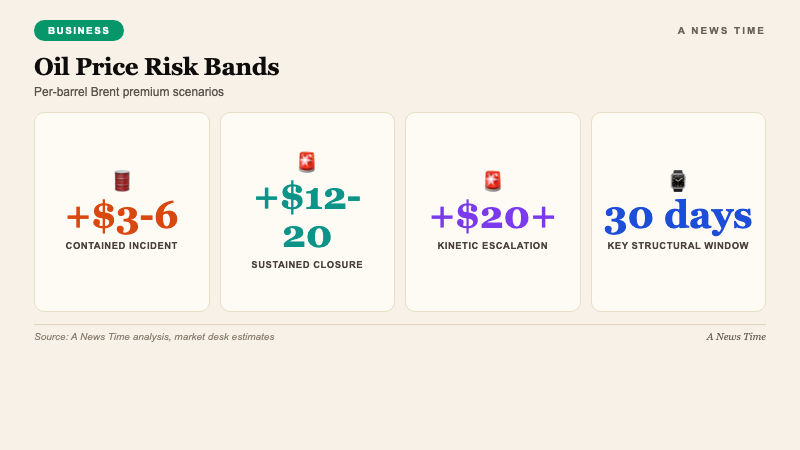
Oil traders head into this week pricing for divergence. Brent crude's risk premium widens if the second-round absence extends past a five-to-seven-day window. Equities, particularly energy-intensive industrials and consumer discretionary, carry the largest downside beta to a sustained closure of the Strait of Hormuz. Defense contractors, cybersecurity firms, and tanker operators benefit in mirror fashion from the same conditions, which is why energy-sensitive sector rotation has been visible in recent weeks.
Sovereign credit markets are quieter but meaningful. Iran's credit default swap spread, for the limited portion that trades, widened during the blockade weeks earlier in the conflict and is likely to widen further if the diplomatic channel remains broken. Gulf partner sovereign credit, particularly the UAE and Saudi Arabia, has held up reasonably well throughout the war, reflecting market confidence that those states can insulate themselves from direct economic damage through pipeline and financial hedges. Whether that insulation holds under a second Hormuz closure is an active, rolling question.
Frequently Asked Questions
Why did Iran refuse the second round of US talks?
Iran's Foreign Ministry cited the US Navy's April 19 seizure of the Iranian-flagged cargo ship Touska as a "breach of the ceasefire" and said the ongoing US naval blockade of the Strait of Hormuz undermined the basis for peace talks. Official Iranian statements also cited "Washington's excessive demands" and "unrealistic expectations" as reasons to stay away.
Is the ceasefire still in effect?
The two-week ceasefire negotiated during the first round of Islamabad talks expires this week. Without a formal second round, there is no procedural mechanism to extend it, which raises the probability of renewed kinetic exchanges in the days ahead.
Is the US still sending a delegation to Islamabad?
The White House confirmed a US delegation was en route to Pakistan for the April 20 talks, even as Iranian state media reported Tehran would not send a team. The resulting diplomatic asymmetry has no immediate precedent in the current war cycle.
What role is Pakistan playing in mediation?
Pakistan has hosted the first round of face-to-face talks between US and Iranian delegations in Islamabad. Prime Minister Shahbaz Sharif spoke with Iranian President Masud Pezeshkian for 45 minutes on April 19 in an attempt to preserve the second round. Pakistan has also been coordinating with Saudi Arabia, Qatar, and Turkey.
What does Iran's rejection mean for oil prices?
A sustained diplomatic breakdown raises the probability of a prolonged Strait of Hormuz closure and elevated shipping war-risk insurance costs. Historically, Gulf conflict episodes that extend beyond 30 days without negotiation embed a $10 to $20 per barrel persistent risk premium on Brent crude, with downstream effects on gasoline, diesel, and inflation expectations.
What to Watch
Three signals determine whether this is a managed pause or a structural shift. First, whether the US delegation in Islamabad converts into back-channel talks with Iranian representatives through Pakistani or Qatari intermediaries. Second, whether Iran's pledged retaliation for the Touska seizure arrives in kinetic form or in a proxy escalation that allows deniability. Third, whether the ceasefire is informally extended even as the formal second round collapses, which would signal that both sides want a path back to negotiation without publicly acknowledging the path while domestic politics reset.