President Donald Trump's approval rating fell to 37% in an NBC News poll released Sunday, his lowest mark in any major NBC poll of his second term, with 63% of adults disapproving of his job performance. The poll, published as US naval forces seized an Iranian-flagged cargo ship in the Gulf of Oman, also found a supermajority of respondents disapproving of the way the administration has handled the war in Iran and of its approach to inflation and cost of living. The data adds to a clustering of April polling that has moved Trump's average approval below 40% for the first time in his second term, a threshold that historically compresses a president's political leverage on domestic policy and makes war-related decisions harder to defend.
For markets and business leaders, the polling matters less as a political scorecard and more as a forward-looking indicator of economic policy constraints. A president polling below 40% tends to face sharper resistance from his own party on unpopular fiscal measures, narrower room for additional tariff escalation, and greater pressure to resolve active foreign conflicts whose economic costs are falling most heavily on consumers.
What the NBC Poll Actually Shows
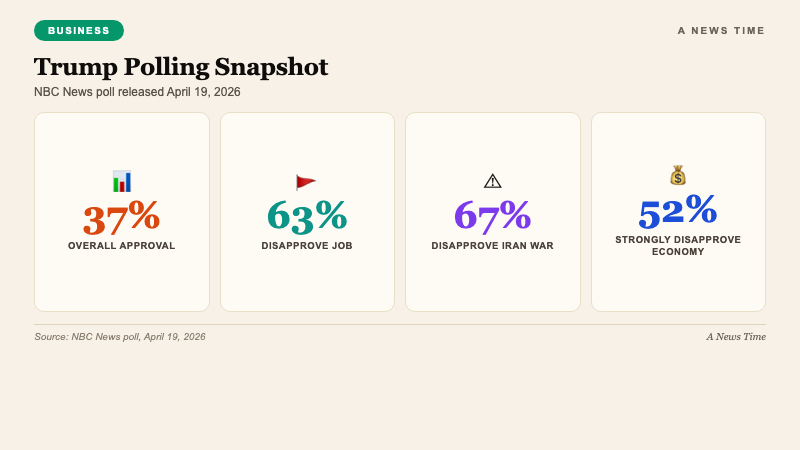
The NBC News poll put Trump's job approval at 37%, with a 63% disapproval share. Only 37% of adults had a positive view of his presidency, the lowest mark in NBC's in-house polling during his current term. The most striking internal number was his handling of the war in Iran. Sixty-seven percent of respondents disapproved of the administration's management of the conflict, split between 54% who strongly disapproved and 13% who somewhat disapproved. That strong-disapproval share is the metric political strategists watch most closely because it tends to predict voter behavior more reliably than soft opinion.
On economic management, 52% strongly disapproved of Trump's handling of inflation and cost of living, up from 44% in the same NBC poll a year earlier. The eight-point jump in strong disapproval on economic stewardship is a meaningful shift in a relatively short timeframe and is the internal data point most directly linked to the Iran war's energy channel.
| Metric | Value | Comparison |
|---|---|---|
| Overall approval (NBC) | 37% | Second-term low |
| Overall disapproval (NBC) | 63% | Second-term high |
| Disapprove of Iran war handling | 67% | 54% strongly disapprove |
| Strongly disapprove of economy handling | 52% | Up from 44% in April 2025 |
| Second-term average (Gallup) | 41% | Equals his first-term average |
| Average gas price (AAA late March) | $3.98/gal | Up 34% since February 28 |
NBC is not the only poll showing the slide. The New York Times poll tracker and Nate Silver's Silver Bulletin average both moved below 40% in March, a low for his second term that he began with an average rating above 50%. His average remains slightly above 41% in RealClearPolitics aggregation, indicating that the decline is broad across pollsters rather than concentrated in one house effect.
The Iran War Is the Pivotal Variable
The correlation between Trump's approval decline and the trajectory of the Iran war is explicit in the cross-tabs of multiple polls. An Associated Press/NORC survey in late March found 59% of respondents said US military operations in Iran had "gone too far." The same poll found a partisan split that is not typical for foreign-policy opinion: 90% of Democrats, 63% of independents, and 26% of Republicans agreed. The independent number is the most politically consequential because it is the demographic most likely to convert opinion into general-election behavior.
Quinnipiac University's late March poll found 54% opposed the military action against Iran and 39% supported it, matching closely with Economist/YouGov and Reuters/Ipsos numbers throughout the spring. A New York Times analysis of polls taken in the initial days of nine other US military interventions since World War II found fewer Americans supported the Iran action (41%) than any of the other conflicts, with the Libya intervention of 2011 the only other war to receive less than majority support.
"A new NBC News poll found only 37% of adults approved of Trump's job performance as the U.S. tries to negotiate a peace deal with Iran."
Sara Dorn, Forbes, reporting the April 19 poll release
The framing matters because the NBC polling internals separate performance on the war from performance on the economy and then show both are now moving in the same direction. That is the pattern most dangerous to an incumbent administration, because it removes the usual option of using one policy lane to offset weakness in another.
How Gas Prices and Inflation Drive the Polling
The mechanical transmission from war to approval runs through the gasoline pump. US retail gasoline averaged $3.98 per gallon in late March according to AAA, up roughly 34% from the start of the US-Israeli conflict with Iran. The price pass-through from Brent crude to retail gasoline normally takes two to four weeks, and the current elevation reflects crude prices that spiked above $110 per barrel during the first Strait of Hormuz closure before moderating to the low-$90s after the temporary ceasefire.
The March CPI print at 3.3%, with energy as the primary driver, created the macro backdrop for the current polling. Headline inflation that stays above 3% tends to produce deterioration in presidential approval ratings across pollsters, regardless of party. Gallup's historical data set shows consistent erosion of approval when real gasoline prices are in the top quartile of their 24-month rolling range, and current retail gasoline is at or near that threshold.
The Federal Reserve's positioning compounds the political pressure. Markets are currently pricing in a rate environment that keeps the Fed from cutting until the energy shock fully clears from the CPI, which means consumers feel both elevated gas prices and elevated mortgage rates simultaneously. That combination historically produces the sharpest declines in consumer-sentiment indices and, by extension, in presidential approval.
The Markets-Politics Feedback Loop
For business leaders, three consequences of sub-40% approval tend to reshape the operating environment.
First, tariff policy becomes more volatile. A president under polling pressure tends to shift to visible, politically salient actions that do not require congressional approval, and tariffs fit that pattern. Trump's prior pattern during approval dips has been to announce new tariff tranches or expand existing ones, which introduces supply-chain repricing risk for importers and manufacturers with global sourcing exposure.
Second, fiscal measures requiring Republican support become harder to pass. House and Senate Republicans in competitive districts generally correlate their voting behavior with the president's approval in their states. A sustained 37% national rating reshapes whip counts on tax legislation, spending packages, and any Iran-related war authorization vote.
Third, the diplomatic path toward ending the Iran war becomes operationally easier to sell politically. The deal Trump might accept in is probably more accommodating than the deal he would have accepted in , simply because domestic polling has shifted the political cost of a prolonged war higher. Markets price that in as asymmetric downside protection for Gulf tail risk and moderate upside for crude if a ceasefire reopens shipping.
What the Polling Doesn't Show
Two caveats matter. Trump's first-term average approval rating, according to Gallup, was also 41%, which matches his second-term average to date. Low approval is not a new baseline condition for his presidency, and the mechanical political consequences are not as dramatic as equivalent numbers would be for a president with a historically normal approval trajectory.
The second caveat is that war-related approval dips have historically recovered quickly once the underlying conflict resolves. The April 2025 "Liberation Day" tariff announcement produced a comparable approval drop that partially reversed once the announced tariffs were modified and markets stabilized. A cleanly negotiated end to the Iran war could produce a similar rebound, which is why markets are watching the status of Pakistan-hosted talks more closely than the current polling snapshot.
The Forbes report citing NBC's own polling history and major trackers put the April 19 number in context as follows. "Trump is considering sending ground troops to Iran, an operation that would be widely unpopular, even with Republicans, according to polls," the Forbes summary observed. The reporting added that the war "is expected to stretch beyond the six-week timeline the Trump administration initially gave for the war."
Frequently Asked Questions
What is Trump's approval rating right now?
The NBC News poll released April 19, 2026 measured Trump's approval rating at 37%, his lowest in that poll during his second term. The Reuters/Ipsos late-March poll measured 36%. The Forbes aggregation average puts his second-term rating below 40% for the first time, with the RealClearPolitics blended average slightly above 41%.
How does the Iran war affect Trump's polling?
Multiple polls show 54% to 67% disapproval of his handling of the Iran war, with the strongest disapproval among independents and younger voters. The war's energy channel, visible at the gasoline pump, has amplified disapproval of his economic stewardship, with NBC showing 52% now strongly disapproving of his handling of inflation and cost of living.
Is Trump's second-term approval unusually low by historical standards?
Trump's 41% average approval during both his first and second terms so far, per Gallup, is below every president since Harry Truman. Joe Biden had the next lowest average at 42%, followed by Truman at 45% and Jimmy Carter at 46%. A 52% average is the benchmark across modern presidents.
What is the market impact of a sub-40% presidential approval rating?
Markets price sub-40% approval as increased tariff-volatility risk, constrained fiscal capacity, and marginal incentive for the White House to resolve active foreign conflicts. For equities, the net effect tends to be neutral to modestly negative on broad indexes with outperformance in defensive sectors and volatility hedges.
Could approval rebound quickly?
Historically, war-related approval dips recover rapidly when the conflict resolves favorably. The speed of any rebound depends primarily on whether the Iran ceasefire is restored and whether energy prices retrace the war-driven increase. A sustained Strait of Hormuz closure extends the downside risk.
The Signal for the Week
The NBC poll would matter less on its own. Paired with the seizure of the Iranian cargo ship Touska, a reimposed Strait of Hormuz closure, and the collapse of the scheduled second round of Pakistan talks, it signals that the political and economic costs of the war are moving in the same direction, faster than either the polling or the markets had priced in only a week ago. The administration's next set of decisions, on whether to escalate the blockade, how to respond to Iranian retaliation, and whether to accept a diplomatic reset, will be made with the 37% number as a constant background constraint.