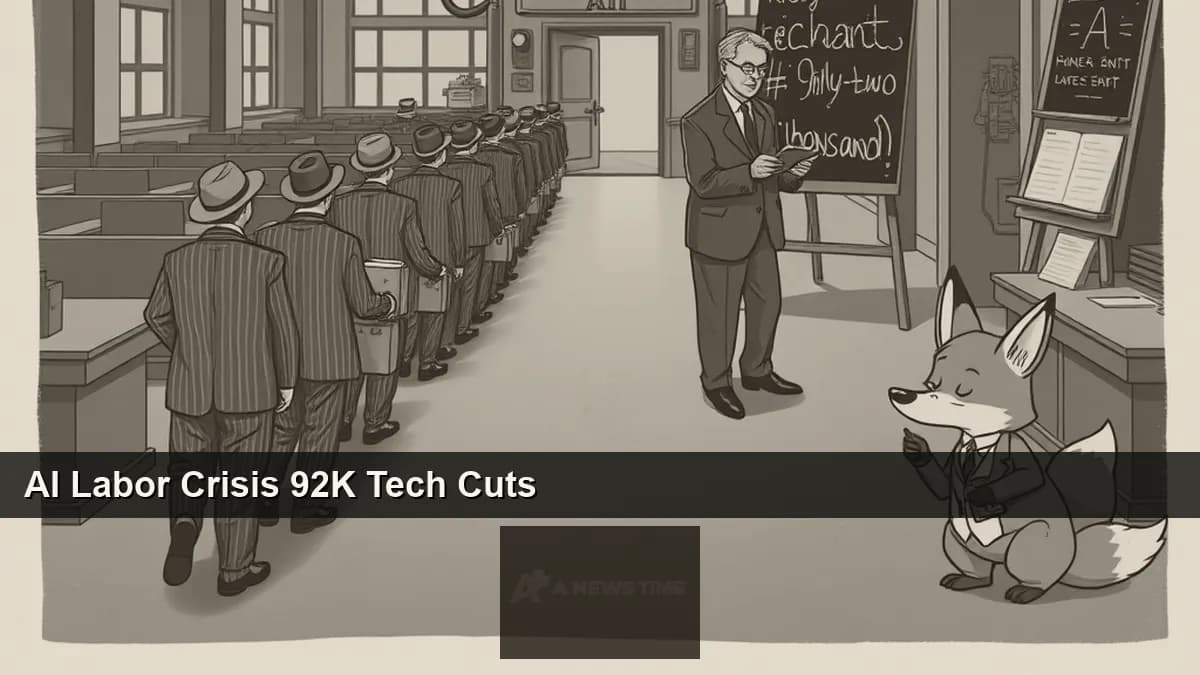
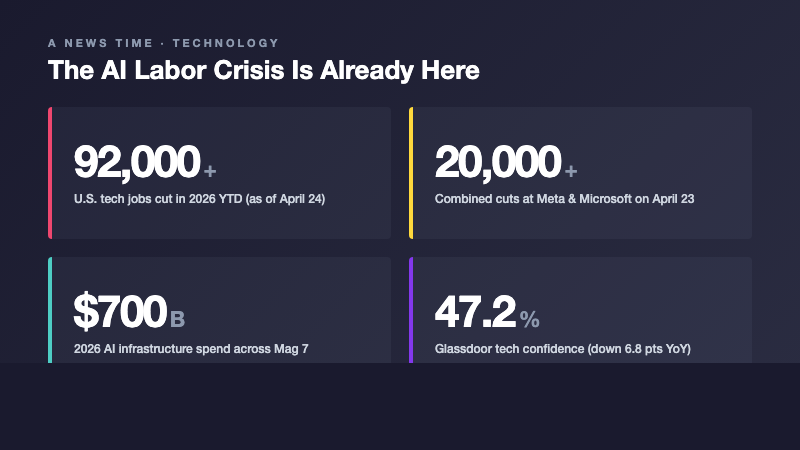
The 20,000-plus combined job cuts disclosed by Meta and Microsoft on have crystallized what economists have been arguing for months: the AI labor crisis is not a future scenario. It is here now, and it is widening. As of this week, more than 92,000 tech workers have been laid off in 2026 alone, bringing the running cumulative total since 2020 to roughly 900,000, according to data from layoff tracker Layoffs.fyi. The proximate trigger is the same at every company making cuts: the same firms paying record sums to build AI infrastructure are shedding the workers their own AI systems can replace.
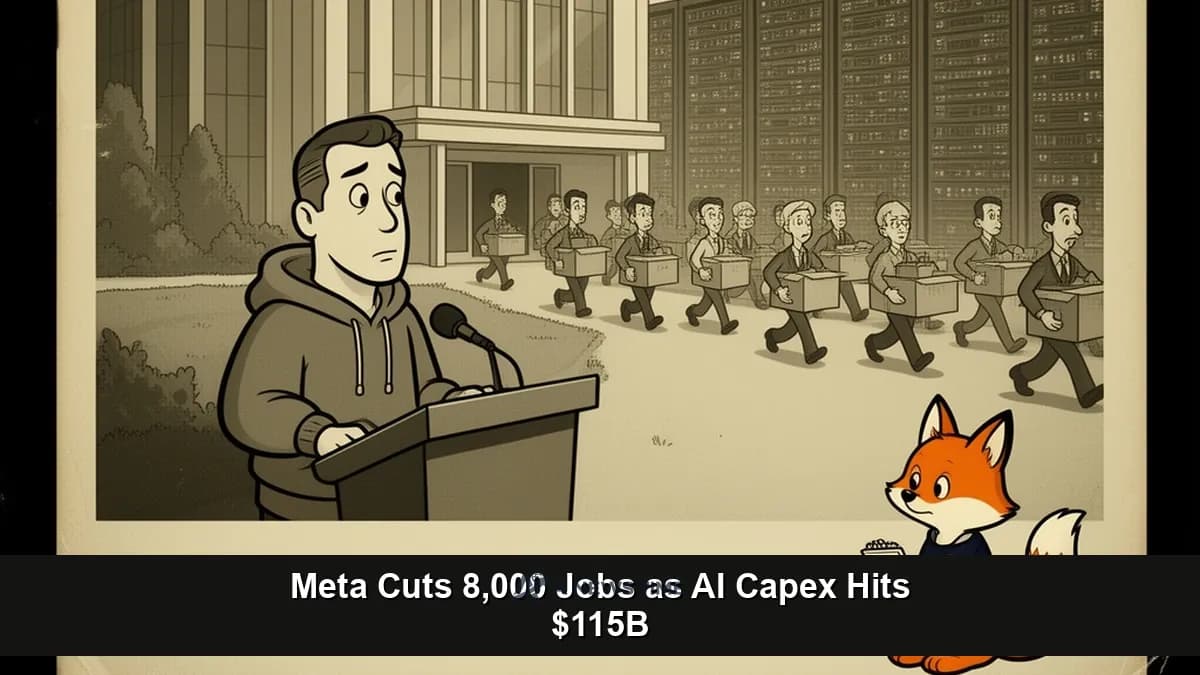
Meta told employees in an internal memo that it will lay off about 8,000 people, roughly 10 percent of its workforce, with cuts beginning . The company is also scrapping plans to fill 6,000 open roles. Hours later, Microsoft confirmed it will offer voluntary buyouts to thousands of long-tenured U.S. employees, the first such program in the company's 51-year history. About 7 percent of Microsoft's U.S. workforce is eligible, which translates to as many as 8,750 potential exits from a U.S. base of roughly 125,000.
The Numbers Behind the Pattern
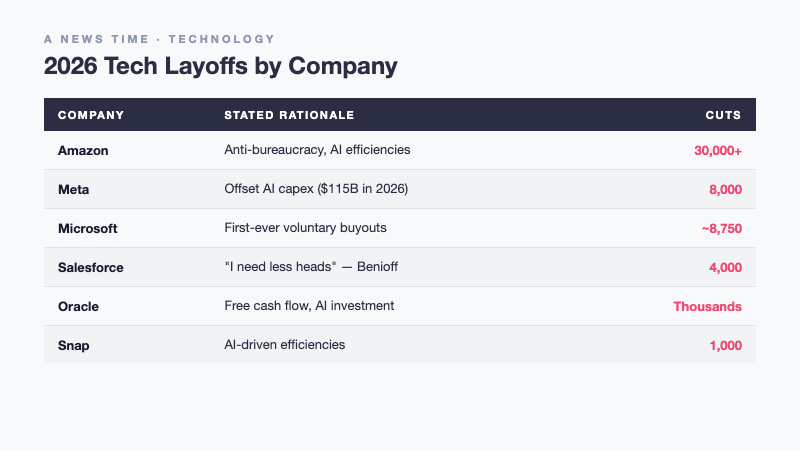
Looking at any single company's cuts in isolation can make the layoffs look like routine cost discipline. Looking at the cumulative tally tells a different story. Amazon has cut more than 30,000 jobs since October, about 10 percent of its corporate and tech workforce, with rolling smaller layoffs running between the headline announcements. Oracle disclosed in March that it was eliminating thousands of roles even as it ramped AI infrastructure spending, a move TD Cowen analysts estimated could free up $8 billion to $10 billion in incremental free cash flow. Salesforce cut 4,000 customer support roles in September 2025, with CEO Marc Benioff telling staff bluntly, "I need less heads."
| Company | Cuts disclosed | Approximate share of workforce | Stated rationale |
|---|---|---|---|
| Amazon | 30,000+ since October 2025 | ~10% of corporate/tech | Anti-bureaucracy, AI efficiencies |
| Meta | 8,000 (April 23 announcement) | 10% | Offset AI capex |
| Microsoft | Up to 8,750 buyouts (April 23) | 7% of U.S. eligible | Voluntary retirement program |
| Oracle | Thousands (March 2026) | Undisclosed | Free cash flow, AI investment |
| Salesforce | 4,000 (September 2025) | ~7% of support roles | Direct AI substitution |
| Snap | ~1,000 (March 2026) | 16% | AI-driven efficiencies |
| Nike | ~1,400 (April 23) | Mostly technology dept. | Reductions in tech org |
Snap chief executive Evan Spiegel cited "AI-driven efficiencies" by name in his letter to staff explaining the company's 16 percent workforce cut last month. Nike's announcement on Thursday, hitting roughly 1,400 employees concentrated in its technology department, makes clear that the trend has now spread well beyond Silicon Valley pure-play software companies. Tech jobs are at risk wherever they exist, regardless of which industry is paying for them.
What the Confidence Numbers Actually Show
The labor side of the story is where the pattern gets most visible. Glassdoor's Employee Confidence Index for tech fell 6.8 percentage points from a year earlier in March, to 47.2 percent. That is the largest year-over-year drop in any industry the index tracks, and it is happening despite what is technically a low overall unemployment rate.
"This represents a fundamental structural shift rather than a temporary market correction. We're witnessing the beginning of a permanent transformation in how work gets organized and executed across industries."
Anthony Tuggle, executive coach and former AI industry leader, quoted by CNBC, April 24, 2026
Daniel Zhao, Glassdoor's chief economist, points to a feedback loop driving the cuts deeper. With workers nervous about the market, fewer of them are quitting voluntarily. That kills off the "natural attrition" companies have historically relied on to manage headcount over time. Instead, employers are reaching for the more direct lever.
"Because natural attrition isn't happening as much, companies are being more aggressive about pushing people out of the door. Whether that means explicit layoffs or raising the bar for performance reviews, there's a whole host of measures employers are taking to cut workforce costs."
Daniel Zhao, Chief Economist, Glassdoor, quoted by CNBC, April 24, 2026
The bar-raising piece matters. Several companies that did not appear on the public layoff tally in the first quarter of 2026 have quietly tightened performance review standards in ways that produced the same outcome. The headcount comes down, but the press release never goes out. That makes the 92,000 tally something closer to a floor estimate than a ceiling.
The Capex Problem That Has to Be Paid For
The single cleanest way to understand why the cuts are stacking is to read them next to the AI infrastructure spending lines on each company's earnings statement. Alphabet, Microsoft, Meta, and Amazon are collectively expected to spend close to $700 billion on AI infrastructure this year. That money buys data centers, custom silicon, the Nvidia and AMD GPU fleets, and the megawatt-scale power deals that make all of it run. The hardware will depreciate against earnings over the next four to six years.
That depreciation has to be offset somewhere if operating margin is to hold. The companies have settled on a consistent answer: people. Meta's $115 billion-plus 2026 capex guidance is not a number that can be defended to public-market investors without an offsetting reduction in operating expenses, and the most flexible operating expense at any modern software company is its salaried workforce. The announcement Thursday from chief people officer Janelle Gale framed the layoffs precisely this way, as part of a continued effort to allow the company to offset other investments it is making. That is the playbook every large platform now appears to be running.
The five Magnificent Seven companies reporting earnings next Wednesday will face a wall of analyst questions about how much further the cuts have to go. The answer will shape the AI capex defense for the rest of 2026. Big Tech's AI spending has now reached a level where the offsetting cost reductions become structurally necessary, and the companies that have not yet announced public cuts are the ones to watch as second-quarter season opens.
The 50-Person Unicorn Pattern
The other side of the story is happening at the smallest end of the venture capital pipeline. The same AI tools that let large incumbents shed support and entry-level engineering roles are letting a new generation of startups stay tiny while scaling revenue. Zach Bratun-Glennon, a partner at venture firm Gradient, told CNBC the pattern is now clearly visible across his portfolio.
"We are seeing companies that can get to $50 million in revenue with like 50 employees, whereas that used to be, for a software business, a 250-person company. Do I think there are going to be 50- or 100-person unicorns and decacorns? Absolutely."
Zach Bratun-Glennon, Partner, Gradient, quoted by CNBC, April 24, 2026
Peter Morales, chief executive and founder of Code Metal, described the same dynamic from inside an operating company. "Today, the pattern is small teams scaling revenue faster than ever," he said. The implication for hiring is direct. The startups now competing with Meta, Microsoft, and Amazon for software engineers are doing so with a 10x smaller headcount target. The total demand for mid-level platform engineers is, mathematically, a fraction of what it would have been three years ago at the same revenue scale.
That bifurcation also clarifies what the laid-off Meta and Microsoft staff will face when they reach the open market in late May and June. The top of the engineering pyramid, the few hundred frontier AI researchers who can lead model development, remains a seller's market with compensation pushing past $10 million a year in some cases. The much larger middle of the pyramid, the strong infrastructure and product engineers who built the recommendation systems and ad pipelines at Meta or the cloud services at Microsoft, faces a thinner landing market than at any point in the last decade.
The Counter-Argument Worth Hearing
Not everyone in the AI economy reads the data the same way. Techno-optimists argue that mass industry disruptions historically create new categories of work that did not exist before. Mobile app developers were not a job description before smartphones. IT administrators were not a category before commercial servers. Rajat Bhageria, chief executive of physical AI startup Chef Robotics, made the optimistic case in measured terms.
"It's just less certain what that will look like at the moment. We're only starting to understand how much of our daily work AI can handle for us across all different kinds of jobs."
Rajat Bhageria, CEO, Chef Robotics, quoted by CNBC, April 24, 2026
The 2026 Motion Recruitment Tech Salary Guide offers some real-time evidence on both sides of that argument. Demand for AI-specialist roles, particularly applied research engineers and inference platform engineers, remains strong with compensation rising. Demand for entry-level and generalist IT work is decelerating sharply, and overall tech salaries are flat year-on-year for the first time since the post-pandemic correction. The new categories may eventually arrive. The question is how long the gap between today's losses and tomorrow's creations turns out to be, and what the labor market looks like in the interval.
What Comes Next
Three things will determine whether the 92,000-and-counting figure becomes the headline number for 2026 or merely the first half of a much larger total. The first is the second-quarter earnings cycle that opens next Wednesday with the megacap reports. If the analyst questions force tighter operating-expense guidance, more cuts follow. The second is whether enterprise customers continue to absorb the cost increases tied to AI feature rollouts on platforms like Microsoft 365 Copilot, Salesforce Agentforce, and Google Workspace. Slower enterprise uptake would force the providers to defend the AI spend with more aggressive headcount reductions, not fewer. The third is the path of agentic AI deployment, which Marcus tracked earlier this month and which is now plausibly capable of replacing whole engineering and operations teams in routine workflows.
The honest read is that all three of those vectors point in the same direction at the moment. Whether the structural shift Anthony Tuggle described turns out to be a one-year reset or a multi-year reorganization of how knowledge work is staffed is the question the next four earnings calls will start to answer.