Walk into any Brooklyn coffee shop with a tote-bag-and-headphones crowd in and you will see a small but growing cluster of orders that did not exist eighteen months ago. Hot water, plain. Sometimes with a single slice of lemon. Sometimes nothing at all. This is, if you have spent any time on the wellness side of TikTok recently, the entry-level uniform of a phenomenon Gen Z has decided to call "Chinamaxxing." The shorthand, awkward as it sounds, refers to the deliberate adoption of Chinese rituals, aesthetics, and lifestyle habits as an answer to a Western culture many young Americans now describe as overstimulating and exhausting.
The visual language of the trend is consistent across the people performing it. House slippers worn indoors as a hard rule. A traditional Chinese skincare routine that prioritizes herbal infusions over actives. Slow morning routines that lean on rice porridge, congee, or herbal soups instead of cold-pressed juice. Wardrobes that pull from contemporary Chinese streetwear rather than Western fast-fashion silhouettes. And, most consequentially for the travel industry, an unexpected surge of American Gen Z and millennial travelers heading to Chongqing, Chengdu, and other second-tier Chinese cities they never would have considered four years ago.
How a Niche Influencer Look Became a Cross-Generational Lifestyle
The trend traces back, in tidy origin-story fashion, to Chinese-American content creator Sherry Zhu, whose videos demonstrating traditional Chinese skincare recipes and "Chinese baddie" beauty rituals built an audience throughout 2024 and 2025. Zhu's content was not designed as a cultural movement. It was designed as practical guidance: which herbs go in a face steam, why hot water is preferred to iced beverages in traditional Chinese medicine, what wearing slippers indoors actually does for your floors and your nervous system. The videos performed because they offered specific, low-cost, reproducible rituals to an audience that had been told for a decade to buy more products to feel better.
"In 2026, it's apparently cool to be Chinese."
Cherie Wong, Hong Kong Canadian activist, Instagram, April 2026
Wong's observation, delivered with the dry edge of someone who has watched the cultural pendulum swing more than once, captures what makes Chinamaxxing slightly different from prior wellness trends. The pieces being adopted are not a marketer's confection. They are the actual daily practices of a billion-plus people. The Western audience picking them up is doing so with a self-awareness, sometimes uncomfortable, sometimes earnest, about borrowing rather than inventing.
Celebrity adoption has accelerated the look's spread without giving the wellness industry a clean monetization path. Timothée Chalamet has been photographed in pieces consistent with the aesthetic. Various pop-culture figures have been observed integrating elements of the routine into their own publicly visible morning rituals. The trend has not yet produced its breakout product, the way matcha defined the previous generation's wellness export, but the conditions for one are present.
The Practices, in Order of Adoption Difficulty
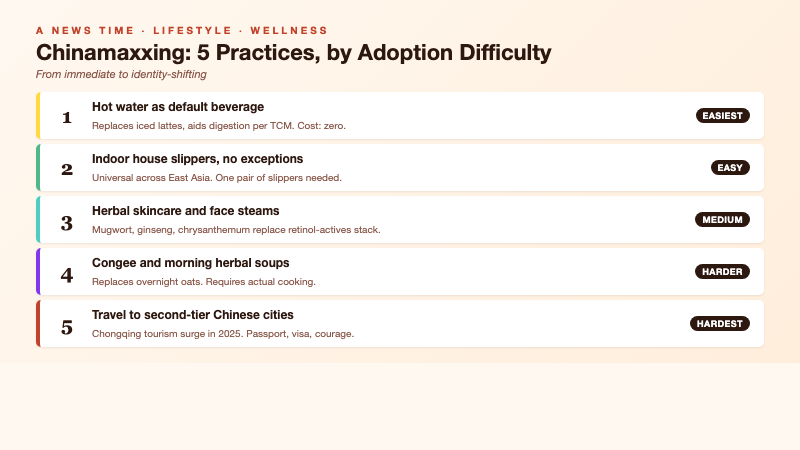
If you talk to people doing this, the routines they cite are remarkably consistent. The list below tracks roughly with how easy each piece is to incorporate, from immediate to identity-shifting.
- Hot water as the default beverage. The single most visible adoption. The reasoning, drawn from TCM, is that hot water aids digestion and supports a calmer nervous system. The cost: zero. The barrier: explaining your order to baristas trained in iced lattes.
- House slippers indoors, no exceptions. A practice that is universal across most of East Asia. Floor-clean households, warmer feet, and a small daily ritual that signals the transition from outside to inside. Adoption requires buying a pair of slippers. That is the entire investment.
- Herbal skincare and face steams. Replaces the actives-heavy Western routine with longevity-oriented herbal infusions. The active ingredient list shifts from retinol and niacinamide to mugwort, ginseng, and chrysanthemum. Adoption is a slow rebuild of a beauty cabinet, but each individual product tends to cost less than its Western equivalent.
- Congee and morning herbal soups. A bowl of rice porridge with savory toppings replaces overnight oats or avocado toast. The morning kitchen feels different. The blood sugar curve flattens. Adoption requires actually cooking, which is the highest barrier on the list.
- Travel to second-tier Chinese cities. The most identity-shifting adoption. Chongqing, the humid southwestern metropolis that became the trend's unexpected travel hub in 2025, has seen surging interest from American travelers looking to experience contemporary Chinese urban life directly. Chengdu, Hangzhou, and Suzhou have followed. The barrier: a passport, a visa, and the social courage to vacation somewhere your friend group cannot place on a map.
Zoom Out: Why Now
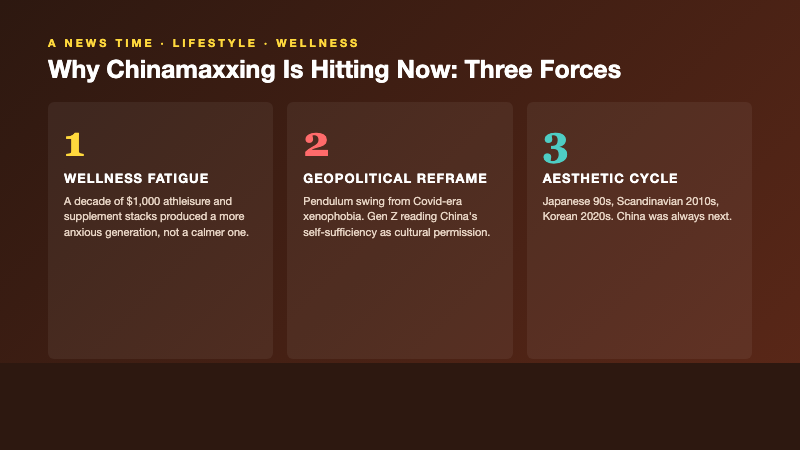
The cultural reading of why this trend is hitting in 2026 specifically deserves more than a paragraph. Several forces are converging.
The first is wellness fatigue. The decade-long American wellness industrial complex, with its $1,000 Lululemon sets, its GLP-1 reshaping of how the country thinks about weight, and its endless supplement stack, has produced a generation that has tried everything and is, by every available survey, more anxious than the one before it. Practices rooted in centuries-old traditions, that ask less of the consumer and promise less in return, register as a relief.
The second is geopolitical reframing. Indulgexpress writer Bristi Dey, in a piece tracking the trend, points to a psychological context worth naming directly. During the early Covid years, U.S. political leaders' rhetoric produced a wave of anti-Asian xenophobia that surfaced in real, documented harm. The pendulum swing now visible in young Americans' embrace of Chinese culture reads, in part, as a generational rejection of that earlier framing. China's continued economic self-sufficiency, visible in the consumer products it exports, the cities it builds, and the technology stack it controls, has made the cultural curiosity more permission-structured than it would have been five years ago.
The third is a much older pattern. Western consumer culture has historically absorbed and re-exported the aesthetic and ritual elements of whichever non-Western culture is currently registering as "ascendant" in geopolitical and economic terms. Japanese minimalism in the 1990s. Scandinavian hygge in the 2010s. Korean skincare and food in the late 2010s and early 2020s. China's turn was, in retrospect, predictable. The question was always when, not whether.
What the Wellness and Travel Industries Are Doing About It
The retail-side response has been faster than the trend-watching infrastructure usually permits. Labubu dolls, the Chinese-designed plush figures that became a global breakout product in 2025, are the consumer good that arrived early and has set the template for what monetization looks like. Beauty brands with East Asian roots, several of which were already growing through TikTok in the U.S., have accelerated their American distribution. Independent traditional Chinese medicine practitioners in major U.S. cities have reported notable upticks in younger clients seeking herbal consultations, though that data is anecdotal rather than systematic.
| Category | Signal | Notable example |
|---|---|---|
| Consumer products | Breakout Chinese-designed goods crossing into U.S. mainstream | Labubu plush figures |
| Skincare | Herbal-focused Chinese brands gaining U.S. shelf placement | TCM-rooted serums and steams |
| Travel | Surge in American visitors to second-tier Chinese cities | Chongqing, Chengdu |
| Beverage | Hot water and herbal teas displacing iced beverages in some Gen Z orders | Independent coffee shops adapting |
| Food | Congee and herbal soups appearing in wellness-coded morning routines | Recipe content on TikTok and Substack |
| Apparel | Indoor slippers, contemporary Chinese streetwear in young-adult wardrobes | Direct-to-consumer Chinese DTC brands |
The travel side has been the more interesting beneficiary. Chongqing, a city of 32 million that few American travelers had on their lists three years ago, has been quietly building tourism infrastructure aimed at Western visitors. Chengdu has done the same on a longer timeline. Both cities are positioned to absorb the wave of Chinamaxxing-adjacent travel that the next 12 to 24 months will likely produce, with airline route expansions and hospitality investment already pricing in the demand shift.
The Honest Tensions
Trends like this come with the obligatory cultural-borrowing conversation, and Chinamaxxing has produced a more nuanced version of it than most. The Chinese-American creators and academics who built the original content infrastructure are, by and large, in favor of the cultural curiosity, with caveats. The cuts that get them include: surface-level adoption that strips practices of their context, beauty-industry monetization that funnels profit away from the communities that originated the traditions, and travel content that flattens contemporary Chinese cities into aesthetic backdrops without engagement.
The pieces of the trend that have generated the least pushback are the ones requiring the most actual lifestyle adjustment. People who have rebuilt their morning routines around congee and hot water are, by definition, doing more than aestheticizing. People who have made the trip to Chongqing have engaged with the place. The pieces that have generated more skepticism are, predictably, the ones that lend themselves to a fast TikTok render: an indoor slipper photo, a face-steam aesthetic, a single bowl of congee styled for the camera.
What Comes Next
Three things will determine whether Chinamaxxing turns out to be a generational lifestyle shift or a 2026-specific moment that the next wellness wave displaces. The first is whether the U.S.-based traditional Chinese medicine and herbal skincare retail infrastructure scales to meet sustained demand. The second is whether U.S.-China travel patterns hold given the geopolitical volatility of the past two years. The third, and most important, is whether the underlying lifestyle adjustments, the slower mornings, the indoor rituals, the digestion-first eating, prove durable in the lives of the people doing them after the social-media reward cycle moves on.
The honest answer is that the trend is too new to predict with confidence. What is already true is that it has surfaced a real conversation, in newsrooms, in beauty boardrooms, and in airline route planning, about what young Americans are looking for that Western consumer culture has stopped providing. Whether or not the slippers stay on the floor, that conversation is now part of how 2026 wellness gets discussed.