James Madison University's Board of Visitors on formally endorsed The Madison Promise: JMU 2032 Strategic Plan, a long-range commitment that includes two guarantees no other public U.S. university has previously offered at this scale. Beginning with the Class of 2030 (current high school sophomores), JMU will guarantee that every bachelor's graduate achieves a positive career outcome within one year of graduation, and will commit to providing free additional coursework to graduates whose employers identify a power-skills gap within two years of graduation. The guarantees are anchored in a strategic plan that runs through 2032, with longer-term targets extending to 2040.
The announcement, made through the university's official news release, lands at a moment when American higher education is facing more public scrutiny over return on investment than at any point in the past two decades. Survey after survey shows declining confidence in the value of a four-year degree, particularly among working-class families weighing the cost-benefit calculus of mid-tier public and private institutions. JMU President Jim Schmidt framed the Madison Promise as a direct response to that scrutiny, structured around two specific commitments rather than the abstract value statements most universities offer in similar situations.
What the Employment Guarantee Actually Promises
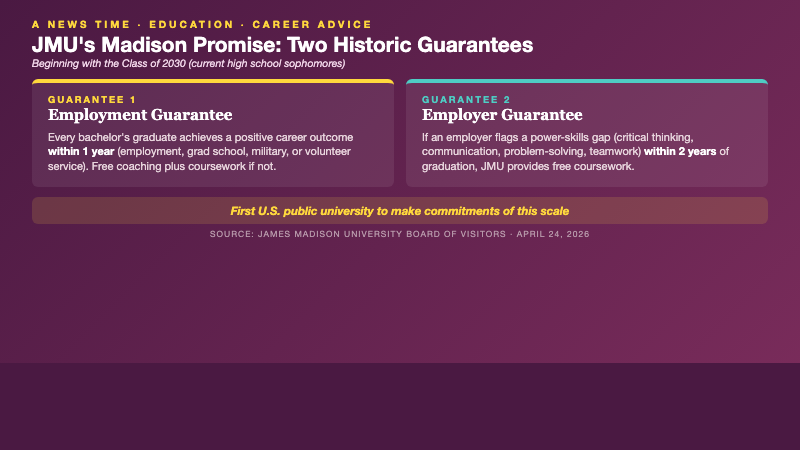
The Employment Guarantee, beginning with the Class of 2030, commits JMU to ensuring every bachelor's degree graduate achieves what the university defines as a "positive career outcome" within one year of graduation. The four pathways the university recognizes as positive outcomes are: full or substantive employment, enrollment in graduate education, a substantive volunteer experience (Peace Corps, AmeriCorps, or comparable), and military service.
For graduates who do not reach one of those milestones within their first post-graduation year, JMU commits to providing personalized support including career coaching, alumni and employer networking, and access to additional education or internship opportunities at no cost to the graduate. That cost-free piece is what makes the commitment meaningful rather than rhetorical. Career services exist at every university, but they typically do not extend their full resource set to graduates a year or more out of school, and they almost never include free additional coursework as part of the support package.
| Element | Detail |
|---|---|
| Starting cohort | Class of 2030 (current high school sophomores) |
| Outcome window | Within one year of bachelor's graduation |
| Qualifying outcomes | Employment, graduate education, volunteer experience, military service |
| Backup support if outcome not reached | Career coaching, networking, additional coursework, internship access |
| Cost to graduate | Free |
The Employer Guarantee: A Genuinely New Mechanism
The Employer Guarantee is the more structurally novel half of the Madison Promise. JMU commits that if an employer identifies a gap in a graduate's "power skills," explicitly defined as critical thinking, communication, problem-solving, or the ability to work in teams, within two years of graduation, the university will provide access to coaching services and additional, personalized coursework at no cost to either the graduate or the employer. The two-year window captures the period during which most graduates are still establishing themselves in their first or second professional role.
The mechanism is structurally significant because it shifts part of the accountability for graduate readiness from the employer's traditional onboarding investment back to the credential-issuing institution. American employers have for decades absorbed the cost of bringing new college graduates up to speed on workplace-specific skills, and many have been openly questioning whether four-year degrees deliver the foundational power skills they once did. JMU's offer to backstop those gaps for two years post-graduation, at no cost to the employer, is precisely the kind of commitment that addresses the employer-side critique directly.
JMU is the university that stands behind every Duke. At a time when the ROI of higher education is increasingly questioned, JMU has the answer. It's career-ready, problem-solving and confident graduates that we stand behind.
Jim Schmidt, President, James Madison University, April 24, 2026
Why Now: The Higher Education Confidence Problem
The Madison Promise is being announced into a higher education environment that has shifted faster than many institutions have adapted to. Public confidence in the value of a four-year degree has dropped meaningfully across multiple national surveys conducted in 2024 and 2025. Working-class families in particular have been recalculating whether traditional college pathways justify the debt that increasingly accompanies them. Enrollment trends at mid-tier public institutions have responded, with several state systems reporting flat-to-declining undergraduate enrollment despite favorable demographic windows.
JMU's strategic position within that environment is specific. The university is a regional comprehensive institution serving primarily Virginia residents and contiguous-state students, with strong reputation in education, business, and the arts but without the brand reach of the Commonwealth's flagship research universities. The competitive question for an institution in JMU's position is how to differentiate when the underlying degree is comparable to what dozens of other public universities offer. The Madison Promise is an explicit answer: differentiation through accountability commitments rather than through campus amenities or marketing positioning.
The deeper economic question is what the guarantees will actually cost JMU to deliver if a meaningful percentage of graduates need to invoke them. The university has not published a detailed cost projection, and the structural exposure depends entirely on how often the guarantees are triggered. If 95 percent of JMU graduates achieve a positive career outcome within one year unaided (which is roughly the historical baseline for the institution's outcome data), the residual cost of supporting the remaining 5 percent is manageable. If the percentage triggering the guarantee rises significantly during a recession, the financial commitment becomes substantially larger.
The "Power Skills" Definition Worth Watching
The Employer Guarantee's specific identification of four power skills, critical thinking, communication, problem-solving, and the ability to work in teams, is the most concrete naming of post-degree competencies that any public university has put behind a contractual-style commitment. Those four skills are not technical credentials. They are the foundational competencies that employer surveys have consistently identified as the differentiators between graduates who succeed in their first roles and those who do not. Naming them explicitly, and committing to remediate gaps in them at the institution's expense, is a meaningful change in how a university talks about what its degree delivers.
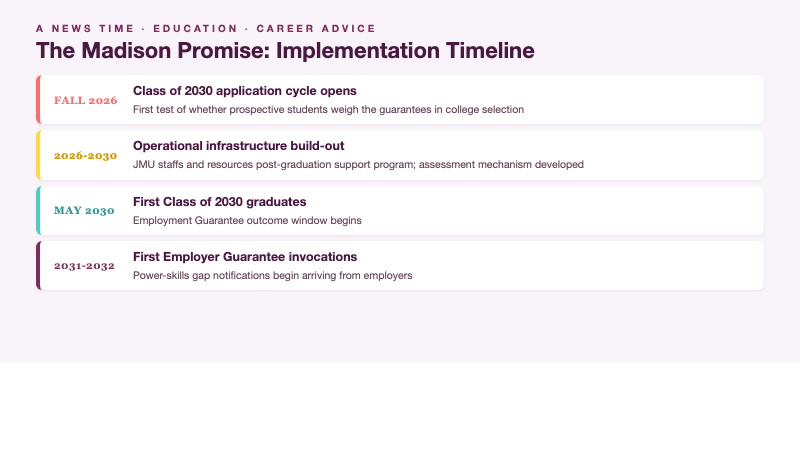
The mechanism for an employer to actually trigger the guarantee will matter operationally. The JMU news release does not specify the exact assessment process by which an employer signals that a power-skills gap exists for a particular graduate. The implementation details will be developed over the coming year, with the first invocation eligibility opening when the Class of 2030 begins graduating in May 2030 and the first power-skills gap notifications arriving in 2031 and 2032. How JMU operationalizes the assessment, the coursework prescription, and the coaching delivery will determine whether the guarantee functions as a real mechanism or as a marketing-forward commitment with significant friction.
What This Means for the Higher Education Landscape
If the Madison Promise functions as designed, the framework is replicable. Other public universities serving similar regional comprehensive missions could adopt comparable structures, particularly state systems facing the same enrollment and confidence pressures JMU is responding to. The replication question depends on whether the financial backstop turns out to be manageable in practice and whether the operational mechanisms work without producing excessive administrative overhead.
The competitive pressure on private institutions of similar scale will be significant if the Madison Promise gains visibility with prospective students and their families. A comparable private institution charging two to three times the JMU tuition cannot easily match a guarantee structure of this kind without either accepting meaningful margin compression or discounting tuition to the point that the commitment becomes financially neutral. The structural advantage of public university tuition, which has historically been one of the strongest arguments for in-state public attendance, gets meaningfully amplified by an outcome guarantee.
The broader implication is that the conversation about college value, which has tilted heavily toward criticism over the past five years, may begin to shift toward institutions that are willing to commit to specific accountability mechanisms rather than relying on traditional reputation signals. The case for college, as The Washington Post put it in a piece published earlier this week, has not actually changed. The narrative has. JMU is betting that the institutions that respond to the new narrative most directly will be the ones that hold their enrollment and reputation through the next decade.
What to Watch Through 2030
Three things will determine whether the Madison Promise is a model that reshapes higher education or an interesting experiment that does not scale. The first is enrollment response. JMU's Class of 2030 application cycle, which opens in fall 2026, will be the first real-time test of whether prospective students and families weigh the guarantees in their college selection. The second is operational execution. How JMU staffs and resources the post-graduation support infrastructure will determine whether the guarantees function as designed or run into capacity constraints. The third is competitive response. Whether other public universities adopt similar frameworks in the next 18 to 36 months will define whether the Madison Promise is a JMU-specific differentiator or the start of a broader structural shift.
For the higher education sector, the Madison Promise is the most concrete institutional response yet to the public confidence problem that has dominated the conversation since 2022. The next four years of JMU's implementation, and the response from peer institutions, will reveal whether commitments of this kind can rebuild the value proposition of a four-year degree at the moment that proposition has been under the most sustained pressure in modern memory.
Sources
- JMU stands behind every graduate with historic employment and employer guarantees, James Madison University
- The Madison Promise: JMU 2032 Strategic Plan
- The case for college hasn't changed but the narrative has, The Washington Post
- National Center for Education Statistics, U.S. Department of Education